At its core, measuring marketing return on investment (ROI) is pretty straightforward. You take the total revenue a campaign brought in, subtract what you spent on it, and divide that number by the original cost. The formula looks like this: (Revenue – Cost) / Cost.
This simple calculation gives you a clear percentage, showing exactly how much you got back for every dollar you put in. It’s what turns marketing from a line item expense into a proven revenue-generating machine.
Why Marketing ROI Is Your Most Important Metric
That’s where ROI comes in. It’s not just another vanity metric; it’s the ultimate measure of accountability. Knowing how to measure marketing ROI shifts your role from a purely creative one to that of a strategic business driver.
When you can confidently prove that every dollar invested brings a specific return, marketing stops being seen as a “cost center.” It becomes a predictable, scalable engine for business growth. This is a game-changer, especially when economic uncertainty puts budgets under the microscope. The teams that can prove their financial impact are the ones that keep their funding and earn a seat at the table.
From Cost Center To Revenue Driver
The pressure on marketing leaders to justify their spending has never been higher. A 2023 HubSpot survey confirmed this, revealing that 49% of marketers say that proving the ROI of their activities is their number one challenge.
This means your ability to calculate and communicate ROI has a direct impact on your team’s resources and your influence within the company. It’s the common language that connects your marketing efforts to the big-picture business goals.
A solid grasp of ROI is your best defense against budget cuts. When you can prove that your campaigns are fueling the bottom line, you’re not just justifying your spend – you’re making a compelling case for increased investment.
Securing Executive Buy-In
Ultimately, mastering ROI measurement allows you to build a powerful business case for every single initiative. You’re no longer framing your ideas as creative experiments but as calculated investments designed to deliver predictable results. This all starts with a well-defined marketing strategy, which provides the foundation for achieving and proving this value.
If you want to dig deeper into the specifics, check out this definitive guide on how to measure marketing ROI. It’s a fantastic resource that breaks down the methodologies even further.
As you continue through this guide, you’ll pick up the practical skills to transform your data into a clear story of financial success.
Gathering Your Core Metrics and Data
So, where do you start? It all comes down to defining what a conversion actually means for your business. A conversion isn’t always a sale. It’s any meaningful action that nudges a prospect further down the path to becoming a customer.
For an e-commerce brand, it’s simple: a purchase. But if you’re a B2B SaaS company, a conversion could be a demo request, a whitepaper download, or a free trial signup. Nail this definition first, because everything else hinges on it.
Identifying Your Revenue and Return Metrics
With your conversion goals defined, it’s time to go data hunting. This is where you connect the dots between your marketing activities and the numbers that matter to the C-suite. You’ll need to pull information from a few key places to assemble the full story.
Your primary data sources will likely be:
- Google Analytics 4 (GA4): This is your command center for website traffic, user behavior, and on-site conversions. Make sure you have specific goals set up to track things like form submissions or key page visits.
- Customer Relationship Management (CRM) System: Your CRM, think Salesforce or HubSpot, is the single source of truth for everything that happens after a lead comes in. It tracks lead progression, deal stages, and, most importantly, closed-won revenue. This is how you link a marketing-generated lead to an actual sale.
- Ad Platform Dashboards: Your dashboards in Google Ads, LinkedIn Ads, or Meta Ads provide the front-line performance data: clicks, impressions, and platform-reported conversions.
Don’t just fixate on the final revenue number. A smarter approach is to track metrics like the number of qualified leads, the lead-to-customer conversion rate, and the average deal size originating from each marketing channel. This gives you a much richer understanding of what’s really working.
Accounting for Every Single Cost
Here’s one of the most common mistakes I see that completely skews ROI figures: only counting ad spend. A true ROI calculation demands that you account for all the expenses tied to a campaign. Ignoring the “hidden” costs gives you a false sense of profitability.
You have to think beyond the obvious and get granular with what you’re actually investing.
Your total marketing investment isn’t just one line item. It’s a sum of parts:
- Direct Ad Spend: The cash you pay directly to Google, Meta, or LinkedIn.
- Team Salaries: A proportional cost of the marketing team members who worked on the campaigns.
- Agency or Freelancer Fees: Payments to any external partners for creative, strategy, or campaign management.
- Software and Tool Subscriptions: The monthly fees for your marketing automation platform, analytics tools, design software, you name it.
- Content Creation Costs: Any expenses tied to producing the blog posts, videos, or case studies that fueled your campaigns.
Getting this right requires a solid operational setup. If you need help building systems to track these inputs effectively, digging into resources on marketing operations can provide a structured framework. This level of detail is non-negotiable if you want an ROI calculation that truly reflects the financial performance of your marketing.
Putting the Right Marketing ROI Formulas to Work
You’ve wrangled your data and have it all organized—now for the fun part. This is where we stop just looking at numbers and start calculating what they actually mean for the business. Applying the right formula is how you turn a pile of metrics into a clear story about financial return. It’s the moment of truth in measuring your marketing ROI.
The most common starting point is the classic ROI formula. It’s clean, simple, and gives you a quick, honest look at profitability.
The Classic ROI Formula:
(Sales Growth - Marketing Cost) / Marketing Cost = ROI
Let’s say your SaaS company decided to run a campaign on LinkedIn. We can walk through a real-world example.
The Simple ROI Calculation in Action
Imagine you spent $10,000 on that campaign. That number should be all-in—covering ad spend, creative development, and even a fraction of your team’s time. Over the campaign’s run, you were able to directly tie $40,000 in new sales back to that effort.
Let’s plug those numbers in:
- ($40,000 – $10,000) / $10,000 = 3
To turn that into a percentage, just multiply by 100. You’re looking at a 300% ROI. Simple, right? This means for every $1 you put in, you got $3 back in profit. It’s a powerful, straightforward way to show the campaign worked.
But this formula has a blind spot. It’s perfect for campaigns where a single purchase is the finish line, like in e-commerce. What about businesses built on long-term value, like a SaaS subscription? That first payment is just the opening chapter.
Focusing only on immediate sales is like judging a movie by its opening scene. You miss the entire plot. For subscription models, you need a formula that sees the full picture.
Looking Beyond the First Sale with Customer Lifetime Value
For any SaaS business, retention is the name of the game. A customer who signs up for $100/month and sticks with you for three years is worth infinitely more than their first transaction. That’s why Customer Lifetime Value (CLV) is so critical.
Bringing CLV into your ROI calculation gives you a far more accurate view of marketing’s long-term impact. The formula just needs one small but powerful tweak.
The CLV-Based ROI Formula:
(Customer Lifetime Value - Marketing Cost) / Marketing Cost = ROI
Let’s go back to our SaaS company. The same $10,000 campaign brought in 10 new customers, and each one pays $100 a month. You know from historical data that your average customer stays for about 36 months.
First, you need the CLV for that group of new customers:
- 10 customers x $100/month x 36 months = $36,000
You might notice this is less than the $40,000 from the first example. That’s perfectly normal. The “sales growth” in that scenario could have included one-time setup fees or larger annual contracts paid upfront. The CLV calculation, on the other hand, is focused purely on the predictable, recurring revenue stream over time.
Now, let’s run the ROI calculation with CLV:
- ($36,000 – $10,000) / $10,000 = 2.6
Your ROI here is 260%. While it might seem lower in this specific case, this number is arguably more meaningful. It’s a forecast of sustainable growth, not just a snapshot of initial revenue. It tells your leadership team that marketing isn’t just closing deals; it’s building a foundation of profitable, long-term customer relationships.
Applying the right formula is less about math and more about matching your calculations to your actual business model.
Marketing ROI Calculation Scenarios
To see how this plays out across different marketing efforts, it’s helpful to compare them side-by-side. The formula remains the same, but the inputs for investment and revenue can vary wildly depending on the channel’s nature and goals.
| Channel | Investment | Revenue Generated | ROI Calculation | Resulting ROI |
|---|---|---|---|---|
| Email Marketing | $2,000 | $25,000 | ($25,000 – $2,000) / $2,000 | 1150% |
| PPC Advertising | $15,000 | $45,000 | ($45,000 – $15,000) / $15,000 | 200% |
| Content Marketing | $8,000 | $12,000 | ($12,000 – $8,000) / $8,000 | 50% |
| Trade Show | $20,000 | $50,000 | ($50,000 – $20,000) / $20,000 | 150% |
As the table shows, a high-cost channel like a trade show can have a lower percentage ROI than a low-cost, high-return channel like email. And content marketing might show a modest initial ROI, but its value often compounds over time as assets continue to generate leads long after the initial investment. This is why context is everything.
Choosing an Attribution Model That Fits Your Business
Once you’ve settled on the right ROI formula for your business, you hit the next big question: how do you know which marketing touchpoint actually gets credit for a sale? This is where attribution modeling comes into play, and frankly, it’s one of the most critical—and hotly debated, parts of getting an accurate read on your marketing ROI.
A customer’s journey is rarely a straight line from A to B. They might see a social ad, read a blog post a week later, click a link in your newsletter, and finally make a purchase after seeing a retargeting ad. An attribution model is just the rulebook you create to assign value to each of these steps along the way.
Making the right choice here is a big deal. The model you pick directly impacts which channels get more budget and which ones get cut. If you get it wrong, you could end up starving the very channels that are quietly filling your pipeline for future growth.
The Most Common Attribution Models
Think of these models as different lenses for looking at your customer data. Each offers a unique perspective, complete with its own set of pros and cons. The goal is to find the one that gives you the clearest, most honest picture of what’s working.
Here are the main models you’ll come across:
- First-Click Attribution: This one gives 100% of the credit to the very first interaction a customer had with your brand. It’s fantastic for understanding which channels are best at generating initial awareness and bringing new faces into your world.
- Last-Click Attribution: As the polar opposite, this model assigns 100% of the credit to the final touchpoint right before the conversion. It’s useful for pinpointing which channels are most effective at sealing the deal.
- Linear Attribution: This model takes a more democratic approach, spreading the credit equally across all touchpoints in the customer journey. It works from the assumption that every single interaction played a part.
- Time-Decay Attribution: A more sophisticated model, this one gives more credit to the touchpoints that happened closer to the conversion. That blog post they read a month ago gets some credit, but the retargeting ad they clicked yesterday gets a much bigger piece of the pie.
- Position-Based (U-Shaped) Attribution: This is a hybrid model that gives the most weight to the first and last interactions—typically 40% each—and then splits the remaining 20% among all the touchpoints in the middle. It values both what started the conversation and what ultimately closed it.
The biggest mistake I see people make is defaulting to Last-Click attribution just because it’s the easiest to track. While it shows you what closes deals, it completely ignores all the hard work your other marketing does to bring people to that final click in the first place.
Matching the Model to Your Business
So, how do you pick one? The best attribution model is always the one that most closely reflects how your customers actually buy from you. A model that works perfectly for a quick-purchase e-commerce store will give you a completely distorted view if you’re a B2B SaaS company with a six-month sales cycle.
A B2B company navigating a long, complex sales cycle, for instance, will get far more realistic insights from a Time-Decay or Position-Based model. These approaches acknowledge that multiple touchpoints—webinars, case studies, sales demos—all play a vital role over several months. First-click is still valuable for seeing what starts the conversation, but it misses the entire nurturing process.
On the other hand, an e-commerce brand that thrives on impulse buys from social media ads might find that Last-Click attribution is perfectly fine. If the entire customer journey is often just a few minutes from ad to purchase, that last click is a pretty reliable signal of what prompted the sale.
This decision tree offers a simple way to think about whether your ROI focus should be on the first sale or on long-term value.
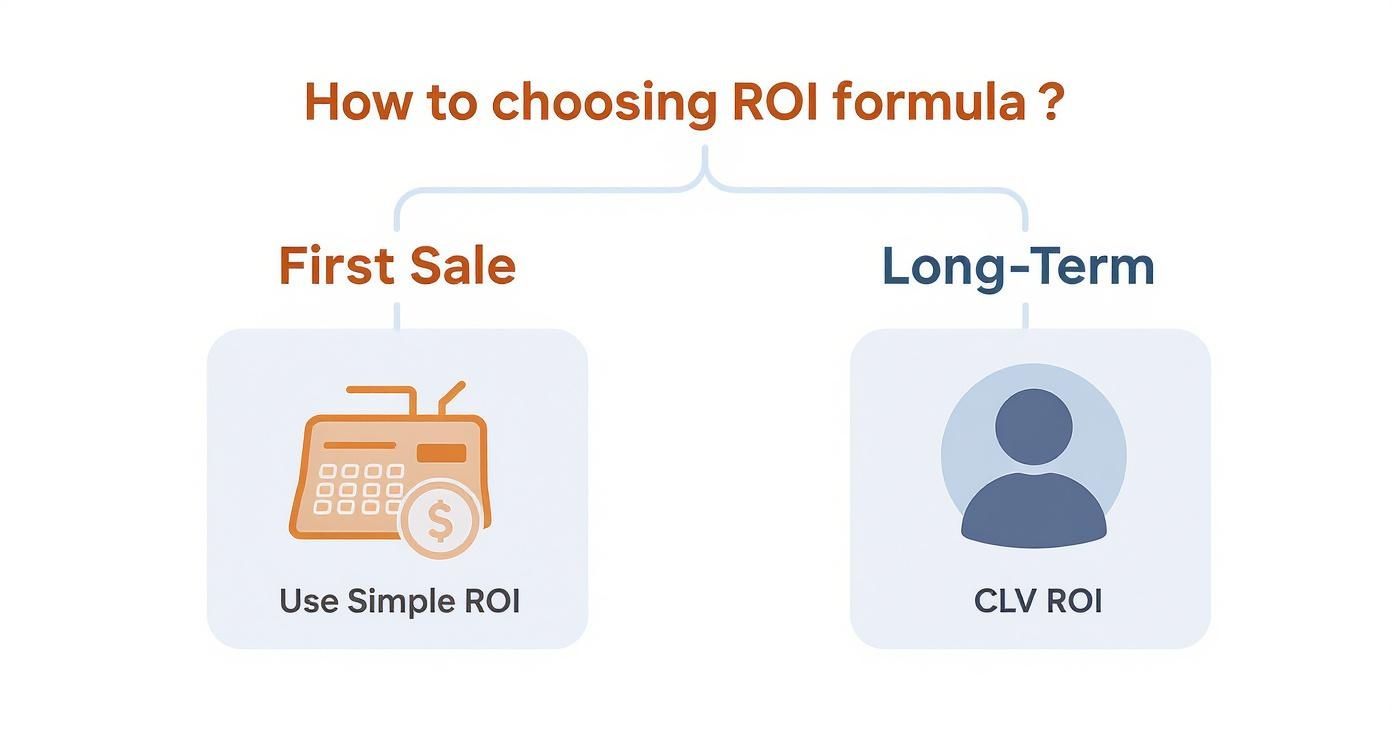
This visual helps clarify that the nature of your sale—whether it’s a one-and-done transaction or the beginning of a long relationship—should really guide your entire measurement strategy.
Ultimately, choosing an attribution model isn’t a one-time decision. It’s something you should test and revisit as your business grows and customer behaviors change. When you align your attribution strategy with how your customers truly buy, you get a much more honest and actionable understanding of your marketing ROI.
Using Technology for Smarter ROI Measurement
Trying to measure marketing ROI with spreadsheets and manual data entry is like trying to drive down a highway by only looking in the rearview mirror. You can see where you’ve been, but the data is old, the process is slow, and it does absolutely nothing to prepare you for the road ahead.
Modern marketing simply moves too fast for that kind of approach. Today’s technology, especially artificial intelligence (AI), is completely reshaping how we measure ROI, giving us a much sharper, more forward-looking view of what’s actually working. Instead of just reporting on past events, the right tools can help anticipate future outcomes by analyzing massive datasets to spot trends and correlations a human could never see. It’s a genuine competitive edge.
Predictive Analytics and AI Attribution
Think of predictive analytics as your crystal ball for campaign planning. These tools dig into your historical data, run it through machine learning algorithms, and forecast the potential outcomes of your strategies. This helps you put your budget behind the channels and tactics with the highest probability of success before you even spend the first dollar.
This is where your decision-making flips from reactive to proactive.
When you pair this with AI-powered attribution, things get really powerful. As we’ve covered, traditional attribution models can be limiting. AI goes a giant step further by analyzing every single touchpoint across thousands, or even millions, of unique customer journeys. It uncovers the real influence of each channel, not just the convenient first or last one.
Recent research underscores this shift. A 2023 study by McKinsey found that companies making extensive use of AI and analytics in their marketing efforts are seeing revenue growth 3 to 5 percentage points higher than their peers.
For instance, a major beverage company used machine learning attribution and was shocked to find their podcast ads drove 22% more conversions than their last-click model had ever shown. It shined a light on a massively undervalued channel.
Navigating the Cookieless Future
The “cookieless future” is more than just a buzzword – it’s a fundamental shift in how we track performance. With privacy regulations getting stricter and third-party cookies being phased out, many of our old tracking methods are on their way to becoming obsolete. This is a huge challenge for ROI measurement, but it’s also a massive opportunity to build smarter, more durable systems built on trust. The key to thriving in this new landscape is first-party data—the information you collect directly from your audience through your website, app, CRM, and email list.
By focusing on building genuine relationships that encourage your audience to share their data willingly, you create a far more reliable and privacy-compliant foundation for your ROI calculations. This is a strategic shift from tracking anonymous users to understanding known customers.
Getting this right requires a high level of operational maturity. Your data, processes, and teams need to be properly structured. To see where you stand, frameworks like The Content Marketing Operations Maturity Model can provide a clear roadmap from reactive chaos to a truly optimized system.
Embracing Advanced Measurement Techniques
Beyond AI-driven attribution, other sophisticated methods are becoming much more accessible. Marketing Mix Modeling (MMM), once the exclusive domain of massive corporations with data science teams, is a great example. MMM uses statistical analysis to show how different marketing inputs—from TV ads to social media posts—contribute to overall sales.
Crucially, it also accounts for external factors like seasonality, economic shifts, and a competitor’s big product launch.
This screenshot from Wikipedia shows how Marketing Mix Modeling breaks down the various factors influencing sales over a period.
As you can see, MMM provides that holistic, 10,000-foot view. It helps you understand the true incremental impact of each channel and fine-tune your budget for the most effective combination. It’s less about tracking individual user clicks and more about seeing the entire marketing ecosystem from a strategic, top-down perspective. Thanks to modern tools, this level of analysis is no longer out of reach.
Common Questions About Measuring Marketing ROI
Even with the best formulas and attribution models, measuring marketing ROI can still feel a bit like navigating a maze. Let’s walk through some of the most common questions and sticking points that pop up for marketers. Think of this as a quick guide to help you clear those hurdles and get confident in your numbers.
How Often Should I Be Measuring My Marketing ROI?
There’s no magic, one-size-fits-all answer here. The right rhythm for measuring your ROI really comes down to the pace of your business and how long it takes a customer to make a purchase.
If you’re running a fast-moving e-commerce store with weekly promotions, you’ll want to keep a close eye on your numbers, maybe even daily or weekly. The sales cycle is short, and things can change in a hurry. Staying on top of the data lets you pivot quickly to get the most out of your campaigns.
On the other hand, a B2B company with a six-month sales cycle won’t get much value from daily check-ins. For them, a quarterly ROI analysis makes way more sense. This longer view gives the full customer journey time to unfold, providing a much clearer picture of what’s actually working. For most businesses, a baseline monthly review is a great starting point, with deeper, more strategic dives happening quarterly. This approach is perfect for assessing the impact of long-term plays like SEO, which build value over time, not overnight.
What’s Considered a Good Marketing ROI?
This is the million-dollar question, isn’t it? The honest answer is: it depends. A “good” marketing ROI isn’t a single number. It shifts dramatically depending on your industry, profit margins, marketing channels, and what you’re trying to achieve.
That said, a generally accepted benchmark to shoot for is a 5:1 ratio. This means you’re bringing in $5 in revenue for every $1 you spend. Anything hitting a 10:1 ratio or higher is typically considered outstanding.
But context is everything. Think about your profit margins. If your business operates on a 20% profit margin, a 5:1 ROI means you’re just breaking even. To actually be profitable, you need to aim higher. Different channels also come with different expectations. Email marketing, for example, is famous for its efficiency. Research from 2023 shows that, on average, email can generate a massive $36 return for every dollar spent.
The most important benchmark isn’t some industry average; it’s your own past performance. Your real goal should be to get better over time. Establish your baseline, then work to improve it.
How Do I Measure ROI for Things Like Branding or Social Media?
Trying to pin down the ROI of top-of-funnel efforts like brand awareness campaigns or organic social media can feel impossible. These channels rarely lead straight to a sale, which makes a clean ROI calculation a real challenge. The trick is to stop looking for direct attribution and start focusing on proxy metrics and correlation analysis.
For brand-building campaigns, you’re not trying to draw a straight line to a sale. Instead, you want to track metrics that show your brand’s presence and perception are growing.
- Brand Search Volume: Are more people typing your company’s name directly into Google?
- Direct Website Traffic: Are you seeing an uptick in visitors who navigate right to your URL?
- Share of Voice: How does your brand’s online chatter stack up against your competitors?
For social media, the focus shifts to engagement and its ripple effect on other channels. Keep an eye on metrics like engagement rates, follower growth, and website referral traffic. Then, see if you can correlate spikes in these indicators with your sales data. Did a viral post lead to a noticeable bump in direct traffic and conversions a week later? It’s not a perfect dollar-for-dollar calculation, but this approach helps you show the value these channels bring to the bigger picture.
What Are the Most Common Mistakes When Calculating ROI?
Knowing where others have stumbled is the best way to keep your footing. When marketers get their ROI numbers wrong, it’s usually because of a few common slip-ups. If you can steer clear of these, your final figures will be far more accurate and reliable.
Here are the most frequent mistakes I see:
- Incomplete Cost Tracking: This is the big one. It’s easy to just count your direct ad spend, but what about team salaries, software subscriptions, agency fees, or the cost of creating content? A true ROI calculation needs to factor in all the costs to reflect your real investment.
- Using the Wrong Attribution Model: Just defaulting to a last-click attribution model is a classic mistake. It’s simple, sure, but it gives all the credit to the final touchpoint and completely ignores all the earlier marketing efforts that introduced and nurtured the customer along the way.
- Ignoring Customer Lifetime Value (CLV): Focusing only on the first purchase gives you a deceptively low ROI, especially if you’re a subscription-based business. When you calculate ROI based on CLV, you get a much more accurate view of how marketing contributes to the business over the long haul.
- Analyzing Metrics in a Silo: Don’t just look at the direct ROI of a single campaign in isolation. A specific effort might have a low direct return but could be playing a huge role in assisted conversions for other channels. You have to look at your data holistically to understand how your entire marketing engine is working together.
By asking these questions and sidestepping these common errors, you can turn your ROI measurement from a simple math problem into a powerful strategic tool that fuels real business growth.
Ready to stop guessing and start building a marketing strategy that delivers measurable results? The experts at Mick-Mar Inc. specialize in creating customized roadmaps for B2B and SaaS companies that connect every marketing action to tangible business growth. Let’s build a plan that proves your marketing’s value.