
When you're selling a B2B service or a SaaS platform, you’re not just selling software or a solution. You're selling a promise.
Unlike a physical product someone can pick up, inspect, and feel, a service is completely intangible. Its value hinges entirely on the trust, experience, and perception you build through your brand.
Why Your Brand Is Your Most Valuable Service
Think about it this way. Before buying a car, you can take it for a spin. But when you buy a service—like cloud hosting or a new project management tool—you're buying a future outcome. You're betting on a result you can't see yet.
This makes branding in service marketing a completely different ballgame and, frankly, far more critical than it is for physical goods. Your brand is the handshake. It’s the bridge that turns an intangible promise into a tangible feeling of trust for your customer.
This isn't just about picking nice logos and color palettes. It's the engine that drives customer loyalty and real, sustainable growth. The data backs this up, showing that a huge number of consumers need to trust a brand before they'll even think about buying. That trust gets built one touchpoint, one interaction at a time.
Turning Intangibility into an Advantage
The very nature of a service—its invisibility—is your biggest branding challenge. How do you market something a customer can’t hold? A powerful brand answers that question by making the invisible visible. It works by focusing on three key areas:
- Establishing Credibility: Your brand becomes a symbol of reliability. It’s the visual and emotional proof that you know your stuff and that clients are making a smart investment.
- Creating an Emotional Connection: A service brand tells a story. It connects with a customer’s goals and values, which resonates far more deeply than a dry list of features ever could.
- Ensuring Consistency: From the first sales call to the last customer support ticket, a consistent brand experience makes your promise feel real and dependable.
Your brand is the complete sum of every interaction a customer has with your company. In service marketing, where the 'product' is an experience, these interactions are everything.
This guide is your roadmap for building that kind of powerful service brand. We'll start with the foundational principles and move into actionable strategies you can put to work—building a brand that customers don't just choose, but one they trust and champion.
How Service Branding Differs From Product Branding
Imagine trying to brand a bottle of water versus a cloud storage service. One is a physical thing you can hold, see, and taste. The other is an ongoing promise of security, reliability, and access—an experience that unfolds over time. This is where branding a service gets interesting.
While both product and service branding aim to connect with customers, the paths they take couldn't be more different. The strategies that work wonders for a physical item often fall completely flat for a service. Why? Because services are a whole different beast.
The Four Pillars of Service Marketing
Marketers often point to the "4 Is" to explain what makes services unique. Getting your head around these is the first step in shifting from a product-first mindset to a service-first one.
-
Intangibility: You can't touch, see, or test-drive a service before you buy it. Customers aren't buying a thing; they're buying a promise. This makes trust your most valuable asset. Your brand has to make the invisible visible through powerful testimonials, detailed case studies, and a consistently professional image.
-
Inseparability: Services are often produced and consumed at the exact same time. The consultant on the call, the support agent answering a ticket, the onboarding specialist guiding a new user—they are the brand in that moment. Your team isn't just performing a function; they're the living, breathing embodiment of your brand promise.
-
Inconsistency (or Variability): Since services are delivered by people, the experience can vary. One support call might be fantastic, while the next is just so-so. A strong brand helps manage this by setting clear standards, training your team, and creating consistent processes that guide every single interaction.
-
Inventory (or Perishability): You can't put a service on a shelf for later. An empty seat on an airplane or an unscheduled hour for a consultant is revenue that's gone forever. Effective branding helps create consistent demand and builds loyalty, making it far easier to manage capacity and smooth out those unpredictable peaks and valleys.
This table breaks down the core differences in thinking and strategy.
Key Differences Between Service and Product Branding
| Focus Area | Product Branding Approach | Service Branding Approach |
|---|---|---|
| Core Promise | Focuses on the what: features, quality, and design of the tangible item. | Focuses on the how: the quality and consistency of the experience delivered. |
| Key Differentiator | The physical product itself and its unique attributes. | The expertise of the people and the reliability of the process. |
| Customer's Role | The customer is a user or consumer of the finished product. | The customer is an active co-creator of the service experience. |
| Primary Goal | Drive a purchase decision based on tangible benefits. | Build a long-term relationship based on trust and consistent value. |
| Communication Focus | Showcasing the product through visuals, demos, and specifications. | Demonstrating credibility through testimonials, case studies, and team expertise. |
| Consistency Challenge | Ensuring manufacturing quality is uniform for every unit produced. | Ensuring every human interaction meets a high, consistent standard. |
Ultimately, the mindset shift is what matters most.
The core difference is simple yet profound: product branding focuses on the what—the features, the design, the physical object. Service branding must focus on the who and the how—the people delivering the experience and the process they follow.
Branding a physical good is about showcasing a finished item. You can learn more about how that works by exploring the fundamentals of product marketing and seeing how the goals diverge.
In contrast, service branding is all about shaping perceptions of an ongoing experience. It’s a continuous effort to build and reinforce trust at every single touchpoint, from the first sales call to long-term customer support, proving your promise is one worth believing in.
Practical Frameworks for Building Your Service Brand
So, how do we move from theory to action? This is where a good service brand really comes to life. Building a brand isn't just a creative exercise; it's a strategic process. For SaaS and B2B companies, this is everything. Your clients aren't just buying a tool—they're investing in a partnership and trusting you with a piece of their business.
The right frameworks give you a blueprint for that process. They help you nail down your unique position in the market, tell a story that actually connects with people, and design an experience where every single touchpoint feels like you.
This concept map really gets to the heart of the difference between branding a physical product versus an intangible service. Both roads lead to the same destination—brand reputation—but they start in very different places.
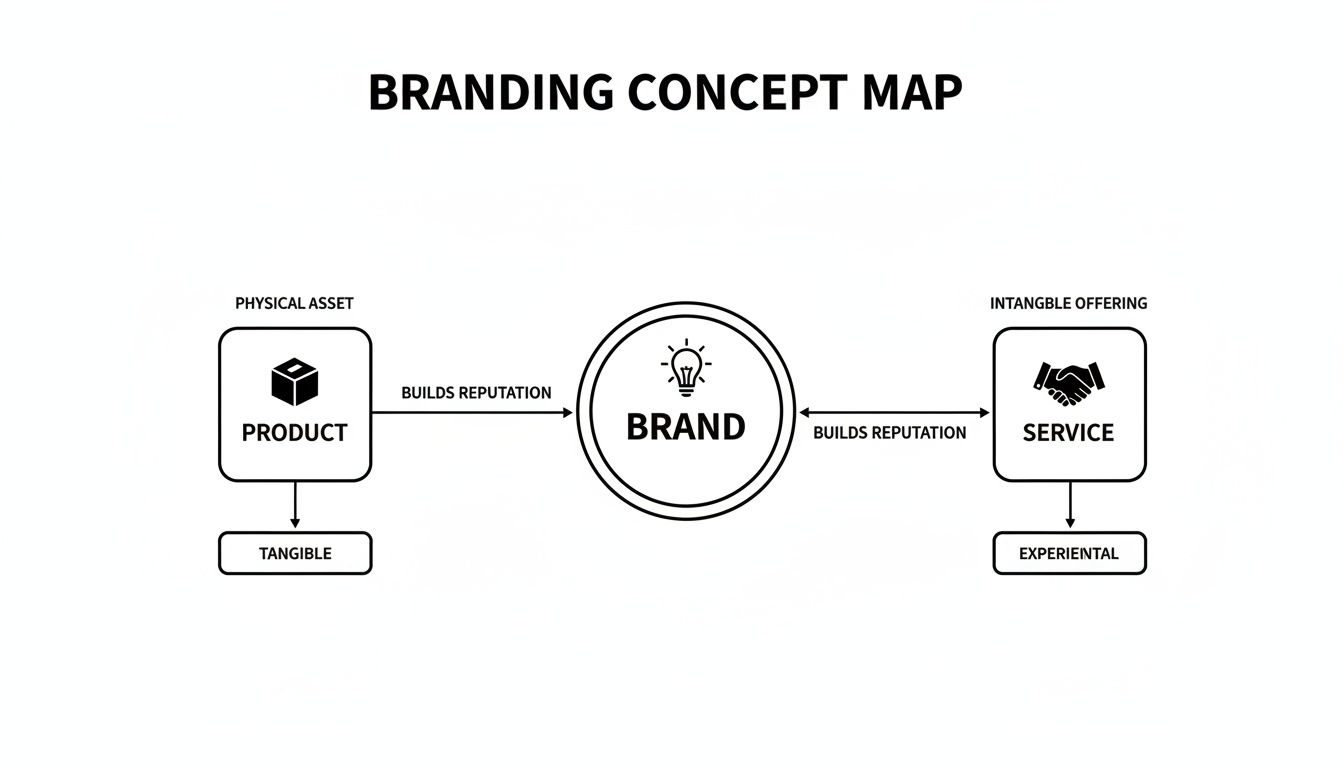
As you can see, product branding is all about the tangible thing. But branding in service marketing? That's built on people and the experience they deliver.
Establish Your Brand Positioning
Brand positioning is all about carving out your unique spot in the market. It answers one simple question: "With all the choices out there, why should my ideal customer choose me?" Get this right, and it becomes your North Star, guiding every decision you make.
To lock it in, you need to get crystal clear on three things:
- Target Audience: Who, exactly, are you for? Don't just say "B2B SaaS companies." Get specific. Something like "Early-stage cybersecurity SaaS startups in North America" is far more powerful.
- Unique Value Proposition (UVP): What’s the one thing you deliver that nobody else can? This isn't a feature list; it's the core outcome or transformation you provide.
- Proof Points: How do you prove you can deliver? This is where your case studies, glowing testimonials, team expertise, and proprietary methods come into play.
Getting this foundation right is non-negotiable. Once you’ve defined your strategic position, you can start translating that into a visual identity. Exploring the core principles of creative design and branding is the next step to making sure your look and feel perfectly match your message.
Craft a Compelling Brand Story
Let's be honest: facts are forgettable, but stories stick. Your brand story is the narrative that forges an emotional connection between your service and your customers. It’s not just about what you do, but why it matters. A good story makes your service memorable and human.
Your story should weave together your company's purpose, the problem you solve for customers, and the values that drive your team. It transforms your service from a simple transaction into a meaningful partnership.
This narrative becomes the soul of your communications. If you're looking for real-world inspiration, check out these incredible examples of branded content. The investment in this area is massive; research from 2023 projected the global brand management software market will grow to over $21 billion by 2030, a clear sign that businesses are putting serious money into getting their story right.
Building the Unbreakable Bond of Brand Trust

For a service business, trust isn't just a nice-to-have. It’s the entire product.
When clients can't hold what they're buying, their decision hinges on one powerful feeling: confidence. This makes trust the most valuable currency you have, especially in service marketing. It’s particularly true in high-stakes B2B deals, where a purchase isn't a simple transaction but the start of a long-term partnership. Every single interaction—from the first demo to a routine support ticket—is a moment where that bond is either strengthened or broken.
The Pillars of Trust in Service Branding
Building trust isn’t magic. It's the outcome of deliberate, consistent action. Forget flashy campaigns for a moment; your most important branding work happens in the quiet, day-to-day execution of your core promise.
Three pillars form the foundation of this unbreakable bond.
- Consistency: Every touchpoint, from your website to your billing, has to deliver a predictable and reliable experience. When your marketing message, sales process, and customer support are all singing from the same hymn sheet, you create a sense of stability people can count on.
- Transparency: Openness is the fastest path to confidence. This means being upfront about your processes, pricing, and even your limitations. Hiding behind jargon or burying details in complex contracts only erodes trust. Clarity builds it.
- Reliability: This is the simplest yet hardest pillar to get right. Just do what you say you will do. Hitting deadlines, honoring agreements, and delivering on your promises is the most powerful brand statement you can possibly make.
In the world of intangible services, brand trust is the bedrock of every purchasing decision. It’s the invisible force that turns a cautious prospect into a vocal champion for your business.
This isn’t just a hunch; the market proves it out. The critical role of branding in service marketing is reflected in consumer behavior. A 2023 study found that an incredible 81% of consumers say they need to trust a brand before even considering a purchase. This is absolutely vital in sectors like SaaS and cybersecurity. You can see more on how branding statistics shape modern marketing.
Weaving Trust into the Customer Journey
Earning trust isn’t a one-and-done deal. It's a thread you have to weave through the entire customer journey, starting with your very first message and continuing long after the sale. This demands a genuine understanding of your customer’s point of view and a deep commitment to clear communication.
Think about it: your website copy, case studies, and testimonials are your first opportunity to establish credibility. From there, your sales team needs to act as trusted advisors, not just closers. Finally, your onboarding and support teams have to deliver the exact experience you promised, reinforcing the customer’s decision to choose you. To learn how this fits into a broader plan, check out our guide on content marketing and strategic communications.
By turning these principles into daily practice, you transform trust from an abstract idea into your most powerful competitive edge.
How to Measure the ROI of Your Service Brand
How do you actually prove that something as fuzzy as "brand" is making you money? It's the classic marketing dilemma, but figuring it out is far from impossible. The key is to look past vanity metrics like social media likes and get to the heart of what’s driving your business.
The real goal is to draw a straight line from your branding efforts to real-world business results. A strong brand isn't just a pretty logo; it acts as a silent salesperson, making every part of your business run smoother. It can shrink your sales cycle, bring in better leads, and keep customers coming back—all things that show up on the balance sheet.
Key Performance Indicators for Brand Health
To get a real handle on brand ROI, you need to be tracking the right Key Performance Indicators (KPIs). These are the vital signs of your brand’s health, telling you how people truly feel about and interact with your company.
Here’s where to focus your attention:
-
Brand Equity: This is the extra value your company gets just because of its name recognition. Think about how you’d measure it: run regular surveys to gauge brand awareness, how people perceive the quality of your service, and how loyal they are over time.
-
Net Promoter Score (NPS): It’s a beautifully simple metric. Asking customers, "How likely are you to recommend our service to a friend or colleague?" gives you a single, powerful number that reflects satisfaction and loyalty.
-
Brand Recall and Awareness: Are you the first name that pops into a potential customer's head when they have a problem you can solve? Keep an eye on your branded search volume (how many people google you by name) and direct traffic to your website.
-
Customer Lifetime Value (CLV): This number predicts how much money you can expect to make from a single customer over their entire relationship with you. A great brand builds the kind of loyalty that increases CLV by keeping customers around longer and reducing churn.
When you invest in your brand, you are investing in an asset that appreciates over time. It makes acquiring new customers easier and retaining existing ones more profitable, directly boosting your CLV.
Connecting Brand Metrics to Business Results
The final, crucial step is tying these brand KPIs to your financial results. It's all about cause and effect. For example, as your NPS score climbs, you should see your customer churn rate fall. When more people are searching for your brand name directly, you ought to see a jump in high-quality inbound leads that close faster and cheaper.
This is where the true power of branding in service marketing shines through. Strong brands build relationships, and in the service world, relationships are built on trust and reliability. To learn more about this, check out this piece on building trust and loyalty with customers in plumbing service.
By consistently tracking these metrics, you can stop guessing and start telling a clear story about how your brand is fueling sustainable growth and delivering a powerful return on every dollar you invest.
Actionable Branding Plays for B2B and SaaS Companies

Alright, enough with the theory. Frameworks and models are great, but the real test is putting them into practice. So, let's get our hands dirty with some concrete tactics built for the unique world of branding in service marketing.
Think of these as your go-to plays for turning abstract brand strategy into real-world results that you can actually measure. Each one is designed to be adapted, whether you’re a scrappy SaaS startup or a well-established B2B player.
The Expert Authority Play
The idea here is simple: become the only name people think of when they have a problem in your niche. Before they even think about buying, they should think of you for the answer. This isn't about a hard sell; it’s about earning trust by being genuinely helpful.
- Your Mission: To position your brand as the undeniable thought leader in your space.
- How to Run It: Go big on a "pillar" piece of content. This could be a definitive guide, a groundbreaking original research report, or an in-depth webinar series that tackles a major pain point for your ideal customer. Then, chop it up. Create a ton of smaller content—blog posts, social snippets, video clips—that all lead back to your big-ticket resource.
- The Payoff: You’ll start seeing more organic traffic from people who are ready to solve a problem, which means higher-quality inbound leads. More importantly, your brand's credibility will skyrocket.
When you consistently give away value with no strings attached, you completely change the dynamic. You're no longer just a vendor; you're a trusted advisor. That authority is what builds lasting loyalty, especially in B2B.
The Internal Champion Play
Let’s be honest: your employees are your most powerful and believable marketers. This play is all about getting your team to not just understand the brand promise, but to live it and share it with genuine enthusiasm. When your own people are bought in, customers can feel it.
- Your Mission: To transform your employees into an army of authentic brand ambassadors.
- How to Run It: Create brand guidelines and key messages that are so simple, anyone can repeat them. Don't just file them away; share customer wins and positive feedback constantly to show how their work makes a real impact. Then, encourage (and even reward) your team for sharing company news and insights on platforms like LinkedIn.
- The Payoff: A customer experience that feels consistent no matter who they talk to. You’ll also see a boost in employee morale and retention, while building brand trust through real, human-to-human connections.
Got Questions About Service Branding? We've Got Answers.
When it comes to branding for services, especially in the SaaS and B2B tech world, a few key questions always seem to pop up. Let's tackle some of the most common ones I hear from founders and marketing leaders.
How Can a Small SaaS Startup Compete with Established Brands?
The classic David vs. Goliath question. The answer isn't to try and outspend the giants—it's to out-focus them. Zero in on a very specific niche and make it your entire world.
Your secret weapons are agility and personality. Where big brands are slow and impersonal, you can build genuine, deep trust within a tight-knit community.
- Deliver unforgettable service: Make every single customer interaction remarkable. This is where you can truly shine.
- Become the expert: Create incredibly valuable content that solves one specific problem for your niche better than anyone else.
- Build a loyal following: A deep connection with a small audience is something huge, generic brands can only dream of.
What Is the Single Most Important Element of Service Branding?
If I had to pick just one, it’s consistency. Hands down.
Your service is intangible. Customers can't hold it or see it. They rely on consistent experiences to build trust and figure out what you're all about. This consistency has to touch everything: your marketing messages, your sales process, the UI of your software, and the quality of your customer support.
A predictable, reliable, and positive experience reinforces your brand promise with every interaction. Inconsistency is the fastest way to plant a seed of doubt and destroy the trust you've worked so hard to build.
How Long Does It Take to See Results from Branding?
Branding is a marathon, not a sprint. You have to be in it for the long haul.
You might see some early green shoots—like a bump in branded search traffic—within 3-6 months. But building real, measurable brand equity? That's a 12-24 month journey of consistent, focused effort. The first real results often look like shorter sales cycles or better-qualified leads, because people are showing up already knowing and trusting you.
Ready to build a service brand that actually moves the needle? At Mick-Mar Inc., we build strategic marketing roadmaps that turn your promise into a brand people trust. Let's start the conversation at https://mick-mar.com/.