
Think of your pricing and market positioning as two sides of the same coin—you simply can't have one without the other. Your price tag is a mental shortcut that instantly communicates your product's value, while your position in the market is what convinces people that price is justified. When you nail this relationship, you're building the foundation for real, sustainable growth.
The Unbreakable Link Between Price and Perception

Let's make this simple. Imagine walking into a kitchen appliance store. You see a sleek, Italian-made espresso machine for $800 next to a standard drip coffee maker for $40. Without knowing anything else, that price difference tells a complete story—one is about craft, quality, and a premium experience, while the other is about convenience and affordability. That's pricing and positioning working together perfectly.
Your price is one of the loudest signals you send. It’s not just about covering costs; it’s a core piece of your brand's DNA that tells customers where you stand long before they read a single word on your website. To see how this plays out with real numbers and tiers, take a look at our comprehensive Pricing page.
Why Your Price Is So Much More Than a Number
Setting a price is an act of strategy. It does far more than just bring in revenue; it carves out your territory in the market and sets customer expectations from day one. When you get it right, the price feels like a perfect match for the value you provide and the people you want to attract.
Here's what your price is really doing:
- It molds perception: A higher price often signals a premium, exclusive solution. A lower price point can appeal to a wider, more budget-focused audience.
- It defines your competition: Your price immediately places you in a category, telling customers how you stack up against other options.
- It drives profitability: The sweet spot is a price that boosts your revenue without pushing away your ideal customer base.
The Struggle to Actually Get Paid What You're Worth
Of course, just slapping a price on your product isn't the whole story. There's a big difference between the price you set and the price you get.
Recent research has shown a worrying trend: the gap between pricing goals and reality is widening. A 2024 analysis by McKinsey found that B2B companies, on average, lose a staggering 8 to 11 percentage points of their annual profits due to poor pricing strategies—often a failure to communicate value effectively. This means companies are leaving a lot of money on the table because they can't defend the value they deliver.
The only way to close this gap is to fuse your pricing with strong, clear market positioning. This means your messaging, visuals, and overall brand experience have to back up the number on the sticker. It all comes down to thoughtful creative design and branding, a process that ensures every customer touchpoint reinforces the value you promise.
Finding Your Strategic Place in the Market
Trying to set a price before you understand your place in the market is like setting sail without a map. You might get somewhere, but probably not where you intended. You have to know where you stand to figure out where you're going, and that process is all about market positioning. It's the bedrock of every smart pricing decision you'll make.
The goal here is to find a slice of the market that's either unoccupied or just plain underserved—a place where your brand can really shine. This means you have to go deeper than just a quick glance at your competitors' pricing pages. You need to become a detective and decode their entire playbook. Who are they really talking to? What big problem do they promise to solve? What's their brand's personality—are they the serious expert or the friendly sidekick? Answering these questions paints a clear picture of the strategic landscape.
Visualizing Your Competitive Landscape
One of the best ways I've found to make sense of all this is through a technique called perceptual mapping. Think of it as creating a "map" of your market that helps you see how customers perceive different brands based on a couple of key attributes. By plotting your competitors on this map, you can instantly spot the crowded neighborhoods and, more importantly, the wide-open opportunities.
For example, a perceptual map could show you where your SaaS product lands on a spectrum from 'high-touch vs. self-service' or 'niche solution vs. all-in-one platform.'
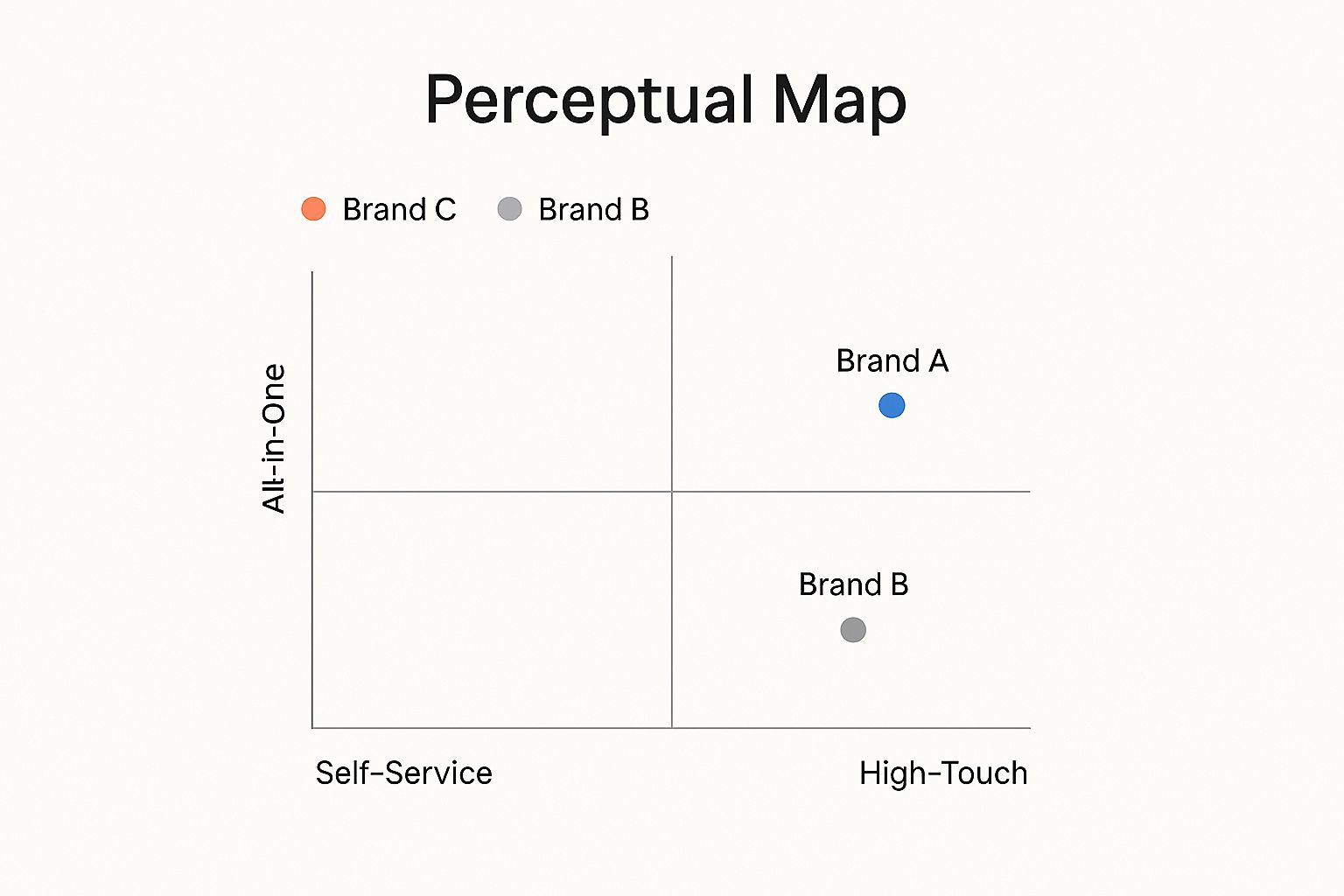
A quick look at a map like this might reveal a gap. Maybe the 'High-Touch, All-in-One' quadrant is empty, hinting at a strategic position you could own.
Defining Your Unique Value Proposition
Once you've mapped out the territory, it’s time to stake your claim with a strong unique value proposition (UVP). This is so much more than a catchy slogan. It's a crystal-clear statement that nails three things:
- The specific benefit you deliver to customers.
- How you solve their unique problems or pain points.
- What makes you different from every other choice they have.
Your UVP has to connect with your ideal customer on a deep level. It's the core promise you're making to them, and your pricing absolutely has to reflect the value of keeping that promise. A solid UVP becomes your North Star, guiding everything from marketing campaigns to sales calls. To really nail this, it's worth exploring some powerful brand positioning strategies to see how you can truly stand out.
When your position in the market is well-defined, your pricing suddenly feels logical and defensible. Customers who "get" the unique value you offer are far more willing to pay a price that reflects it.
At the end of the day, positioning isn't about claiming to be better than everyone else. It's about being different in a way that genuinely matters to a specific group of people. Getting that clarity is the key to building a cohesive marketing strategy where your product, price, and promotion all tell the same story. When you establish your strategic position first, your pricing becomes a deliberate choice that reinforces your brand's unique place in the world—not just a number you guessed.
Choosing the Right SaaS Pricing Model
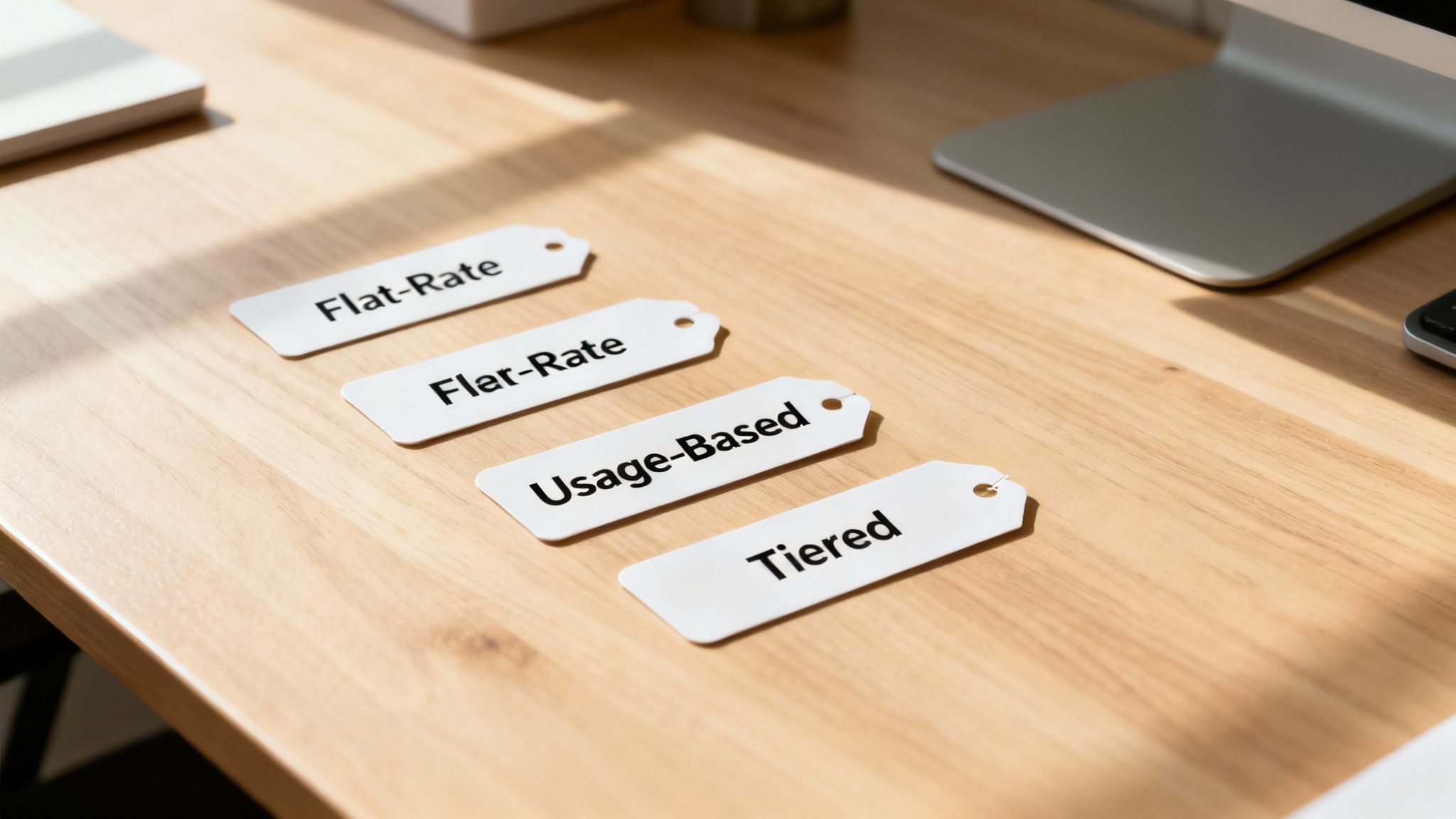
Once you’ve nailed down your strategic position in the market, it's time to build the engine that powers it. That engine is your pricing model—the actual framework for how you charge customers. This isn't just about picking a number; it’s about designing a structure that feels fair, makes sense, and aligns perfectly with the value your product delivers.
Making the right choice here is a massive step in your pricing and positioning journey. The structure you land on sends a strong signal about your product. Is it simple and all-inclusive? Does it scale as a customer's business grows? Each model tells a completely different story to your potential buyers.
The Four Core Pricing Architectures
Let's dive into the most common models you'll find in the SaaS world. These aren't just academic concepts; they are the battle-tested frameworks that thousands of successful companies rely on. Each one has its own personality and works best for certain types of products and customers.
-
Flat-Rate Pricing: The champion of simplicity. It's one price, for one product, with all the features included. This approach is a fantastic fit for tools with a very specific, singular purpose because it makes the buying decision incredibly easy.
-
Tiered Pricing: This is the most popular model for a good reason. It bundles features and usage limits into distinct packages (think Basic, Pro, Enterprise) designed for different customer segments. This creates a natural ladder for customers to climb as their needs evolve.
-
Per-User Pricing: Simple, direct, and predictable. The cost scales in lockstep with the number of people on a team using the software. It’s the go-to model for collaborative tools where every new user adds more value to the whole team.
-
Usage-Based Pricing: You only pay for what you actually use. This model ties cost directly to consumption—things like API calls, gigabytes of data stored, or messages sent. It’s a perfect match for infrastructure products where value is easy to measure by volume.
The core idea is simple but incredibly powerful: your pricing model has to create a direct, unbreakable line between the value a customer gets and the price they pay. If that connection feels off, churn is almost guaranteed to follow.
Matching the Model to the Mission
The real magic happens when you select the model that best supports your product's core purpose.
Take usage-based pricing, for example. It's brilliant for a cloud storage provider or an email API service like Twilio. The value is completely quantifiable—the more data you store or the more emails you send, the more value you receive.
But that same model would be a complete disaster for a collaboration tool like Slack or Asana. Why? Because it would actually punish teams for communicating more or managing more projects, creating a direct conflict with the very reason the product exists. That's why they lean on a per-user model, which naturally encourages widespread adoption and teamwork.
To help you sort through the options, here’s a quick breakdown of the four primary SaaS pricing models. This table compares them side-by-side, showing where each one shines and where the potential pitfalls lie.
Comparison of Common SaaS Pricing Models
| Pricing Model | Best For | Pros | Cons |
|---|---|---|---|
| Flat-Rate | Simple, single-purpose tools | Easy to understand and sell | Leaves money on the table; one size fits none |
| Tiered | Products serving multiple customer segments | Caters to diverse needs; clear upgrade path | Can be complex; customers might choose the wrong tier |
| Per-User | Collaborative software and team tools | Predictable revenue; scales with customer growth | Can discourage team-wide adoption due to cost |
| Usage-Based | Infrastructure, APIs, and resource-heavy platforms | Price scales directly with value; low barrier to entry | Unpredictable costs for customers; complex billing |
Think of this table as a cheat sheet to guide your thinking. Each model has its place, and understanding these trade-offs is key to making a smart decision that supports long-term growth.
Ultimately, your pricing model is the bridge connecting your market position to your bottom line. It's what turns your brand's perceived value into tangible, predictable revenue. Get it right, and your product will feel like a smart investment, not just another monthly expense.
Connecting Price Points to Perceived Value

This is the moment where everything comes together—where your carefully chosen market position and pricing model finally meet the real world of customer psychology. Those numbers on your pricing page aren't just the result of a spreadsheet calculation. They're powerful signals that tell your brand's story.
Getting this connection right is the final, make-or-break step. It’s all about closing the gap between the actual value your product delivers and what customers feel it’s worth. That perception is shaped by every detail, from the numbers you choose to how you frame your different plans.
Harnessing Psychological Pricing Tactics
Let's be honest: buying decisions are rarely 100% rational. Smart SaaS companies know this and use subtle psychological cues to frame their prices in a way that makes perfect sense to the buyer. These aren't sneaky tricks; they’re established methods for helping customers recognize the value they're getting.
Here are two of the most effective tactics in the SaaS playbook:
- Price Anchoring: You've seen this a thousand times. A company presents its highest-priced option first. That initial, higher number acts as an "anchor," making the other plans look far more reasonable in comparison. It's a simple way to guide customers toward your preferred, middle-tier option.
- The Decoy Effect: This one is a bit more clever. You introduce a third option—the "decoy"—that is intentionally designed to be slightly less attractive than another. For instance, a "Pro" plan suddenly looks like an incredible deal when it's placed next to a "Basic+" plan that's only a little cheaper but offers way fewer features.
A word of caution, though: these tactics must always serve your brand positioning. If you’re building a premium, enterprise-level brand, you should steer clear of prices ending in ".99." That's a psychological trigger for discounts and budget-conscious consumers. A clean, round number like $5,000/month communicates confidence and quality, reinforcing the high-end position you're aiming for.
Your price point is a direct reflection of your brand's confidence. Every number, from the main price to the cost of add-ons, should be consistent with the value story you've worked so hard to build.
Moving to a Value-Based Approach
The most sophisticated and defensible strategy of all is value-based pricing. This is where you stop thinking about your costs and start pricing based on the tangible impact your product has on a customer's business. You're shifting the entire conversation from your expenses to their return on investment. It's the ultimate expression of confident positioning.
To pull this off, you have to be able to quantify the value you deliver. For example, if your software automates a process that saves a team 10 hours a week, you can put a real dollar amount on that saved time. If your tool helps them increase lead generation by 20%, that has a clear, measurable impact on their bottom line.
This approach demands a deep, almost obsessive, understanding of your customer's world—a core principle of great product marketing. If you want to dive deeper into aligning your product's features with what customers truly need, our guide on product marketing is a great place to start.
HubSpot is a master of this. Their pricing tiers are perfectly aligned with the growth stages of their customers. The "Starter" plan solves early-stage headaches, while the "Enterprise" tier is built to deliver massive value for complex, large-scale operations. Each price feels logical because it mirrors the immense value delivered at that specific stage. Slack does the same, justifying its higher-tier plans with enterprise-grade features like SSO and compliance reports—things large organizations absolutely need and are willing to pay for.
Using Data and AI for Smarter Pricing
https://www.youtube.com/embed/YX8VPxo2DbA
The days of the static, set-it-and-forget-it price list are officially over. The most effective pricing and positioning strategies today are alive, constantly evolving with the help of data and artificial intelligence. This is a huge shift—we're moving away from educated guesses and toward intelligent, real-time decisions.
Think of it like a smart thermostat for your pricing. Instead of picking one temperature and hoping it works for everyone, all the time, it constantly adjusts to the conditions. Smart pricing does the same thing, using live data on user behavior, competitor moves, and market demand to find the sweet spot for your price at any given moment. This isn't just about jacking up prices; it's about being nimble and responsive.
Letting Data Drive Decisions
Using data to set prices isn't some futuristic idea reserved for Silicon Valley giants anymore. It's quickly becoming a must-have for any business that wants to compete. When you analyze how different customer groups actually use your product, you uncover insights that can completely reshape your strategy for the better.
This data-first mindset lets you get much more granular:
- Tailor offers to specific segments: You might find that customers in one part of the world jump on annual discounts, while another group much prefers a pay-as-you-go model. Data tells you this.
- Spot the perfect time to upsell: By seeing which features people use most, you can pinpoint the exact moment a customer is starting to outgrow their plan and is ready for an upgrade.
- React instantly to market shifts: If a competitor changes their pricing, data tools can help you figure out the potential fallout and craft a smart response, instead of just reacting blindly.
The real goal here is to get away from a one-size-fits-all price tag and build a more personalized, flexible structure that grows revenue without frustrating your customers.
The Rise of AI-Powered Dynamic Pricing
Artificial intelligence kicks this data-driven approach into high gear, making truly dynamic pricing possible. AI algorithms can crunch massive datasets way faster and more accurately than any human team could. They spot subtle patterns and predict future trends to suggest the best price points in real time.
And this isn't science fiction; it's rapidly becoming the norm. By 2025, AI-powered dynamic pricing is expected to be standard practice, not just a niche experiment. As more companies get on board, this shift will fundamentally change pricing and positioning, allowing businesses to protect their margins with decisions backed by hard data. If you want to dig deeper, you can see what industry experts predict for 2025 pricing.
Ultimately, bringing AI into the mix just makes your pricing smarter, faster, and a whole lot more effective.
Building a Resilient Global Pricing Strategy
Your pricing and positioning strategy doesn't live in a vacuum. The moment you decide to go global, you're stepping into a much bigger and more unpredictable arena. A truly solid strategy doesn't just react to the chaos—it anticipates it.
Think about it: navigating international markets is a constant juggling act. Sudden currency swings can eat into your profits seemingly overnight, and major geopolitical events can reshape customer demand across an entire continent. This is where a rigid, one-size-fits-all price tag will fail you. You need a model that can bend without breaking.
Adapting to Economic Realities
The first, most crucial step is to accept that one price won't work for everyone, everywhere. This is where regional pricing comes into play. It’s all about adjusting what you charge to make sense in the local context—thinking about the economy, what people can actually afford, and who you’re competing against in each market.
Getting this right isn't just about plugging numbers into a currency converter. It takes real work:
- Do Your Homework Locally: Before you set a price, you have to understand the local scene. What are competitors charging? What do customers in that specific country expect to pay?
- Account for Local Costs: The cost of doing business can be wildly different from one country to the next. You have to factor in local taxes, operational overhead, and other expenses that will impact your bottom line.
- Keep an Eye on Currencies: Exchange rates are always moving. You'll want to use financial tools to track them and maybe even build a small buffer into your pricing to shield your revenue from a sudden dip.
Proactive Planning for Global Uncertainty
Beyond local economics, you have to contend with the big picture of global trade. Pricing in 2025 is still feeling the effects of things like tariffs and shaky trade agreements, which makes pricing and positioning a real headache for any company with a global footprint. As we see more and more volatility, the smart move is to start running scenarios to figure out how these changes might impact your costs. If you want to dive deeper, there are some great insights on 2025 pricing trends that can help you win in this kind of market.
The companies that thrive don't just react to global events—they game them out ahead of time. By running 'what-if' scenarios for things like new tariffs or supply chain breakdowns, you can have a playbook ready to go instead of being caught completely off guard.
When you do have to make a change, how you communicate it is just as important as the change itself. If you're forced to raise prices because of external pressures, be transparent. Don't hide behind corporate jargon. Explain why it's happening and connect the dots for your customers. This kind of open communication builds trust and shows them you’re being thoughtful, not just greedy.
Still Have Questions About Pricing and Positioning?
Look, even with the best-laid plans, pricing and positioning are never really "done." It’s a living, breathing part of your business, not a one-time project you can check off a list. Let’s tackle a couple of the most common questions that always seem to come up.
How Often Should We Revisit Our Prices?
There’s no single right answer here, but I can tell you the wrong one: "set it and forget it." That's a surefire way to leave a ton of money on the table.
As a general rule, you should be doing a serious review of your pricing strategy at least once a year. But you'll want to act faster if you see any of these signals:
- You’ve rolled out significant new features or made major product improvements.
- The competitive landscape has shifted—maybe a new player showed up or a rival changed their model.
- Your customer acquisition costs have spiked or dropped significantly.
What's the Smartest Way to Test a New Price?
Whatever you do, don't just spring a new price on your entire user base overnight. That's a recipe for disaster.
The best approach is to test it with a small, specific segment of new customers. Think of it as A/B testing your price points. This gives you hard data on how the new price affects conversion rates without alienating the loyal customers who got you here.
The whole point is to make decisions based on data, not guesswork. A controlled test will tell you exactly how a new price will impact sign-ups and revenue before you commit to it across the board.
And for your existing customers? Always consider "grandfathering" them in on their current plan, at least for a while. It’s a simple act of goodwill that shows you value their loyalty and can save you from a major backlash. It’s a small thing that makes a world of difference for retention.
A solid pricing and positioning strategy is what separates companies that thrive from those that just survive. At Mick-Mar Inc., we live and breathe this stuff, building marketing roadmaps that connect your product's true value to your ideal customer. Let us help you build a strategy that drives results.