Picking the right virtual event platform isn't just a technical task—it's a strategic move that can make or break your lead generation and revenue goals. A proper virtual event platform comparison goes beyond a simple feature list. It’s about digging into how a platform truly aligns with your specific business objectives, whether that’s packing your sales pipeline or building a thriving community. This guide is designed to give B2B marketers that deeper, side-by-side evaluation, helping you find the perfect fit.
Choosing Your Strategic B2B Engagement Engine
Let’s be clear: choosing a virtual event platform is a core marketing decision now, not just a task for the IT department. The right platform becomes your central hub—your "engagement engine"—for everything from connecting with new prospects to nurturing leads and fostering real brand loyalty. As events have shifted from in-person to digital-first, these platforms have become essential infrastructure for any B2B company serious about growth.
The market data tells the same story. The virtual event platform market is booming, hitting a value of USD 11.47 billion in 2025 and projected to explode to USD 52.28 billion by 2035. This isn't just a fleeting trend; it reflects a fundamental shift as businesses recognize the massive reach and cost efficiencies of digital events over traditional trade shows.
Aligning Platform Choice with Business Goals
Every platform out there has a unique mix of features, but the real trick is matching those capabilities to the outcomes you need to achieve. The platform you choose will shape everything from the attendee's first impression to the quality of data you can pipe back into your marketing stack.
A smart selection process really boils down to asking the right questions:
- Lead Generation: How good is it at capturing attendee data? Can you easily track engagement signals to spot who's a sales-qualified lead and who's just browsing?
- Brand Perception: Can I make this look and feel like my brand? I need to create a professional, polished experience that people will remember for the right reasons.
- Community Building: Does it have the tools to spark actual conversation? I’m talking about interactive networking lounges, live Q&As, and breakout rooms that let people connect.
- Sales Enablement: How easily can my sales team get their hands on the data? Can they see who the hot leads are and follow up right from our CRM?
Of course, beyond the platform itself, a major goal for any engagement engine is building a brand that sticks. For some great ideas on that front, check out these strategies for building lasting brand awareness.
A virtual event platform is so much more than a webinar tool. Think of it as a strategic asset for creating immersive brand experiences that drive real, measurable business results. The right choice doesn't just support your marketing—it amplifies it and delivers a clear ROI.
At the end of the day, the best platform is the one that fits perfectly into your broader B2B marketing strategy. It’s what turns your virtual events from one-off campaigns into a powerful and consistent engine for growth.
Defining Your Core Platform Requirements
Picking a virtual event platform without a clear plan is like trying to build a house without a blueprint. You might end up with something that stands, but it’s definitely not going to be what you envisioned. The features that make one platform a dream for a small internal training session are the very same ones that would make it a nightmare for a massive international conference. So, the first and most important step is to figure out exactly what you need based on the business goals you're trying to hit.
This isn't about just rattling off a generic list of features. It's about understanding the unique DNA of your event. Choosing the wrong platform doesn't just lead to technical glitches; it can completely derail your event's purpose by failing to deliver the right experience. Before you even think about looking at a single vendor's website, you need to have a documented checklist of your "must-haves" and "nice-to-haves."
Map Out Your Event Scale and Audience
The size and complexity of your event are probably the biggest drivers of your platform decision. A straightforward, single-session webinar for 50 people has entirely different technical needs than a multi-day summit with concurrent tracks, a virtual expo hall, and thousands of attendees from around the globe.
Start by asking a few fundamental questions to get your bearings:
- Attendee Count: Are we talking 100 people or 10,000? A platform's pricing, stability, and support model often change dramatically based on this number.
- Session Complexity: Is this a single keynote presentation, or do you need the platform to handle multiple breakout sessions, hands-on workshops, and one-on-one meetings all happening at the same time?
- Audience Profile: Is your audience filled with tech-savvy early adopters who'd love an immersive 3D environment? Or do they need a simple, intuitive interface that lets them click and watch without a learning curve? What works for one group can be a point of major frustration for another.
Getting clear answers to these questions will immediately cut down your list of potential platforms. You can quickly filter out the ones that are either too weak for your needs or way too complicated and expensive.
Choosing a platform built for a 10,000-person conference to host a 100-person webinar is a recipe for overspending and a clunky user experience. Right-sizing your technology to your event's scale is the foundation of a successful virtual event strategy.
Identify Non-Negotiable Engagement and Integration Needs
With the basics covered, it's time to drill down into the specific functions that will make or break your event's success. Let's be clear: engagement isn't a "nice-to-have" anymore. A 2023 report underscores that interactive features are absolutely essential for keeping virtual audiences tuned in. You have to think about how you want your audience to participate.
This means you need to define what "engagement" actually looks like for your specific event:
- Interaction Tools: Do you need live polls to gauge audience sentiment, a moderated Q&A to manage questions, or real-time chat to get the conversation flowing? What about gamification features like leaderboards to inject some energy and friendly competition?
- Networking Requirements: Is a simple group chat going to cut it? Or do you need something more sophisticated, like structured networking lounges, AI-powered matchmaking to connect the right people, or virtual roundtables for deep-dive discussions?
- Integration Power: How well does this platform play with the other tools in your marketing stack? Native integration with your CRM (like Salesforce) and marketing automation platform (like HubSpot) is a must-have for tracking leads and proving ROI. Without that seamless data flow, all that valuable attendee data gets stuck in a spreadsheet, never to be seen again.
By building out this detailed list of requirements first, you stop wandering aimlessly through a maze of options. Instead, you're conducting a strategic evaluation. You'll be able to disqualify platforms that don't meet your core needs and focus your energy only on the contenders that can actually help you crush your business goals.
A Detailed Comparison of Leading Platforms
Okay, with your core needs mapped out, it's time to put the leading platforms under the microscope. A proper virtual event platform comparison goes way beyond a simple feature checklist. We need to dig into how these tools actually perform in real-world B2B scenarios, focusing on top contenders like Cvent, Hopin (now RingCentral Events), BigMarker, and ON24.
It's not enough to ask if a platform has networking tools. The real question is, how effective are those tools at sparking genuine business connections? That's the kind of contextual analysis that leads you to a solution that doesn't just host an event, but actively fuels your marketing and sales engine.
The flowchart below breaks down the three pillars that should frame your evaluation: the scale of your event, your audience profile, and the specific features you absolutely need.
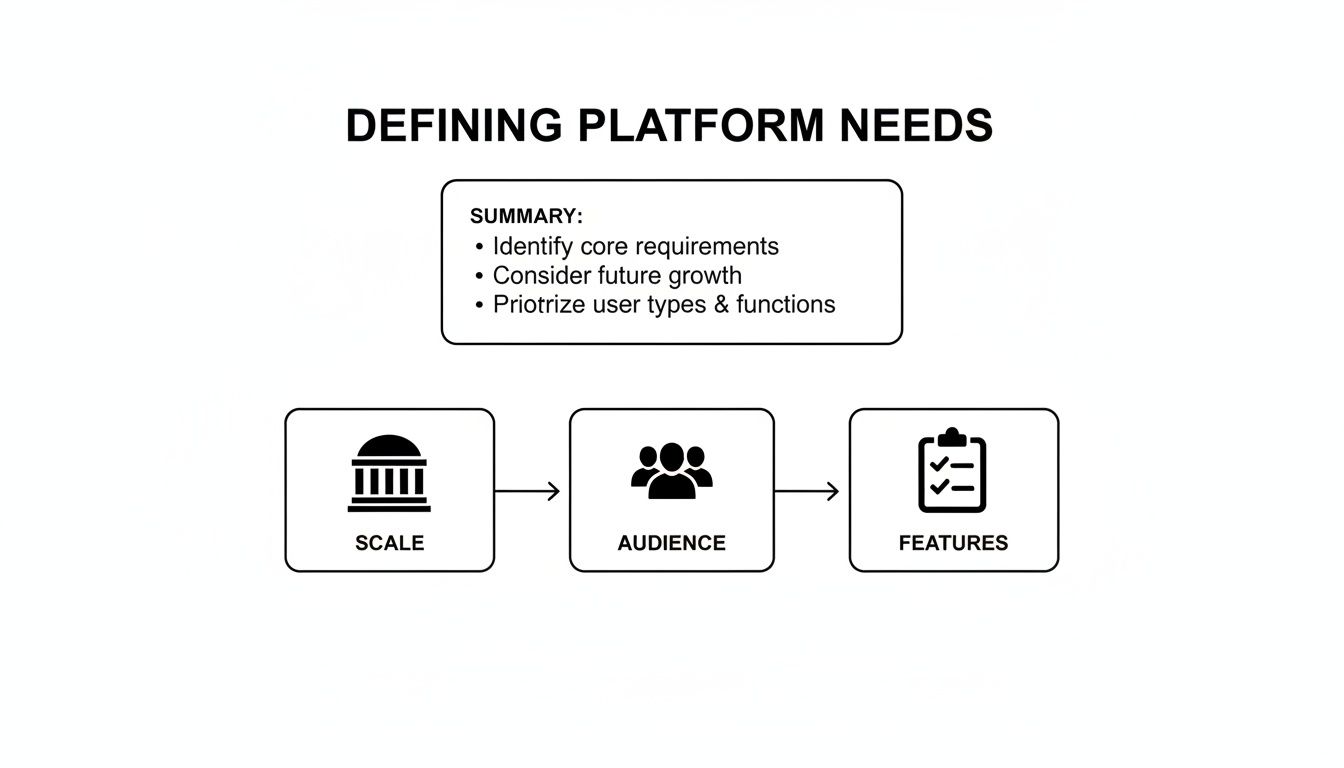
Think of this as your strategic blueprint. Your final choice should be a direct alignment of your event's operational needs and what you want to achieve, ensuring the platform truly fits the job.
The Enterprise Powerhouses: Cvent and ON24
Cvent is a titan in the event management world. It offers an incredibly deep suite of tools that manages the entire event lifecycle—from registration and attendee management all the way to on-site check-in for hybrid events. Its real strength is its sheer robustness and scale, which is why it's the go-to for massive corporations running complex, multi-track global conferences.
ON24, on the other hand, has carved out a specific niche as a "digital experience" platform. It’s laser-focused on content-heavy webinars that generate a goldmine of first-party engagement data. If your main goal is B2B lead generation through thought leadership, ON24’s analytics are second to none, tracking everything from poll responses to which resources an attendee downloaded.
Key Differentiator: Go with Cvent for complex logistical management of large-scale hybrid or virtual conferences. Choose ON24 when your primary objective is capturing deep, actionable engagement data from content-first webinars to speed up your sales funnel.
This focus on data and powerful features is driving major market trends. Recent data shows that the software side of the virtual event market now commands a massive 77.1% value share, blowing past services. This boom is fueled by demand for advanced tools like AI-powered networking and immersive 3D environments. It’s no surprise that top players like Cvent and BigMarker are investing heavily in AI to automate management and personalize the attendee experience.
The All-in-One Challengers: RingCentral Events and BigMarker
RingCentral Events (which you probably know as Hopin) was built to be a more accessible, all-in-one solution that mimics the feel of an in-person event. It has distinct areas like a main stage, session rooms, networking zones, and an expo hall, making navigation super intuitive for attendees. It really hits its stride with community-focused events and mid-sized conferences where organic networking and sponsor visibility are the main priorities.
BigMarker competes head-to-head in this space with a highly customizable, browser-based platform. That means no software downloads for your attendees, which is a big plus. It's particularly strong when it comes to creating fully branded virtual venues and integrating with a ton of marketing automation tools, making it a favorite for marketing teams who need total control over the brand experience and data flow.
Evaluating Integration Capabilities
A platform's ability to talk to your existing SaaS stack isn't a "nice-to-have"—it's an absolute necessity for proving ROI. This is a make-or-break point in any virtual event platform comparison.
- Cvent: Offers deep, native integrations with major CRMs like Salesforce. This allows for sophisticated data syncing that can track a customer's entire journey, from event registration to a closed deal.
- ON24: Its superpower is piping engagement data directly into marketing automation platforms like Marketo and HubSpot. This enables automated lead scoring and nurturing sequences based on exactly how an attendee interacted with your content.
- RingCentral Events & BigMarker: Both provide a solid lineup of native integrations but often lean on services like Zapier to connect with less common or industry-specific tools.
As you look at different solutions, it’s also worth exploring platforms built around social engagement, like the Saucial platform. Tools like these can add a unique layer of interaction that might perfectly complement your main event goals.
Platform Feature And Integration Matrix
To make this easier to digest, here's a side-by-side look at how these platforms stack up across the features that matter most to B2B marketers.
| Platform | Key Engagement Features | Native CRM/MA Integrations | Ideal Event Type | Scalability Rating (1-5) |
|---|---|---|---|---|
| Cvent | Advanced ticketing, 1:1 appointments, hybrid check-in | Salesforce, Microsoft Dynamics 365 | Large conferences, trade shows | 5 |
| ON24 | Rich engagement analytics, custom CTAs, certification | HubSpot, Marketo, Eloqua | Lead gen webinars, product demos | 4 |
| RingCentral Events | Speed networking, virtual expo booths, multi-session | Salesforce, HubSpot, Marketo | Community summits, internal kick-offs | 4 |
| BigMarker | Browser-based, white-label branding, automation | ActiveCampaign, Pardot, Zapier | Branded marketing events, summits | 3 |
This matrix gives you a quick snapshot, but remember to always schedule a demo to see how these integrations work in a live environment.
Matching Platform to Event Type
The truth is, there's no single "best" platform—it all depends on your specific use case. The right choice is the one that’s best for your event.
High-Stakes Product Launch: For this, you need rock-solid reliability and a polished, professional look. ON24 is an excellent choice here because of its broadcast-quality streaming and deep branding capabilities, ensuring your message lands flawlessly.
Multi-Day Industry Conference: The sheer complexity demands a powerful management tool. Cvent excels with its ability to juggle intricate schedules, multiple tracks, complex ticketing, and hybrid components without breaking a sweat. If you want to learn more about planning these kinds of complex programs, check out our guide to managing B2B events.
Community-Building Summit: When connection is the name of the game, you need features that actually get people talking. RingCentral Events is built for exactly this, with dedicated networking features that encourage those spontaneous conversations that make an event memorable.
Ultimately, the best choice becomes clear when you map each platform's core strengths directly against your event's primary goals. By looking past the shiny feature lists and focusing on these real-world applications, you can find a true strategic partner that will help you deliver impactful and measurable B2B virtual events.
Finding the Right Platform for Your B2B Industry
Let's be clear: there's no single "best" virtual event platform. The right choice depends entirely on your industry and what you need to accomplish. The features that make a SaaS product launch a roaring success are completely different from what a high-stakes cybersecurity summit requires. A smart virtual event platform comparison starts with your world, your audience, and your goals.
Think of it this way: you're not just buying a software license; you're investing in an outcome. When you match the platform’s strengths to your industry’s demands, you create an experience that truly connects with your audience and hits your business targets, whether that's generating a flood of new leads or delivering accredited professional training.
For SaaS Companies: It's All About High-Velocity Lead Gen
The SaaS world is a fast-moving machine, and your events have to keep up. The name of the game is generating leads, showcasing your product in the best possible light, and plugging everything seamlessly into your sales funnel. The platforms that win here are more than just streaming services—they're data-gathering powerhouses.
If you're a SaaS marketer, these are your non-negotiables:
- Deep CRM and Marketing Automation Integration: You need to instantly send rich engagement data—poll answers, downloaded resources, every question asked—straight into Salesforce or HubSpot. This is what fuels your lead scoring and gets your sales team on the phone with hot prospects immediately.
- Interactive Demo Tools: Look for crystal-clear screen sharing, in-session CTAs that let attendees book a demo right then and there, and one-on-one video chat rooms for private talks with your sales engineers.
- Analytics That Actually Mean Something: Forget vanity metrics like attendance counts. You need a platform that shows you which features prospects engaged with most, giving you gold for your product and sales teams.
For the Cybersecurity Sector: Security Is Everything
In the cybersecurity industry, trust is the only currency that matters. If your event platform feels even slightly insecure, you could torpedo your brand's reputation. For this reason, the evaluation checklist here is strict and puts security front and center.
When you're running a cybersecurity event, flashy features take a backseat to ironclad security and compliance. Your choice of platform is a direct statement about your company's own commitment to protecting data.
Here’s what to look for:
- Compliance and Certifications: The platform vendor should be upfront about their security credentials. Demand certifications like SOC 2 Type II, ISO 27001, and proof of GDPR compliance.
- Airtight Access Control: Essentials include secure, tokenized registration links, multi-factor authentication (MFA), and the power to lock down access by domain or even IP address.
- End-to-End Data Encryption: Make sure the platform encrypts all video, audio, and chat data—both while it's moving and when it's stored—to protect every sensitive conversation and presentation.
For Energy and Professional Services: Global Training and Community Building
The energy sector often needs to run massive global training sessions and all-hands meetings for a workforce spread across continents. Likewise, professional services firms in law or accounting depend on virtual events for continuing education and nurturing their professional networks.
For these fields, the focus shifts to scale, accessibility, and keeping the conversation going. They need platforms that can:
- Handle Huge Audiences: The tech has to support thousands of people joining from all over the world without the stream quality dropping or the connection failing.
- Manage Continuing Education Credits: For professional services, this is a game-changer. Look for built-in tools that track who attended which session, run quizzes, and automatically generate certificates for accredited content.
- Build a Lasting Community: The event shouldn't end when the live stream does. Strong platforms offer networking lounges, dedicated forums, and content libraries that keep people engaged for weeks or months.
Knowing your market geography is also key, especially for global energy companies or SaaS businesses with an eye on expansion. North America currently leads the virtual event platform market, holding a 36.75% share in 2024, which points to its stable infrastructure—a safe bet for events targeting US-based executives. But keep an eye on the future: the Asia-Pacific region is expected to grab 38% of the market by 2035, thanks to booming tech adoption. This trend makes it a strategic region for any B2B growth plans. You can explore the full market analysis on Research Nester to sharpen your global event strategy.
Digging into Platform Pricing and True ROI

Let's talk money. Getting to the real cost of a virtual event platform means looking far beyond the initial quote. To make a smart investment, you need to understand the total cost of ownership and, more importantly, the potential return it can deliver. A proper comparison means decoding the different pricing models vendors use, because they'll directly shape your budget and the value you get.
You’ll find that almost no two platforms price things the same way, which makes an apples-to-apples comparison a real challenge. The models range from annual subscriptions to per-event fees and even attendee-based pricing. The right fit for you hinges entirely on how often you run events and at what scale.
Decoding Common Pricing Models
To make a solid choice, you first have to get your head around the main ways these platforms charge. This is the only way to align your event strategy with a cost structure that actually works for your business.
- Annual Subscriptions: This is your best bet if you're running a steady stream of events all year long. It gives you predictable costs and usually brings the per-event price down significantly. Platforms like GoTo Webinar and HeySummit are big fans of this model.
- Per-Event Fees: If your main focus is one or two big annual conferences, this model makes a lot more sense. You pay a single flat fee for one event. It might look steep upfront, but it's way more economical than paying for a year-long subscription you’ll barely touch.
- Per-Attendee or Per-Registrant Fees: This is a scalable model often used by platforms like Cvent. You typically pay a base license fee plus a small charge for every person who signs up. It’s great for growth but can get expensive if your event draws a massive, hard-to-predict crowd.
The most critical step is to look beyond the base price. Hidden costs for essential features like dedicated support, advanced analytics, or key CRM integrations can quickly inflate your final bill. Always ask for a detailed breakdown of what's included versus what's considered an add-on.
Calculating the True Return on Investment
A strong business case isn't just about managing costs; it’s about proving financial benefits. Calculating the potential ROI of your virtual event is how you'll justify the expense and get the budget you need from leadership. This means putting real numbers to both direct cost savings and the long-term value you’re creating.
Start by framing the benefits in concrete financial terms.
- Quantify Cost Savings: Add up all the money you’re saving by not hosting a physical event. This is where you’ll see dramatic cuts in expenses like venue rentals, travel and lodging for staff and speakers, and printing physical marketing materials.
- Measure Expanded Reach: Virtual events have no geographic limits, opening the door to a much larger, global audience. That expanded reach directly translates to a bigger top-of-funnel and a larger pool of potential new leads.
- Track Lead Generation Value: For most B2B events, it all comes down to generating quality leads. Use your platform’s analytics to monitor attendee engagement, then push that data into your CRM to track how many of those leads turn into sales pipeline and, ultimately, closed-won deals.
When you can present a clear financial picture that balances the platform’s cost against these tangible returns, you change the conversation. It’s no longer about an expense—it’s about a strategic investment in growth.
Turning Your Research Into a Decision
Alright, you've done the heavy lifting with your research. Now it’s time to take all that analysis and turn it into a final decision. A solid action plan is what separates a confident choice from a shot in the dark, ensuring the platform you pick actually delivers on its promises. This is your roadmap from demo to launch.
The first real test is the vendor demo. Think of these not as sales pitches, but as job interviews where you're the one hiring. You need to take control of the conversation from the start.
How to Run Demos and Trials Like a Pro
Don't just sit back and watch a canned presentation. Give the sales rep a real-world scenario—maybe a detailed script for your upcoming product launch or the agenda for your annual hybrid conference. Ask them to walk you through exactly how their platform handles it, step by step.
This is your chance to dig into the details that glossy brochures leave out. Get specific with your questions:
- "Show me the exact process for pulling attendee engagement data and getting it into our HubSpot CRM. I want to see the clicks."
- "What are the real limits on branding with your standard package? Where are the hard walls we'll hit?"
- "What's the service-level agreement for live technical support during an event? If our keynote speaker's video fails, who answers the phone and how fast?"
A vendor's hesitation is a red flag. If they can't give you a straight answer on integration workflows or support response times, that tells you more than their slickest slide deck ever will. Listen for what they don't say about extra fees and hidden costs.
Once the demo looks promising, insist on a hands-on trial. Get your marketing and event teams in there to play around. Have them experience it as an organizer and then register and join as an attendee. For more tips on getting the most out of your marketing stack, check out the guides in our B2B marketing resource center.
Planning for a Painless Implementation
Picking the right software is just the beginning; getting it up and running smoothly is a whole different challenge. An implementation can take a few days for a simple webinar tool or drag on for weeks with a more complex platform. Get a firm timeline from the vendor before you sign anything.
Next, focus on getting your people trained. Your event managers, demand gen specialists, and even the sales team need to feel confident using the tool. A well-trained team is the only way you'll actually use all those powerful engagement and lead-capture features you're paying for. A smooth launch happens when the people and the platform are in sync, ready to deliver results from your very first event.
Common Questions We Hear All The Time
When you're wading through the options for a virtual event platform, a lot of questions pop up. It’s a crowded space, and getting straight answers is the only way to feel good about your final pick. Let's tackle a few of the most common questions we see from event planners and marketers.
Should I Get an All-in-One Platform or a Specialized Webinar Tool?
This is probably the biggest fork in the road for most people. The honest answer? It comes down to how complex and varied your event calendar really is.
Think of an all-in-one platform like Cvent as your command center. It’s built for managing a whole portfolio of events—large conferences, trade shows, hybrid meetups, you name it. These platforms bring everything under one roof, from registration and multi-track session scheduling to virtual expo halls and sophisticated networking features.
On the other hand, a specialized webinar tool like ON24 is laser-focused on one thing: delivering polished, content-heavy presentations that generate leads. They are masters at capturing deep engagement analytics and plugging that data right back into your marketing automation system.
Your choice should really just mirror your strategy. If you need a powerful engine for a wide range of event types, go all-in-one. But if your main goal is to perfect lead-generating webinars, a specialized tool is going to serve you much better.
What Level of Technical Support Should I Expect?
This is a big one, and the answer varies wildly between vendors. Never assume great support is a given; you have to dig in and ask pointed questions.
Support usually comes in tiers:
- Basic Plans: You’ll likely get standard email or chat support, often limited to business hours. Expect response times to be a bit slower.
- Enterprise Plans: This is where you get the premium treatment. It often includes a dedicated account manager, 24/7 phone support, and sometimes even a live technician for your actual event day. This is often called "white glove" support.
Before you sign anything, ask for their specific Service Level Agreements (SLAs). You need to know exactly what the onboarding looks like and how much extra it costs for premium support, especially if you're running high-stakes events where technical glitches are a non-starter.
How Important Are Native Integrations, Really?
They’re not just a nice-to-have; they're absolutely critical for efficiency and proving your event's worth. A smooth, native connection between your event platform and your CRM (like Salesforce) or marketing automation software (like HubSpot) is what transforms event data into real business intelligence.
These integrations are what automate the flow of essential data—registrations, attendance, poll responses, and Q&A. This is how you get real-time lead scoring, trigger instant sales follow-ups, and track ROI without someone having to manually stitch together spreadsheets. Platforms without these native connections force you into clunky data exports or pricey custom development, creating data headaches and a huge administrative drag.
Ready to build a B2B marketing strategy that drives real growth? At Mick-Mar Inc., we specialize in creating customized roadmaps that turn your marketing efforts into revenue. Let's connect and build your success story.