A customer acquisition cost calculator is a straightforward but powerful tool. It takes all your sales and marketing expenses over a set time, then divides that total by the number of new customers you brought in. The result tells you one simple truth: exactly how much you're spending to win each new customer.
In a market this competitive, knowing that number isn't just a good idea—it's the first step to building a business that actually lasts.
Why a CAC Calculator Is Non-Negotiable
Let's be direct: you can't afford to guess what it costs to land a new customer anymore. Sales and marketing costs are climbing across the board, squeezing margins and putting real pressure on profitability. If you don't have a firm grip on your Customer Acquisition Cost (CAC), you're flying blind. You're just pouring money into different channels without knowing which ones are actually driving growth and which are just a black hole for your budget.
This isn't just a hunch; the numbers back it up. For instance, a 2023 study highlighted that nearly half of all B2B marketers cited rising ad costs as a major pain point. This reality makes a precise customer acquisition cost calculator less of a "nice-to-have" and more of a core survival tool. You can read more about the rising cost of customer acquisition and what it means for today's marketing leaders.
Revealing the True Health of Your Marketing
Calculating your CAC gives you more than just a number; it’s a health check for your entire go-to-market engine. It forces you to look past vanity metrics like clicks and impressions and concentrate on what really moves the needle—efficient, profitable growth.
Before we dive deeper, it's helpful to see what goes into a proper CAC calculation. Here’s a quick breakdown of the essential inputs and what you get out of it.
Core Components of a CAC Calculation
| Component | What It Includes | Why It Matters |
|---|---|---|
| Sales & Marketing Expenses | Salaries, ad spend, commissions, software subscriptions, event costs, and any other overhead tied to acquiring customers. | This is the "cost" part of the equation. Being comprehensive here ensures your CAC isn't artificially low. |
| New Customers Acquired | The total number of new logos won within the same time period as your expenses. | This is your output. Accuracy is key—don't mix in existing customer upsells. |
| Time Period | The specific timeframe you're measuring (e.g., monthly, quarterly, annually). | Consistency allows for accurate trend analysis. Are your costs going up or down over time? |
| CAC Result | The final number: Total Expenses ÷ New Customers. | This is your baseline metric for efficiency and profitability. |
This table lays out the fundamentals. Getting these inputs right is the first step toward a CAC metric you can actually trust.
By consistently tracking this, you can start making some real strategic moves:
- Pinpoint Your Most Profitable Channels: Is that big-budget trade show actually delivering a better return than your scrappy Google Ads campaign? A proper CAC analysis will give you the answer.
- Justify Marketing Spend: When you can walk into a budget meeting and show that every $1 spent on a campaign generates $3 in lifetime value, those conversations get a lot easier.
- Improve Operational Efficiency: A high CAC can be a red flag for problems elsewhere—inefficiencies in your sales funnel, poor lead quality, or messaging that just isn't connecting.
- Make Data-Backed Decisions: Stop relying on gut feelings. You can confidently shift resources to the strategies proven to bring in customers without breaking the bank.
A CAC calculator transforms your marketing from a cost center into a predictable revenue driver. It's the bridge between what you spend and what you earn, giving you the clarity needed to scale responsibly.
Ultimately, understanding your CAC is the foundation for a smarter growth strategy. It helps you stop wasting money, double down on what works, and build a more resilient business that can handle whatever the market throws at it. It’s all about making every single marketing dollar count.
Getting the Right Data for Your CAC Formula
Your CAC calculation is only as reliable as the numbers you put into it. If you’re just looking at ad spend, you're flying blind with a dangerously incomplete picture of your actual costs.
To get a "fully loaded" CAC that truly reflects your business, you have to dig into every single expense that helps land a new customer. It’s a lot like building a house—you can't just count the cost of lumber. You have to factor in the foundation, labor, roofing, and even the screws. Your CAC is the same; it needs to include every marketing and sales cost, big and small.
Your Core Sales and Marketing Costs
First things first, you need to round up all the expenses tied to your customer acquisition machine. A lot of founders stop at ad spend, but that’s just the tip of the iceberg. Getting this list right is the difference between a vanity metric and an honest one.
Here’s a practical checklist to make sure you don't miss anything:
- Salaries & Commissions: This is usually the biggest line item. Be sure to include the gross salaries for your entire marketing and sales teams, plus any commissions or bonuses they earned in the period you're measuring.
- Advertising Spend: This is the obvious one. It’s all your paid channels—Google Ads, social media campaigns, sponsorships, affiliate payouts, you name it.
- Software & Tool Subscriptions: Time to tally up the monthly or annual costs for every tool in your stack. Think CRM (like Salesforce), marketing automation (like HubSpot), analytics tools, and anything else that supports your acquisition efforts.
- Content & Creative Expenses: Did you hire a freelance writer for your blog? Pay a designer for new ad creative? These costs, including agency retainers or one-off project fees, absolutely count.
- Overhead Allocation: This is the one most people forget. A portion of your company's general overhead, like office rent and utilities, needs to be allocated to your sales and marketing departments. An easy way to do this is by headcount. If your sales and marketing teams make up 25% of your company's total employees, then 25% of those overhead costs should go into your CAC calculation.
By meticulously tracking these inputs, you'll get a far more accurate view of your spending. If you need a hand structuring these expenses, our guide on marketing budget allocation best practices offers a great framework.
Don't Forget the Hidden Expenses
Beyond the usual suspects, there are always "hidden" or one-off expenses that can slip through the cracks and make your CAC look artificially low. It’s crucial to have a system for catching these.
These often include things like:
- Agency fees and retainers for SEO, PPC, or PR.
- Event and trade show costs, including booth rentals, travel, and swag.
- One-time campaign expenses for a big product launch or seasonal push.
- Referral program payouts or special discounts offered to new sign-ups.
The visual below shows a great breakdown of what should be factored into your total sales and marketing costs, giving you a clear map of what to include.
This breakdown really drives home how salaries, tools, and ad spend all come together. It's a perfect reminder that a truly useful customer acquisition cost calculator has to be comprehensive.
The Importance of a Consistent Time Period
Finally, you have to decide on the time period you're measuring. Are you calculating CAC monthly, quarterly, or annually? There isn't a single right answer, but whatever you choose, consistency is everything.
Our advice? Start by calculating your CAC monthly. It gives you a fast feedback loop to see how new campaigns or spending changes are performing. Then, roll that up into a quarterly view. This smooths out any monthly spikes or dips and gives you a more stable, strategic look at your acquisition efficiency over time.
Choosing a consistent timeframe—and sticking to it—is what allows you to spot trends. You can see if your CAC is creeping up or trending down and make smart decisions based on data you can actually trust. This simple discipline is what turns your CAC from a one-off number into a powerful diagnostic tool for your business.
How to Build Your Own CAC Calculator
Alright, let's get our hands dirty and build a simple tool to track your spending. You don't need fancy, expensive software to get a handle on this; a basic spreadsheet is all it takes to build your own customer acquisition cost calculator. This DIY approach is the fastest way to get immediate clarity on how efficiently your marketing dollars are working.
We'll break this down into a few manageable pieces. We'll start by setting up columns for all your costs, then a spot to track new customers, and finally, the formula that ties it all together.
Setting Up Your Spreadsheet
Think of your calculator as a straightforward ledger. You need a place to itemize all your expenses and a separate column to track the results of that spending—new customers.
Open a new spreadsheet and create these columns:
- Month/Quarter: The specific time period you're measuring.
- Total Marketing Costs: The sum of all your marketing-related expenses.
- Total Sales Costs: The sum of all your sales-related expenses.
- Total Sales & Marketing Costs: The combined total of the previous two.
- Number of New Customers Acquired: The final count of new logos you brought in.
- Customer Acquisition Cost (CAC): The magic number we're calculating.
The formula at the heart of this is powerful in its simplicity. It’s the core of your entire analysis.
(Total Sales & Marketing Costs) / (Number of New Customers Acquired) = CAC
This simple equation cuts through all the noise. It tells you exactly how much you paid, on average, for each new customer you landed during that period. For a deeper dive and some great templates, this Customer Acquisition Cost Calculator guide is an excellent resource.
This flowchart visually maps out all the components that should feed into your total acquisition cost.
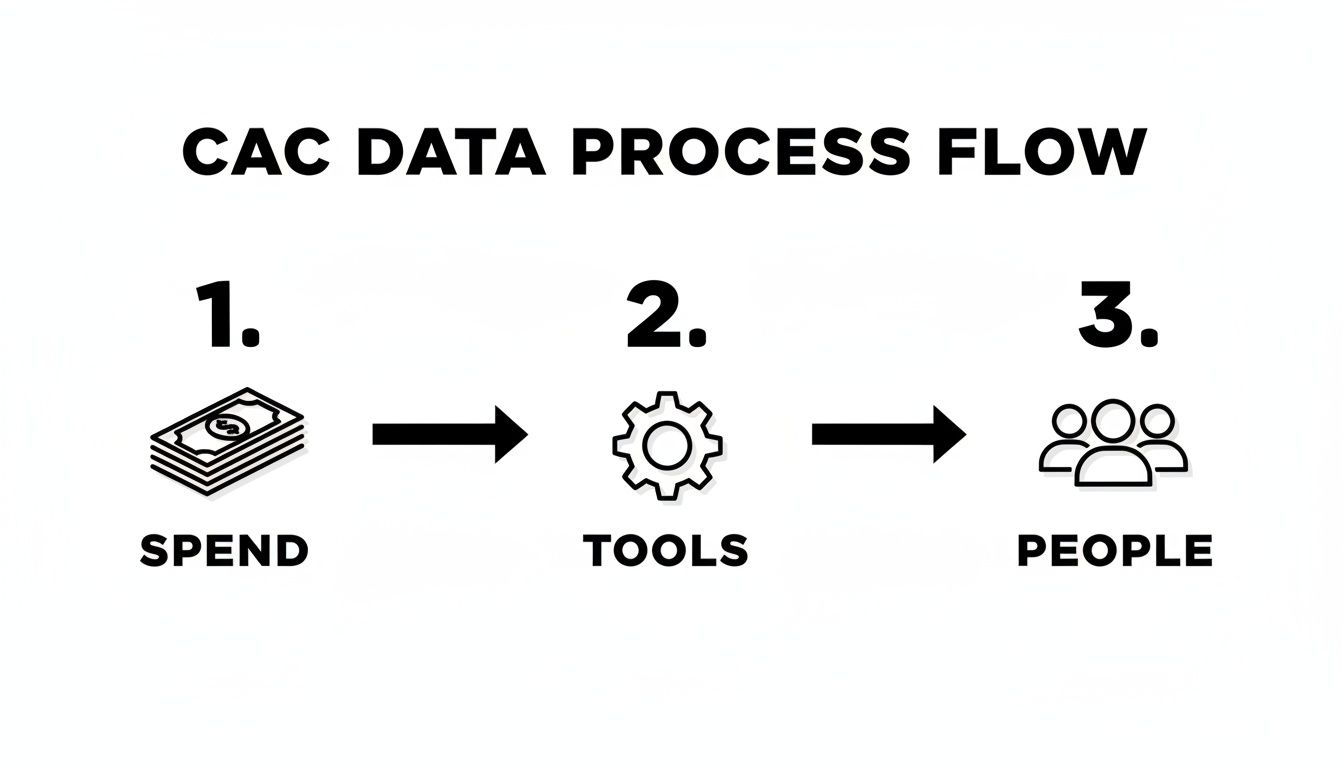
As you can see, a true "fully loaded" CAC goes beyond just ad spend. It includes the crucial costs of the tools and people that make acquisition happen.
CAC Calculator in Action: A SaaS Scenario
Let's walk through a realistic example for a B2B SaaS company. We'll call them "Innovate SaaS," and they want to figure out their CAC for the first quarter (Q1).
First, they need to round up all the relevant costs from that period:
- Marketing Team Salaries: $60,000
- Sales Team Salaries & Commissions: $85,000
- Google & LinkedIn Ad Spend: $45,000
- Content Creation (Freelancers): $5,000
- Software Subscriptions (CRM, Analytics): $15,000
- Overhead Allocation (20% of office costs): $10,000
Now, we just add it all up.
- Total Sales & Marketing Costs: $60k + $85k + $45k + $5k + $15k + $10k = $220,000
In that same quarter, the sales team worked their magic and closed 88 new customers.
With those two key figures, we can plug them right into our formula:
$220,000 / 88 New Customers = $2,500 CAC
There it is. For every new customer Innovate SaaS acquired in Q1, they spent an average of $2,500. This single number is now a critical benchmark they can use to measure future performance and the health of their growth engine.
CAC Calculator in Action: An Ecommerce Scenario
The formula is just as effective for an ecommerce business, even though the specific costs and channels will look different. Let's imagine an online skincare store, "Glow Beauty," calculating its CAC for the month of May.
Here’s a breakdown of their expenses for the month:
- Marketing Manager Salary: $7,000
- Facebook & Instagram Ad Spend: $20,000
- Influencer Marketing Campaign: $5,000
- Email Marketing Platform (Klaviyo): $1,000
- Shopify App Subscriptions: $500
- Creative (Photography & Design): $1,500
Let’s tally up their total investment.
- Total Sales & Marketing Costs: $7k + $20k + $5k + $1k + $500 + $1,500 = $35,000
In May, all their marketing efforts resulted in 700 brand-new customers making a purchase.
Time to apply the formula:
$35,000 / 700 New Customers = $50 CAC
For Glow Beauty, it cost $50 to acquire each new customer in May. With this number in hand, they can now compare it directly to their Average Order Value (AOV) and Customer Lifetime Value (LTV) to see if their marketing spend is truly profitable.
Building your own customer acquisition cost calculator isn't about getting lost in complex financial models. It’s about creating a simple, repeatable process that gives you a clear line of sight into the health of your business. Whether you're running a SaaS or an ecommerce brand, this tool is the first step toward making smarter, data-driven decisions that fuel sustainable growth.
Putting Your CAC Into Perspective
So, you’ve calculated your Customer Acquisition Cost. Whether it’s $50 or $2,500, that number is pretty much meaningless on its own. It's just a data point floating in space.
To make it actually useful, you need to add context. Is your CAC "good" or "bad"? The only way to find out is to see how it stacks up against industry benchmarks and, more importantly, to break it down by your specific acquisition channels. This is what turns CAC from a simple metric into a powerful strategic lever, showing you exactly where your marketing dollars are pulling their weight.
What Is a Good CAC, Really?
There’s no magic number here. A "good" CAC is completely relative to your business model, your industry, and the lifetime value (LTV) of your customers.
A company selling a $10,000-a-year enterprise software subscription can comfortably spend a lot more to land a new customer than an e-commerce brand selling $30 t-shirts. The enterprise SaaS business has massive long-term revenue potential from that one customer, while the t-shirt company is working with much tighter margins.
The golden rule is pretty simple: for your business to be profitable, your CAC has to be significantly lower than your Customer Lifetime Value. You need to find that sustainable sweet spot where the cost of getting a customer doesn't gobble up all the profit you'll eventually make from them.
Benchmarking Your CAC Across Industries
Comparing your CAC to industry averages is a fantastic way to get a quick gut check on your performance. These benchmarks provide a valuable reference point, but just remember, they're averages. Your specific situation will always be unique.
A quick look at the data shows just how wildly these costs can swing. Context is everything.
Average Customer Acquisition Cost by Industry
To give you a better sense of where you might stand, here’s a look at some typical CAC values across different sectors. Keep in mind that factors like sales cycle length, market competition, and product complexity heavily influence these figures.
| Industry | Average CAC | Key Influencing Factors |
|---|---|---|
| B2B SaaS | $702 | Longer sales cycles, reliance on high-touch sales teams, competitive content marketing. |
| Fintech | $1,450 | High customer LTV, strict regulations, and intense competition for customer trust. |
| B2B E-commerce | $536 | Higher order values, but often requires targeted outreach and relationship building. |
| General E-commerce | $70 | Driven by paid social/search, influencer marketing, and high volume of transactions. |
| Electronics (E-commerce) | $377 | High-ticket items, extensive customer research, strong brand loyalty plays a role. |
| Health & Beauty | $127 | Dominated by social media influencers, visual platforms, and repeat purchase behavior. |
| Arts & Entertainment | $21 | Lower price points, impulse buys, and strong word-of-mouth or viral potential. |
Data compiled from recent industry reports. For a deeper dive, you can explore more on how CAC varies by industry on loyaltylion.com.
These numbers make it crystal clear why a one-size-fits-all approach to CAC is a huge mistake.
A high CAC isn't inherently bad if it brings in a high-value customer. The real question isn't "What's our CAC?" but "Is our CAC profitable and sustainable for our business model?"
The Real Power Is in Tracking CAC by Channel
This is where your customer acquisition cost calculator becomes a true optimization tool. A blended, company-wide CAC is fine for board meetings and high-level planning, but it hides all the important details you need to make smart decisions. To make real, tactical improvements, you have to track your CAC for each individual marketing channel.
Think about it. Are your Google Ads campaigns more or less efficient than your organic SEO efforts? Does that expensive trade show sponsorship actually deliver a better return than your LinkedIn outreach? You'll never know for sure until you segment your costs and results.
Here’s a practical way to break it down:
-
Isolate Your Channel Spend: For a given period, add up every dollar dedicated only to that channel. For paid search, this means your ad spend plus any agency fees or the salary cost for the person managing the campaigns.
-
Attribute Your New Customers: Dig into your analytics or CRM to figure out how many new customers came directly from that channel during the same timeframe.
-
Calculate the Channel-Specific CAC: Now just divide the isolated costs by the number of customers you attributed to that channel. It’s that simple.
You might find your Google Ads CAC is $250, while your SEO-driven CAC is only $50. This doesn't automatically mean you should kill your Google Ads budget—it might be bringing in higher-value customers or scaling much faster. But what it does give you is powerful information to start reallocating your budget, optimizing your campaigns, and doubling down on your most efficient growth engines.
Connecting CAC to LTV for Deeper Insights
Calculating your Customer Acquisition Cost is a huge step forward, but honestly, it only tells half the story. If you stop there, you’re flying blind. To truly understand the health and long-term viability of your business, you have to connect that cost to the value each customer brings in over time.
This is where the magic happens. Your mindset shifts from a simple "How much did this customer cost?" to a much more powerful question: "How profitable is this customer for us in the long run?"
Two key metrics make this possible: Customer Lifetime Value (LTV) and the CAC Payback Period. When you look at these alongside your CAC, you're no longer just looking at an expense report. You're using a powerful diagnostic tool for your entire business model.
The All-Important LTV:CAC Ratio
The LTV:CAC ratio is arguably the ultimate gut check for your business model's viability. It's a straightforward comparison of the total value a customer brings to your business versus the upfront cost you paid to get them. In short, it answers the most critical question: is your growth engine actually profitable?
A ratio of 1:1 means you're just breaking even, and that's before you factor in all your other operational costs. You're spending a dollar to make a dollar. On the flip side, a ratio that's too high—say, 5:1 or more—might mean you're being too conservative and leaving growth on the table.
For a healthy, sustainable SaaS business, the widely accepted "gold standard" is an LTV:CAC ratio of 3:1. This sweet spot means for every dollar you spend on acquisition, you generate three dollars in lifetime value. That's a strong margin for profit and reinvestment.
But context is everything here. Recent data from 2023 shows that B2B companies are grappling with climbing acquisition costs, with some paying as much as $2.82 to acquire just $1 of annual recurring revenue (ARR). This is a staggering figure—triple what top-performing companies spend. So while 3:1 is the ideal, a 2:1 ratio might be perfectly acceptable for an early-stage startup focused on capturing market share. Cutting spending too early could stall your momentum entirely.
Understanding Your Payback Period
While the LTV:CAC ratio tells you if you'll be profitable, the CAC Payback Period tells you when. This metric is all about timing, measuring the number of months it takes for a new customer's revenue to cover their initial acquisition cost. For any business with a recurring revenue model, this is an absolutely vital metric for managing cash flow.
A shorter payback period is always better. It means your business becomes cash-flow positive on new customers faster, freeing up capital to pour back into acquiring even more customers. A long payback period, on the other hand, can put a serious strain on your finances, even if your LTV:CAC ratio looks great on paper.
Think of it this way:
- LTV:CAC Ratio: Answers, "Is our business model sustainable?" It’s a measure of long-term profitability.
- CAC Payback Period: Answers, "How long until we get our money back?" It’s a measure of capital efficiency and cash flow.
To really nail this, you first need to master your Customer Lifetime Value (LTV) calculation. Once you have a firm grasp on the revenue side of the equation, you can make much smarter decisions about your acquisition spending. This can even inform your product strategy and how you structure your service tiers. For more ideas on how value perception ties into revenue, check out our guide on pricing and positioning strategies.
By tracking both of these metrics, you finally get a complete picture of your acquisition engine's performance—not just the cost, but the full return on your investment over time.
Proven Strategies to Lower Your Acquisition Cost
Once you've got a handle on your CAC numbers and can confidently interpret them, the real work starts. The goal isn’t just to track this metric—it's to actively push it down. Lowering your acquisition cost is how you unlock more profitable and sustainable growth.
The good news? You don't need to blow up your budget to make a real difference. The most impactful changes often come from smart, strategic refinements and a relentless focus on the customer journey. It’s all about working smarter, not just spending more.
Master Your Conversion Funnel
The most direct way to slash your CAC is by getting more out of the traffic you already have. Every visitor who bounces from your site is a missed opportunity and, frankly, wasted ad spend. By optimizing your conversion rates, you can sign up more customers with the same marketing budget, which brings your CAC down immediately.
Think of your website as your digital storefront. Is it a breeze for people to find what they need? Is the sign-up or checkout process totally seamless? Even tiny points of friction can cause massive drop-offs.
Our personal advice? Start where the traffic is. Focus your energy on your homepage, key landing pages, or your pricing page. Even a small lift in the conversion rate here can have an outsized impact on your bottom line.
A/B testing is your best friend in this process. You have to systematically test different headlines, calls-to-action (CTAs), page layouts, and form fields to find out what truly clicks with your audience. Removing those little barriers to purchase is a huge lever for CAC reduction. Our guide on how to improve website conversion rates is a fantastic place to start digging in.
Increase Customer Lifetime Value
This might sound a little backward, but one of the best ways to manage your CAC is by getting more revenue from each customer you acquire. When your Customer Lifetime Value (LTV) goes up, your business can suddenly afford a higher acquisition cost and still be wildly profitable.
This approach shifts your thinking from a one-time sale to building a long-term relationship.
Here are a few practical ways to get your LTV climbing:
- Implement Smart Upsells and Cross-sells: At just the right moment, offer existing customers a relevant plan upgrade, a valuable add-on, or a premium service tier. This boosts their average order value and their total worth to your business.
- Create a Loyalty Program: Reward customers for sticking around. Things like exclusive discounts, early access to new features, or a simple points system can encourage retention and turn one-time buyers into genuine fans.
- Focus on Post-Purchase Engagement: The relationship doesn't end at the credit card screen. Use email marketing to provide real value, share tips, and keep your brand top-of-mind. It's the perfect way to set up future purchases.
Leverage the Power of Referrals
Your happiest customers are your best (and cheapest) marketing channel. A solid referral program can turn your existing customer base into a powerful, low-cost acquisition engine. Instead of paying Google or Facebook for ads, you're rewarding your own customers for bringing in qualified leads who already trust you.
The magic of referral marketing is the compounding effect. Customers who come in via a referral are often more loyal and have a higher LTV themselves. This creates a fantastic virtuous cycle of profitable growth.
Double Down on Organic Channels
Paid ads get you results fast, but the costs never stop. Organic channels like content marketing and Search Engine Optimization (SEO) are different—they're investments that pay dividends for years. A single, high-quality blog post can attract new customers long after it's published, bringing your blended CAC down over time.
Focus on creating genuinely helpful content that solves your audience's biggest problems. This is how you build trust and establish your brand as the go-to authority in your niche.
One of the most effective, low-effort SEO tactics we've seen is simply to refresh and update old blog posts. Go back to articles from a year or two ago, update the stats, add new insights, and fix the internal linking. This simple habit can give them a serious boost in search rankings and drive a whole new wave of organic traffic—all without the cost of creating something from scratch.
Common CAC Questions Answered
Even with the formulas nailed down, a few questions always seem to surface when teams start digging into their customer acquisition cost. Getting these right is the difference between a vanity metric and a truly reliable number that can steer your strategy.
Let's clear up some of the most common points of confusion we see.
What Is a Good LTV to CAC Ratio?
The LTV:CAC ratio is the ultimate health check for your business model. While benchmarks can vary, the classic gold standard for a healthy SaaS business is a 3:1 ratio. In plain English, for every dollar you put into acquiring a customer, you should get at least three dollars back over their lifetime.
Here's how to think about your ratio:
- Below 1:1: This is a five-alarm fire. You're losing money on every single customer you bring in.
- 1:1: You're just breaking even on your acquisition spend. This leaves zero margin to cover your product, G&A, and other operational costs, let alone make a profit.
- 3:1: You've hit the sweet spot. This shows you have a profitable engine with enough cash flow to cover all your costs and reinvest in scaling up.
- 5:1 or higher: This looks fantastic on paper, but it might actually be a sign you’re leaving money on the table. A ratio this high often suggests you're underinvesting in marketing and could be growing much faster by putting more fuel on the fire.
How Often Should I Calculate My CAC?
You should be looking at your CAC regularly, but the cadence depends on what you're trying to learn. We generally recommend calculating it both monthly and quarterly.
A monthly calculation is your tactical pulse check. It gives you a quick feedback loop on specific campaigns or channel experiments. Did that new ad set on LinkedIn move the needle? A monthly CAC will tell you right away.
Quarterly calculations, on the other hand, give you a more strategic, high-level view. They smooth out the natural volatility you might see month-to-month, offering a clearer picture of your overall acquisition health and helping you make smarter long-term budget decisions.
A huge mistake we see is when companies only calculate CAC annually. The feedback loop is just too slow. You could be bleeding cash on an inefficient channel for months without even realizing it.
What Are the Biggest Mistakes When Calculating CAC?
The single most common error is not calculating a "fully loaded" CAC. This is where you only count the obvious costs, like your ad spend, and completely ignore all the other expenses that go into landing a customer.
A truly accurate CAC must include:
- Salaries and commissions for your sales and marketing teams.
- The cost of your tech stack—your CRM, marketing automation tools, analytics platforms, etc.
- Fees for any agencies, contractors, or freelancers you use.
- Even a portion of general overhead can be attributed here.
Another classic blunder is mixing up acquisition and retention costs. Your CAC should only include the spend and the new customers related to first-time acquisition. If you start throwing in the costs of your email campaigns to existing users or counting repeat purchases, you’re going to get a skewed number that makes your acquisition efforts look far more efficient than they really are.
We've covered a lot of the common sticking points people run into when working with their CAC. Here’s a quick summary of the key questions.
| Question | Short Answer |
|---|---|
| What's a good LTV:CAC ratio? | 3:1 is the ideal target for a sustainable SaaS business. |
| How often should I calculate CAC? | Monthly for tactical insights and quarterly for strategic planning. |
| What's the biggest mistake in CAC calculation? | Forgetting to make it "fully loaded" by including all related salaries, tools, and overhead. |
| Should I include retention costs? | No, CAC should only reflect the costs of acquiring brand-new customers. |
Hopefully, this clears up any lingering confusion and helps you calculate your CAC with more confidence.
At Mick-Mar Inc., we help SaaS companies build and execute marketing strategies that drive sustainable growth. If you're ready to move beyond guesswork and start making data-backed decisions to lower your CAC and boost your bottom line, we're here to help.
Learn more about our marketing solutions and how we can become your strategic growth partner.