Ever feel like your marketing efforts are just a bunch of random, disconnected activities? You're running social media ads, publishing blog posts, and sending emails, but they don't seem to connect. It’s a common challenge, and it's precisely where an integrated marketing campaign comes in to change the game.
Simply put, it’s a strategy where all your marketing channels work together to deliver one powerful, unified brand message. Instead of separate teams doing their own thing, your blog, ads, social media, and sales team are all singing from the same hymn sheet. The result? A seamless, consistent, and trustworthy experience for your audience.
Unpacking Integrated Marketing Campaigns

Have you ever seen an ad on Instagram, clicked through to a landing page, and felt like you landed on a totally different planet? The colors are off, the message is different, and the offer you clicked on is nowhere to be found. That jarring feeling is what happens when marketing lives in silos.
An integrated campaign is the complete opposite. Think of your marketing as an orchestra. Each instrument—the violins (your blog), the percussion (your social media), the trumpets (your paid ads)—plays a different part. But they’re all following the same conductor and the same sheet of music, creating a beautiful, cohesive symphony.
That’s the essence of integration. Every channel works in harmony to make sure that no matter where a customer bumps into your brand, they get a consistent, reinforcing message.
The Power of a Unified Voice
Speaking with a unified voice does more than just make your brand look polished; it builds genuine trust. When a prospect sees the same core message on LinkedIn, in an email, and again during a sales demo, it establishes your brand as reliable and authoritative.
This is especially critical in the B2B SaaS world, where trust is everything in a long-term buying decision.
And the data backs this up. A 2023 report from McKinsey highlights that companies that excel at integrating channels and personalizing the customer journey see a 5 to 15 percent increase in revenue and a 10 to 30 percent boost in marketing-spend efficiency. That’s a massive leap compared to siloed efforts, which often just lead to mixed messages and a wasted budget.
The core principle is simple: every piece of your marketing should build on the others, creating a cumulative effect that is far greater than the sum of its parts. It's about telling one complete brand story across many different platforms.
From Disjointed Noise to Perfect Harmony
Let's look at a quick comparison to really see the difference between a truly integrated campaign and the all-too-common siloed approach. One feels like a symphony, the other like a bunch of musicians all playing different songs at the same time.
| Aspect | Integrated Campaign (The Symphony) | Siloed Campaign (The Disjointed Band) |
|---|---|---|
| Approach | All channels and teams are aligned with a single, central message and goal. | Each marketing channel operates independently with its own separate goals and messaging. |
| Customer Experience | Seamless and consistent. The customer feels understood as they move from one touchpoint to the next. | Jarring and confusing. Messages conflict, leading to a fragmented brand perception. |
| Messaging | Consistent, reinforced, and builds trust over time. | Inconsistent and often contradictory, which erodes trust and weakens brand recall. |
| Business Outcome | Stronger brand equity, higher ROI, and a more efficient marketing spend. | Wasted budget, lower conversion rates, and a weaker brand presence in the market. |
As you can see, the difference is night and day. A siloed campaign feels chaotic to the customer. The social media team runs a promotion with one discount, while the email team talks about a new feature, and the sales team is pushing a completely different value prop. It just creates confusion.
An integrated campaign, on the other hand, rallies every team around a single "big idea." This ensures every touchpoint smoothly guides the customer on their journey. This strategic alignment, as detailed in our guide on building a powerful marketing strategy, doesn't just feel better for the customer—it delivers a much stronger return on your investment.
The Core Pillars of a Unified Campaign

To get your marketing to work like a well-oiled machine instead of a collection of mismatched parts, you need to build your strategy on a solid foundation. A truly integrated campaign isn't just a bunch of random activities; it’s a deliberate structure held up by three core pillars. When these elements work together, they create a seamless and persuasive experience for your audience.
Think of them as the legs of a stool—if one is weak or missing, the whole thing wobbles. These pillars make sure every single touchpoint, from a social media post to a sales call, reinforces the same central idea.
Pillar 1: Consistent Messaging
The first and most important pillar is consistent messaging. This is the heart and soul of your campaign—the core idea, the key value prop, and the main story you want people to remember.
This doesn't mean you just copy and paste the same sentence everywhere. It's about adapting your core message to fit the context of each channel while keeping its meaning intact. The goal is to create a single, unified brand story that guides your audience with a clear narrative.
Recent research underscores this point. A 2023 study by Lucidpress found that consistent brand presentation across all platforms can increase revenue by up to 33%. When your message is clear and constant, you build familiarity and trust, which are the bedrock of any lasting customer relationship.
Pillar 2: Cohesive Creative
Next up is cohesive creative. If messaging is what you say, creative is how you show it. This pillar covers all the visual and sensory elements of your campaign: your brand colors, fonts, logo usage, photography style, and the overall design aesthetic.
Your creative assets are literally the face of your campaign. When a prospect sees your Google Ad and then clicks through to your landing page, that transition needs to feel effortless and familiar. This kind of recognizability is what cuts through the clutter and makes your brand instantly identifiable, no matter where it shows up.
Cohesive creative is about more than just looking good; it's about building brand equity. Every time someone sees your distinct visual style, it strengthens their mental connection to your brand, making you the first one they think of when they need a solution.
This visual harmony ensures that even a quick glance at an ad or an email header immediately connects the dots back to your company. It’s the silent reinforcement of your brand promise.
Pillar 3: Aligned Channel Strategy
Finally, we have an aligned channel strategy. This is where you decide where and when to tell your story. It’s not about being on every single platform, but about showing up on the right ones—where your target audience is actually spending their time and is open to hearing from you.
An aligned strategy means each channel has a specific job to do. You might use one platform for building awareness, another for education and nurturing, and a third for driving conversions.
Here’s a practical look at how a B2B SaaS company might use these pillars to launch a new AI-powered analytics feature:
Core Message: "Stop guessing. Make data-driven decisions in minutes with our new AI analytics feature."
LinkedIn Article (Awareness): A thought-leadership piece titled, "The Hidden Costs of Intuition-Based Business Decisions," which subtly introduces their new feature as the solution. The tone is educational, and all visuals use the company's professional branding.
Google Ad (Consideration): A direct, benefit-driven ad with the headline, "AI-Powered Analytics for SaaS. Get Clear Insights, Fast." The ad uses the same color scheme and font seen on the company website.
Email Newsletter (Nurturing): A message to existing subscribers featuring a mini-case study of how a beta customer used the feature to boost efficiency by 30%. The call-to-action is to watch a short demo video.
Sales Deck (Decision): A polished presentation for qualified leads that includes customer testimonials and a deep dive into the feature’s ROI. Both the messaging and visuals are perfectly aligned with every previous touchpoint.
In this example, the message is tailored for each stage, the creative is consistent, and the channels work in harmony to guide the prospect from curiosity to conversion. By building your strategy on these three pillars, you make sure every part of your campaign works together to hit your goals.
Why Integrated Marketing Is a Growth Engine for SaaS
For any SaaS company dealing with a complex product or a long sales cycle, integrated marketing isn't just a "nice-to-have." It’s the engine that powers sustainable growth. When every single touchpoint works together in harmony, you create a powerful flywheel effect. It builds momentum, gets rid of friction, and smoothly guides people from their very first click to becoming your biggest fans.
Imagine you're building a bridge. Every cable, beam, and support has to connect perfectly to create a structure that's safe and reliable. If there's even one gap or a single piece is out of place, the whole thing is at risk. Integrated marketing works the same way—it makes sure there are no gaps in the customer journey, making the path from awareness to purchase feel obvious and compelling.
Building Unshakeable Brand Trust
In the B2B world, where decisions involve serious money and risk, consistency is the currency of trust. An integrated campaign ensures your core message, your value proposition, and your brand’s personality are relentlessly consistent everywhere.
Think about it from the customer's perspective. When they see the same confident messaging on your website, hear it again in a webinar, and then it's reinforced during a sales call, it builds an incredible sense of reliability. This constant reinforcement cuts through the noise and positions your brand as an authoritative, trustworthy partner. This is a crucial piece of effective product marketing, where clarity and trust are everything.
Maximizing Your Marketing ROI
Let's be honest, disconnected marketing efforts are a huge waste of money. You might have your paid media team bidding on keywords that have nothing to do with your latest content push, or your social media team promoting a feature that isn't even mentioned in your email nurture sequence. It's like having two people in a rowboat paddling in opposite directions—a whole lot of effort for zero forward movement.
An integrated approach puts a stop to that inefficiency. By getting every channel aligned around a single, unified strategy, you make sure every dollar you spend builds on the last.
An integrated campaign forces your teams to chase a common goal. This creates a synergistic effect where the combined impact of your channels is far greater than the sum of their individual parts. This is how you stop burning budget and start multiplying your results.
This strategic alignment means every ad, every piece of content, and every sales conversation is part of a bigger, cohesive story designed to drive conversions.
Creating a Seamless Customer Journey
The modern B2B buyer’s journey is messy and all over the place. Prospects bounce between dozens of touchpoints—they might read a blog post, see you at a trade show, and later watch a demo. An integrated campaign is all about making this journey feel completely seamless and intuitive.
Here’s how it makes the customer experience so much better:
- It Breaks Down Silos: It forces marketing, sales, and even product to actually talk to each other and get on the same page. When everyone is working from the same playbook, the customer gets a consistent experience no matter who they interact with.
- It Guides Customers Intentionally: Every asset and interaction is designed to nudge a prospect toward the next logical step. A top-of-funnel blog post naturally leads to a mid-funnel webinar, which then sets up the perfect opportunity for a bottom-of-funnel demo offer.
- It Personalizes at Scale: When you have a unified view of the customer, you can deliver messages that are way more relevant. The data from their engagement with a LinkedIn ad can directly inform the content of the next email they receive from you.
Ultimately, this approach transforms your marketing from a bunch of random activities into a well-orchestrated system that nurtures leads, builds real relationships, and reliably drives revenue.
How To Plan Your Integrated Marketing Campaign
Turning the idea of an integrated campaign into a real-world, revenue-driving machine starts with a solid plan. This is where your strategy gets its hands dirty and meets execution. A well-built plan is your roadmap, ensuring everyone—from content creators to sales reps—is marching in the same direction toward a shared, measurable goal.
Without this roadmap, even the most brilliant creative concepts can fall flat. A plan takes your campaign from a collection of hopeful tactics and turns it into a coordinated system designed for results. It’s all about being deliberate, aligning your resources, and setting yourself up for a win before you even launch.
Step 1: Set Clear And Measurable Goals
First things first: you need to define exactly what success looks like. Vague goals like “increase brand awareness” are impossible to track and even harder to achieve. Instead, anchor your campaign to specific, quantifiable business objectives.
What do you really want this campaign to do? Are you looking to generate more qualified leads? Increase demo requests? Drive sign-ups for a new feature? Get specific. For instance, a clear goal might be: “Increase qualified demo requests by 20% within the next quarter.” This gives your team a clear target to hit and a benchmark to measure performance against.
Step 2: Define Your Audience And Map Their Journey
You can't create a compelling experience if you don’t have a deep understanding of who you’re talking to. Go beyond basic demographics and flesh out detailed buyer personas. What are their biggest pain points? Where do they hang out online to find information? What truly motivates them to pull the trigger on a purchase?
Once you know your audience inside and out, map their typical buyer's journey. This means identifying the key stages they move through—from becoming aware of their problem, to considering your solution, and finally making a decision. This map becomes your guide, showing you exactly where to place your touchpoints to move them smoothly from one stage to the next.
Step 3: Craft Your Central Big Idea
Every powerful integrated campaign is built around a single, compelling "big idea." This is the core message or story that ties every single piece of your campaign together. It needs to be simple, memorable, and resonate on an emotional level with your audience's challenges.
Think of it as the campaign's theme. For a cybersecurity SaaS, the big idea might be "Proactive Defense in an Age of Uncertainty." This central theme then guides everything you create, from high-level thought leadership down to the nitty-gritty copy in a social media ad. It’s this consistency that makes your campaign feel cohesive and trustworthy.
To keep your team working in sync and your campaign unified, consider integrating essential tools like Collabdesk for better collaboration during the planning phase.
This visual shows how focusing on trust, ROI, and the customer journey work together to create sustainable growth for a SaaS business.
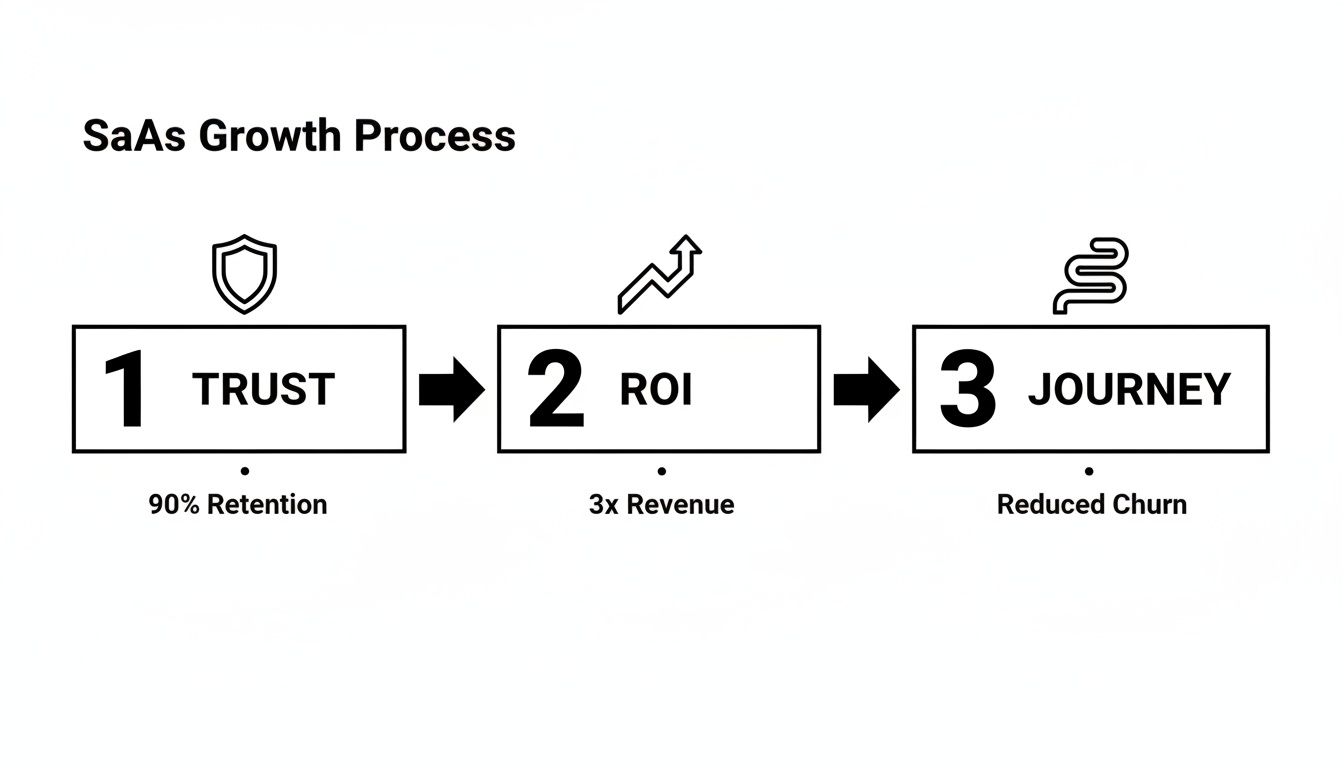
The key takeaway here is that each element builds on the last. It creates a powerful flywheel effect that ultimately reduces churn and drives revenue.
Step 4: Select Your Channel Mix
With your message and audience dialed in, it’s time to pick the right channels to tell your story. The goal isn't to be everywhere; it's to be where your audience is most active and receptive.
A strong channel mix for a B2B SaaS company often includes:
- LinkedIn: Perfect for sharing thought leadership, running hyper-targeted ads to specific job titles, and joining industry conversations.
- Webinars: An excellent mid-funnel tool for educating prospects, showing off your product's value, and capturing high-intent leads.
- Email Marketing: Ideal for nurturing leads with personalized content, case studies, and targeted offers that gently guide them toward a decision.
- Paid Search (Google Ads): Essential for capturing people who are actively searching for a solution just like yours.
Remember, each channel should have a specific job. LinkedIn might be for building awareness, while your email sequence is designed to convert. The channels have to work together, not as isolated silos.
Step 5: Create Cohesive Assets And Define Kpis
The final step is to create the actual content and assets for each channel, making sure they all tie back to your big idea and visual identity. This means writing blog posts, designing ad creative, producing webinar slides, and crafting email copy that all feel like part of the same conversation.
As you build these assets, define the Key Performance Indicators (KPIs) you'll use to measure success. These metrics should link directly back to your primary goal. For example, if your goal is increasing demo requests, your KPIs might include:
- Website: Landing page conversion rate.
- LinkedIn: Click-through rate (CTR) on ads and engagement on organic posts.
- Email: Open rates, click-through rates, and the number of demos booked directly from email links.
By setting these KPIs upfront, you create a clear framework for tracking progress and proving the campaign's ROI. For a deeper dive into optimizing these workflows, you can learn more about The Content Marketing Operations Maturity Model in our detailed guide.
Your Integrated Campaign Planning Checklist
To help pull all these steps together, here's a quick checklist you can use to guide your planning process. Think of it as a sanity check to ensure you've covered all your bases before launch.
| Phase | Key Action | Success Metric Example |
|---|---|---|
| Strategy & Goals | Define a single, clear business objective. | Increase free trial sign-ups by 15% in Q3. |
| Audience | Develop detailed buyer personas and map the customer journey. | Identify 3 key touchpoints for the "Consideration" stage. |
| Messaging | Craft a central "big idea" and core messaging pillars. | All ad copy reflects the theme of "Effortless Automation." |
| Channels | Select a strategic mix of channels where your audience is active. | Allocate 40% of the ad budget to LinkedIn, 60% to Google Ads. |
| Assets & KPIs | Create cohesive content and define tracking metrics for each channel. | Track landing page conversion rate (target >5%). |
This table isn't just a to-do list; it's a framework for accountability. By thinking through each phase and defining what success looks like ahead of time, you're building a campaign that’s designed to perform from day one.
Measuring Success and Proving Campaign ROI
A brilliant integrated marketing campaign is only as good as the results it delivers. You can launch a perfectly synchronized effort, but the real test comes when you have to prove its value. This is where measurement comes in—moving beyond flashy "vanity metrics" to uncover the Key Performance Indicators (KPIs) that actually mean something to the business.
Effectively measuring an integrated campaign means connecting the dots across the entire customer journey. It’s not enough to say the campaign was “active.” You need to show the C-suite exactly how that blog post, the conversation at the trade show, and the final PPC ad all worked together to close a deal. It’s about telling a data-driven story, proving that your unified approach is a powerful engine for revenue, not just a creative exercise.
Moving Beyond Vanity Metrics
It's tempting to get swept up in metrics that look impressive on a slide but don't say much about business growth. A huge spike in social media reach or a flood of website visitors might feel like a win, but if they don't lead to real outcomes, they're just noise. To prove real ROI, you have to focus on metrics that tie directly to your business goals.
For any SaaS company, this means tracking KPIs across the entire funnel—from the first touch to the final handshake and beyond.
- Top of Funnel (Awareness): How well are you capturing attention? Instead of just impressions, look at brand mentions, share of voice, and direct website traffic. When people start typing your URL directly into their browser, you know you’re building real brand recall.
- Middle of Funnel (Consideration): Now, let's see how effectively you're engaging potential customers. Think webinar sign-ups, lead magnet downloads, and email click-through rates. Even metrics like time spent on key website pages show that your audience is leaning in and actively learning.
- Bottom of Funnel (Decision): This is where the money is. Track the hard numbers: demo requests, free trial sign-ups, marketing qualified leads (MQLs), and, of course, the customer acquisition cost (CAC). This is how you draw a straight line from your marketing spend to new business.
By focusing on these stage-specific KPIs, you can paint a clear picture of how your integrated efforts guide prospects from being vaguely aware to becoming paying customers.
Connecting The Dots With Your Tech Stack
So, how do you track all this? The secret is in your marketing technology (martech) stack. Your tools are the central nervous system of your measurement strategy, pulling in data from every touchpoint and stitching it all together. Without the right tech, you’re just guessing.
Your Customer Relationship Management (CRM) platform, whether it's Salesforce or HubSpot, has to be your single source of truth. It’s the home for all customer interaction data, letting you see the complete history of every lead. When it's all integrated properly, you can see that a new customer first found you through a LinkedIn ad, later downloaded an ebook, and finally requested a demo after a targeted email.
Your martech stack isn’t just a collection of software; it's the engine that proves ROI. It allows you to stitch together the customer journey and attribute revenue back to the specific marketing activities that drove it.
This unified view is what allows you to move from simply reporting on individual channel performance to demonstrating how the integration of those channels created a result far greater than the sum of its parts.
The Importance of Attribution Modeling
Finally, to truly nail down the ROI of your integrated campaign, you need to get comfortable with attribution modeling. This is simply the framework you use to give credit to the various touchpoints a customer interacts with on their path to buying. It helps answer the all-important question: which parts of our campaign are actually working?
There are a few ways to look at it:
- First-Touch Attribution: Gives 100% of the credit to the very first thing a customer did (e.g., the first blog post they read).
- Last-Touch Attribution: Gives all the credit to the final touchpoint right before they converted (e.g., the Google Ad they clicked before signing up).
- Multi-Touch Attribution: This is where the magic happens for integrated campaigns. It distributes credit across multiple touchpoints, recognizing that the blog post, the webinar, and the final ad all played a role in the journey.
By adopting a multi-touch model, you can accurately show how different channels worked together. This gives you the hard evidence you need to justify your budget, fine-tune future campaigns, and prove to everyone that your integrated approach is driving real, measurable growth.
Putting It All Together: A SaaS Campaign Example
So, what does an integrated campaign actually look like in the wild? Let's walk through a real-world scenario to connect the dots.

Imagine a SaaS company, let's call them "DataSense," just rolled out a game-changing AI feature that predicts customer churn. Instead of just blasting the news everywhere, they built a smart, cohesive campaign designed to guide prospects from curiosity to conversion.
They kicked things off with a deeply researched whitepaper on the hidden costs of customer churn. This wasn't just a simple blog post; it was a serious, top-of-funnel asset that established their authority and got people thinking. It worked, too, pulling in 1,200 downloads in the first week alone.
With that initial interest sparked, they moved to the next logical step: a webinar series featuring industry experts to discuss practical churn-prevention strategies. This mid-funnel content was perfect for engaging the leads from the whitepaper, and it drew 500 engaged attendees ready to learn more.
How the Campaign Flowed
The magic is in how each piece connects to the next. The entire experience was designed around the buyer's journey.
- Top of Funnel (Awareness): A detailed report, promoted through organic social media and paid ads, caught the attention of their target audience.
- Mid-Funnel (Consideration): Interactive webinars and follow-up email sequences kept the conversation going, using case studies to show the new feature in action.
- Bottom of Funnel (Decision): For the most engaged leads, they sent personalized demo invitations and links to targeted content, making the final decision easy.
This multi-layered approach ensures every channel is telling part of the same story, creating a seamless journey for the customer.
Crafting a Consistent Message
DataSense anchored the entire campaign around one powerful core message: "Predict With Precision." This tagline wasn't just a throwaway line; it showed up everywhere—on the website, in their ad copy, and even in the sales team's scripts.
This consistency is crucial. It builds trust and eliminates the confusion that happens when marketing messages feel all over the place.
When your messaging feels disjointed, prospects get confused. That confusion leads to dropped engagement and, ultimately, a wasted budget.
All their visuals followed suit, too. From LinkedIn ad graphics to email banners and landing pages, everything used the same brand colors and dynamic AI-themed imagery. This created a strong, unified brand presence that felt professional and trustworthy.
Aligning Every Touchpoint
The team at DataSense was meticulous about connecting their channels. The LinkedIn posts promoting the whitepaper didn't just link to a download page; they included eye-catching stats and visual snippets from the report itself.
Then, the email nurture sequence that followed the whitepaper download didn't just push for a demo. It naturally referenced the webinar content, creating a smooth, logical progression for the user.
- Website banners highlighted the key outcomes of the new AI feature and linked directly to the whitepaper.
- Social ads gave a sneak peek of the upcoming webinars, with a clear call to action to sign up.
- Sales outreach from the BDR team echoed the exact same value propositions found in the marketing content.
Mapping it all out helps keep everyone on the same page. A simple table can do wonders for team alignment.
| Stage | Primary Channel | Key KPI |
|---|---|---|
| Awareness | Whitepaper & Ads | 1,200 Downloads |
| Consideration | Webinar Series | 500 Signups |
| Decision | Demo Offers | 15% Demo Requests |
The Results Speak for Themselves
So, did all this coordination pay off? Absolutely.
The campaign delivered a 25% increase in demo requests and a 12% jump in free trial signups compared to their previous, more siloed efforts. Even better, their cost per acquisition (CAC) dropped by a healthy 18% because their message was so coherent and effective.
Here's the bottom line:
- Demo Requests: Up 25% quarter-over-quarter.
- Trial Signups: Grew by 12% in the period following the webinar series.
- CAC Reduction: An 18% drop, thanks to better message-market fit.
These numbers aren't just vanity metrics; they represent real business growth driven by a truly integrated strategy.
Adapting This Blueprint for Your Business
Of course, no two SaaS companies are the same. Your audience, channels, and product are unique.
Think of the DataSense example as a flexible framework, not a rigid set of rules. You can—and should—tweak the messaging, visuals, and channels to fit your specific goals. The key is to start with a plan, test your assumptions, measure what's working, and constantly refine your approach based on real data. That’s how you build memorable campaigns your audience will actually value.
Common Questions About Integrated Campaigns
Even with the best plan in hand, jumping into your first integrated marketing campaign can feel a little daunting. Let's walk through some of the most common questions and hurdles marketers run into when they shift to this all-in-one approach.
How Do You Start With A Small Team Or Budget?
This is a big one, and the answer is surprisingly simple: focus on quality, not quantity. You don't need to be everywhere at once. The magic of an integrated campaign is in the "integration" itself, not the sheer number of channels you're on.
Pick three or four channels where you know your audience spends their time. Maybe that’s your blog, an email newsletter, and a strong presence on LinkedIn. A small, tightly synchronized campaign that tells a consistent story across those few places will always beat a scattered, disjointed effort spread across ten.
The biggest mistake you can make is spreading yourself too thin. A focused, consistent presence on a few key channels has a much greater impact than a scattered, inconsistent effort across many.
What Is The Biggest Mistake To Avoid?
Without a doubt, the most damaging mistake is inconsistent messaging. This is when your social media team is pushing one angle, your paid ads are saying something else entirely, and your sales team is using a completely different value proposition. It’s confusing for the customer and it absolutely kills brand trust.
Before you launch anything, get everyone in a room (virtual or otherwise) for a kickoff meeting. Make sure every single person, from marketing to sales to customer success, is on the same page about the core message, the goals, and the creative direction.
Which Tools Are Essential For Management?
You can’t keep all the moving parts straight without a solid tech stack. While every company is different, a good starting point usually includes these core pieces:
- A CRM: This needs to be your single source of truth for all customer data. Think of it as your campaign's central nervous system.
- A Marketing Automation Platform: This is what helps you build, manage, and track those customer journeys across different channels.
- A Project Management Tool: Absolutely crucial for keeping your team, their tasks, and all the deadlines in sync.
- Analytics Platforms: You have to measure what matters. These tools are how you track performance and ultimately prove your campaign’s ROI.
Ready to build a powerful, unified marketing strategy that drives real growth? The team at Mick-Mar Inc. specializes in creating integrated campaigns for B2B SaaS companies. Let's create your roadmap to success.