A content distribution strategy is your playbook for getting your content in front of the right people. Let's be honest, hitting "publish" is just the starting line. Without a solid plan to share, promote, and amplify your work, even the best content will just gather digital dust. It's about strategically using a mix of your own platforms, getting others to talk about you, and sometimes, paying to get a boost.
Why Content Distribution Is Your SaaS Growth Engine
So you’ve created a killer piece of content. That’s great, but it’s only half the battle. The real work begins now: making sure the right people actually see it.
Think of your best blog post like a revolutionary piece of software packed away in a warehouse. It might be brilliant, but if there's no delivery truck to get it to customers, it’s worthless. A distribution plan is that delivery truck.

A smart distribution strategy turns your content from a static library entry into a dynamic engine for growth. It’s the critical link between creating something valuable and seeing it generate real business results. For SaaS companies, this isn’t just marketing fluff—it's how you build authority, generate leads, and fill your sales pipeline.
The True Cost of Neglecting Distribution
When you skip distribution, you're essentially throwing away your investment. You pour countless hours and resources into crafting insightful articles, in-depth guides, and persuasive case studies. If that content never reaches its intended audience, your ROI flatlines. This is precisely the waste that a good distribution strategy is designed to prevent.
A proactive distribution plan moves you from a "publish and pray" approach to a "publish and profit" model. It ensures every piece of content works as hard as possible to attract, engage, and convert your ideal customers.
This methodical approach helps you maximize the lifespan and impact of every single asset. You get more mileage out of what you’ve already created instead of just constantly churning out new stuff.
Setting The Stage For Success
To build a growth model that actually lasts, you need a framework. The most effective content distribution strategies don’t just happen—they're built on three core pillars that work in harmony.
Understanding these pillars is your first step toward building a system that consistently delivers your message to the right people, at the right time, and on the right platform. These are often called owned, earned, and paid media.
Here’s a quick-glance table to help you understand their fundamental roles in your strategy.
The Three Pillars of Content Distribution at a Glance
| Channel Type | Primary Channels | Key Benefit | Main Challenge |
|---|---|---|---|
| Owned Media | Your blog, website, email list, social media profiles | Total Control – You own the platform and the audience. | Building an Audience – It takes time to grow from scratch. |
| Earned Media | PR mentions, guest posts, reviews, social shares, backlinks | High Credibility – Third-party validation builds immense trust. | Lack of Control – You can't dictate when or if it happens. |
| Paid Media | PPC ads, social media ads, sponsored content, influencer marketing | Speed & Scale – Instantly reach a targeted audience. | Cost & Ad Fatigue – It costs money and can be ignored by users. |
As you can see, each channel type has its own strengths and weaknesses. The real magic happens when you stop treating them as separate buckets and start blending them into a cohesive plan.
By combining these three elements, you create an integrated approach that amplifies your reach, builds brand credibility, and drives measurable growth for your SaaS business. We’ll dive deep into each of these throughout this guide.
The Owned, Earned, and Paid Media Framework
To build a content distribution strategy that actually works and lasts, it helps to lean on a simple but powerful model: the Owned, Earned, and Paid media framework.
Think of it like a three-legged stool. If one leg is too short or missing entirely, the whole thing gets wobbly and unreliable. A balanced approach gives you stability and supports real, long-term growth.
This framework is your map for categorizing distribution channels, figuring out what each one is good for, and blending them together for the biggest impact. For any SaaS company, getting this blend right is what separates you from just "publishing content" and actually building an audience that drives revenue.
Let's break down each piece with an eye toward how you can use it.
Owned Media: Your Digital Home Base
Owned media is every channel you have complete control over. This is your digital real estate—the platforms where you set the rules, own all the audience data, and can talk directly to your community without a gatekeeper. It's the absolute foundation of your content strategy.
For SaaS companies, the most important owned channels are:
- Your Company Blog and Resource Center: This is your content hub. It's where you publish deep-dive technical guides, sharp industry analysis, and valuable resources that pull in organic traffic and cement your reputation as an expert.
- Email Newsletter and Subscriber List: Your email list is arguably your single most valuable owned asset. These are people who have explicitly asked to hear from you, making them a super-engaged audience for new content, product updates, and special offers.
- Your Social Media Profiles: While the platforms themselves are rented space, your profiles and the follower base you build are your assets. You control the messaging and can open a direct line of communication with your audience.
The main advantage here is control and direct access. You're not at the mercy of some other company's algorithm changes or ballooning ad costs. Building these assets is a long-term investment that pays off with compounding interest in the form of trust and direct audience engagement.
Earned Media: The Power of Digital Word-of-Mouth
Earned media is basically the digital version of word-of-mouth. It’s the organic attention your content gets from other people simply because it's genuinely valuable, interesting, or newsworthy. You don't pay for it; you earn it by creating exceptional stuff.
In essence, earned media is what happens when other people voluntarily become your brand advocates. This type of promotion carries immense credibility precisely because it comes from an unbiased source.
Common examples of earned media for a SaaS brand include:
- Public Relations (PR): Getting featured in industry publications or tech journals.
- Guest Posts: Writing articles for other relevant blogs in your niche, which puts you in front of their audience.
- Social Media Shares and Mentions: When users, influencers, or other brands share your content with their followers.
- Backlinks: When other websites link to your content as a resource. This also gives you a huge SEO boost.
- Organic Reviews: Positive mentions on sites like G2, Capterra, or even in forums like Reddit.
The biggest challenge with earned media? You can't directly control it. You can create the right conditions—by producing amazing content and building relationships—but you can't force a journalist to write about you or a user to share your post. Still, its high credibility makes it a goal worth chasing.
Paid Media: The Strategic Accelerator
Paid media is exactly what it sounds like: you pay to put your content in front of a specific audience. This is your accelerator pedal. While owned and earned media can take time to build momentum, paid channels can deliver immediate visibility and traffic.
For SaaS companies trying to reach very specific decision-makers, paid media is a must. If you need to get your new whitepaper in front of VPs of Engineering at Series B tech companies, paid channels are simply the fastest way to do it. To get a better sense of how this fits into a broader plan, you can explore the fundamentals of digital marketing and advertising.
Key paid channels for SaaS include:
- Social Media Advertising: Platforms like LinkedIn Ads or X Ads allow for hyper-specific targeting based on job title, company size, industry, and interests.
- Search Engine Marketing (SEM): Using platforms like Google Ads to show up at the top of search results for important keywords.
- Sponsored Content: Paying a publication to feature an article or video you've created.
- Influencer Marketing: Partnering with trusted voices in your industry to promote your content to their built-in audience.
The true power of paid media is its speed, scale, and precision. You can turn the tap on and off as needed, test different messages, and reach incredibly niche audiences that would be almost impossible to find organically. The obvious trade-off is the cost; it requires a budget and careful management to make sure you're getting a positive return on your investment. A truly great strategy weaves all three of these together to create a powerful growth engine.
Building Your Content Fortress on Owned Media
With social media algorithms in constant flux and ad costs always climbing, your owned media channels are more than just part of the mix—they're your most stable, valuable assets. It helps to think of your owned media as a content fortress: a central hub you build, you control, and you own outright. This is your ground, where you can build direct relationships with your audience, safe from the whims of third-party platforms.
For a SaaS brand, this fortress is typically built on the foundation of a blog, a resource center, and an email list. These aren't just distribution channels; they are powerful engines for building a loyal audience and owning your data. Focusing on these owned assets creates a compounding advantage that delivers predictable, long-term value.

Fortify Your Foundation with SEO-Driven Content Hubs
The cornerstone of your fortress is your blog or resource center. This is where you can truly flex your expertise, answer your audience's biggest questions, and pull in qualified traffic from search engines. This isn't about publishing random articles and hoping for the best. It’s about strategically creating a library of high-value content that genuinely serves your ideal customers.
One of the most powerful tactics here is building out pillar pages around the core topics your software addresses. A pillar page is a comprehensive guide on a broad subject that links out to more specific "cluster" articles. For instance, a SaaS company with project management software could create a pillar page on "Agile Project Management." From there, they could build out cluster posts on topics like "Scrum vs. Kanban," "Writing Effective User Stories," and "Sprint Planning Best Practices." This structure does two things: it signals your deep authority on a topic to search engines and provides immense value to visitors, keeping them on your site.
To really get an edge in the search rankings and future-proof your owned media, it’s worth looking into the best AI SEO tools for 2025 that can help optimize this process.
Nurture Your Inner Circle with an Exclusive Email List
If your blog is the public square of your fortress, then your email list is the private council chamber. These are your most dedicated followers—the people who have literally invited you into their inbox. That direct line of communication is priceless.
Your email list is the one audience you truly own. It’s a direct, unfiltered channel to your most engaged prospects and customers, independent of any algorithm or platform.
Don't just treat your email list like another broadcast channel. You have to nurture it. Give them exclusive content they can’t find anywhere else.
- Early Access: Let subscribers be the first to see new research reports, try beta features, or sign up for upcoming webinars.
- Exclusive Guides: Create handy checklists, useful templates, or short ebooks that are only available to your email community.
- Behind-the-Scenes Content: Share stories from your team, the thinking behind a new product update, or lessons you've learned from a recent campaign.
This approach elevates your newsletter from a simple sales tool into a genuinely valuable resource people look forward to reading. It helps build a loyal community that is far more likely to become—and remain—paying customers. You can see how this fits into a bigger picture by exploring content marketing and strategic communications.
The Shift Toward Owned Media Investment
It's clear that the strategic importance of owned media is only growing. As more businesses get frustrated with unpredictable search rankings, they're doubling down on the channels they actually have control over. Recent data confirms this trend. A 2023 Orbit Media survey found that marketers who get "strong results" are significantly more likely to have a documented content strategy and consistently update old content. This isn't just about creating new things; it's about investing in the quality and longevity of the assets you already own.
The Art of Content Repurposing for Maximum Reach
Creating a truly great piece of content takes a serious investment of time, brainpower, and resources. So why would you let a masterpiece like that fade into obscurity after its first and only showing?
The smartest content distribution plans aren't about an endless grind of creating more. It's about getting more mileage out of what you’ve already created. This is the whole idea behind content repurposing: the art of taking one core piece of content and strategically reshaping it into a bunch of different formats for different channels.
Think of your best-performing asset—maybe an in-depth webinar—as a big block of marble. With a bit of strategic chiseling, you can carve that single block into a dozen different sculptures. Each one appeals to a different taste and can be displayed in a different gallery. You don't need a new block of marble for every sculpture; you just need to be creative with the one you have.
This approach doesn't just save you an unbelievable amount of time. It also explodes your content's reach, making sure your message connects with people in the formats and on the platforms they actually use.
From One Asset to Many Touchpoints
The real goal here is to meet your audience where they already are. The person on their morning commute might love a short podcast clip. A busy executive might only have two minutes to swipe through a LinkedIn carousel. A developer might want to dive deep into a technical blog post.
By transforming one core piece of content, you can deliver for all of them.
This multiplies the impact of your original effort exponentially. A single webinar suddenly fuels an entire week's worth of promotion across a dozen channels. You're creating multiple touchpoints that all reinforce the same core message, building brand recall and authority along the way.
Repurposing turns a single content launch into a sustained campaign. You shift from a "one and done" mindset to a "create once, distribute forever" philosophy that gets the absolute most out of every single thing you produce.
A Practical Repurposing Workflow in Action
Let's make this tangible. Imagine your SaaS company just wrapped up a killer 60-minute webinar called "Mastering AI-Powered Customer Support." This is your block of marble.
Instead of just uploading the recording and calling it a day, let's atomize it. We can break it down into a whole suite of micro-content.
- A Detailed Blog Post: Transcribe the whole thing and shape it into a comprehensive, 2,000-word blog post. Weave in screenshots from the presentation, embed the full video, and get it fully optimized for search.
- LinkedIn Carousels: Pull out 3-4 of the most powerful takeaways. Turn each one into a clean, visually engaging 5-7 slide carousel for LinkedIn—perfect for sharing bite-sized insights.
- Short-Form Video Clips: Slice the webinar recording into 5-6 short, punchy video clips, each about 30-60 seconds long. Each clip should highlight one killer tip or a shocking statistic. These are gold for Reels, Shorts, and TikTok.
- An Engaging Twitter Thread: Break down the main arguments from the webinar into a 10-tweet thread. Start with a strong hook, use emojis, and add visuals to get the conversation going.
- Newsletter Content: Write a quick summary of the webinar's best lessons for your next email newsletter. Add a clear call-to-action that points people to the full recording or the new blog post.
Just like that, one single hour of content has spawned over a dozen unique assets. This systematic approach ensures your core message hits home on different platforms, grabbing the attention of all your different audience segments.
The Strategic Value of Repurposing
This isn't just a nice theory; it's how top-tier marketers operate. A great distribution strategy depends on taking one pillar asset and squeezing every last drop of value out of it.
The data backs this up. A recent Semrush study found that 77% of companies that call their content marketing "very successful" have a documented content distribution strategy. This highlights a clear connection: successful companies don't just create content, they have a plan for promoting it.
There's a clear connection here. Businesses that invest more into their core content are far more likely to win. In fact, companies spending over $4,000 per pillar piece of content are 2.6x more likely to call their strategies "very successful." You can explore the full findings on content distribution here.
By building a repurposing workflow right into your content process, you make your content work smarter, not harder. It’s the key to maintaining a consistent presence, reinforcing your expertise, and driving real engagement without completely burning out your team.
Creating Your Content Distribution Workflow
Let's move from high-level strategy to on-the-ground execution. You need a system. A repeatable content distribution workflow is what turns promotion from a last-minute, chaotic scramble into a predictable process that gets every piece of content the attention it deserves.
This isn't about piling on more work. It’s about being smarter, more strategic, and ultimately, far more effective with the effort you're already putting in. The best workflows actually begin before you even write a single word, weaving distribution planning right into the content creation process itself.
Phase 1: Pre-Launch Preparation
Think of the pre-launch phase as setting the stage for a blockbuster premiere. This is where you build anticipation and get all your promotional assets lined up and ready to go. When launch day arrives, you want to be able to just hit the "go" button, not scramble to create graphics or write copy.
Your pre-launch checklist should look something like this:
- Asset Creation: This is where you build your promotional toolkit. Think social media graphics tailored for each platform, compelling ad copy, the email announcement, and any micro-content you can carve out, like short video clips or quote cards.
- Channel Identification: Finalize your hit list of owned, earned, and paid channels. Getting this right is make-or-break; for SaaS companies, knowing the best websites to promote your SaaS is half the battle.
- Outreach and Coordination: If you’re working with partners, influencers, or even just other internal teams, now is the time to sync up. Share the launch details, provide them with the assets they need, and make sure everyone is on the same page.
Phase 2: Launch Day Execution
Launch day is showtime. This is where all that prep work pays off. The goal is to create a concentrated burst of activity right out of the gate, giving your content a powerful surge of momentum that signals to both people and platform algorithms that this is something worth paying attention to.
A successful launch isn't just about hitting "publish." It's a coordinated event designed to maximize initial visibility and engagement across multiple channels all at once.
When your content goes live, your team should be ready to execute a planned sequence of actions:
- Publish and Announce: The main piece of content goes live on its primary home, like your company blog.
- Email Broadcast: Send a dedicated email to your subscriber list letting them know there’s something new and valuable for them to check out.
- Social Media Blitz: Roll out all those pre-made promotional assets across your key social media profiles.
- Community Sharing: Drop a link and a conversation starter in relevant Slack groups, forums, or your own customer community where it adds genuine value.
This initial promotional wave is absolutely critical for getting that all-important early traction.
A huge part of an efficient workflow is repurposing. The diagram below shows how one major piece of content, like a webinar, can be sliced and diced to fuel a dozen other promotional efforts.
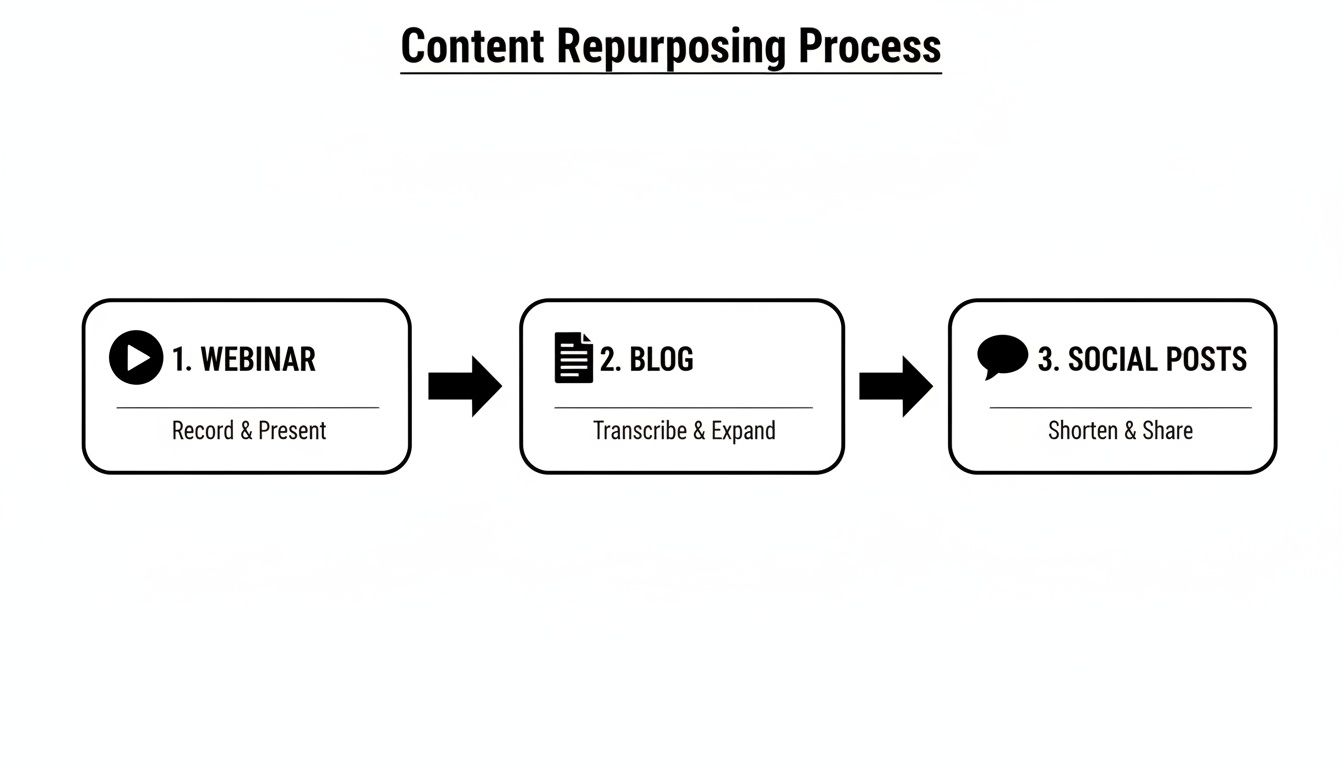
As you can see, a single high-effort asset can become the source for a ton of smaller, channel-specific pieces of content, saving you a massive amount of time.
Phase 3: Post-Launch Amplification and Analysis
The job isn’t done when the launch-day dust settles. The post-launch phase is all about sustaining momentum, extending the life of your content, and—most importantly—analyzing what actually worked so you can get better next time.
Key activities in this phase include:
- Ongoing Promotion: Don't just share it once. Keep sharing the content and its repurposed offshoots over the following days and weeks. Mix up the messaging and formats to keep it fresh.
- Performance Monitoring: Dig into the data. Track your key metrics for every channel. Which sources sent the most traffic? Where did you see the highest engagement?
- Optimization: Take what you learned and feed it back into your process. Use the data to tweak and refine your workflow for the next campaign.
By turning your distribution efforts into a clear, three-phase system, you build a powerful and repeatable engine for growth. To see how this fits into a larger operational picture, check out our guide on The Content Marketing Operations Maturity Model.
Measuring Your Distribution Success Like a CEO
Throwing content out into the world without measuring what happens next is like flying a plane without any instruments. Sure, you feel the engine running and you're definitely moving, but are you actually heading toward your destination? To get buy-in and prove your content distribution strategy is working, you have to speak the language of business outcomes.
It's easy to get caught up in likes, shares, and retweets. We call these vanity metrics because they feel good, but they don't really tell the whole story. Your CEO doesn't care about a viral tweet; they care about how your work impacts the bottom line. This means we have to connect the dots from our content all the way to revenue.
Moving Beyond Vanity Metrics
For a SaaS company, true measurement is about tracking the key performance indicators (KPIs) that show how your content is actually creating opportunities. It’s time to stop just counting views and start following the customer's journey, from the first time they read your blog post to the moment they sign a contract.
This shift requires a more disciplined approach to analytics. We're valuing the quality of engagement over the sheer quantity of it. Think about it: what's more valuable? Knowing 10,000 people saw your LinkedIn post, or knowing that five of those people were so impressed they immediately requested a demo?
Measuring success like a CEO means connecting every piece of distributed content to a potential dollar value. The ultimate goal is to prove that your content isn't just a cost center—it's a revenue generator.
The KPIs That Actually Matter for SaaS
To build a measurement framework that your leadership team will actually care about, you need to zero in on metrics that map directly to the sales funnel. These are the numbers that prove your distribution efforts are building a healthy pipeline.
Start tracking these KPIs for every channel you use:
- Marketing Qualified Leads (MQLs): Of all the leads your content generates, how many are actually a good fit and ready for a sales conversation? For instance, track how many downloads of your latest ebook came from a specific LinkedIn ad and match your ideal customer profile.
- Demo Requests from Content: This is a huge signal of intent. When you can trace a demo request directly back to a particular blog post or webinar, you've found a direct line from a piece of content to a potential sale.
- Content-Influenced Pipeline: Using attribution tools, you can see exactly how many open sales opportunities have interacted with your content. You might be surprised to find that one of your key blog posts was the very first touchpoint for 30% of your current pipeline.
- Cost Per Acquisition (CPA) by Channel: For any paid distribution, you need to know exactly what it costs to land a new customer. This data tells you where to put your money, helping you double down on the most efficient platforms.
When you adopt this data-first mindset, your content distribution stops being a guessing game and starts becoming a predictable engine for growth. You won't just be able to prove your content’s ROI—you’ll gain the insights you need to get smarter with every campaign.
Your Questions, Answered
Even the most well-laid plans hit a few bumps. To help you navigate them, I've gathered answers to some of the most common questions that pop up when SaaS marketers and founders start putting their content distribution strategies into action.
Think of this as a quick-reference guide to reinforce the core ideas we've covered.
I'm Working with a Tight Budget. Where Do I Start?
When you're strapped for cash, your owned media channels are your best friends. Start there. Pour your resources into building out your blog with genuinely helpful, SEO-focused articles and growing your email list. These are long-term assets that pay dividends over time without a hefty ad spend.
Once you have a solid foundation on your owned channels, pick just one earned tactic and one low-cost paid channel to experiment with.
- Earned Tactic: Focus on building real relationships for guest posts or getting mentioned by industry peers. It costs you time, not money, and the payoff is high-credibility traffic and backlinks.
- Paid Tactic: Take a small budget and dip your toes into LinkedIn Ads. You can get incredibly specific with targeting, putting your best-performing content in front of the exact right people without breaking the bank.
What's the Real Role of Automation Tools in All This?
Think of modern tools as force multipliers, not replacements for strategic thinking. Their job is to handle the repetitive, time-sucking tasks so your team doesn't burn out.
For example, a social media scheduling tool lets you map out your entire promotional calendar weeks ahead of time. Some tools can even take a 30-minute webinar and automatically chop it into a dozen ready-to-post clips. That’s a massive time-saver.
The point of automation is to free up your team’s brainpower. Let the tools handle the ‘what gets posted when’ so your people can focus on the ‘why it matters’ and ‘how we can do it better’.
How Do I Change My Strategy for Different Content Formats?
You absolutely have to adapt your distribution to the format. A one-size-fits-all approach is a recipe for wasted effort. Every piece of content has a natural home where it's most likely to thrive.
Here’s a simple way to think about it:
- Blog Posts & Ebooks: These are your SEO powerhouses. Push them through your email newsletter and share them on professional networks like LinkedIn and X (formerly Twitter).
- Webinars & Videos: YouTube and LinkedIn are the primary homes for long-form video. Then, slice and dice them into short, punchy clips for Instagram Reels, TikTok, and YouTube Shorts.
- Case Studies: These are conversion assets. Feature them prominently on your website, arm your sales team with them, and send them in targeted email campaigns to prospects who are close to making a decision.
Matching the format to the channel just makes sense. It ensures your audience gets the content in a way that feels native and welcome on that platform.
At Mick-Mar Inc., we live and breathe this stuff. We build and run data-driven content distribution strategies that connect SaaS companies with the customers they need to grow. We create custom roadmaps that turn your content from a cost center into a predictable growth engine. Learn how we can become your strategic growth partner.