A solid content strategy is your roadmap. It’s what turns a simple list of blog post ideas into a predictable engine for growth. It's about clearly defining who you’re talking to, what you want to achieve, and how you'll measure whether you're actually getting there. For any B2B SaaS company, this high-level blueprint is what ensures every piece of content pulls its weight and contributes to real business results.
Building Your B2B SaaS Content Foundation
Let’s clear something up right away: a content plan is not the same as a content strategy. Think of the plan as your editorial calendar—the "what" and "when." The strategy, on the other hand, is the "why" and "how." It’s the connective tissue that links every article, webinar, and case study back to a specific business goal.
Without that strategic foundation, you're just making content for content's sake. You might get lucky and publish a few hits, but you won't build a reliable system for attracting the right customers or empowering your sales team. A smart strategy is what elevates your content from an expense line to a genuine revenue driver.
From Noise to Revenue
Having a documented strategy isn't just a nice-to-have anymore; it's a must-have for standing out. In fact, a 2024 report from the Content Marketing Institute revealed that 71% of the most successful B2B marketers have a documented content strategy. That's a huge clue: writing down your plan is directly linked to better results.
That data tells a clear story. Without a plan, even the best-written content just becomes more noise in an already crowded space.
The Core Strategic Process
When you strip it all down, the process is pretty straightforward. It’s a cycle of understanding your audience, planning your execution, and measuring what works.
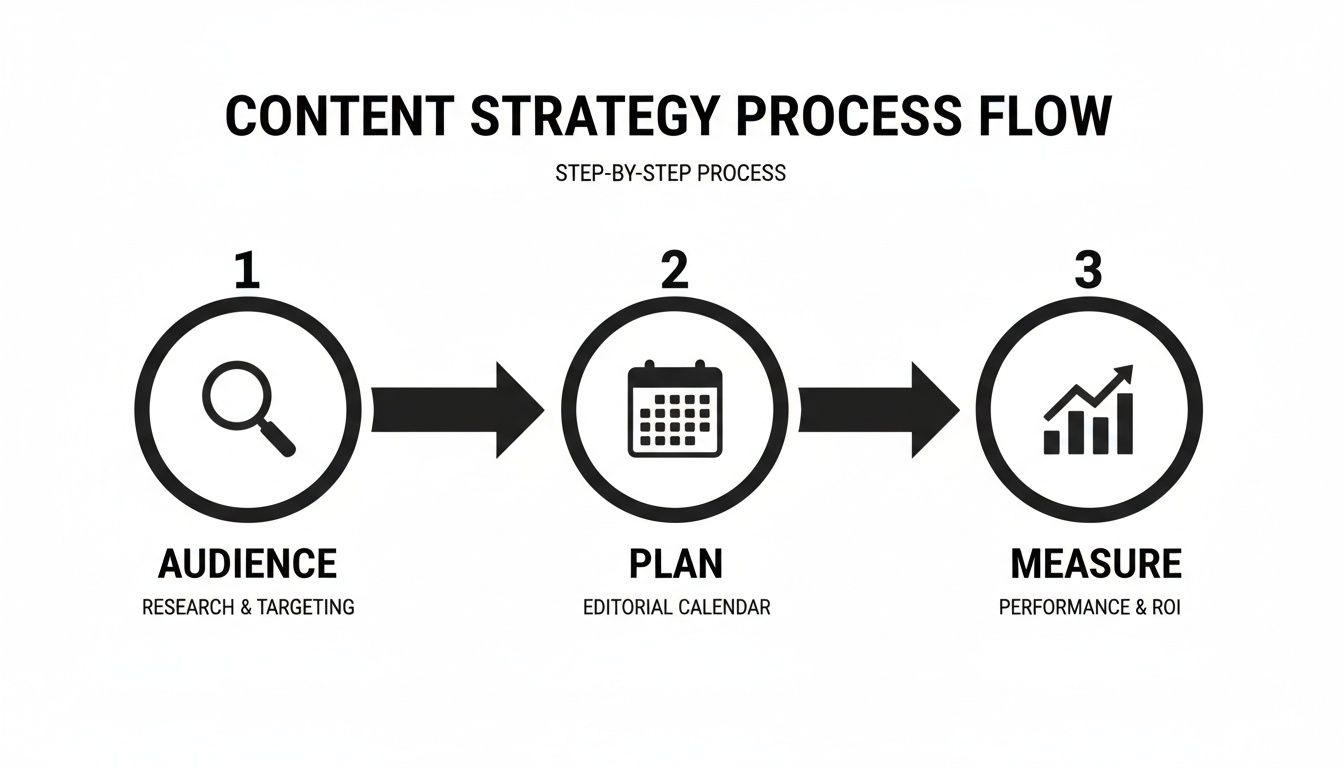
This isn't a one-and-done task. As the visual shows, it’s a continuous loop. The data you gather from measuring your results should constantly feed back into your audience research and future planning, making your strategy smarter over time.
To help you get started, here's a quick look at the essential pieces you'll need to put in place.
The Core Components of a Successful Content Strategy
| Component | What It Answers | Why It's Critical |
|---|---|---|
| Audience & Personas | "Who are we talking to?" | Defines the pain points, goals, and language of your target customer. |
| Goals & KPIs | "What are we trying to achieve?" | Connects content efforts directly to measurable business outcomes like leads or revenue. |
| Content Pillars | "What core topics will we own?" | Establishes your expertise and ensures your content stays focused and relevant. |
| Distribution & Channels | "Where will our audience find this?" | Ensures your content actually reaches the right people on the right platforms. |
| Measurement & SEO | "How do we know if it's working?" | Provides the data needed to prove ROI and optimize future content. |
Getting these pillars right is the first step toward building a content program that truly performs. For a broader perspective, this modern social media and content strategy guide offers a solid primer, and you can also explore how content marketing and strategic communications intersect to build a stronger brand.
Who Are You Talking To? And Why?
The best content feels like a one-on-one conversation, not a broadcast to a faceless crowd. Before you write a single word, you need to know exactly who you're talking to. That means getting laser-focused on your Ideal Customer Profile (ICP)—a living, breathing picture of the person your product was built to help.
Don’t settle for vague descriptions like "marketing managers at mid-sized tech companies." That’s not a person; it's a job title. A real ICP gets into the nitty-gritty of their world. What are their biggest headaches at work? What internal battles are they fighting? What does a "win" look like for them? Answering these questions is how you turn generic content into something that truly connects.

Uncovering Customer Truths
So where do you find these deep insights? Hint: it’s not by guessing from your desk. You have to become a bit of a detective inside your own company. The clues are everywhere once you start looking.
Your best intel comes directly from the people who are already talking to your customers.
- Chat with your sales team. They’re in the trenches every day, hearing the raw objections, answering the tough questions, and learning what really pushes someone to make a decision.
- Dig through support tickets. Look for patterns. What are the common points of confusion or frustration? These are goldmines for content ideas just waiting to be explored.
- Actually interview your customers. There's simply no replacement for a real conversation. Ask open-ended questions about their challenges and goals. You'll be amazed at what you learn.
Doing this homework grounds your personas in reality, not just assumptions. Once you understand the person behind the title, you can finally start creating content that helps them solve real problems.
Setting Goals That Actually Mean Something
With a clear picture of your audience, the next piece of the puzzle is defining what you’re trying to achieve for the business. It’s easy to fall into the trap of setting fuzzy goals like "get more leads" or "increase brand awareness." But those are wishes, not strategies.
This is where the SMART framework is your best friend. It’s a simple but powerful way to turn vague ambitions into concrete, actionable targets.
A SMART goal is Specific, Measurable, Achievable, Relevant, and Time-bound. It’s the difference between saying "We want more traffic" and "We will increase organic blog traffic by 15% in Q3 by targeting X keywords."
This shift in mindset is crucial. It connects every piece of content back to a tangible business outcome, which makes it infinitely easier to prove your value later on. A solid goal might sound like, "Increase demo requests from organic search by 20% in the next six months" or "Achieve a 44% webinar attendee-to-MQL conversion rate this quarter."
The numbers back this up. For B2B SaaS companies, content marketing is a powerhouse, costing 62% less than old-school advertising while bringing in 3 times more leads. It's no wonder that 73% of B2B marketers have made it a core part of their strategy. As you can read more about on ai-bees.io, B2B content marketing truly drives business growth.
By marrying a deep understanding of your customer with precise, measurable goals, you lay the critical foundation for your entire content strategy. Get this right, and you ensure that everything you create not only resonates with your audience but also directly fuels your company's growth.
Developing Your Content Pillars and Messaging
Alright, you’ve got a crystal-clear picture of who you're talking to and what you want to achieve. Now for the fun part: deciding what you’ll actually talk about. This is where we bridge the gap between high-level strategy and the nitty-gritty of content creation. The goal here isn't to be a jack-of-all-trades; it's to become the go-to expert on a few select topics that truly matter.
This is where your content pillars come in. Think of these as the 3-5 core subjects your brand is going to own, period. These are the big-picture topics that sit right at the intersection of what your audience is desperate to solve and where your product is uniquely brilliant. When someone in your niche thinks about "project management for remote teams," your company should be the first name that pops into their head. That's the real power of a well-defined pillar.
Brainstorming Your Core Topics
Finding your pillars isn’t a guessing game. It’s a deliberate, strategic exercise that connects your audience's biggest headaches with your company’s core strengths. You're looking for that sweet spot where their problems meet your expertise.
A simple way to start is to map this out. Grab a whiteboard or open a doc and create two columns:
- Audience Pain Points: List the top challenges, frustrations, and burning questions your ICP wrestles with every day. Pull these straight from sales call recordings, support tickets, and those customer interviews you just did.
- Your Unique Expertise: Now, list where your product, service, or team truly shines. What problems do you solve better than anyone else on the market? What unique data, perspective, or methodology can you bring to the table?
The magic happens in the overlap. If your SaaS tool helps with financial forecasting, a major pain point is "budgeting uncertainty." Your expertise is "data-driven financial modeling." Boom—a natural content pillar emerges: "SaaS Financial Strategy."
By focusing your efforts on a few core pillars, you build a concentrated library of content that establishes deep authority. This focus is what turns casual readers into loyal followers and, eventually, customers.
To make this even more practical, here’s a framework you can use to brainstorm and validate your pillar ideas. It forces you to connect each potential topic directly to an audience need and your business's strengths.
Content Pillar Ideation Framework
| Pillar Idea | Audience Pain Point Addressed | Your Unique Expertise | Primary Content Formats |
|---|---|---|---|
| Example: SaaS Financial Strategy | Uncertainty in budgeting, difficulty forecasting revenue, pressure to prove ROI to investors. | Our platform's predictive modeling, proprietary data on industry benchmarks, in-house finance experts. | In-depth guides, webinar series, downloadable templates, data-driven reports. |
| Example: Remote Team Productivity | Inefficient workflows, communication breakdowns, trouble tracking project progress across time zones. | Our tool’s asynchronous collaboration features, integrations with popular remote work stacks. | How-to articles, video tutorials, case studies, best-practice checklists. |
| Example: Customer Retention Automation | High churn rates, inability to scale personalized communication, lack of insight into user behavior. | Our powerful segmentation engine, proven automated workflows, unique data on engagement triggers. | Playbooks, expert interviews, success stories, step-by-step implementation guides. |
This simple exercise ensures your content pillars aren't just topics you want to talk about, but topics that will genuinely resonate and position you as an indispensable resource.
Building a Cohesive Messaging Framework
Once your pillars are locked in, the next crucial step is to get everyone singing from the same hymn sheet. Your marketing team, your sales reps, even any AI writing assistant you use—they all need to speak the same language. This is where a core messaging framework becomes your best friend. Think of it as the single source of truth for your brand’s personality, voice, and core promises.
This framework is non-negotiable for maintaining consistency. Without it, your brand voice fractures, your message gets diluted, and you start confusing the very people you’re trying to attract. It's a surprisingly common pitfall, especially as more people and tools get involved in creating content.
Research from 2023 by Orbit Media backs this up, showing that brands with strong, consistent messaging are valued up to 20% more than those without it. Consistency doesn't just look professional; it builds the kind of trust that directly impacts your bottom line. With so many teams and tools, including AI, now contributing to content, a clear messaging framework is the only thing standing between you and brand chaos.
Your messaging framework doesn't need to be a 50-page novel, but it absolutely must define:
- Tone of Voice: Are you authoritative and data-driven? Or are you more friendly, witty, and conversational?
- Key Value Propositions: What are the three core benefits customers get from you? Spell them out clearly.
- Boilerplate Statements: How do you describe your company in one sentence? In a short paragraph? Get these locked down.
Document this, share it widely, and make it part of your onboarding. It’s the simple-but-powerful tool that ensures every blog post, social update, and case study feels like it came from the same smart, trusted brand—the kind of consistency that builds real market trust.
Mapping Your Content Distribution Channels
Let’s be honest. Creating brilliant content is only half the job. If your ideal customer never sees it, all that hard work might as well not exist. This is where a smart, intentional distribution plan comes into play—it’s the engine that gets your message in front of the right people, on the platforms they already use and trust.
Without a solid distribution strategy, you're basically publishing content into a void and crossing your fingers. A proactive approach, however, turns every article, report, and video into a targeted tool for reaching potential customers. People spend nearly seven hours online every day, so meeting them where they are isn't just an option; it's essential.

The PESO Model A Modern Framework
To build a plan that actually works, it helps to think about your channels systematically. The PESO model is a fantastic framework for this, breaking down your options into four clear categories.
- Paid: This is any channel where you pay to play—think LinkedIn Ads, Google Ads, or sponsored content in industry newsletters. It’s perfect for guaranteeing reach and getting hyper-specific with your targeting.
- Earned: Consider this your digital PR. It’s the coverage you earn through merit, like getting featured in a trade publication, being a guest on a popular podcast, or having your original research cited by another company.
- Shared: This is your social media home turf. Platforms like LinkedIn and X (formerly Twitter) are where you engage with your community, share your content, and jump into relevant industry conversations.
- Owned: These are the platforms you control completely. Your company blog, your email newsletter, and your website are your most powerful assets because you own the audience and the rules of engagement.
The most effective distribution strategies don’t just pick one; they blend all four. You might use paid ads to promote a major report (owned), which then gets picked up by an industry blog (earned), and is then discussed by your team on LinkedIn (shared). This creates a powerful echo effect that amplifies your message.
Prioritizing Channels for B2B SaaS
For most B2B SaaS companies, some channels just plain work better than others. While the right mix always depends on your specific audience, a great starting point is to double down on your owned and shared platforms first.
Your company blog and email list are your crown jewels. These are your direct lines of communication with your most engaged prospects and customers. Honestly, every piece of content you create should, in some way, aim to grow these two assets.
Next, pick a primary social channel where your ideal customers actually spend their time. For the vast majority of B2B SaaS, that platform is LinkedIn. It's unmatched for both organic engagement with decision-makers and highly targeted paid campaigns. For a much deeper look, check out our guide on building a B2B social media strategy that drives real growth.
The goal isn't to be everywhere. It's to be everywhere that matters to your ideal customer. Focus on mastering one or two key channels before spreading yourself too thin.
Finally, layer in earned media by strategically pitching guest posts to key industry publications. This builds high-authority backlinks (which is gold for SEO) and lets you borrow credibility from established voices in your space.
The Power of Content Repurposing
Here's the secret to getting the most mileage out of your content: stop thinking in terms of one-off pieces. Instead, see every major asset as the center of a content galaxy. This is content repurposing, and it’s a total game-changer for efficiency and impact.
Imagine you invest a ton of time and resources into creating a comprehensive data report—your "pillar" asset. A smart repurposing plan can atomize that single report into dozens of smaller pieces, each perfectly tailored for a different channel.
Here’s what that could look like in practice:
- The Pillar: A 2,000-word data report on "The State of Remote Work in Tech."
- Blog Posts: Turn each key section of the report into a standalone, SEO-optimized blog post (e.g., "5 Tools Every Hybrid Team Needs in 2024").
- Infographic: Visualize the most compelling stats from the report into a sharp, shareable graphic for your blog and social media.
- LinkedIn Carousel: Create a slick, slide-deck-style carousel highlighting the top 3-5 takeaways from the report.
- Webinar: Host a live presentation where your in-house expert walks through the report's findings and hosts a Q&A.
- Email Mini-Course: Break down the report's advice into a 5-day automated email sequence for new subscribers.
- Short-Form Video: Film a few quick, punchy videos for social, with each one focusing on a single surprising statistic.
This system ensures your core message reaches different people in the format they prefer. It maximizes the return on your initial content investment and keeps your distribution calendar full of valuable material without constantly having to reinvent the wheel. By building strategic distribution and repurposing into your content strategy from the start, you create a sustainable system for reaching the right people, consistently.
Building Your Editorial Calendar and Workflow
Your strategy is now a solid blueprint, but a blueprint doesn't build the house. This is where the rubber meets the road—where you translate those big ideas about pillars, personas, and channels into a real, actionable plan. It's time to build the operational backbone that turns your strategy into a consistent, high-performing content engine.
This all starts with an editorial calendar. Think of it less as a simple spreadsheet with dates and more as your command center for the entire content pipeline. A well-structured calendar becomes the single source of truth for your team, ensuring everyone knows what’s being created, for whom, and by when. It’s what ends the last-minute scramble for topics and brings a calm, predictable order to your content creation.
Designing Your Calendar for Success
A great editorial calendar should be more than a to-do list. To make it a truly strategic tool, it needs to track several key data points for every single piece of content you plan to create. It's essentially the briefing document for each asset.
For most B2B and SaaS teams, a practical calendar should include fields for:
- Topic/Title: The working title or main idea of the piece.
- Content Pillar: Which of your core strategic pillars does this content support?
- Target Keyword: The primary SEO keyword you're aiming to rank for.
- Format: Is it a blog post, a case study, a webinar, or a video?
- Author/Creator: Who owns producing the content?
- Key Deadlines: Don't just list the publish date. Include milestones for the first draft and final edit.
- Distribution Checklist: A quick list of channels (LinkedIn, email, etc.) where the piece will be promoted after it goes live.
This level of detail transforms your calendar from a mere schedule into a powerful project management tool. It keeps the team aligned and makes sure every piece of content is created with a clear purpose and plan. If you're starting from scratch, learning how to create a content calendar with a focus on this kind of strategic planning is a fantastic first step.
Establishing a Clear Content Workflow
Beyond the calendar, you need a defined process for how content moves from an idea to a published asset. This is your content workflow, and it's absolutely essential for maintaining quality and consistency, especially as your team grows or you start working with freelancers. A chaotic workflow is where deadlines get missed and quality standards slip.
Your workflow is the operational process that ensures every piece of content meets your standards before it goes live. It’s your quality control system, defining who does what and when.
This process doesn't need to be some overly complicated, 50-step monster. In fact, a simple, documented workflow that everyone understands is far more effective than an intricate system that no one actually follows.
Defining Roles and Responsibilities
A clear workflow starts with clear roles. Even if you're a team of one, thinking through these roles helps structure your time. In a larger team, it's non-negotiable.
- Writer/Creator: Responsible for the initial research, drafting, and creation of the content.
- Editor: Reviews the piece for clarity, accuracy, tone of voice, and adherence to brand style guidelines.
- Approver: This is often a marketing manager or subject matter expert who gives the final green light.
- Publisher: The person who loads the content into the CMS, optimizes it for SEO, and hits "publish."
Documenting these roles removes ambiguity and prevents those frustrating bottlenecks. For a deeper dive into structuring these operations, our guide on the Content Marketing Operations Maturity Model offers a roadmap from reactive to fully optimized workflows. Ultimately, this operational backbone is what allows your content engine to run efficiently and scale over time.
Measuring Your Content's ROI and Tweaking the Plan
Your content strategy isn't something you set in stone and walk away from. It's a living, breathing part of your marketing engine. The real magic happens when you build a feedback loop fueled by data—this is how you stop guessing and start making smart, informed decisions that actually grow the business.
Think of every blog post, webinar, and case study you publish as a mini-experiment. You have a hypothesis about what your audience wants and what will nudge them to take the next step. The data you gather is the result, telling you exactly what hit the mark, what flopped, and where you should be putting your money and effort next.

Ditching Vanity Metrics for What Actually Matters
It’s easy to get caught up in things like social media likes and overall page views. They look good on a chart, but they don't pay the bills. For B2B and SaaS, your Key Performance Indicators (KPIs) need to be tied directly to revenue. I find it helps to map them to the customer journey.
- Top-of-Funnel (Awareness): Are we reaching the right people? Here, I’m watching organic traffic, keyword rankings for our money terms, and the number of new users hitting the blog.
- Mid-Funnel (Consideration): Is our content building trust and generating leads? The key metrics here are newsletter sign-ups, downloads of gated content like ebooks, and webinar registrations.
- Bottom-of-Funnel (Decision): Is this stuff actually making us money? This is where the rubber meets the road. We track demo requests, content-influenced pipeline (how many deals did our content touch?), and the holy grail: customer acquisition cost (CAC).
To really see the full picture, you have to connect the dots between your CMS, your analytics platform (like Google Analytics 4), and your CRM. This is the setup that lets you trace a new customer all the way back to the specific blog post they read six months ago.
Building Your Content Performance Dashboard
You don’t need a fancy, expensive BI tool right out of the gate. A simple dashboard in Google Looker Studio or even a well-structured spreadsheet can give you all the clarity you need to start. Pull in your core KPIs from each stage of the funnel and make it a habit to review them weekly or bi-weekly.
The goal is to spot patterns. Maybe you'll notice one content pillar is driving way more demo requests than the others. Or perhaps case studies are converting readers into qualified leads at a much higher rate than your how-to articles. That's the gold you're digging for.
Your dashboard isn't just for showing off to the C-suite. It's a tactical tool for your team. It should instantly answer the question, "Is what we're doing actually working?"
The Quarterly Content Audit and Refresh Routine
Your content library is a business asset, and like any asset, it needs regular maintenance to keep its value. I’m a huge believer in the quarterly content audit. It’s a powerful routine for making sure every single piece of content is pulling its weight.
Here’s a simple way to approach it:
- Find Your Heavy Hitters: Pinpoint the top 10-20% of your content that drives the most traffic, leads, or pipeline. These are your all-stars. Look for common threads—what topics, formats, or styles do they share?
- Spot the "Almost Famous" Pieces: Dig for articles that are hovering on page two or three of Google for valuable keywords. These are low-hanging fruit. A simple "content refresh"—updating stats, adding new sections, and beefing up the on-page SEO—can often give them the push they need to hit page one.
- Prune the Dead Wood: Let's be honest, some content just isn't going to work. If a post is getting zero traffic, isn't strategically important, and has no backlinks, it might be time to say goodbye. Pruning it and redirecting the URL to a more relevant page can actually improve your site's overall health.
This cycle of measuring, analyzing, and refreshing turns your content program from a series of one-off projects into a dynamic, ever-improving system. It's how you build a content engine that delivers predictable, measurable results time and time again.
Frequently Asked Questions
How Often Should I Update My Content Strategy?
Your content strategy shouldn't be a "set it and forget it" document. Think of it as a living, breathing part of your marketing efforts.
We recommend doing a full, deep-dive strategic review annually. This is where you'll realign everything with your company's new business goals for the year ahead. But don't wait a whole year to check in. It’s smart to conduct a lighter performance review and content audit quarterly. This gives you a chance to react to market changes, double down on what’s working, and pivot away from what isn’t.
What's the Difference Between a Content Strategy and a Content Plan?
This is a fantastic question and a common point of confusion. The two are related, but they serve very different purposes.
A content strategy is your high-level "why." It's the foundation that answers the big questions: Who are we talking to? What are our goals? What are our core messaging pillars? How will we measure success?
The content plan, on the other hand, is the tactical "what," "when," and "where." This is usually your editorial calendar, which maps out the specific topics, formats, and publishing schedules.
Here's a simple way to think about it: The strategy is the blueprint for building a house. The plan is the day-to-day construction schedule. You absolutely need both to build something that lasts.
How Much Should I Spend on Content Marketing?
If only there were a magic number! The right budget really depends on your specific goals, the competitiveness of your industry, and your company’s size.
As a general benchmark, many B2B companies allocate somewhere between 5% and 15% of their total marketing budget to content marketing. If you're just starting out, my advice is to begin with a budget you can sustain consistently. Focus on proving the ROI with solid, clear metrics. Once you show that it's working, it becomes much easier to make the case for scaling that investment.
Ready to build a content strategy that drives real business growth? At Mick-Mar Inc., we specialize in creating data-driven marketing roadmaps for B2B SaaS companies. Let's turn your content into your most powerful asset. Start your journey with us today.