A solid marketing roadmap template is more than just a document—it's your strategic command center. Think of it as the tool that takes your big, ambitious goals (like hitting a new MRR target) and breaks them down into a clear, actionable plan. Essentially, it’s the bridge between your grand vision and the day-to-day work required to win in the fast-paced SaaS world.
Why Your SaaS Needs a Marketing Roadmap
Let's be honest: SaaS marketing can feel like a whirlwind. One minute you're deep in planning a new feature launch, and the next you're scrambling to adjust your strategy because of a sudden shift in the market or a competitor's big move. Without a guiding plan, it’s all too easy to get stuck in a cycle of reactive, "fire-fighting" tasks, completely losing sight of your core business goals.
This is where a marketing roadmap becomes your most valuable asset. Don't think of it as a rigid, set-in-stone schedule. Instead, see it as your strategic compass. It acts as the single source of truth that gets everyone—from product and sales to the C-suite—on the same page about the what, why, and when of every marketing effort.
From Chaos to Clarity
A well-crafted roadmap brings a welcome sense of order to the natural chaos of marketing. It forces you to connect every single activity, whether it's a simple blog post or a massive paid campaign, back to a specific, measurable objective.
This kind of disciplined approach pays off in a few key ways:
- Better Stakeholder Alignment: Everyone from engineering to sales can see the marketing priorities and understand how their own work fits into the bigger picture. This dramatically cuts down on inter-departmental friction.
- Smarter Resource Management: By mapping everything out, you get a clear visual on team bandwidth, budget allocation, and tech stack needs. This helps prevent burnout and ensures you’re putting your money and time where they'll have the most impact.
- Greater Focus and Agility: When a shiny new opportunity or an unexpected challenge pops up, the roadmap gives you the context to decide intelligently whether to pivot or stick to the plan.
The Power of a Unified Strategy
A 2023 report by Gartner highlights that marketing leaders are increasingly focused on improving operational efficiency and proving their impact on revenue. A roadmap is a key tool for this, as it visualizes how marketing initiatives directly support broader business objectives. The same report found that marketers who could clearly demonstrate their value were more likely to secure and retain their budgets.
Of course, a roadmap is only as good as the strategy it’s built on. For it to be truly effective, it needs to be grounded in a strong product marketing strategy. This foundational work ensures your roadmap isn't just a to-do list, but a coherent plan designed to carve out market share and drive real revenue.
Here’s a quick look at the essential parts of a roadmap we’ll build together, giving you a high-level overview before we dive into the details.
| Core Elements of a Winning SaaS Marketing Roadmap |
| :— | :— |
| Component | Its Role in Driving SaaS Growth |
| Business Goals & KPIs | Aligns all marketing efforts with top-level objectives like MRR, LTV, or churn reduction. |
| Buyer Journey Stages | Maps initiatives to specific customer phases (Awareness, Consideration, Decision) for targeted impact. |
| Initiatives & Campaigns | Details the specific projects, from content creation to paid ads, that will achieve the goals. |
| Timeline & Milestones | Provides a clear schedule, sets deadlines, and tracks progress against key checkpoints. |
| Resource Allocation | Assigns team members, budget, and tools to each initiative, ensuring feasibility. |
| Stakeholder Alignment | Clearly defines roles and responsibilities, keeping all departments in sync. |
Each of these components plays a crucial role in transforming your marketing from a series of disconnected tasks into a cohesive growth engine.
A great roadmap doesn’t just schedule activities; it tells a compelling story about how marketing will achieve business goals. It connects the dots between a single tweet and the quarterly revenue target, giving every action a clear and powerful purpose.
In this guide, we'll walk you through how to build a flexible, customizable marketing roadmap template designed for the unique challenges of SaaS. It’s the tool you need to finally close the gap between brilliant strategy and flawless execution.
Laying Your Strategic Foundation First
Alright, let's talk about a common pitfall. A team gets excited about a new marketing roadmap template, dives right in, and starts plugging in tactics. It feels productive, but it's really just building a house on a foundation of sand. A template is a tool, not a strategy. Before you even touch that spreadsheet, you have to get your "why" straight.
This foundational work is what separates a roadmap that actually drives growth from a glorified to-do list. It’s how you ensure every blog post, every ad campaign, and every dollar you spend is pulling in the same direction—directly toward your company's most important goals.
Connecting Marketing Objectives to Business Goals
Your marketing goals can't live on an island. If you're chasing vanity metrics like social media likes while the business is trying to reduce churn, you won't be seen as a strategic partner. You have to translate the C-suite's ambitions into real-world marketing outcomes.
It’s a simple translation exercise:
- If the business wants to cut customer churn by 15%… your marketing team could aim to boost user engagement through a better email onboarding series or create in-app guides for sticky features.
- If the goal is to add $2M in Annual Recurring Revenue (ARR)… a concrete marketing objective might be to generate 500 new MQLs from your enterprise segment every quarter.
- If the company needs to improve trial-to-paid conversion rates… marketing can focus on creating powerful case studies and product comparison pages that demolish late-stage buyer objections.
Drawing this clear, direct line from your activities to business impact is how you get buy-in and prove your team’s value. It’s that simple.
Conducting a SaaS-Specific SWOT Analysis
A SWOT analysis is a classic for a reason, but for SaaS, you have to go deeper than the generic stuff. Don't just list "strong brand" as a strength. That's not specific enough. Get to the heart of your business model.
A SaaS-specific strength is something like "high user stickiness due to deep workflow integrations." That's something you can build a strategy around. A real threat isn't just "new competitors," it's "a competitor launching a freemium model that could devalue our entry-level tier." See the difference? One is a vague worry; the other is an actionable threat you can plan for.
Part of this process absolutely must involve conducting SEO competitor analysis. Understanding where they're winning (and failing) online helps you pinpoint gaps in the market and sharpen your own unique value proposition.
Pro Tip: Don't let your SWOT analysis gather dust. The SaaS world moves way too fast for an annual review. I tell my clients to revisit it quarterly. This keeps your roadmap agile and prevents you from getting blindsided by market shifts.
Defining Your Ideal Customer Profile and Their Journey
You can't build a roadmap to a destination you haven't defined. If you don't know exactly who you're marketing to, you're just shouting into the void. Nailing down your Ideal Customer Profile (ICP) is one of the most important things you can do.
This means going way beyond basic demographics. You need to know their firmographics (company size, industry), their technographics (what’s in their tech stack?), and their psychographics (what are their real-world goals, pains, and buying triggers?).
Once you've got a sharp picture of your ICP, you have to map their entire journey. What are they thinking and doing at each stage?
- Awareness: How do they first realize they have a problem? Are they Googling "how to solve X," asking for recommendations in a Slack community, or seeing a thought leader's post on LinkedIn?
- Consideration: When they're comparing you to others, what do they need? Detailed feature checklists? Transparent pricing? Social proof from companies they trust?
- Decision: What’s the final nudge that gets them to sign up or book a demo? Is it a killer case study, a frictionless trial experience, or an ironclad security promise?
Mapping this journey is the final piece of the puzzle. It allows you to align every initiative in your roadmap to what your ideal customer needs, right when they need it. This kind of thoughtful preparation is the core of any successful B2B SaaS marketing strategy, and it’s what will turn your template into a genuine engine for growth.
Making the Roadmap Template Your Own
Alright, this is where the magic happens. A blank template is a great starting point, but its real value comes alive when you mold it to fit the unique DNA of your SaaS business. We're moving past the theory and into the practical, transforming a generic framework into a strategic command center that actually works for your team.
Forget about forcing a one-size-fits-all approach. The structure of your roadmap should feel natural, not like some rigid system you have to fight against. The first big decision is your timeline. Are you an agile crew that thrives on quarterly sprints and quick pivots? Or does your business run on a more traditional annual planning cycle? There’s no right answer here, just what’s right for your company.
Nailing this first step sets the stage for a roadmap that's genuinely useful.
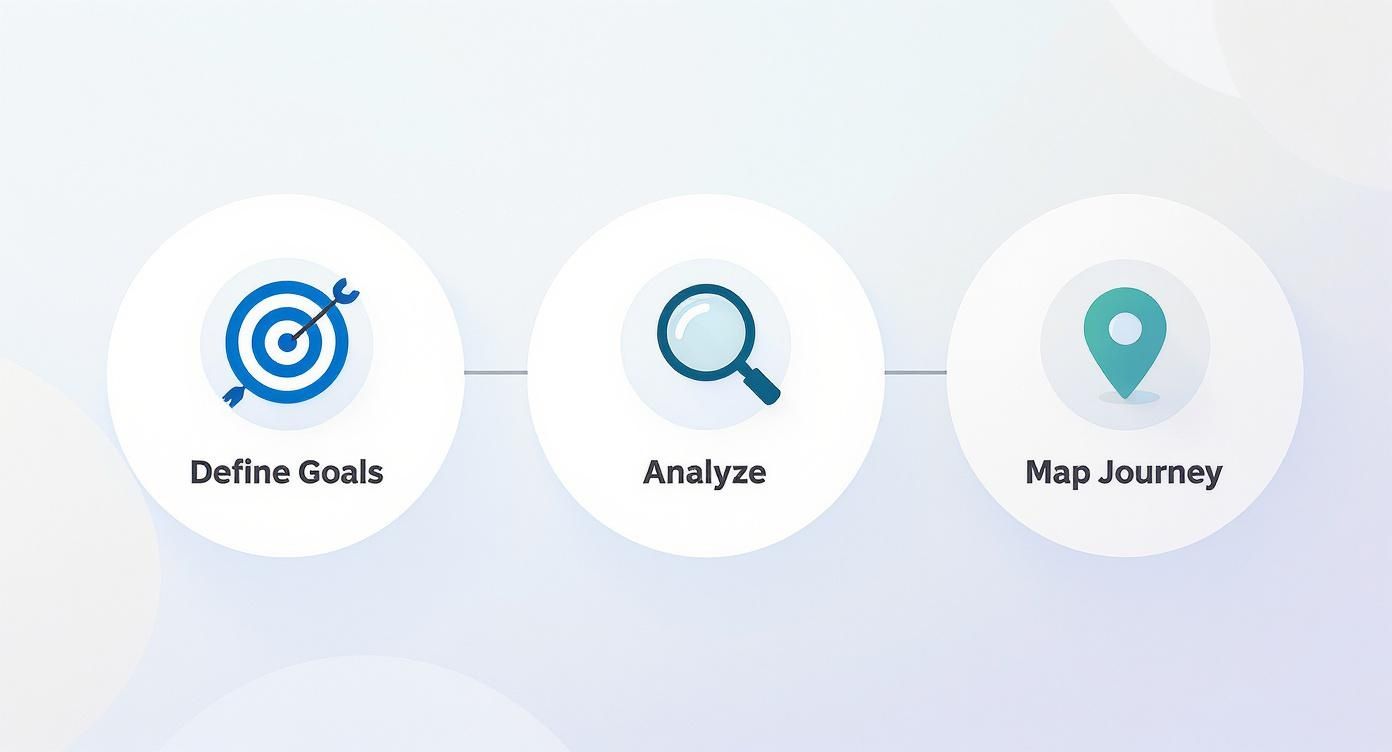
This graphic really breaks down the core thinking you need before you even start filling in the template. First, define your goals. Then, analyze where you stand. Finally, map out the customer's journey. Following this flow ensures every single thing you add to your roadmap has a clear, strategic purpose.
Using Swimlanes to Organize Your Initiatives
One of the most powerful features you’ll find in modern roadmap tools is swimlanes. Think of them as horizontal rows that group your marketing initiatives. It's a simple visual trick that can completely transform a jumbled mess of tasks into a coherent, easy-to-read strategy.
You can slice and dice your swimlanes a few different ways, depending on what makes the most sense for your team:
- By Team: This is a classic. Create lanes for Content, Performance Marketing, Product Marketing, and so on. It’s perfect for clarifying ownership and seeing who’s responsible for what at a quick glance.
- By Funnel Stage: Try structuring your roadmap with lanes for Awareness, Activation, Retention, and Advocacy. This approach forces you to think holistically about the entire customer lifecycle, making sure no critical stage gets ignored.
- By Strategic Goal: If you’re rallied around a few big company objectives, why not make those your swimlanes? Think "Increase Enterprise MQLs" or "Reduce Customer Churn." This keeps every activity laser-focused on moving the needle where it counts.
For instance, say you’re mapping out a big product-led growth (PLG) push for Q3. Your "Activation" swimlane might house initiatives like "Launch In-App Onboarding Guides" and "A/B Test Trial Email Nurture Sequence." The KPI tied directly to this work could be a 15% increase in your trial-to-paid conversion rate. Suddenly, every task is explicitly linked to a business outcome.
Getting Specific with Campaigns and KPIs
Vague entries like "Run social media ads" just won't fly. A truly effective roadmap demands specificity. You should treat each initiative like a mini-project plan, complete with its own objective and a measurable result.
Let’s walk through a real-world SaaS example. Instead of a lazy "Create content" task, a properly defined initiative looks more like this:
- Initiative: Develop "Ultimate Guide to Cybersecurity Compliance for SMBs" Pillar Page
- Team Swimlane: Content Marketing
- Timeline: August 1 – September 15
- KPIs: Generate 200 new MQLs in Q4; Rank in the top 5 for 3 target keywords.
- Dependencies: Needs technical accuracy review from the Product Marketing team.
See the difference? This level of detail removes all ambiguity and turns your roadmap into a genuine plan of action. It's especially important for bigger, strategic assets. If you want to go deeper on this, our guide on content marketing for SaaS companies has tons of detail on building these high-impact campaigns.
A roadmap isn't just about scheduling what you'll do; it's about defining what success looks like for every single thing you do. If an initiative doesn't have a clear KPI tied to a business goal, it doesn't belong on your roadmap.
This need for clarity and collaboration is why many teams are moving away from static spreadsheets. A 2023 survey found that marketing teams using dedicated, cloud-based roadmapping software reported a significant boost in cross-functional alignment compared to those using traditional methods. The ability to comment, update in real-time, and create custom views for different stakeholders is becoming a must-have, not a nice-to-have.
This collaborative spirit is everything. By tailoring your template with clear timelines, well-organized swimlanes, and hyper-specific KPIs, you create a living document that gets everyone on the same page, drives real accountability, and turns your marketing strategy into results the business can see.
How to Get Your Roadmap Approved and Funded
Let's be honest. A brilliant marketing roadmap is just a pretty document if it never leaves your hard drive. To bring it to life, you need buy-in and a budget. This is where your job shifts from being a planner to a champion for your strategy, and frankly, it's what separates good marketers from great ones.
Getting that green light isn’t about flashy presentations. It’s about learning to speak the language of each stakeholder. You have to draw a straight line from every marketing activity you’ve planned to the specific outcomes and metrics that they care about. Without that, your roadmap is just a wish list.
Speak Their Language: Tailor Your Pitch
Your CEO and your Head of Sales operate in different universes, even if their offices are next to each other. Dropping the same generic roadmap in front of both of them is a surefire way to get blank stares and a rejected budget. To get them on board, you have to frame your plan through their unique lens.
Imagine you're pitching a new webinar series. Here's how that conversation changes depending on who you're talking to:
- To the CEO: You’d say, "This webinar series is a scalable MQL-generation engine. Our projections show it will add $150k to the sales pipeline next quarter, and we can do it with a Customer Acquisition Cost 20% lower than our current paid channels."
- To the Head of Sales: The pitch becomes, "I'm about to hand your team a new source of high-intent leads. Every attendee is a warm prospect who just spent an hour with our experts. We'll even equip your BDRs with their specific engagement data so they can personalize every single follow-up."
- To the Product Team: You’d frame it as, "This series is a direct feedback channel to you. We'll use the audience Q&A and post-event surveys to gather real-world insights on feature demand and user pain points, and I'll send you a summary every week."
See what happened? The initiative is the same, but the value proposition is completely different for each person. This is how you turn skeptical colleagues into your biggest supporters.
Justifying the Resources You Need
Once everyone's aligned on the vision, the next conversation is always about resources—people, budget, and tools. Your roadmap is the perfect tool for this discussion because it visually connects investment to outcome. Never just ask for more money; show precisely what that money will achieve.
A common mistake marketers make is presenting a vague, top-level budget request. Instead, tie every single dollar to a specific initiative on your roadmap.
Your marketing roadmap is your business case. It says, 'If you give me X resources, I will deliver Y results.' When you frame it this way, you're not asking for money; you're presenting a strategic investment opportunity.
Let's say you need a new marketing automation platform. Don't talk about its features. Talk about the results it will unlock on your roadmap.
| Resource Request | Roadmap Initiative It Supports | Projected Business Impact |
|---|---|---|
| New Automation Platform | "Q3 Lead Nurturing Overhaul" | Increase our MQL-to-SQL conversion rate by 10%. |
| Hire a Content Manager | "Q4 Pillar Page SEO Strategy" | Drive 5,000 more organic visitors to the site per month. |
| $20k Ad Spend Increase | "Q2 Enterprise LinkedIn Campaign" | Generate 50 qualified demos for the enterprise sales team. |
This kind of structured approach shifts your request from a simple expense to a clear, ROI-driven plan. It proves you’ve thought through the what, the how, and the why. By making that crystal-clear connection between resources and revenue, you make it incredibly easy for leadership to say "yes," turning your well-crafted roadmap into a funded, company-wide mission for growth.
Tracking Performance and Evolving Your Roadmap
In the SaaS world, your marketing roadmap can't be a "set it and forget it" document. If you frame it and hang it on the wall, you've already lost. Think of it as a living guide—one that has to adapt to new data, market shifts, and customer feedback. This is how you turn a simple plan into a powerful growth engine.
Those KPIs you defined earlier? They're your compass now. They’re what you'll use to monitor progress, prove your team's impact to the C-suite, and make smart decisions about what to do next. A roadmap without a solid tracking system is just a collection of hopeful guesses.

Building Your Performance Dashboard
To get a real feel for what's working, you need a mix of metrics. A good dashboard keeps an eye on both leading indicators (the early signs of what's to come) and lagging indicators (the results that prove what you did worked).
- Leading Indicators: These are the metrics that give you a sneak peek into future performance. They’re the pulse of your marketing engine. For a SaaS business, this could be things like demo requests, new trial sign-ups, or website-to-lead conversion rates. If these numbers are trending up, it’s a good sign your top-of-funnel activities are hitting the mark.
- Lagging Indicators: These are the big-picture results. Think Customer Acquisition Cost (CAC), Monthly Recurring Revenue (MRR) from marketing efforts, and trial-to-paid conversion rates. They take longer to move, but they're the ultimate proof that your strategy is paying off.
You don't need a super-complex setup. A well-organized spreadsheet or a simple analytics tool can pull this all together, giving you a clear view of how you’re tracking against your roadmap goals.
The Quarterly Roadmap Review Framework
Data is worthless if you don’t act on it. That’s why a structured, regular review is non-negotiable for any serious marketing team. The quarterly review is your dedicated time to step back, look at the numbers, and make agile adjustments.
This meeting isn't for pointing fingers. It's a strategic huddle to answer a few critical questions:
- What went right? Where did we knock it out of the park this quarter? Did a specific webinar series crush its MQL target? Did our new onboarding emails actually move the needle on activation rates? Figure out why these things succeeded so you can do more of it.
- Where did we miss? Which initiatives fell short? This is a learning opportunity, not a time for blame. Was the messaging off? Did we target the wrong audience? Dig deep to find the real lesson.
- How do we pivot? Based on all this, what needs to change for the next quarter? This is where your roadmap evolves. It might mean doubling down on a winning channel, killing a campaign that’s not working, or shifting budget to a new opportunity you've uncovered.
This approach keeps your marketing sharp and ensures you’re always putting your resources where they’ll have the biggest impact.
Your roadmap is a hypothesis. The data you collect is the experiment. The quarterly review is where you analyze the results and form your next, smarter hypothesis. Treat it like a science, and you’ll consistently drive better outcomes.
Making Data-Driven Decisions a Reality
Weaving real-time analytics into your marketing roadmap template isn't a "nice-to-have" anymore; it's essential for staying competitive. The numbers back this up. According to a 2023 HubSpot report, marketers who consistently measure ROI are significantly more likely to receive higher budget allocations.
Furthermore, another recent study highlighted that companies that embrace data-driven marketing are more likely to have a competitive advantage and increase their profitability. This underscores the importance of a dynamic, data-informed roadmap that helps you hit your goals more consistently.
Ultimately, tracking performance is about more than just hitting numbers. It's about building a culture of continuous improvement. When you can clearly show how your team’s work moves the needle on key business metrics, you prove marketing’s value as a core revenue driver. For a deeper dive into connecting activities to financial outcomes, check out this guide on how to measure marketing ROI.
By embracing this cycle of planning, executing, measuring, and evolving, your roadmap becomes your most powerful tool for sustainable growth.
Got Questions About Your Roadmap? We've Got Answers
Even with a solid template, you're bound to hit a few bumps or have some questions pop up as you build out your marketing roadmap. That's completely normal. Think of this as your go-to FAQ for navigating those common sticking points that trip up even seasoned marketers.
Let's clear up some of the usual suspects.
How Often Should I Actually Update This Thing?
This is probably the number one question I get. The short answer? Your roadmap is a living guide, not a stone tablet you carve once a year.
For most SaaS businesses, a quarterly review and refresh hits the sweet spot. It’s frequent enough to keep you nimble and responsive to what's happening in your market, but not so frequent that your team gets whiplash from constantly shifting priorities.
Of course, some things can’t wait for the quarterly check-in. You'll want to revisit the plan immediately if you're facing a major event, such as:
- A big-time product launch or a strategic pivot.
- A game-changing move from your main competitor.
- Wildly unexpected results—good or bad—from a key campaign.
- A fundamental change in the company's overarching business goals.
The trick is to use it as your North Star, not as a rigid, unchangeable set of commandments.
What's the Real Difference Between a Roadmap and a Project Plan?
It’s easy to get these two mixed up, but they play very different roles.
Your marketing roadmap is the 30,000-foot strategic view. It’s all about the "why" and the "what." It outlines your major initiatives and themes for the next quarter or year, connecting them directly to the big-picture business objectives.
A project plan, however, is pure tactics. It gets into the weeds of the "how" and "who" for a single initiative from your roadmap. This is where you'll find the nitty-gritty details: specific tasks, hard deadlines, dependencies between tasks, and who on the team owns what.
Here’s how I like to explain it: The roadmap is the world map showing your final destination and the major cities you’ll visit along the way. A project plan is the turn-by-turn GPS navigation that gets you from one of those cities to the next. You need both to complete the journey, but they operate on totally different scales.
Should I Share the Roadmap with Other Teams?
Yes. A thousand times, yes. A transparent roadmap is your secret weapon for getting everyone on the same page. But—and this is a big but—don't just blast the same document to the entire company. You need to tailor the view to your audience.
- For the Execs: They want the highlight reel. Show them the high-level goals, top-line timelines, and how your marketing plan is going to make the company money.
- For the Sales Team: They care about what’s going to help them close deals. Focus on the campaigns and content that will feed their pipeline, like upcoming webinars, new case studies, and lead gen initiatives.
- For the Product Team: Connect the dots for them. Highlight your go-to-market strategy for new features, show them how you're gathering user feedback, and explain how you’ll drive adoption.
When you share your plan proactively, you build trust and turn other departments into your biggest fans. It shows that marketing isn't just an expense line but a strategic driver for the entire business.
Ready to stop guessing and start building a strategic plan that actually moves the needle? At Mick-Mar Inc., we live and breathe B2B SaaS marketing. We partner with companies like yours to build custom roadmaps that align teams, lock in budgets, and launch campaigns that deliver real, measurable growth. Let's build your path to success together. Learn more about our strategic services.