For a SaaS company, content marketing isn’t just another task on the marketing to-do list – it’s the very engine that powers sustainable growth. It’s a complete shift in thinking. Instead of just broadcasting your features, you create and share genuinely helpful content that attracts, educates, and ultimately converts your ideal customers, often without a heavy sales pitch. This is how you build authentic trust, establish your company as the go-to expert, and lay the foundation for long-term success.
Why Content Is the Engine for SaaS Growth
This strategy is especially vital in the competitive SaaS landscape. In fact, a 2023 report from SaaS Capital highlights that top-performing private SaaS companies invest a median of 29% of their revenue into sales and marketing. Within that spend, content marketing delivers a huge bang for your buck; blogs alone are responsible for bringing in roughly 53% of all traffic to SaaS websites. You can find more SaaS marketing statistics on Digital Silk to see the full picture.
Driving Down Acquisition Costs
When you consistently publish high-quality, helpful content, you start ranking for the keywords your ideal customers are searching for. That organic visibility brings a steady, reliable stream of qualified traffic to your site—without the recurring cost of pay-per-click ads.
As your content library grows and your authority in the search results expands, you’ll see your Customer Acquisition Cost (CAC) begin to drop. It’s a powerful and natural benefit of a well-executed content strategy.
Building Trust and Educating Users
Let’s be honest, most SaaS products have a bit of a learning curve. Customers need to understand not just how your software works, but why it’s the perfect solution for their unique problems. Content marketing is the ideal tool for bridging that knowledge gap.
You can use different types of content to help them along their journey:
- Explain complex features with in-depth tutorials and how-to guides.
- Show what’s possible with compelling case studies that highlight real customer wins.
- Solve their biggest headaches with insightful articles, webinars, and whitepapers.
By taking this educational approach, you transition from being just another vendor to becoming a trusted advisor and an indispensable partner. You’re not just selling a tool; you’re equipping them with the knowledge they need to succeed with it.
Think of it this way: Paid ads rent attention, but great content earns it. By solving your audience’s problems before they ever sign up, you build a foundation of trust that makes the sales process smoother and more natural.
This trust directly impacts user retention. A customer who feels educated and empowered is far more likely to get set up properly, see the value in your product, and stick around for the long haul. Your content essentially becomes an extension of your customer success team, proactively answering questions and reinforcing your product’s value.
Building Your SaaS Content Strategy From Scratch
A great content program isn’t built on luck; it’s built on a solid, thoughtful foundation. Just publishing articles and hoping for the best is a quick way to burn through your budget with little to show for it. A real strategy means every piece of content has a clear purpose, guiding potential customers along a path you’ve intentionally designed for them.
The truth is, while almost everyone in tech is doing content marketing, most aren’t doing it effectively. While a whopping 96% of tech marketers report having a content strategy, only 29% feel it’s ‘extremely or very effective.’ That massive gap is your opportunity. If you build a thoughtful, customer-focused plan from day one, you’re already miles ahead of the competition.
Start With Your Ideal Customer Profile
Before you write a single word, you need to know exactly who you’re talking to. And I don’t just mean basic demographics. I’m talking about a deep, detailed Ideal Customer Profile (ICP) that truly captures the essence of your best customers.
Think of your ICP as a real person. What are their biggest frustrations at work? What’s the “big win” they’re trying to achieve this quarter? Where do they hang out online to find answers?
To build out this profile, you need to do a little research:
- Interview your best customers: Hop on a call with the people who truly love your product. Ask them about their day-to-day challenges and what specific problem pushed them to find a solution like yours.
- Mine your support tickets: Your customer support team is sitting on a goldmine of insights. What are the common questions, frustrations, and workarounds they hear about every day?
- Talk to your sales team: No one understands customer pain points better than the sales reps on the front lines. They know the objections, the “aha!” moments, and the language that resonates with prospects.
Once you have this information, you can craft a clear profile. Maybe your ICP is “Marketing Melanie,” a manager at a mid-sized tech company who is constantly stressed about proving her team’s ROI to leadership. Suddenly, you know exactly who you’re writing for.
Map the Entire Customer Journey
With Melanie in mind, your next step is to map out her entire journey. This isn’t just a sales funnel; it’s a lifecycle. Your content needs to be there for her at every stage, from the moment she realizes she has a problem to the day she becomes a power user of your tool.
A typical SaaS customer journey breaks down into a few key phases:
- Awareness: She knows she has a problem but might not have a name for it yet. Your content should be educational and focused on her pain point (e.g., “How to Improve Team Productivity”).
- Consideration: Now she’s actively researching solutions. Your content should help her compare options and introduce your product as a top contender (e.g., “Best Project Management Tools for Remote Teams”).
- Decision: She’s narrowed it down and is ready to choose. Content here needs to build trust and prove your value with things like case studies, demo videos, or competitor comparison pages.
- Activation & Retention: She’s officially a customer! Now, your content should help her get value quickly, stick around, and discover your product’s more advanced features (think tutorials, onboarding guides, and best-practice webinars).
A truly effective SaaS content strategy doesn’t stop at the sale. It creates a ‘flywheel’ where content designed to retain and delight existing customers also attracts new ones. Happy customers become your best marketing channel.
When building your SaaS content marketing strategy, using the right technology can make a huge difference in streamlining your efforts. It allows you to produce more content more consistently, which is where scaling content creation effortlessly with AI can be a game-changer. This approach helps you create high-quality content for every stage of the journey without completely overwhelming your team.
High-Impact Content Formats Every SaaS Needs
Once you’ve got a solid strategy mapped out, it’s time to roll up your sleeves and create the actual content that’s going to drive growth. In the SaaS world, not all content formats are created equal. Some just work better, consistently hitting the mark by matching how B2B buyers actually research and decide on new software. If you focus on these heavy hitters, you can be sure every hour you spend creating content is an hour well spent.
This infographic breaks down the essential flow of a killer SaaS content strategy, from day one of knowing your audience to building a growth engine that runs itself.
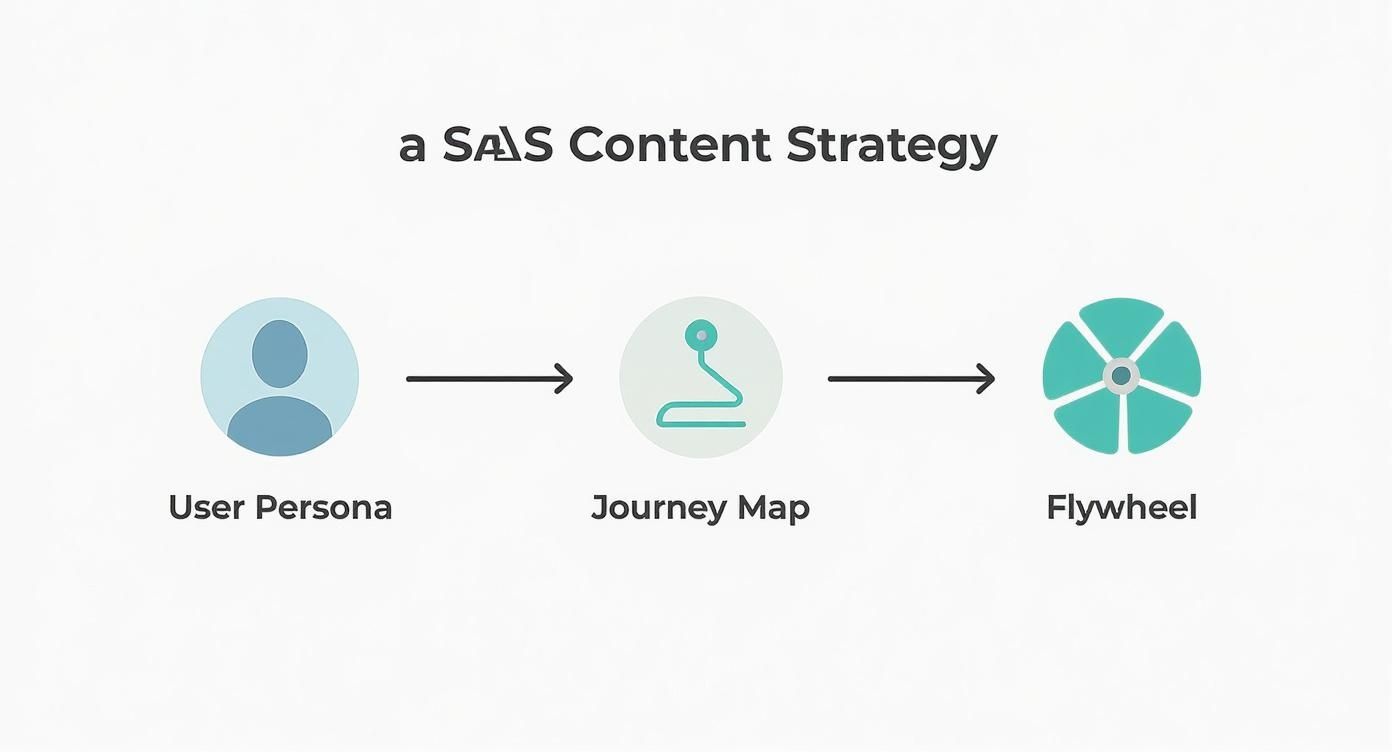
As you can see, a powerful strategy starts with deeply understanding who your customer is. From there, you map out their journey and build a content flywheel to attract and keep them engaged.
In-Depth Blog Posts and Articles
The blog is the absolute cornerstone of content marketing for any SaaS company. Think of it as your own media channel, consistently publishing genuinely helpful, problem-solving articles that pull in organic traffic from search engines. These aren’t just fluffy 500-word updates; we’re talking about comprehensive guides that dig deep into your customers’ biggest challenges.
For example, a company selling a project management tool shouldn’t just write about “productivity.” Instead, they could publish “The Ultimate Playbook for Running Agile Sprints with a Remote Team.” This tackles a very specific pain point and instantly positions them as an expert. The goal is to become the go-to resource in your space, building brand authority and trust with every click.
High-Converting Comparison Pages
When potential customers get serious, they start weighing their options. This is where comparison pages, often called “vs.” pages, become your secret weapon. They are magnets for high-intent traffic from people searching for things like “[Your Brand] vs. [Competitor].”
But these pages aren’t for bashing the competition. The best ones offer an honest, feature-by-feature breakdown that clearly and fairly highlights where you shine. By controlling the conversation on your own turf, you get to frame the comparison in a way that underscores how your software uniquely solves your ideal customer’s problems.
Comparison pages are bottom-of-the-funnel gold. They might not get the massive traffic of a top-of-funnel blog post, but the conversion rate on these pages can be exceptionally high because the visitor is just one step away from making a purchase decision.
These pages build incredible trust. You acknowledge your competitors exist while confidently showing why you’re the better choice for a specific type of user.
Webinars That Educate and Qualify
Webinars are a fantastic way to engage with prospects on a more personal, interactive level. They give you a platform to demo your product’s real value, share deep industry knowledge, and answer questions live. This format is perfect for people in the middle of the funnel who are past the initial “just looking” phase and are now actively evaluating different solutions.
The real magic of a webinar, though, is how much you can get out of it. One single sixty-minute session can be sliced and diced into a dozen different pieces of content, stretching your ROI way further.
Here’s how you can repurpose a single webinar:
- Blog Post: Write a detailed summary covering the webinar’s key takeaways.
- Social Media Snippets: Cut out short, punchy video clips for sharing on LinkedIn or Twitter.
- SlideShare Presentation: Upload the deck to SlideShare to reach a different audience.
- Gated On-Demand Video: Use the full recording as a lead magnet to keep capturing new contacts.
This strategy turns a one-time event into a content machine that keeps generating leads long after the live broadcast is over.
Compelling Case Studies and Success Stories
Nothing builds trust faster than proof that your product actually works. Case studies are that proof. They go beyond listing features and benefits to tell a relatable story of transformation, showing how a real customer went from having a huge problem to achieving incredible success with your tool.
Great case studies are always built on data. They quantify the “before and after” with hard numbers, like “reduced onboarding time by 40%” or “increased team productivity by 25%.” These concrete results make your software’s value tangible and help prospects see themselves in that success story. Plus, they give your sales team an incredibly powerful asset to help close deals.
Matching these different content formats to the right stage in the buyer’s journey is crucial for guiding prospects smoothly from discovery to purchase.
Choosing the Right Content for Your SaaS Funnel
This table breaks down which content types work best at each stage of the marketing funnel and what you’re trying to achieve with each one.
| Content Format | Funnel Stage | Primary Business Goal |
|---|---|---|
| In-Depth Blog Posts | Top of Funnel (ToFu) | Attract organic traffic, build brand awareness, educate |
| Webinars | Middle of Funnel (MoFu) | Generate qualified leads, demonstrate product value, build relationships |
| Case Studies | Bottom of Funnel (BoFu) | Build trust and credibility, overcome objections, aid sales |
| Comparison Pages | Bottom of Funnel (BoFu) | Capture high-intent traffic, convert prospects into customers |
By strategically deploying these formats, you create a comprehensive content ecosystem that not only attracts potential customers but also nurtures them effectively toward becoming loyal users.
Mastering Content Distribution and Promotion
Let’s be honest: creating a brilliant piece of content is only half the battle. Even the most insightful case study or groundbreaking blog post is worthless if no one ever sees it. This is where a smart distribution and promotion plan comes in, turning your hard work from a dusty library asset into an active, lead-generating machine.
Think of it like this: your content is a powerful race car, but promotion is the fuel. Without it, you’re just sitting on the starting line. The goal isn’t just to publish; it’s to build a repeatable process that gets every single piece in front of the right people at the right time. It’s time to move beyond the old “publish and pray” strategy.
Building Your Organic Traffic Flywheel
For most SaaS companies, Search Engine Optimization (SEO) is the bedrock of a sustainable distribution strategy. It’s how you get in front of people who are actively searching for solutions to the exact problems your software solves. When you get this right, you create a reliable, ever-growing stream of high-quality traffic.
To make SEO truly work for you, focus on these core actions:
- Target High-Intent Keywords: Don’t just go for volume. Target terms that signal a user is ready to buy, like “best [your category] software” or “[competitor] alternative.”
- Optimize Every Post: Nail the on-page basics. Every article needs a keyword-focused title, clear headings (H1, H2, H3), and a compelling meta description to stand out on the search results page.
- Build Internal Links: Weave a web between your blog posts, case studies, and product pages. This shows search engines how your content is related and, just as importantly, keeps human visitors clicking and engaging with your site longer.
A solid SEO foundation is one of the most powerful ways to increase organic traffic and reduce your dependence on paid advertising.
Engaging Niche Communities
Your ideal customers are already gathered online. They’re in LinkedIn groups, specific subreddits, and niche Slack channels, talking about their biggest challenges and asking for recommendations. Your job is to find them. But you have to approach these spaces with care.
The golden rule of community engagement is to provide value before you ask for anything in return. Simply dropping links to your blog will get you ignored or banned. Instead, become a helpful member of the community first.
Spend time answering questions, sharing your own insights, and joining conversations authentically. Then, when the moment is right, you can share your content as a genuinely helpful resource that solves a problem being discussed. This strategy builds incredible trust and establishes your brand as an expert, not a spammer.
Leveraging Email for Nurturing and Promotion
Never underestimate the power of email. It remains one of the most effective channels in any SaaS marketing playbook because it’s a direct line to your most engaged audience—the people who have already raised their hands to hear from you.
Use your email list to promote new content, but don’t just blast out a link. Frame your content as the solution to a specific pain point. For example, instead of a generic “New Blog Post!” subject line, try something like, “Struggling with team productivity? This playbook can help.” This targeted approach ensures your content actually connects, nurtures subscribers, and moves them one step closer to becoming customers.
Measuring Content Success With SaaS-Specific Metrics
Creating fantastic content is one thing, but in the SaaS world, what gets measured gets managed – and most importantly, it gets funded. It’s time to look past surface-level “vanity metrics” like page views and social media likes. We need to connect our content marketing efforts directly to what the C-suite and investors actually care about: revenue growth.
This means we have to start focusing on key performance indicators (KPIs) that prove our content is a powerful business driver, not just a creative side project. We need to show how that brilliant blog post or in-depth case study is actively adding to the bottom line and making the entire business stronger.
Moving Beyond Clicks to Conversions
The first big step is tracking how your content generates real leads. This goes way beyond simple traffic numbers and gets into metrics that signal genuine customer intent. By measuring these, you can start painting a clear picture of how your content is filling the sales pipeline.
Here are the key metrics to zero in on:
- Marketing Qualified Leads (MQLs): Of all the leads coming from your content (like an ebook download or a webinar signup), how many are actually good enough to hand off to the sales team?
- Demo or Trial Sign-ups: How many people who read an article or watched a video took the next step and signed up for a free trial or requested a product demo?
- Content-Sourced Pipeline: What’s the total potential deal value sitting in your sales pipeline that started with a content touchpoint?
Tracking these numbers helps you prove that your content isn’t just attracting an audience; it’s attracting the right audience and nudging them toward a purchase.
Tying Content to Financial Health
This is where the rubber really meets the road. To truly show the power of content marketing for SaaS companies, you have to connect it to core financial metrics like Customer Acquisition Cost (CAC) and the overall return on investment.
The most impactful content strategies are those that can directly demonstrate how they lower the cost to acquire a new customer. When you can show that organic leads from content convert at a higher rate and a lower cost than paid channels, you’ve built an undeniable case for more budget.
This way of thinking is quickly becoming the new standard. A 2023 Semrush report noted a clear shift away from traditional metrics toward advanced KPIs that track audience engagement quality, pipeline generation, and Marketing Efficiency Ratio (MER). These modern metrics do a much better job of capturing content’s real impact on revenue.
By tying content directly to the sales pipeline and customer acquisition costs, SaaS companies can optimize their spending and prove how educational content actually shortens the sales cycle. To learn more, check out our guide on how to improve ROI from your marketing efforts.
Of course, measurement is just the beginning. Continuous campaign optimization strategies are essential to get the most value out of your SaaS content. By focusing on the metrics that truly matter, you can make data-driven decisions that not only justify your work but also fine-tune your strategy for maximum financial impact.
Real-World Examples of Winning SaaS Content
Theory is great, but let’s be honest – seeing how the big players do it is where the real learning happens. When you peel back the layers of what top SaaS companies are actually doing, you get a much clearer roadmap for your own strategy.
Let’s break down the playbooks for two giants who took very different paths to content marketing success. By looking at their specific tactics, you can grab ideas that work for your business, no matter how big or small you are right now.
Ahrefs: The SEO Content Powerhouse
If you’ve ever Googled an SEO question, you’ve probably landed on the Ahrefs blog. They are the gold standard for what’s often called product-led content, and their strategy is brilliantly simple: create the single best resource on the planet for any topic their customers care about.
It’s not just a blog; it’s an encyclopedia for anyone serious about search. Here’s how they pull it off:
- Data-Driven Everything: Ahrefs has a treasure trove of data from their own tool. They mine it for unique insights and bake those findings into massive, in-depth guides that competitors simply can’t copy.
- Focus on the “How-To”: They go after keywords that show someone is stuck and needs help, like “how to do keyword research” or “link building strategies.” They’re targeting people with a problem to solve.
- Show, Don’t Sell: Throughout their guides, they naturally show how their tool makes a specific task easier. It never feels like a sales pitch, just an organic part of the solution.
The big lesson from Ahrefs? Become the go-to teacher in your industry. When you educate your audience and help them solve their problems, your product becomes the obvious tool they need to succeed.
Notion: The Community-Led Content Engine
Then you have Notion, the all-in-one workspace tool. They took a completely different, but just as powerful, approach. Their content isn’t just about what they create; it’s about what their users create.
Notion built its entire content strategy around its passionate community, essentially turning its users into its most powerful marketing channel. It’s a masterclass in leveraging user-generated content (UGC).
Here’s their magic formula:
- The Ultimate Template Library: They host and promote thousands of templates built by users for literally everything you can imagine. This shows off the product’s incredible flexibility and gives new users immediate value.
- Spotlighting Power Users: Notion constantly features its most creative users on its blog, social media, and YouTube channel, turning them into micro-celebrities within the community.
- Building an Ambassador Army: They have a formal ambassador program that empowers community leaders to create their own tutorials, host local meetups, and spread the word.
This community-first model creates a flywheel. Happy users create content, which brings in new users, who then become happy users and create more content. It’s an engine that runs on authentic passion and social proof.
Got Questions About SaaS Content Marketing? We’ve Got Answers.
Even the sharpest SaaS marketers run into questions. Let’s tackle some of the most common ones I hear, clearing up the confusion so you can get back to building your content engine.
How Long Does This Stuff Actually Take to Work?
Let’s be real: patience is a virtue here. While a great piece of content might get a nice little bump on social media right away, the true, compounding magic of content marketing is a long game.
You can generally expect to see the first green shoots—things like better keyword rankings and a noticeable lift in organic traffic—within 3-6 months. But the results that really move the needle, like a steady stream of qualified leads and a clear impact on revenue, often take a good 6-12 months of consistent, high-quality work. Think of it like planting a tree. It doesn’t provide shade overnight, but its value grows exponentially over time.
What’s the Biggest Mistake SaaS Companies Make with Content?
Hands down, the most common pitfall is creating content that’s completely disconnected from the product. I see it all the time: SaaS brands pump out top-of-funnel blog posts that get plenty of clicks but do absolutely nothing to show readers why their software is the answer.
The content might solve a tiny, surface-level problem, but it fails to build a natural bridge to the product as the deeper, more powerful solution.
The secret sauce of great SaaS content is what we call product-led content. It educates the reader on their problem while seamlessly showing how the software is the best tool for the job. That’s how you turn readers into actual users.
Should I Gate My Content or Give It All Away for Free?
Why not both? The best approach is almost always a hybrid one. You need a smart mix of gated and ungated content that meets people at different stages of their journey.
- Keep it Open (Ungated): Your blog posts, articles, and public tutorials should be free for everyone. This is your top-of-funnel powerhouse for building brand awareness, climbing the SEO ranks, and earning trust with a broad audience.
- Ask for an Email (Gated): Save this for your absolute best, highest-value stuff. Think in-depth ebooks, exclusive webinar recordings, or comprehensive templates. This is perfect for capturing leads who are already engaged and willing to trade their contact info for your expertise.
The strategy is simple: draw people in with fantastic free content, and once you have an engaged audience, offer them something even better behind a gate to turn them into qualified leads.
At Mick-Mar Inc., we live and breathe this stuff. We build and run content marketing strategies that drive real, measurable growth for SaaS companies. If you’re ready to turn your content into a powerful customer acquisition engine, let’s build your growth roadmap together.