Ever wonder how a company’s brands, products, and services all fit together? That underlying structure is your brand architecture. Think of it as the strategic blueprint that maps out the relationship between your main company brand and all its various offshoots, from sub-brands to individual product lines.
Defining Brand Architecture for Strategic Growth
Let's try a friendly analogy. Imagine your brand portfolio is a family. Is it a tight-knit family where everyone shares the same last name and looks alike (think Google)? Or is it more of a modern, blended family, with distinct individuals who are clearly related but maintain their own unique identities (think Marriott)?
A solid brand architecture answers those questions. It’s the "family tree" for your offerings, creating a logical, easy-to-understand system for customers, employees, and investors alike.
This isn't just a creative branding exercise; it's a fundamental piece of business strategy. When people understand how your products relate to each other, they navigate your offerings with confidence. That confidence makes it easier for them to find what they need and, ultimately, become loyal customers. In fact, a 2023 analysis from LinkedIn found that brands with a consistent presentation are 3.5 times more likely to have excellent visibility in the market. That consistency is impossible to achieve without a clear architectural plan.
More Than Just a Name and Logo
At its heart, brand architecture forces you to answer some tough but essential questions about your business:
- Clarity: How do our different products and services connect with one another in a way that makes sense to our customers?
- Efficiency: Are we accidentally making our own products compete against each other for attention and budget?
- Growth: When we launch a new product or acquire another company, where does it logically fit into our family?
- Equity: How can the reputation of our main brand lend credibility to our other offerings (and vice versa)?
Figuring this out creates a system that stops customer confusion before it starts, sharpens your position in the market, and lays the groundwork for future growth. This is mission-critical for SaaS companies constantly adding new features, integrations, and service tiers. Just winging it is a recipe for a diluted brand and confused buyers.
A well-defined brand architecture doesn't just organize your offerings; it tells a coherent story about your company's value and vision. It transforms a collection of products into a powerful, interconnected ecosystem.
The Impact on Your Bottom Line
A messy brand structure isn't just confusing—it’s expensive. It leads to wasted marketing dollars on disjointed campaigns and makes it harder for sales teams to cross-sell or upsell effectively. If customers can't quickly figure out what you do, they'll simply move on to a competitor with a clearer message.
On the flip side, a strategic architecture makes your entire go-to-market engine run smoother. It lets you tap into the hard-earned equity of your master brand to give new products a head start or seamlessly absorb acquisitions into your portfolio.
For any business serious about building long-term value, getting the brand architecture right isn't just a nice-to-have; it's a core piece of a winning marketing strategy. This deliberate approach ensures that as your company scales, your brand's strength and clarity grow right along with it.
So, you understand what brand architecture is and why it's so important. Now for the fun part: let's look at the actual blueprints.
Think of these models as different ways to structure your brand family. Each one comes with its own set of pros and cons, and the one you choose will have a massive impact on how customers see you, how you go to market, and how your business runs day-to-day.
There’s no magic "right" answer here. The best model is the one that lines up with your company's big-picture vision, where you sit in the market, and how you plan to grow. We'll break down the three main frameworks: the Branded House, the House of Brands, and the more flexible middle-ground options.
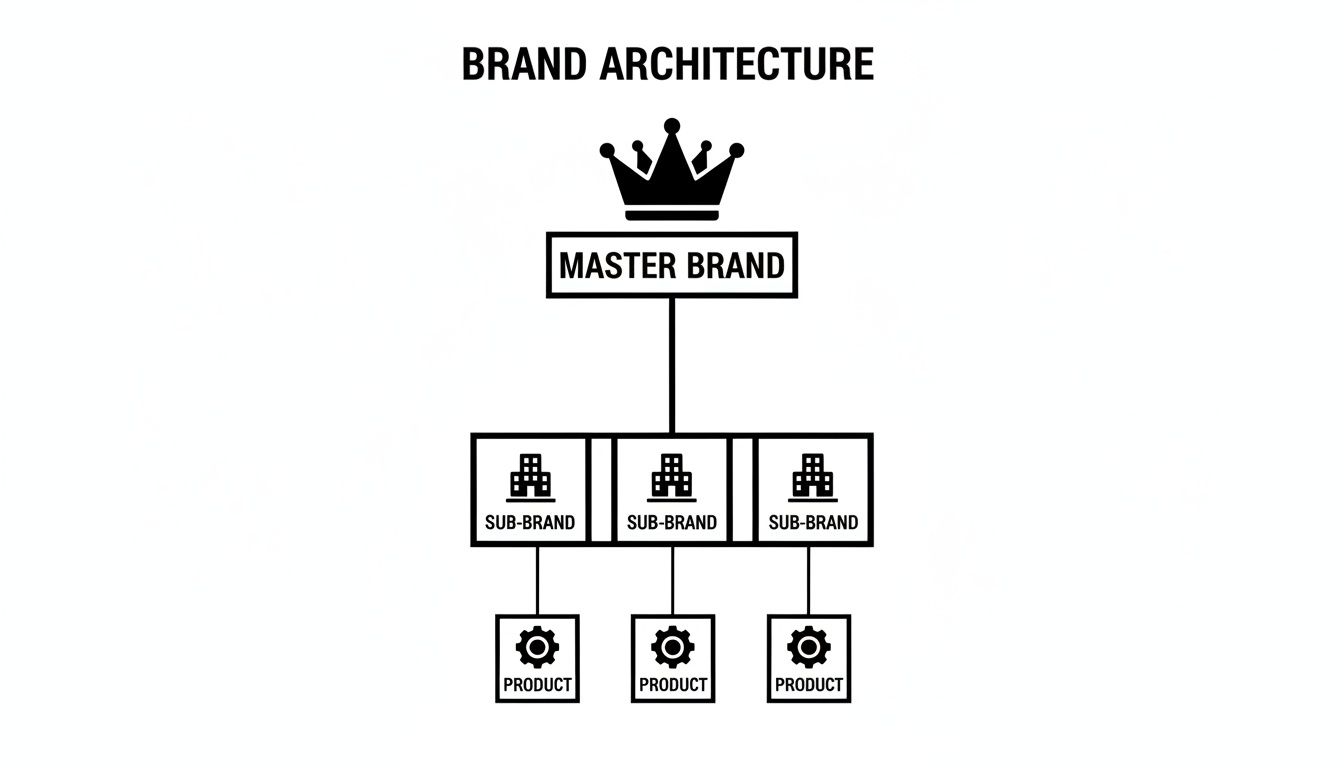
This diagram neatly shows how a master brand sits at the top, setting the tone for the sub-brands and products nested underneath it.
Comparing Brand Architecture Models At a Glance
Before we dive deep, here’s a quick overview of how these models stack up against each other. Think of this as your cheat sheet for understanding the core differences at a glance.
| Model Type | Core Concept | Best For… | Example |
|---|---|---|---|
| Branded House | One master brand is the hero. All products and services live under it. | Companies with a strong, single brand identity and a focused set of offerings. | Google (Google Maps, Google Drive) |
| House of Brands | A portfolio of distinct, individual brands. The parent company is often invisible. | Conglomerates targeting diverse markets with different customer segments. | Procter & Gamble (Tide, Pampers, Gillette) |
| Endorsed/Hybrid | A mix of approaches. Sub-brands have their own identity but get a "stamp of approval" from the parent brand. | Companies that grow through acquisition or need to serve very different audiences. | Courtyard by Marriott |
This table helps frame the conversation, but the real value comes from understanding the strategic thinking behind each choice.
1. The Branded House (Monolithic)
Imagine a family where everyone proudly shares the same last name. That's the Branded House model in a nutshell.
Here, a single, powerful master brand is the foundation for everything. All products and services are clearly part of that one family, often named as simple, descriptive extensions.
Google is the perfect example. You have Google Maps, Google Docs, and Google Calendar. The "Google" brand is always front and center, lending its credibility, recognition, and trust to every single offering. This creates a really cohesive experience, where the goodwill you have for one product easily transfers to the next.
- Upside: This model is incredibly efficient. Marketing dollars go further because every campaign strengthens the master brand. It also makes life easier for customers—they see the parent name and instantly know what to expect.
- Downside: The biggest risk is putting all your eggs in one basket. If the master brand takes a PR hit, that damage can spread to every product in the portfolio. It can also be tough to stretch the brand into new, unrelated markets where its core identity might not fit.
2. The House of Brands (Freestanding)
Now, let's flip the script. The House of Brands is like a real estate developer who owns a portfolio of completely different properties, each with its own name, personality, and target resident. The parent company often stays completely behind the scenes.
This strategy was famously pioneered by Procter & Gamble, which manages a massive portfolio of individual powerhouses like Tide, Pampers, and Gillette. Each brand is given its own space to thrive and target a specific customer, all without confusing the others.
This model lets a company dominate multiple, distinct market segments at the same time. Each brand is free to tell its own story and build its own community.
- Upside: You get maximum flexibility. Each brand can be laser-focused on a specific niche without being held back by the parent company's reputation. It also builds a firewall; if one brand stumbles or faces a crisis, the others are safely insulated.
- Downside: It’s expensive. Really expensive. Every brand needs its own marketing budget, its own team, and its own strategy from the ground up. You’re essentially launching a new company every time you launch a new product.
3. Endorsed and Hybrid Models
What if neither of those extremes feels quite right? Good news—you don't have to choose. Many of the smartest companies land somewhere in the middle with Endorsed or Hybrid models.
An Endorsed model is like a rising star getting a public shout-out from a respected legend. The sub-brand has its own identity, but it’s explicitly backed by the master brand. Think "Courtyard by Marriott." Courtyard is its own thing, but that "by Marriott" endorsement is a powerful stamp of quality and trust.
A Hybrid model mixes and matches even more freely. A company might use a Branded House structure for its core services but operate an acquired company as a freestanding brand. Salesforce is a fantastic example. It has Salesforce Sales Cloud and Service Cloud (a classic Branded House), but it lets its big acquisitions like Slack and Tableau keep their strong, independent identities.
These blended approaches are perfect for companies that are growing fast, especially through acquisitions, or that serve wildly different customer bases. Getting this right is a huge part of your go-to-market plan, as we explore in our guide to product marketing. It’s all about aligning your brand structure with your business goals.
Unlocking the Strategic Payoffs of a Cohesive Brand Architecture
Knowing the different models is one thing, but the real magic of brand architecture lies in the business results it creates. A smart structure isn't just about tidying up your logos; it’s a powerful tool for clarity, efficiency, and growth. It turns a jumbled mess of products into a logical system that customers actually enjoy navigating.
Think of it like a well-organized grocery store. You know exactly where to find the milk, you might discover a new type of cheese in the same aisle, and you leave feeling good about the experience. A messy store just leaves you frustrated and ready to shop somewhere else. Your brand portfolio is no different.
Bringing Clarity to the Market and Making Choices Easy
The most immediate win from a clear brand architecture is market clarity. When someone lands on your website, they should be able to figure out what you do and how your products connect—fast. This is absolutely critical in the B2B SaaS world, where the buying process is already complicated enough.
A good brand hierarchy smooths out the customer's journey. It helps them figure out if they're in the right place and guides them to the right solution without needing a sales rep to hold their hand. For instance, a SaaS company offering a "Marketing Suite," "Sales Suite," and "Service Suite" under one main brand makes it incredibly simple for visitors to find what they need. That kind of clarity doesn't just make for a better user experience; it speeds up the whole sales cycle.
A strong brand architecture acts as a silent salesperson, guiding customers to the right solution and building their confidence in your company’s ability to solve their problems.
This clear structure also prevents you from competing against yourself. Without defined roles for each product, you might have two of your own offerings fighting for the same customers, which just confuses your message and wastes marketing dollars.
Finding Greater Marketing and Operational Efficiency
A unified brand architecture is also a massive driver of efficiency. Once your brands are organized under a clear model, you can streamline your marketing and get way more bang for your buck. Instead of running a dozen disconnected campaigns, you can create a single, powerful message that lifts the entire portfolio.
Just think about these efficiencies:
- Unified Campaigns: A Branded House model, like HubSpot uses, lets you run big-picture campaigns that promote the whole platform. Every dollar spent builds the master brand’s reputation.
- Smarter Budgeting: You can put your resources where they’ll have the most impact—backing the products with the highest growth potential—without sparking internal turf wars.
- Simplified Onboarding: New hires get up to speed much faster because they can easily grasp the company's product ecosystem and how it all creates value.
A well-defined brand architecture is a crucial piece of a bigger, more cohesive B2B brand strategy. It ensures everyone, from marketing to sales, is telling the same story.
Building Brand Equity and Fueling Future Growth
Finally, a strategic brand architecture is the foundation for long-term, sustainable growth. It’s how you build and protect your most valuable asset: brand equity. That’s the trust and recognition you've built in the market, and a smart structure lets you use it to your advantage.
When you're ready to launch something new, you can lean on the master brand's reputation to give the product instant credibility. This slashes the time and money it takes to get a foothold in the market compared to building a new brand from the ground up. In fact, a 2023 study from Kantar BrandZ found that brands with a strong, coherent portfolio saw significantly faster value growth.
Plus, a clear architecture makes M&A activity so much smoother. You already have a blueprint for where a newly acquired company or product fits into your portfolio. This helps you avoid the integration chaos that can weaken your brand and leave customers scratching their heads. It’s the framework that keeps your brand strong and coherent, no matter how much your business grows.
How To Build Your Brand Architecture Framework
Building a solid brand architecture framework can feel like a huge undertaking, but it’s really just about creating a logical system from the ground up. Think of it less as a one-time fix and more as a thoughtful process of auditing, planning, and executing.
This step-by-step process breaks down the complexity into manageable stages, giving you a clear playbook to bring order and strategic alignment to your brand portfolio.

Whether you're a startup just starting to scale or an established company trying to clean up a messy collection of brands, these steps will guide you toward a structure that actually helps you hit your business goals. Let's walk through it.
Step 1: Conduct a Comprehensive Brand Audit
Before you can build for the future, you have to get an honest look at where you are today. A brand audit is your starting point—a complete inventory of every brand, sub-brand, product, and service you currently have out in the world. The real goal here is to map out your entire ecosystem and see how it’s actually perceived, both inside and outside your company.
Don’t just make a list of names. For each one, you need to dig deeper by asking some tough questions:
- Market Position: Who is this product really for? What problem does it uniquely solve?
- Brand Equity: On its own, how well-known and respected is this brand? Does it have any weight?
- Customer Perception: What do customers immediately associate with this brand? Is that feeling positive, negative, or just neutral?
- Business Performance: How much money does it actually make? Is it profitable?
This audit will almost always uncover some surprising things—redundancies, points of confusion, and even hidden strengths. You might find two products are accidentally competing for the same audience or that a little-known feature has a fiercely loyal following. This data gives you the solid ground you need to make smart decisions later on.
Step 2: Define Your Business Goals and Future Vision
Your brand architecture can't exist in a bubble. It has to be a direct reflection of where your company is headed. Where do you want to be in five years? Are you planning to push into new markets, roll out a dozen new features, or maybe grow by acquiring other companies?
The answers to these big-picture questions will absolutely shape your architectural choices. For example, if your main goal is to be seen as a single, all-in-one platform, a Branded House model makes a ton of sense. But if you plan to acquire diverse companies and let them keep their independence, a House of Brands or Hybrid model might be a much better fit.
Your brand architecture is a tool to achieve business objectives. Aligning your brand structure with your growth strategy ensures it enables, rather than hinders, your future success.
This alignment is non-negotiable. Without it, you risk creating a framework that looks great on a whiteboard but falls apart when it comes to supporting where the business is actually going. Our guide on creative design and branding dives deeper into how visual systems can support these strategic goals.
Step 3: Research Your Customers and Market
Okay, time to look outward. How do your customers and the market in general see your brands? Understanding their perspective is critical because, frankly, their perception is your reality.
This research phase is about gathering both qualitative and quantitative data:
- Customer Surveys: Ask your customers directly how they see the relationships between your products. Do they even know they're from the same company?
- Focus Groups: Get people in a room (virtual or otherwise) and facilitate discussions to uncover the "why" behind their brand associations.
- Market Analysis: Take a hard look at how your competitors structure their brands. What seems to be working for them, and why?
A 2023 report from PwC emphasized that building trust is paramount for consumers, and a clear, logical brand structure is a key component of that trust. You might find out that customers already group two of your products together as a single solution, which is a powerful clue for how you should structure them.
Step 4: Choose Your Model and Develop a Naming System
Armed with your audit, goals, and customer research, you’re finally ready to pick a primary brand architecture model. Will it be a Branded House, a House of Brands, or some kind of Hybrid approach? Go with the model that best fits your strategic vision and the reality of how you operate.
Once you’ve settled on a model, the next crucial piece is creating a logical naming convention. This system is what brings your architecture to life and makes it easy for customers to navigate. A clear architecture provides the blueprint for how brands interact, which is why it's so important to understand how to create a brand identity that people remember for every piece of the puzzle.
For a SaaS company using a Branded House model, a simple, descriptive naming system is often best (e.g., CompanyName Analytics, CompanyName CRM). For a Hybrid model, you’ll need to establish clear rules for when a product gets the master brand's name and when it gets to fly its own flag. Consistency is everything here; it prevents confusion down the road.
Step 5: Create a Migration Plan and Communicate Changes
Rolling out a new brand architecture isn't like flipping a switch. It demands a carefully considered migration plan, especially if you’re rebranding, retiring, or merging existing products. This plan should clearly outline the timeline, the budget, and the people needed to make the transition happen smoothly.
Frankly, communication is the most critical part of this entire stage. First, you need to get buy-in from your internal teams—from the C-suite down to the sales reps—making sure everyone understands the "why" behind the changes.
Next, map out a clear communication strategy for your customers. Explain what’s changing, but focus on the benefits for them (like "a more streamlined experience"). Guide them through any new names or navigation. A smooth transition builds trust; a chaotic one can destroy it.
Common Brand Architecture Mistakes To Avoid
Building a solid brand architecture is a serious strategic move, but even the best-laid plans can go wrong. Honestly, knowing what not to do is just as important as following best practices. Getting this wrong leads to confused customers, wasted money, and a structure that actively undermines your own business goals.
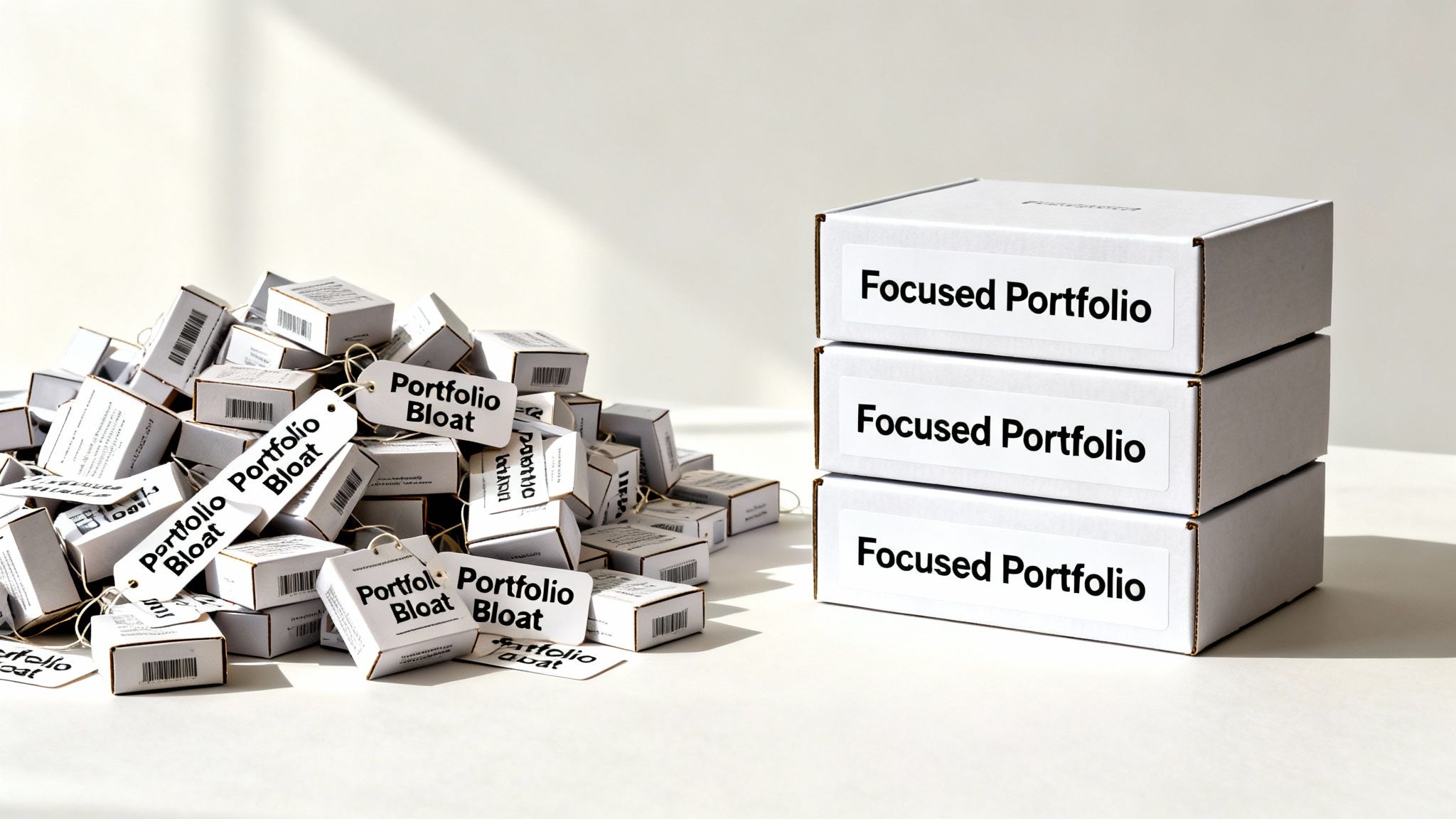
Spotting these common errors early on can save you a world of hurt and make sure your brand framework is an asset, not a liability. Let's dig into the most common ways companies mess this up.
Creating Portfolio Bloat and Cannibalization
One of the easiest traps to fall into is portfolio bloat. This is what happens when a company keeps adding brands, products, or services without a clear plan—often a byproduct of rapid growth or a string of acquisitions. Before you know it, you have a confusing jumble of offerings that are actually competing with each other for the same customers.
This internal fight for attention, known as cannibalization, is a massive drain on your marketing budget and weakens your overall market position. Instead of putting up a united front, you’re creating a fragmented experience that makes potential buyers scratch their heads, wondering which of your products is the right one. A focused portfolio is almost always stronger than a bloated one.
Misaligning Architecture with Business Strategy
Your brand architecture needs to be a mirror of your company's long-term vision. A huge mistake is designing a structure that looks neat on a flowchart but has no connection to where the business is actually going. For instance, forcing a rigid Branded House model on a company whose growth plan depends on acquiring diverse, independent businesses is just asking for trouble.
Your brand framework isn't just a marketing tool; it's a strategic enabler. If it’s not aligned with your five-year plan for growth, M&A, and market expansion, it will eventually become a roadblock.
This kind of misalignment forces awkward rebranding projects down the line or creates serious internal friction, slowing everything down and making it impossible to adapt to market shifts.
Forgetting About Future Growth and Acquisitions
Another classic blunder is tunnel vision. A brand architecture designed only for what you have today is incredibly shortsighted. What’s the plan when you launch that game-changing new product next year? Or when you acquire a competitor?
Without a flexible, scalable system, every new addition forces a chaotic, case-by-case decision. This breeds inconsistency and turns integrating new assets into a logistical nightmare. A smart architecture has clear rules for how new brands get brought into the fold—whether they’ll be absorbed, endorsed, or left as standalone entities. Thinking ahead like this prevents messy, reactive clean-up jobs later.
The fallout from these mistakes isn't just about looks; it hits the bottom line. Businesses are waking up to the fact that a disorganized portfolio can lead to significant revenue leakage from brand confusion alone. You can dig into more data on the brand architecture service market and its growth to see the bigger picture.
Maintaining an Inconsistent Brand Experience
At the end of the day, inconsistency kills trust. When customers see different names, logos, and messages across your products, it chips away at their confidence in your brand as a whole. This usually happens when different teams are working in silos, making their own branding decisions without a central strategy to guide them.
This fractured approach makes it nearly impossible to build brand equity or let the goodwill from one product rub off on another. Every single customer touchpoint should tell a clear and logical brand story. Consistency is what transforms a collection of products into a powerful, interconnected ecosystem.
Your Brand Architecture Questions Answered
Even with a great plan, a few questions always seem to pop up when you're wrestling with brand architecture. It's a complex topic with a lot of moving parts, so that's perfectly normal. Let's tackle some of the most common ones to clear up any lingering doubts and help you make smart, confident decisions.
Think of this as the FAQ section for those tricky "what ifs" and "how oftens" that can bring a project to a screeching halt.
How Often Should We Review Our Brand Architecture?
One of the biggest mistakes companies make is treating their brand architecture like a one-and-done project. In reality, it’s a living framework that has to evolve right alongside your business. You don't need to blow it up every quarter, but you absolutely need to review it at key moments.
A strategic review is non-negotiable whenever your business goes through a major shift. These triggers are your cue to take a fresh look:
- Mergers and Acquisitions: You just bought another company. Now what? You have to decide how their brand and products fit into your world.
- Major Strategic Pivots: If you're overhauling your business model or jumping into a totally new market, your architecture needs to reflect that new reality.
- Rapid Product Expansion: When you’re launching a flurry of new products or features, it's easy to end up with a confusing mess. A solid architecture prevents that portfolio bloat before it starts.
- Noticeable Market Confusion: This is a big one. If your sales team is getting an earful from customers who don't understand how your products relate to each other, it’s a massive red flag.
As a rule of thumb, plan for a light health check once a year and a full, deep-dive review every 3-5 years—or as soon as one of those triggers pops up.
What Is the Difference Between Brand Architecture and Brand Identity?
This question comes up all the time, and it's a critical distinction to grasp. The easiest way to think about it is to imagine you're building a house.
Brand architecture is the blueprint. It's the structural plan that lays out how many rooms there are, how they're all connected, and the overall flow of the entire house. It’s the strategic foundation for your entire portfolio of brands.
Brand identity is the interior design. This is the fun stuff—the paint colors, the furniture, the logos, and the specific vibe you create in each room. It’s the collection of all the tangible elements that give each individual brand its unique look and feel.
In short, architecture is the structure and relationship between your brands. Identity is the look, feel, and personality of each one.
You can't fix a confusing blueprint by just redecorating one of the rooms. A powerful brand identity can’t save a flawed brand architecture; you need the structure to be solid first.
Why Should an Early-Stage SaaS Startup Care About This?
When you only have one or two products, it's easy to think of brand architecture as a "big company problem." I get it. But honestly, thinking about this early is one of the smartest, most forward-thinking things a growing SaaS company can do.
Putting a simple framework in place from the start saves you from monumental headaches down the road. It forces you to be intentional about how you grow. As you inevitably add new features, integrations, or pricing tiers, you’ll already have a logical system for naming and positioning them.
This builds a scalable foundation and prevents the kind of "accidental" portfolio chaos that plagues so many companies as they hit their growth stride. A 2023 report from Interbrand highlighted that organizations with strong brand management, which includes clear architecture, consistently outperform their competitors in long-term value creation.
For most startups, a simple Branded House model is the perfect place to start. It lets you pour all of your limited marketing budget into building one powerful, recognizable master brand. That gives you a solid base of brand equity you can then use to launch new products as you mature. It’s not about designing for the company you are today, but for the one you plan on becoming.
At Mick-Mar Inc., we specialize in building the strategic marketing frameworks that SaaS companies need to scale effectively. If you're ready to bring clarity and power to your brand portfolio, let's talk. Learn more about how we can help at https://mick-mar.com/.