Ever wondered why someone would happily pay a premium for a HubSpot subscription when a dozen cheaper CRMs seem to offer the exact same features? The answer, my friend, is brand equity. It's that powerful, intangible value a company builds simply by having a name people recognize, trust, and feel loyal to.
The True Meaning of Brand Equity
So, what is brand equity, really? Think of it as your company's reputational savings account. Every positive customer experience—a helpful support ticket, a feature that just works, a glowing review on G2—is a deposit. Over time, these small deposits compound into a massive reserve of goodwill and trust.
This isn't just some fluffy marketing concept. That accumulated value is what makes a customer choose your software, stick with you through thick and thin, and tell their friends about you, often without even checking a competitor's price. It's the invisible engine that turns a simple SaaS tool into an indispensable part of a customer's workflow.
Why Brand Equity Is a SaaS Superpower
In a SaaS market where new competitors can pop up overnight, features are easy to copy, and pricing wars are a race to the bottom, your brand is the one thing no one can replicate. It’s a powerful moat around your business that directly shapes how customers perceive you and whether they’re willing to invest in your solution.
Don't just take our word for it. A 2023 Kantar study revealed that brands perceived as strong are valued at four times the average. While this applies across industries, the logic holds even more weight in B2B SaaS, where decisions involve bigger budgets, longer commitments, and higher stakes.
Brand equity is a measure of your influence. It’s how many people pick your brand over an alternative and how deep that preference runs. It acts as a shortcut to trust for new buyers and a powerful glue for keeping the customers you already have.
This value creates real, measurable advantages for your business:
- Greater Pricing Power: Strong equity means you can command premium pricing. Customers see your product as more valuable and less risky, so the higher price feels justified.
- Improved Customer Loyalty: When customers truly trust your brand, they become advocates. They stick around longer, which dramatically reduces churn and boosts your overall Lifetime Value (LTV).
- Lower Acquisition Costs: A well-known brand does a lot of your marketing for you. People search for you by name, and word-of-mouth becomes a primary lead source, which in turn drives down your Customer Acquisition Cost (CAC).
- Market Resilience: When budgets get tight, businesses cut the tools they see as commodities. They stick with the brands they trust and rely on. Strong equity makes you indispensable, providing a vital buffer against economic downturns.
Ultimately, building brand equity is about playing the long game. It’s the strategic shift from being just another tool in a crowded market to becoming a trusted and irreplaceable partner for your customers.
Deconstructing the Pillars of Brand Equity
If you want to understand what makes a brand truly powerful, you have to look beyond the surface. I like to think of a strong brand as a sturdy, four-legged table. Each leg is a core pillar holding the whole thing up, and if one gets wobbly, the entire structure becomes unstable.
These four pillars are Brand Awareness, Perceived Quality, Brand Associations, and Brand Loyalty. They all work together, with each one building on the last, to create that intangible value that defines an iconic brand. Let’s take a look at how each one works.
The diagram below really simplifies this idea. It shows how happy customers, great reviews, and genuine trust all feed into building your brand's strength, almost like a piggy bank for goodwill.

This just goes to show that brand equity isn't some abstract formula. It's built from real, positive experiences that earn you a customer's trust and turn them into fans.
Brand Awareness: The Starting Point
This is the absolute ground floor. Put simply, brand awareness is just about whether people in your target market even know you exist. It’s more than just recognizing your name, though—it’s about how quickly your brand pops into someone’s head when they’re facing a problem you can solve.
For a SaaS business, that means when a marketing manager thinks, "I desperately need a better project management tool," your name—like Asana or Trello—is one of the first they think of. Getting that top-of-mind spot is the first major hurdle you have to clear.
There are really two levels to this:
- Brand Recognition (Aided Awareness): This is the "Oh yeah, I've heard of them" moment. Someone recognizes your brand when they see it in a list or when prompted with your logo. It’s a start.
- Brand Recall (Unaided Awareness): This is the real prize. It's when a customer, without any hints, names your brand when asked about a certain product category. This is what it means to be the go-to solution.
Awareness is your first chance to stand out. If nobody knows who you are, they can’t possibly judge your quality, form an opinion, or eventually become a loyal customer. To get a better handle on this, it's worth exploring the fundamentals of creative design and branding.
Perceived Quality: The Promise of Excellence
Once people know who you are, they immediately start forming an opinion about your quality. Perceived quality isn't about having a 100% bug-free product or a laundry list of technical specs. It's the customer's gut feeling about your brand's overall excellence and reliability.
In the SaaS world, this extends far beyond the software itself. It’s the entire experience:
- Is your website easy to navigate?
- How smooth is the new user onboarding?
- How fast and helpful is your customer support?
- Does your pricing feel transparent and fair?
Think about it: a 2023 study by PwC found that one-third of customers will walk away from a brand they love after just one bad experience. This shows just how fragile perceived quality is. You build it slowly through consistent, positive interactions, but you can lose it in a single moment.
A CRM tool could technically have more features than all its competitors, but if the interface is a nightmare and support takes days to respond, its perceived quality will be in the gutter. On the flip side, a tool like Slack might not have every single feature imaginable, but its reliability and ease of use create an incredibly high perception of quality.
Brand Associations: The Personality of Your Brand
Brand associations are all the mental shortcuts, feelings, and ideas that people connect to your brand. It’s your company’s “personality.” When people hear your name, do they think "secure," "easy to use," "for startups," or "for enterprises"?
You build these associations through every single interaction, from the tone of your marketing copy and your visual design to the customers you highlight in your case studies.
Just look at these SaaS brands:
- Mailchimp: We instantly associate it with being "user-friendly," "quirky," and "perfect for small businesses." That personality comes through in everything from its playful mascot to its simple, clean interface.
- Salesforce: The associations here are "powerful," "enterprise-grade," and "comprehensive." This is built through its professional branding, massive feature sets, and its larger-than-life Dreamforce conference.
These associations are a massive help to buyers. A startup founder looking for an email tool they can actually figure out will gravitate toward Mailchimp because its brand personality speaks directly to their needs.
Brand Loyalty: The Ultimate Goal
And finally, we get to brand loyalty, the very top of the mountain. This is the deep-seated commitment a customer has to keep using your product, no matter what shiny new object a competitor dangles in front of them.
This is where all your hard work building equity really pays off. Loyal customers aren't just repeat buyers—they're your champions. They're the ones writing glowing reviews, recommending you to their network, and even defending you on social media.
This loyalty creates massive business advantages:
- Reduced Churn: Loyal customers stick around, which means a much more stable and predictable revenue stream for you.
- Higher Lifetime Value (LTV): They stay longer, upgrade to higher-tier plans, and buy new services, maximizing the return on every customer.
- Powerful Social Proof: Their authentic advocacy is more persuasive than any paid ad you could ever run. It’s marketing gold.
Brands like HubSpot are masters of this. Their customers are more than just users; many have built entire careers around the platform by becoming certified experts. That’s the ultimate power of turning customers into a community, and it's the clearest sign of incredible brand equity.
How to Measure Brand Equity in the Real World
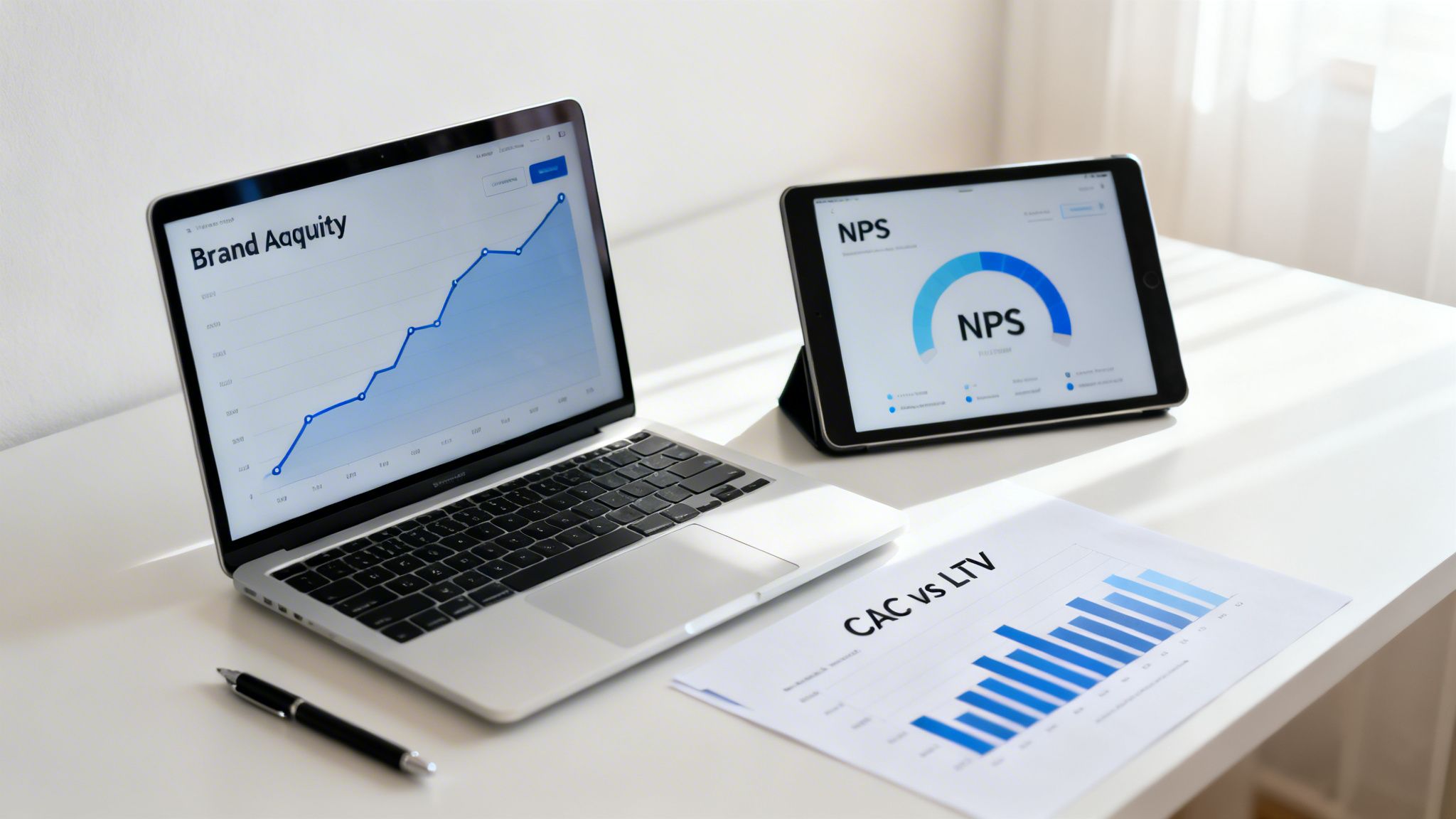
It’s one thing to understand the building blocks of brand equity, but it’s another thing entirely to measure it. After all, you can’t improve what you don’t track. So how do you put a concrete number on something as seemingly intangible as your brand’s reputation? It comes down to a smart mix of financial analysis and customer-centric metrics.
Think of measuring brand equity not as a one-off project, but as an ongoing health check. It gives you a clear snapshot of where you stand against competitors and tells you if your marketing dollars are actually moving the needle. Brands that keep a close eye on these numbers are far better at adapting to market shifts and building real, lasting strength.
Financial Models for Brand Valuation
The most direct, bottom-line way to measure your brand is to look at it through a financial lens. Big-shot analysts and major corporations use complex models to slap a dollar value on a brand, which is crucial for things like mergers, acquisitions, and high-level strategic planning.
While you probably don't need a Wall Street-level valuation, knowing the basics is incredibly helpful.
Two common approaches you’ll hear about are:
- Cost-Based Approach: This is a bit like adding up receipts. It calculates brand value by totaling all the money ever spent on marketing, ad campaigns, and brand-building activities. The big flaw here? It completely ignores whether that spending actually worked.
- Market-Based Approach: This method is more grounded in reality. It involves comparing your company to a similar but unbranded (or generic) competitor. The difference in market value between the two—looking at revenue, market share, or even stock price—is a rough proxy for your brand equity.
For most marketers, especially in SaaS, these high-level financial models are more of a compass than a detailed map. The truly actionable insights come from listening directly to your customers.
Actionable Customer-Based Metrics
This is where your marketing team can really get its hands dirty. Customer-based metrics get to the very heart of what brand equity is by measuring the perceptions, feelings, and actions of your audience. These are the leading indicators that predict future sales and long-term business health.
By tracking these metrics regularly, you establish a baseline. From there, you can see exactly how your efforts are impacting awareness, sentiment, and loyalty over time.
Brand Awareness and Recall Surveys
First things first: do people even know you exist? Simple surveys are your best friend here, helping you quantify both aided and unaided awareness.
- Unaided Awareness: You ask an open-ended question, like, "When you think of project management software, which brands pop into your head?" Your goal is to be one of the first names they mention, totally unprompted.
- Aided Awareness: Here, you give them a cheat sheet. You present a list of brands (yours and your competitors) and ask, "Which of these have you heard of?" This measures basic name recognition.
Running these surveys quarterly or semi-annually will show you whether your campaigns are cutting through the noise and earning a spot in your customers' minds.
Social Listening and Sentiment Analysis
Right now, people are talking about your brand on social media, review sites, and online forums. Social listening tools like Brandwatch or Sprout Social let you tune into those conversations as they happen.
But it’s not just about counting mentions. Sentiment analysis takes it a step further by classifying those mentions as positive, negative, or neutral. This gives you a real-time pulse on public perception. A sudden spike in negative comments could be an early warning of a product bug or a brewing PR issue, giving you a chance to get ahead of it.
Think of it this way: brand equity is a measure of influence. It reflects how many people pick your brand over an alternative and how deep that preference runs. Sentiment analysis gives you the "why" behind those preferences.
Net Promoter Score (NPS)
When it comes to measuring loyalty, the Net Promoter Score (NPS) is one of the most powerful and widely-used metrics out there. It’s all based on one brilliantly simple question: "On a scale of 0-10, how likely are you to recommend our brand to a friend or colleague?"
Customers are then sorted into three buckets based on their score:
- Promoters (9-10): These are your die-hard fans. They’ll be your best source of word-of-mouth growth.
- Passives (7-8): They’re satisfied, but not thrilled. These customers are happy enough for now but could easily be poached by a competitor.
- Detractors (0-6): These are unhappy campers who can actively hurt your brand with negative feedback.
To get your NPS, you just subtract the percentage of Detractors from the percentage of Promoters. Any positive score is considered good, while a score above 50 is excellent.
Connecting Brand Equity to Core Business KPIs
The ultimate proof of your brand's power lies in its direct impact on your most important business metrics: Customer Acquisition Cost (CAC) and Lifetime Value (LTV).
A strong brand simply makes your entire funnel more efficient. When people already know, like, and trust you, you don't have to spend as much time or money convincing them to buy. This naturally leads to a lower CAC. For instance, leads who come from a "branded search" (typing your company name into Google) almost always convert at a higher rate than those from generic searches.
At the same time, strong brand equity builds loyalty. Loyal customers stick around longer, upgrade their plans more often, and are less likely to churn. This directly pumps up their LTV. The equation is simple: brands with high equity consistently have lower acquisition costs and higher lifetime value, creating a powerful and profitable growth engine. That's an investment case that's impossible to ignore.
A Strategic Roadmap for Building Brand Equity
So, you know what brand equity is. Now for the hard part: actually building it. A strong brand doesn't just materialize out of thin air—it’s the result of a deliberate, long-term strategy that’s woven into every single thing you do.
Think of it less as a marketing campaign and more as an operational philosophy. Every touchpoint, from the first ad a person sees to the customer support ticket they file two years later, is an opportunity to strengthen your reputation. The goal is to build a consistent and valuable experience that earns genuine trust over time.
Develop a Consistent and Cohesive Brand Identity
Consistency is the bedrock of a recognizable brand. When your visuals, your messaging, and your tone of voice are the same everywhere, customers begin to recognize you on sight. That predictability creates a sense of comfort and professionalism.
If your brand’s personality changed every time a customer interacted with it, they’d never learn to trust it. That’s why you need to lock down your identity across every channel:
- Visual Elements: Your logo, color scheme, and fonts need to be uniform across your website, app, social media, and sales decks. Little details matter, and even learning how to animate your logo to instantly upgrade your brand can make your visuals more memorable.
- Brand Voice: Decide who you are. Are you the buttoned-up, professional guide like Asana? Or the quirky, fun-loving expert like Mailchimp? That voice needs to come through in everything from your ad copy to your in-app error messages.
- Core Messaging: Your value proposition—what you do, who you do it for, and why you’re different—has to be crystal clear. Your entire team should be able to recite it in their sleep.
Engineer an Exceptional Customer Experience
In the world of SaaS, your product is the brand experience. You can have the slickest marketing on the planet, but if the product is clunky, confusing, or poorly supported, your brand equity will plummet. A smooth, helpful, and even delightful user journey is your most powerful brand-building tool.
It’s no surprise that recent research shows an overwhelming majority of consumers—around 88% according to a 2023 Salesforce report—say the experience a company provides is just as important as its products or services. In software, that trust is earned one click at a time.
A fantastic customer experience is its own form of marketing. When users feel supported and understood, they turn into your most effective advocates. Their positive experience becomes the social proof that convinces others to sign up.
Pay close attention to these make-or-break moments in the customer journey:
- Frictionless Onboarding: A new user’s first five minutes are everything. You have to guide them to that "aha!" moment—the point where they get the value—as fast as humanly possible. An intuitive setup and helpful tooltips are non-negotiable.
- Proactive Support: Don't wait for users to get stuck. Offer help before they even have to ask with in-app guides, a thorough knowledge base, and lightning-fast support. A single quick and empathetic response can turn a frustrated user into a loyal fan for life.
- Delightful Interactions: Find small moments to surprise and delight your users. It could be a perfectly designed feature that just works, a personal check-in email from a founder, or celebrating a milestone they achieved with your tool.
Establish Thought Leadership with High-Value Content
Want to build authority and trust? Stop selling and start teaching. Content marketing is your chance to prove you know your stuff, solve real problems for your audience, and position your brand as the go-to expert in your niche.
This means creating content with a singular focus: being genuinely helpful. A great content strategy goes beyond the blog and can include:
- In-depth Guides and Whitepapers: Tackle your audience's biggest headaches with detailed, data-backed resources that they'll want to bookmark and share.
- Webinars and Workshops: Share your expertise live, giving you a chance to interact directly with potential customers and answer their specific questions.
- Case Studies and Success Stories: Nothing sells like proof. Show how real customers are using your product to get real results.
By giving away your expertise, you build a relationship founded on trust, not just a transaction. If you want to go deeper, check out our guide on building a comprehensive marketing strategy.
Build a Thriving Community
The ultimate form of brand equity is when your customers stop being just customers and become a community. A community creates a space where users can connect with each other, share tips, and feel like they belong to something bigger than themselves. That sense of belonging creates a level of loyalty that’s almost impossible for competitors to replicate.
Giants like HubSpot and Salesforce have mastered this. Their users don't just use the software; they build careers around it. They attend annual conferences, earn certifications, and network with other professionals in the ecosystem. The brand becomes part of their professional identity, creating an incredibly powerful moat around the business.
You don't need to be a massive corporation to start. You can build a community with a dedicated Slack channel, a LinkedIn group, regular user meetups, or by simply featuring your power users' content on your social channels.
Common Pitfalls That Erode Brand Value
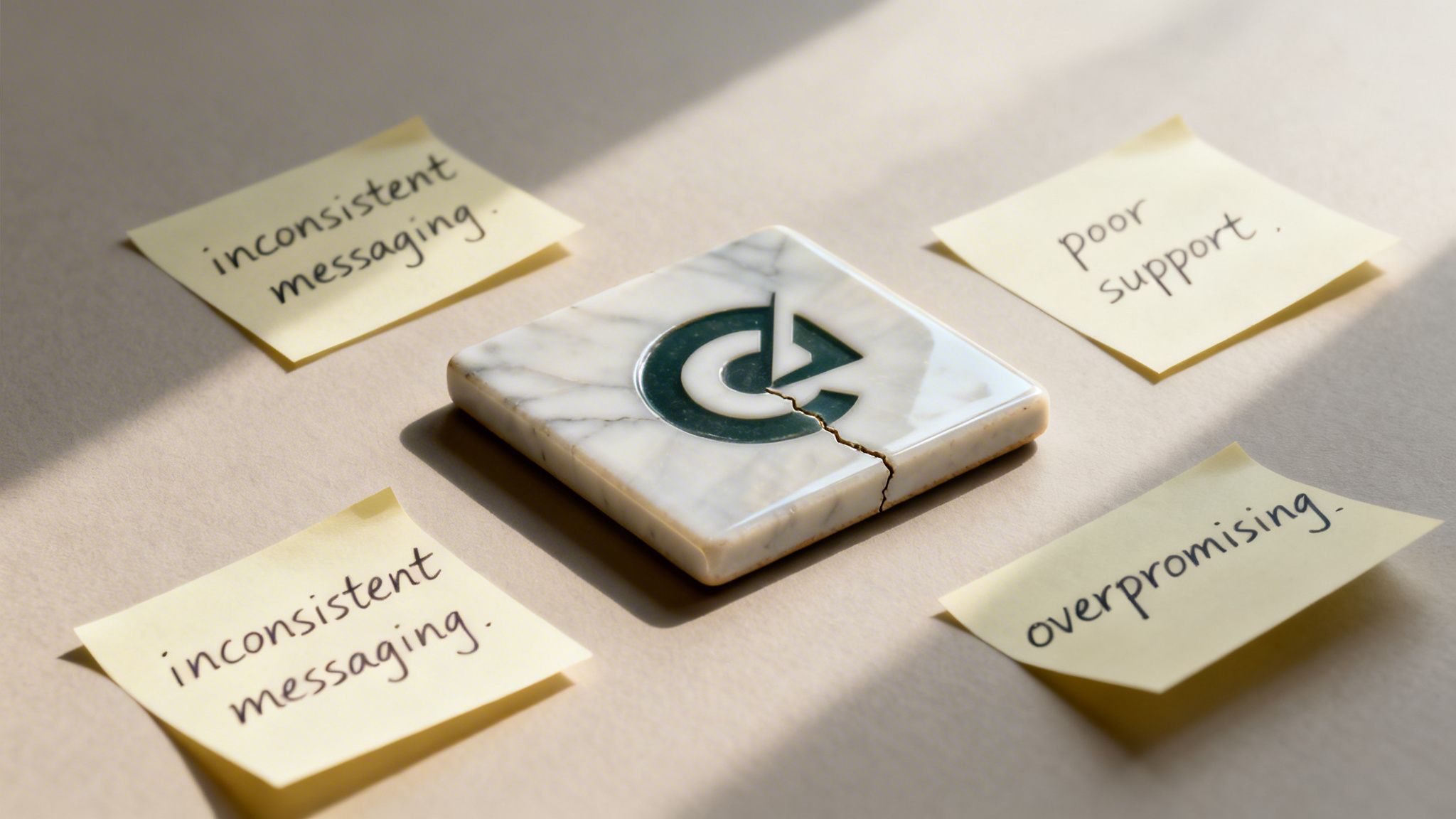
Building brand equity takes years. Tearing it down? That can happen in an instant. All the trust and loyalty you’ve worked so hard to cultivate can evaporate with just a few critical missteps. Knowing where these landmines are is the first step to avoiding them entirely.
These aren't just minor blunders; they're fundamental violations of the promise you’ve made to your customers. Once that bond is broken, winning back their confidence is an incredibly steep climb.
Inconsistent Messaging That Creates Confusion
One of the fastest ways to chip away at your brand is by sending mixed signals. It creates a kind of brand whiplash. Your marketing emails might be fun and casual, but your in-app support is cold and corporate. This kind of inconsistency makes your brand feel disjointed and, frankly, a little fake.
People need to know what they're getting. They look for predictability every time they interact with you. When your voice, visuals, or values shift from one channel to the next, you create a fragmented identity that weakens customer confidence.
Think about a SaaS company that runs ads positioning itself as “simple and user-friendly.” If a new customer signs up and is immediately hit with an onboarding process that feels like it needs a 50-page manual, there’s a massive disconnect. That experience makes them question the brand’s entire promise.
Neglecting the Customer Experience
You can pour millions into a brilliant marketing campaign, but if using your product or getting help is a frustrating experience, you’re essentially pouring water into a leaky bucket. A single negative interaction with your support team can undo months of positive brand perception. One bad experience quickly multiplies into negative reviews and social media callouts.
The customer experience is your brand in action. Every support ticket, every product bug, and every confusing feature is a moment of truth that either builds or breaks trust.
Great service isn't a cost center—it's an essential part of your brand strategy. When customers feel like you're listening and actually care, they don't just stick around; they become your biggest fans. A responsive and genuinely helpful support team can turn a product failure into an opportunity to build even stronger loyalty.
Over-Promising and Under-Delivering
This is a classic trap, and it's the quickest way to destroy credibility. When you announce a "game-changing" new feature that ends up being buggy or underwhelming, you break trust. Unmet expectations don't just disappoint customers; they make your future promises feel empty.
This mistake often comes from a "growth at all costs" mentality, where the marketing team makes bold claims that the product team simply can’t back up. It might create a short-term spike in excitement, but the long-term damage to your brand's reputation can be severe.
For example, imagine a project management tool that advertises "flawless" integrations. If users discover those integrations are constantly breaking or need complicated workarounds, they won't just be mad about the feature. They'll lose faith in the company's integrity altogether. It is always, always better to under-promise and over-deliver, building a rock-solid reputation one reliable feature at a time.
Frequently Asked Questions About Brand Equity
Now that we’ve covered the fundamentals of brand equity, let's dig into a few questions that always come up. Here are some straightforward answers to help you put these ideas into practice.
How Long Does It Take to Build Strong Brand Equity?
Honestly? It's a marathon, not a sprint. You can definitely see a real jump in brand awareness within 6-12 months of a dedicated campaign, but building the kind of deep-seated loyalty that defines a strong brand is a long game—we're talking years.
Think of your brand as having a reputational bank account. Every time you solve a customer's problem or deliver on a promise, you're making a deposit. It's not about one big campaign; it’s about the consistent, compounding value you build over time.
Can a Small Startup Compete on Brand Equity with Large Enterprises?
You bet. You won't outspend a corporate giant on a Super Bowl ad, but you can absolutely outmaneuver them. The trick is to play a different game, one where your size becomes your strength.
Here’s how you can build a powerful brand from the ground up:
- Own a Niche: Don't try to be the solution for everyone. Instead, become the absolute best, go-to choice for a very specific group. Their word-of-mouth will do your marketing for you.
- Deliver an Unforgettable Experience: Big companies often automate the human touch out of their service. As a startup, you can provide incredible, white-glove support and build real relationships that people remember.
- Build a True Community: Create a space for your first 100 or 1,000 users. Make them feel like insiders who are part of the journey, and they’ll become your most passionate advocates.
A reputation for being authentic and responsive is an asset money can't buy. This is especially powerful when founders embrace personal branding to connect with their audience on a more human level.
What Is the Difference Between Brand Equity and Brand Awareness?
This is a really important one to get right. Brand awareness is just the first step—it means people have heard of you. Brand equity, on the other hand, is the total value of that awareness combined with what people actually think and feel about you.
Think about it like this: a fast-food chain might have 100% awareness, but if everyone associates it with "cheap" and "unhealthy," its brand equity is weak. People know it, but they don't necessarily value it.
High awareness does not guarantee high value. Brand equity is the combination of being known and being respected. It's the difference between people knowing your name and people trusting your promise.
In the SaaS world, we see this all the time. An old, clunky software that’s been around forever has high awareness. But a newer competitor with a killer design and a reputation for amazing support has far more brand equity, even if fewer people have heard of it. One has recognition; the other has respect.
At Mick-Mar Inc., we live and breathe this stuff. We partner with SaaS companies to build brands that don't just get noticed—they get chosen. We'll help you craft a story and a strategy that creates real, lasting brand equity.
Ready to build a brand people trust? Let’s talk. See how we can help at https://mick-mar.com/.