So, what exactly is LMS marketing? Think of it as the specialized craft of connecting Learning Management System software with the right audience—usually businesses scrambling to train their teams or universities managing online courses. It's a friendly mix of smart content, targeted digital ads, and strategic relationship-building, all aimed at showing how a particular LMS solves real-world training and development headaches. A winning approach digs deep into what buyers actually need and then clearly shows them the path to a better outcome.
Understanding the Modern LMS Marketing Landscape

The market for Learning Management Systems isn't just growing—it's completely changing shape. If you're in this space, recognizing this shift is the first step to building a marketing plan that actually works. It's time to move beyond rattling off a generic list of features and start talking about why organizations are pouring money into learning tech right now.
This boom is being driven by a few powerful forces. Companies are in a race to reskill their entire workforce just to keep up with technology, and at the same time, digital education has become the new normal across the globe. This creates a massive, value-driven opportunity for LMS providers who can get their message right.
The Unprecedented Growth Trajectory
The numbers paint a clear picture of opportunity. The global LMS market is expected to reach USD 51.9 billion by 2028, growing from USD 22.1 billion in 2023. That’s a compound annual growth rate (CAGR) of 18.6%, a clear sign of massive investment in the space. This is all part of a much larger explosion in e-learning, a sector projected to be worth over $600 billion by 2030.
This isn't just a fleeting trend; it's a fundamental shift in how organizations handle talent development and knowledge sharing. Your LMS marketing needs to capture this sense of urgency and opportunity. You’re not just selling software—you're offering a critical tool for future-proofing a company's workforce.
Adapting to Diverse Buyer Needs
In a field this crowded, a one-size-fits-all message is a surefire way to get ignored. The real secret is understanding the very different needs of your customer segments, whether you’re talking to a small business owner, a corporate HR director, or a university dean. Each one has a unique set of problems and a different definition of success. A solid marketing strategy starts with knowing these audiences inside and out.
For a masterclass in how to speak to different buyers, it’s worth taking a look at Coursera's B2C and B2B marketing strategy. Seeing how the big players tailor their approach for different markets can give you some powerful ideas for positioning your own LMS. In the end, it all comes down to building a strategy that speaks directly to the challenges of your ideal customer, making your platform the only logical choice.
Choosing the right channels is just as important as crafting the right message. The table below provides a quick cheat sheet to help you match your marketing efforts to the audience you're trying to reach.
Key LMS Marketing Channels and Their Target Audience
| Marketing Channel | Primary Target Audience | Key Objective |
|---|---|---|
| LinkedIn Ads | Corporate L&D, HR Managers, C-Level Execs | Lead Generation, Brand Awareness |
| SEO & Content Marketing | Anyone researching LMS solutions | Building Authority, Organic Lead Flow |
| Google Ads | High-intent buyers actively searching for an LMS | Capturing Immediate Demand |
| Webinars | Mid-to-late stage prospects, existing users | Product Demos, Education, Upselling |
| Email Marketing | Nurturing leads, engaging current customers | Building Relationships, Driving Conversions |
| Industry Events | Enterprise-level decision-makers, partners | Networking, High-Value Lead Generation |
This isn't an exhaustive list, but it's a great starting point for thinking strategically about where to invest your time and budget to get in front of the people who matter most.
Pinpointing Your Ideal LMS Customer

Great LMS marketing isn’t about casting the widest net possible; it's about laser-focused precision. Before you even think about writing ad copy or mocking up a landing page, you need a crystal-clear picture of who you're actually talking to. This goes way beyond surface-level labels like "HR Manager." We're talking about building detailed buyer personas that feel like real people with real, frustrating problems.
Think of these personas less as demographic checklists and more as stories. They capture your ideal customer’s daily headaches, their career goals, and the specific challenges that keep them up at night. The aim is to get inside their world so completely that your marketing feels less like a sales pitch and more like a genuinely helpful, educational conversation.
Beyond Job Titles to Real-World Pain Points
The first step is to break down your audience into distinct groups based on their roles and what drives them. A Learning & Development (L&D) director at a massive corporation has a completely different set of needs than a sales enablement manager at a high-growth startup. They might both be looking for an LMS, but they're trying to solve fundamentally different problems.
Let's look at two classic examples we see all the time:
-
Persona A: The Compliance-Focused HR Director. Picture someone at a large, established company. Their world is all about mitigating risk. They need to ensure thousands of employees complete mandatory training, track everything meticulously, and pull reports for audits at a moment's notice. They’re looking for stability, powerful reporting, and a seamless hookup with their existing HRIS. Their pain isn't a lack of training content—it's the administrative chaos of managing it all at scale.
-
Persona B: The Speed-Obsessed Sales Leader. Now, imagine a manager leading a sales team at a scrappy startup. Their singular focus is getting new reps ramped up and closing deals yesterday. They need an LMS that's mobile-first, dead simple to use, and perfect for quick, on-the-go microlearning. Deep compliance features? They couldn't care less. They just want to slash the time it takes for a new hire to make their first sale.
These two people require completely different messaging, feature highlights, and success stories. Your product marketing has to speak their language and address their unique version of a "win." If you want to dive deeper into this, check out this excellent guide on product marketing strategy.
Gathering Actionable Customer Insights
So, where do you get the details to build these profiles? You listen. The best intel comes straight from the source. Stop guessing what your customers want and just ask them.
The most powerful insights for your LMS marketing will come from conversations, not spreadsheets. Understanding the 'why' behind a customer's decision is more valuable than knowing their company size.
Here are a few proven ways to gather the intelligence you need:
- Talk to your customers. Schedule calls with your best clients (and even some who left). Ask about their buying process, what other tools they looked at, and what a huge success looks like in their role.
- Mine your sales call recordings. Listen for the exact words and phrases prospects use to describe their problems. What terminology keeps popping up? Those are your keywords.
- Survey your email list. Send out short, simple surveys. Ask pointed questions about their biggest training roadblocks and what they truly value in a learning platform.
When you blend all this qualitative data together, you can build powerful personas that will guide every single marketing decision you make. This ensures your message always hits home with the right person, at exactly the right time.
Crafting a Value Proposition That Cuts Through the Noise

Let's be honest: the LMS market is packed with platforms that all start to sound the same after a while. If your message is generic, you're just adding to the noise. This is where your value proposition comes in. It’s not just a slogan; it's the core of your entire LMS marketing strategy. It needs to be a crystal-clear promise that instantly tells your ideal customer, "This is exactly what I've been looking for."
So many LMS providers fall into the trap of leading with features. They’ll boast about their "gamification tools" or "advanced analytics." But here's the thing—your prospects aren't shopping for features. They're shopping for solutions to their problems and, ultimately, better business outcomes.
From Features to Business Outcomes
The secret is to translate every single technical capability into a tangible, desirable result for the customer. Stop thinking about what your LMS does and start articulating what it helps your customers achieve. This one shift in mindset will completely change the game for your marketing.
Here’s how you can reframe your own messaging:
-
Instead of: "AI-powered reporting."
-
Think: "Get weekly training insights in 5 minutes, not 5 hours."
-
Instead of: "Mobile-responsive design."
-
Think: "Empower your field team with on-demand training they can access from any job site."
-
Instead of: "Automated compliance tracking."
-
Think: "Eliminate audit anxiety and prove 100% training completion with a single click."
See the difference? Each of those revised statements connects a feature to a real-world benefit—saving time, boosting productivity, or cutting down on risk. That’s the kind of value-driven language that gets the attention of decision-makers.
Navigating a Booming Market
Having a razor-sharp value proposition isn’t just a nice-to-have; it's a survival tactic. The LMS market is exploding, valued at USD 22.1 billion in 2023 and expected to rocket to USD 51.9 billion by 2028. That’s a staggering 18.6% CAGR. This growth is being driven by a huge demand for AI-driven learning and mobile-first training. To even have a chance of standing out, your message has to be incredibly precise. You can discover more insights about this rapidly growing market to see just how competitive it's getting.
A strong value proposition isn't just a tagline; it's a strategic filter for your entire marketing and sales operation. It guides your ad copy, website headlines, sales decks, and even your product roadmap.
When you nail down a value proposition that speaks directly to the outcomes your ideal customers are desperate for, you create a powerful, consistent message. This clarity ensures that from the first ad they see to the final demo, your unique value shines through. It makes your LMS feel less like an option and more like the solution that truly gets their problems.
Building Your Content Engine for Lead Generation
Think of your content as the fuel that powers your entire LMS marketing machine. A solid content plan isn't just about publishing a blog post here and there. It’s about building a system that consistently attracts the right people and walks them through the process of choosing you. This means creating different types of content that solve your audience's problems at every step in a friendly, educational way.
The real goal is to have the perfect resource ready for each stage of their journey. Maybe it's a simple blog post explaining the basics of asynchronous learning for someone just starting their research. For someone further along, it could be a detailed case study proving the ROI you delivered for a company just like theirs. And for those ready to decide, an interactive webinar showing off your platform's best features might be just the ticket.
Mapping Content to the Buyer's Journey
Let's be realistic: not everyone who hits your website is ready to book a demo. Your content has to meet them right where they are, mentally and emotionally. When you create value-driven assets specifically for each stage of the marketing funnel, you're always ready with the right answer at the right time.
Here’s a practical way to break it down:
-
Top of Funnel (Awareness): At this point, your prospects are just realizing they have a problem or a need. Your job is to educate, not sell. Think helpful blog posts, quick "how-to" videos, and handy downloadable checklists that answer those first big questions.
-
Middle of Funnel (Consideration): Now, they're actively researching solutions. This is your chance to build trust and show you know your stuff. This is where detailed case studies, in-depth whitepapers, and guides comparing different types of solutions really shine.
-
Bottom of Funnel (Decision): They're close to making a choice. Your content now needs to make a strong, clear case for why your LMS is the one. This is the time for free trials, personalized live demos, and transparent pricing pages to get them across the finish line.
If you want to go even deeper on building a content strategy that truly supports your business goals, our guide on content marketing and strategic communications is a great next step.
The Power of Data-Driven Content
The LMS space is booming, and recent research shows that for every dollar invested in online training, companies can see a return of $30 in productivity. This isn't just hype; it's driven by the incredible value these platforms deliver, like boosting knowledge retention by up to 60% while slashing training costs. To stand out in such a crowded field, your content absolutely must speak to these core benefits.
Your content shouldn't just be created; it should be engineered. Dive into your analytics. See which topics get people talking and which formats actually convert visitors into leads. If you notice a blog post on "compliance training for manufacturers" is blowing up, that's your signal to turn it into a webinar or a more detailed ebook to capture even more interest.
This data-first approach stops the content guesswork and turns it into a predictable way to generate leads. To keep that content engine humming with fresh ideas, you'll need to stay creative. For a little inspiration, check out these 10 Innovative Ways to Ignite Ideas. By consistently creating content your audience is already looking for, you’ll become the go-to resource in your niche and keep your LMS marketing efforts moving forward.
Choosing Channels to Reach High-Value Buyers
You've nailed down your value proposition and have some great content ready to go. Now, the big question is: where do you actually put it? The goal of smart LMS marketing isn't to shout from every rooftop; it's to show up in the specific places where your ideal buyers are already searching for answers.
This is all about making strategic choices to get the most bang for your buck. You need a focused plan that prioritizes the channels your audience actually uses. Think about it: are your prospects frantically Googling for a solution right now, or are they casually scrolling through their professional network, not yet aware that a better training system even exists? Your answer changes everything.
Aligning Channels with Buyer Intent
The most effective marketing campaigns always match the channel to the buyer's state of mind. Grabbing the attention of someone actively looking for an LMS on Google is a totally different game than trying to build brand recognition with L&D leaders on LinkedIn.
Here are a few of the channels that consistently deliver for LMS companies:
- Google Ads (Search): This is your go-to for capturing high-intent leads. When someone searches for "LMS for compliance training," they have an urgent problem. Your ad can be the first solution they see, putting you right in their path at the perfect moment.
- LinkedIn Ads: For B2B, LinkedIn's targeting is second to none. You can serve your ads directly to VPs of HR, Sales Enablement Managers, or L&D Directors at companies of a specific size, in a specific industry. It's brilliant for building awareness and generating leads from a hand-picked audience.
- Co-Marketing Partnerships: Don't overlook the power of collaboration. Teaming up with respected HR tech influencers or companies with complementary software can be a goldmine. A joint webinar or a co-branded ebook instantly borrows their credibility and gives you access to a warm, engaged audience.
This decision tree helps illustrate how your main goal—whether it's attracting new people, converting interested leads, or establishing your authority—should shape the kind of content you create.
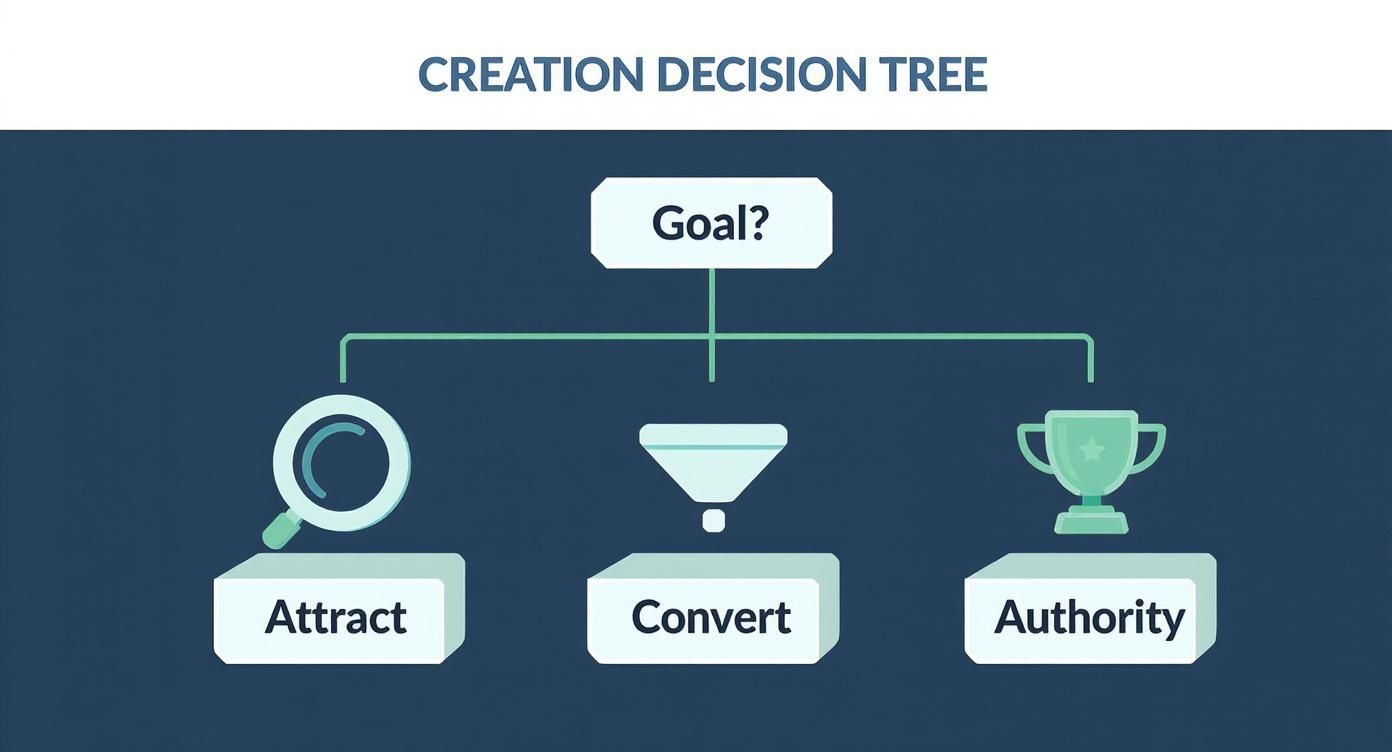
As you can see, your objective directly points to the type of content you should be developing for each channel to get the best results.
From Clicks to Conversions
Getting traffic to your site is just the first step. The real work begins when a potential buyer clicks your ad or social post. Where do they land? That page needs to speak directly to their problem and show them a clear path forward. A solid, high-converting landing page is absolutely essential.
A classic mistake we see all the time is sending paid traffic to a generic homepage. Don't do it. Instead, build dedicated landing pages for each campaign. Each page should have one clear call-to-action (CTA), like "Request a Demo" or "Download the Case Study." This focus makes a massive difference in conversion rates.
To squeeze every bit of performance out of your campaigns, you have to A/B test your creative assets relentlessly. Experiment with different headlines, images, and button copy to discover what truly connects with your audience. Sometimes, the smallest tweaks can lead to huge improvements in lead quality and your cost per acquisition.
By marrying smart channel selection with finely-tuned conversion paths, you create a reliable engine that consistently generates demos and free trials. That's how you turn marketing spend into real, measurable growth.
Measuring Performance and Optimizing for Growth
Getting your campaigns live is a huge step, but in the world of LMS marketing, that’s really just the beginning. Real, sustainable growth isn’t about a flashy launch; it’s born from a constant cycle of measuring, learning, and tweaking what you’re doing.
It's tempting to get caught up in vanity metrics—things like social media likes or a spike in website traffic. But the true pulse of your business is found in the numbers directly tied to revenue. To make smart, growth-oriented decisions, you have to look past the surface and get comfortable with the data that tells the whole story.
KPIs That Actually Matter
From our experience, the most successful LMS companies are laser-focused on just a handful of core metrics. These aren't just numbers to report in a meeting; they're the vital signs of your marketing's health and your company's long-term viability. If you're serious about scaling, mastering these is non-negotiable.
Here are the big three you need to live and breathe:
- Customer Acquisition Cost (CAC): Simply put, this is what it costs you in sales and marketing spend to land one new customer. Keeping this number in check is fundamental to being profitable.
- Lifetime Value (LTV): This is the total revenue you can reasonably expect from a single customer over their entire relationship with you. The whole game is to make sure this number is significantly higher than your CAC.
- Demo-to-Close Conversion Rate: For most B2B LMS businesses, the product demo is where the magic happens. Tracking how many of those demos actually become paying customers tells you volumes about your lead quality and sales process.
The ultimate health check for your LMS marketing is the LTV:CAC ratio. A solid benchmark for SaaS companies is at least 3:1. This means for every dollar you put into acquiring a customer, you're getting three dollars back over their lifetime. If you're hitting that, you're on the right track.
Turning Insights into Actionable Improvements
Your analytics platform and CRM are your most powerful tools here. They're treasure troves of information, holding all the clues about what’s resonating with your audience and what's falling flat. By making a habit of digging into this data, you can spot patterns and make calculated adjustments instead of just guessing.
Let's say you notice that leads coming from your LinkedIn campaigns have a much higher demo-to-close rate. That’s not a coincidence; it's a clear signal from the market to double down on what's working there. On the flip side, if an ad set is burning through your budget with tons of clicks but almost no demo requests, it’s time to pull the plug and rethink your messaging or audience.
This data-first mindset should permeate everything you do. You can use these insights to:
- Sharpen your ad targeting to zero in on the specific job titles or industries that consistently convert.
- Optimize landing page copy by A/B testing different headlines that address the exact pain points of your best customers.
- Build out email nurture sequences to automatically follow up with leads who ghosted after a demo, keeping your solution top-of-mind for when they’re finally ready to pull the trigger.
By consistently tracking these core metrics and turning those insights into real-world actions, you stop just "running campaigns" and start building a predictable, scalable growth engine for your business.
Ready to build a marketing strategy that delivers real, measurable results? The team at Mick-Mar Inc. specializes in creating data-driven marketing roadmaps for B2B tech companies just like yours. Let's build a plan that turns your marketing efforts into your biggest growth driver. Find out how we can help.