In the complex B2B SaaS landscape, a generic email blast is the fastest way to the spam folder. Decision-makers are inundated, and their attention is a scarce, valuable resource. Standing out requires a strategic, value-driven approach that respects their time and directly addresses their most pressing problems. Simply sending more emails isn't the answer; success hinges on sending smarter emails.
This article moves beyond rehashed advice to give you a deep dive into the 9 actionable email marketing best practices B2B leaders are using right now to cut through the noise, build meaningful relationships, and drive revenue. We'll explore everything from hyper-targeted Account-Based Marketing (ABM) campaigns and advanced segmentation to sophisticated analytics that prove ROI and secure budget. Think of these strategies as your toolkit for transforming your email list from a simple contact database into a powerful growth engine.
You will learn how to craft emails that not only get opened but also compel action, whether you're in cybersecurity, energy, or event planning. We'll provide fresh perspectives and practical implementation steps to help you refine your approach and achieve measurable results. Many of these tactics rely on intelligent systems to scale effectively. To develop intelligent, scalable systems that drive B2B email success and boost ROI, explore these marketing automation best practices for building a robust foundation. For specialized agencies and in-house marketing teams alike, mastering these practices is the key to delivering the customized, high-impact campaigns that propel modern businesses forward.
1. Account-Based Marketing (ABM) Email Campaigns
Account-Based Marketing (ABM) flips the traditional marketing funnel on its head. Instead of casting a wide net to capture as many leads as possible, ABM concentrates your sales and marketing resources on a select group of high-value target accounts. This B2B-specific strategy treats each account as a unique market, allowing you to create hyper-personalized, multi-touch email campaigns that resonate deeply with key decision-makers.
In practice, this means moving away from generic email blasts and toward a coordinated, strategic approach. You identify your most valuable potential customers first, then craft bespoke messaging and content designed to address their specific pain points, industry challenges, and business goals. This highly targeted method is one of the most effective email marketing best practices B2B teams can adopt because it maximizes resource efficiency and significantly increases the likelihood of closing large, complex deals.

How to Implement ABM in Your Email Strategy
To successfully integrate ABM into your email efforts, focus on deep personalization and strategic coordination. For instance, platforms like 6sense leverage predictive analytics to help you identify accounts showing purchase intent, allowing you to engage them at the perfect moment.
Here are some friendly, actionable steps to get you started:
- Develop Account-Specific Personas: Go beyond general buyer personas. Create detailed profiles for the key stakeholders within each target company, such as the CFO, the Head of IT, and the end-user. Understand their individual motivations and challenges.
- Use Dynamic Content Blocks: Personalize email sections based on the recipient's role, industry, or past engagement. An email to a CFO could highlight ROI and cost savings, while a message to a technical lead could focus on integration and security features.
- Coordinate Multi-Channel Touches: Align your email sends with other ABM tactics. For example, schedule an email to land in a decision-maker's inbox the day after they see a targeted display ad on LinkedIn.
- Track Account-Level Engagement: Shift your metrics from individual lead scores to account-wide engagement. A 2023 report from the ABM Leadership Alliance highlights that successful ABM programs measure influence across the entire buying committee, not just one contact. This provides a more accurate picture of an account's true interest level.
2. Segmentation and List Hygiene
Effective B2B email marketing hinges on sending the right message to the right person at the right time. Segmentation is the practice of dividing your email list into smaller, more targeted groups based on specific criteria like industry, company size, or job function. Paired with list hygiene—the process of keeping your contact data clean and up-to-date—this practice ensures your messages are highly relevant, which dramatically improves deliverability and engagement rates.
Instead of sending one generic newsletter to your entire database, you can create tailored communications that speak directly to the unique needs of different audience subsets. For B2B marketers, this is crucial for navigating complex buying cycles with multiple stakeholders. A clean, well-segmented list is a foundational element of any successful email strategy, directly impacting your sender reputation and campaign ROI.

How to Implement Segmentation and List Hygiene
To implement this practice, combine strategic audience division with routine data maintenance. Platforms like HubSpot excel at this, offering powerful automation tools that can segment contacts based on behavior and engagement scores, as well as automatically clean lists by identifying unengaged subscribers. This approach is one of the most vital email marketing best practices B2B teams can adopt.
Here's how to get started:
- Segment by Firmographics and Behavior: Create distinct segments for job titles (e.g., VPs vs. Managers), company size, and industry verticals. Also, segment based on behavior, such as which contacts have downloaded a specific whitepaper or attended a webinar.
- Establish a Re-Engagement Workflow: Before removing inactive subscribers, launch an automated re-engagement campaign. This gives disengaged contacts a final chance to opt back in, preserving valuable leads while confirming who should be scrubbed from your list.
- Implement Real-Time Email Verification: Use tools at the point of capture, like on your demo request forms, to prevent invalid or misspelled email addresses from entering your database in the first place. This proactive step is key to long-term list health.
- Conduct Quarterly List Audits: Regularly perform audits to remove duplicate contacts, correct data entry errors, and scrub hard bounces. According to a 2023 Validity report, maintaining a clean list can improve inbox placement rates by up to 20%, ensuring more of your emails actually reach their intended recipients.
3. Personalization and Dynamic Content
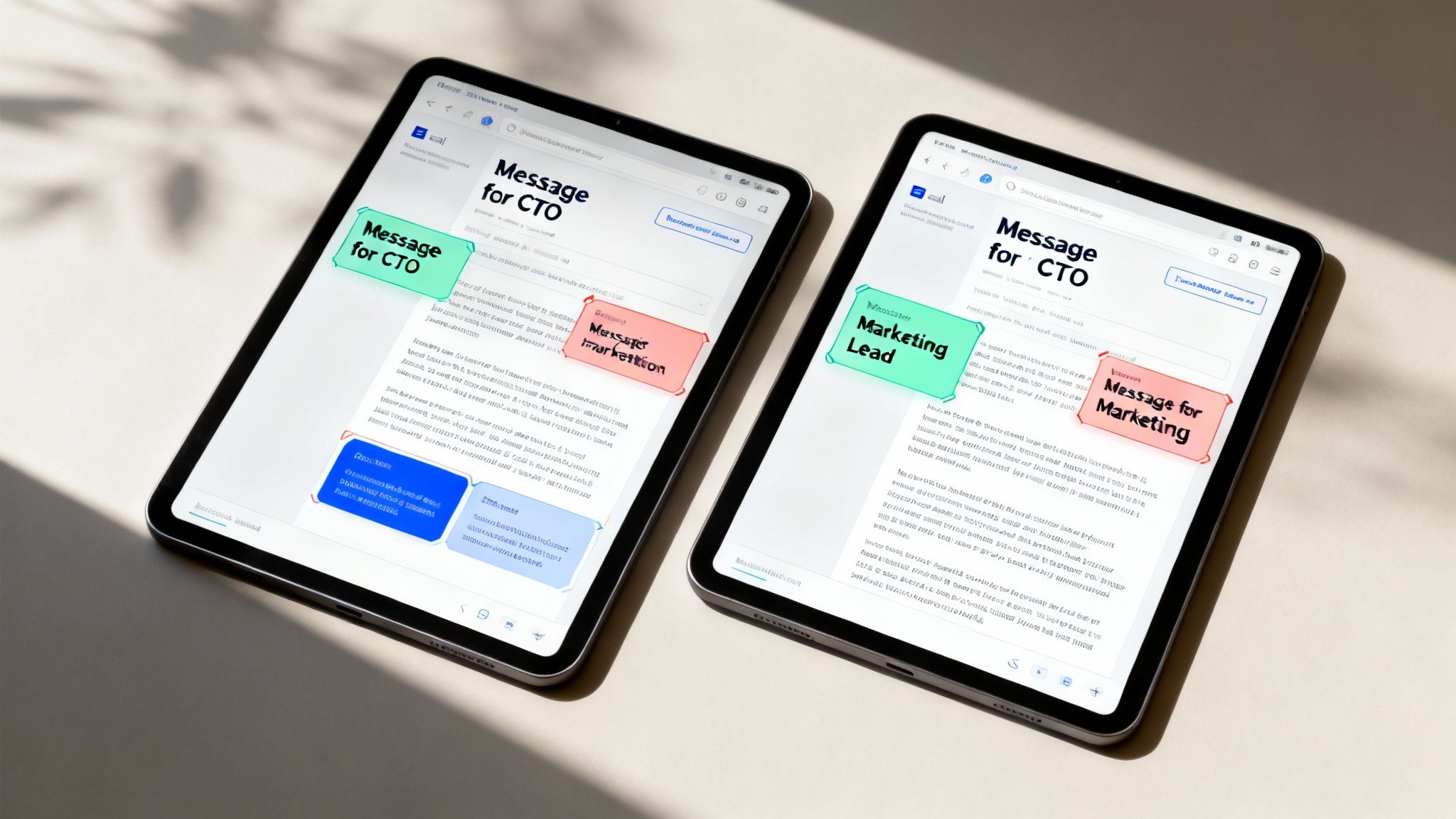
Personalization in B2B email marketing has evolved far beyond simply using a recipient's first name. True personalization involves deploying dynamic content blocks that adapt based on subscriber data like their role, industry, past behavior, and buying stage. This strategy ensures every email is as relevant as possible to the individual receiving it, transforming a one-to-many broadcast into a collection of one-to-one conversations.
This approach is one of the most crucial email marketing best practices B2B teams can master because it directly addresses the diverse needs within a single target account. Instead of sending a generic message to everyone on the buying committee, you can deliver content that speaks specifically to the financial concerns of a CFO and the technical requirements of an IT Director, all within the same campaign. This targeted relevance significantly boosts engagement, builds trust, and accelerates the sales cycle.
How to Implement Personalization and Dynamic Content
Effectively using personalization requires a solid data foundation and a clear segmentation strategy. Platforms like HubSpot and ActiveCampaign make it easy to build emails with dynamic blocks that change based on specific contact properties or list memberships. For instance, a SaaS company could show a case study relevant to the recipient's industry. The effective use of AI-driven tools can further enhance these strategies; you can learn more about how AI is shaping modern marketing to create even more sophisticated campaigns.
Here are a few actionable ways to put this into practice:
- Use Merge Tags and Dynamic Fields: Go beyond
{{first_name}}. Incorporate fields for company name, job title, or even a recent interaction to make your opening lines highly relevant and attention-grabbing. - Segment by Firmographics and Behavior: Create dynamic content blocks tailored to different buyer personas, company sizes, or industries. For example, a campaign for a cybersecurity firm could show different compliance features based on whether the recipient is in finance or healthcare.
- Implement Behavioral Triggers: Send automated, personalized emails based on user actions, such as visiting a specific pricing page, downloading a whitepaper, or attending a webinar. This ensures your message is both timely and contextually relevant.
- Personalize Calls-to-Action (CTAs): Don't use the same CTA for everyone. A new prospect might see a "Download the Ebook" button, while a lead in the consideration stage sees a "Book a Demo" button, guiding each segment to the most logical next step.
4. Strategic Subject Lines and Preview Text
Your subject line and preview text are the gatekeepers to your email's content. Long before a recipient engages with your carefully crafted copy or call-to-action, they make a split-second judgment based on this initial impression. In the B2B world, where inboxes are crowded and time is scarce, an effective subject line must be clear, benefit-driven, and highly relevant to the recipient's professional context.
This initial touchpoint directly dictates your open rates and is a critical component of successful B2B email marketing best practices. The goal is not just to get an open but to set the right expectation for the value contained within. Preview text, the short snippet of text visible next to the subject line in most email clients, acts as a critical extension, providing a secondary opportunity to entice the reader and elaborate on the core message.
How to Craft High-Impact Subject Lines and Preview Text
To master this crucial first impression, focus on delivering a clear value proposition while sparking just enough curiosity to earn a click. Companies like HubSpot and Salesforce have built their email marketing success on rigorous testing of different subject line formulas, from benefit-driven hooks to hyper-personalized messages.
Here are some helpful tips to get you started:
- Lead with a Clear Benefit: Instead of being vague, state the value upfront. For example, a subject line like "How [Competitor Company] increased lead quality by 30%" is far more compelling than "New marketing strategies."
- Optimize for Mobile: Keep subject lines between 41-50 characters to ensure they don't get cut off on mobile devices, where a significant portion of B2B professionals check their email.
- Use Preview Text Strategically: Don't let the preview text default to "View this email in your browser." Use it to complement the subject line. For a subject line like, "Is your data secure?", the preview text could be, "Our new report details the top 3 threats for Q4."
- Incorporate Specificity and Data: Numbers and statistics stand out in a crowded inbox. A subject line such as "Cut your team’s reporting time by 10 hours/week" is specific and promises a tangible outcome. A 2023 study by Campaign Monitor confirms that personalized subject lines can increase open rates by over 26%, reinforcing the need to move beyond generic messaging.
5. Lead Nurturing and Email Sequences
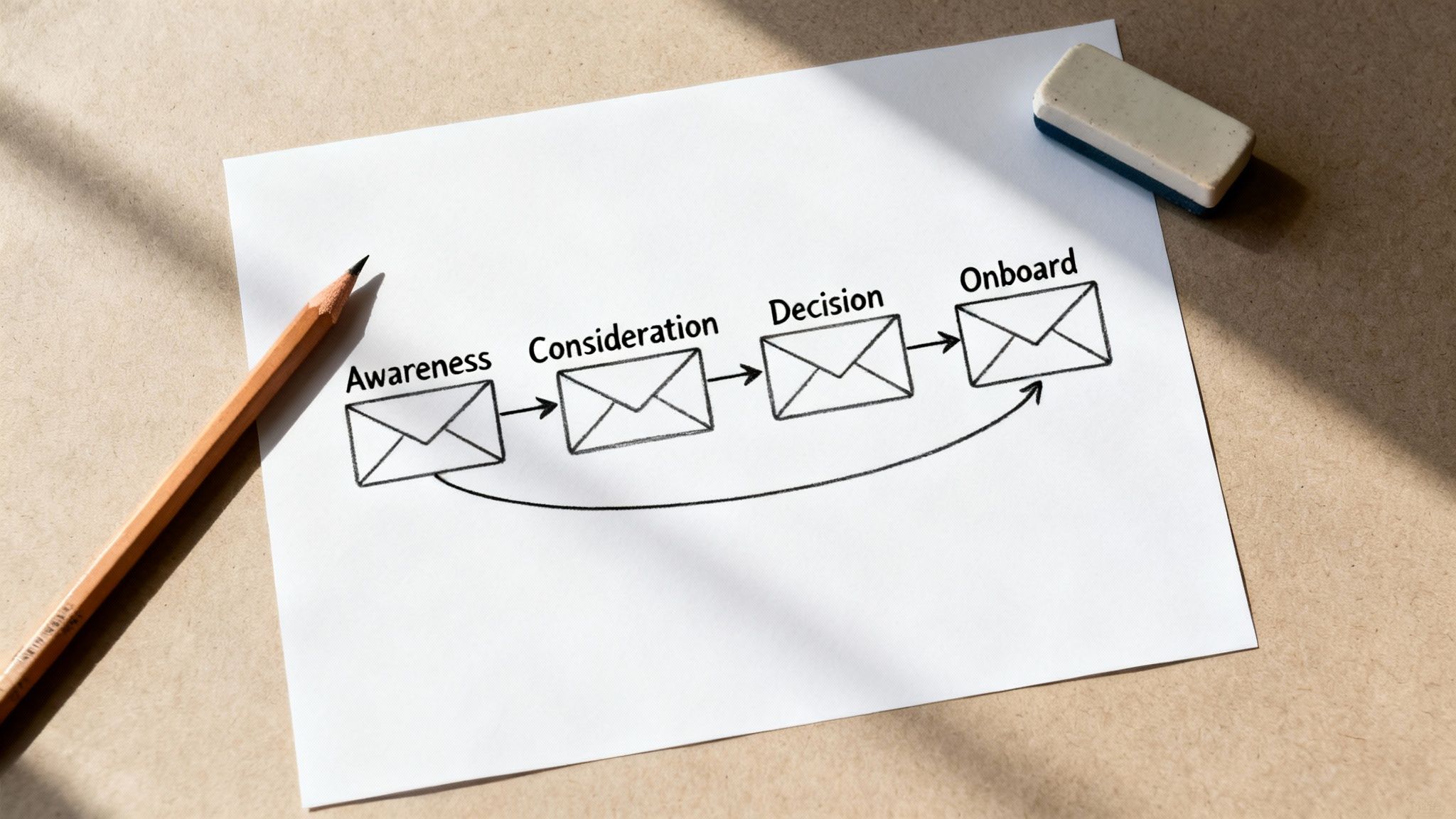
Lead nurturing is the automated process of building relationships with prospects who are not yet ready to buy. Instead of one-off blasts, this strategy uses a series of targeted emails, known as sequences, to guide potential customers through the buyer's journey. Each email delivers valuable, relevant content at the right time, establishing trust, demonstrating expertise, and gently moving leads from initial awareness toward a purchase decision.
This methodical approach is a cornerstone of effective B2B email marketing because it addresses the long and complex sales cycles typical in the industry. By providing consistent value, you keep your brand top-of-mind and position your solution as the ideal choice when the prospect is finally ready to engage with sales. Platforms like HubSpot and Marketo have popularized this model by enabling sophisticated, behavior-driven automation that feels personal and timely.
How to Implement Lead Nurturing in Your Email Strategy
Successful lead nurturing hinges on delivering the right message at the right moment. This means mapping your content directly to the stages of the buyer's journey and using automation triggers to advance prospects based on their engagement. For more in-depth strategies on initiating contact and developing relationships, refer to this detailed cold email playbook.
Here's how you can build effective nurture sequences:
- Map Content to the Buyer’s Journey: Align your emails with the prospect's stage. A lead in the "Awareness" stage needs educational blog posts or ebooks, while a lead in the "Decision" stage benefits from case studies, pricing information, or demo invitations.
- Use Behavioral Triggers: Automate sequence progression based on actions. If a prospect downloads a whitepaper on a specific feature, move them into a sequence that provides more detailed content about that feature's benefits.
- Space Emails Appropriately: Avoid overwhelming your audience. A typical cadence is one email every 3-7 days, but you should test this to see what works best for your audience. The goal is to stay present without being intrusive.
- Establish Clear Graduation Criteria: Define the exact point when a lead is "sales-ready." This could be a lead score threshold, a specific action like requesting a demo, or a combination of engagement signals. Once criteria are met, the lead is automatically passed to the sales team. You can learn more about building powerful email marketing sequences on mick-mar.com.
6. Value-Driven Content and Social Proof
B2B buyers operate on logic and risk mitigation, not impulse. Before committing to a solution, they need concrete evidence that it delivers on its promises. This is where incorporating value-driven content and social proof directly into your emails becomes a critical B2B email marketing best practice. Instead of simply telling prospects what you do, you show them the tangible results and successes others have achieved with your product.
This approach builds immediate credibility and trust by leveraging the power of third-party validation. By featuring testimonials, case studies, and quantifiable results from similar companies, you address a prospect's inherent skepticism and reduce the perceived risk of a new partnership. It effectively demonstrates that choosing your solution is a safe, proven, and valuable business decision.
How to Implement Social Proof in Your Email Strategy
Effectively weaving social proof into your emails requires more than just adding a quote; it's about strategically placing the right proof in front of the right audience at the right time. For instance, SaaS companies like Salesforce often feature a "logo bar" of well-known clients in their nurture emails to establish authority, while HubSpot embeds specific ROI statistics in sales outreach.
Here are a few ways you can add social proof to your emails:
- Feature Customer Logos Prominently: Add a visually appealing block in your email templates showcasing 2-3 logos of recognizable clients, especially those in the recipient's industry.
- Use Quantifiable Results: Don't just say a customer was successful. Use specific data points. For example, "See how [Client Name] increased their pipeline by 45% in Q3."
- Include Segmented Testimonials: Pull quotes from customers that match the recipient's persona, company size, or industry. A testimonial from a fellow startup founder will resonate more with another founder than one from a Fortune 500 executive.
- Leverage Third-Party Validation: Integrate ratings and badges from trusted review sites like G2 or Capterra directly in your email signature or footer. A 2023 G2 report on B2B buying behavior confirmed that 86% of buyers use peer review sites before making a software purchase, making this a powerful trust signal.
7. Mobile Optimization and Responsive Design
With a significant portion of B2B decision-makers checking their inboxes on the go, responsive email design is no longer an afterthought; it's a fundamental requirement. Mobile optimization ensures your emails are readable, look professional, and are fully functional across all screen sizes, from a large desktop monitor to a small smartphone. This practice is crucial because a poorly rendered email on a mobile device is often immediately deleted, wasting your campaign efforts.
This approach involves designing emails that automatically adapt their layout, font size, and images to fit the device on which they are viewed. Prioritizing a seamless mobile experience is a key component of modern email marketing best practices B2B, as it directly impacts accessibility, user engagement, and ultimately, conversion rates. An email that is difficult to read or navigate on a phone undermines your message and reflects poorly on your brand's attention to detail.
How to Implement Mobile Optimization in Your Email Strategy
Integrating a mobile-first mindset into your email creation process is essential for connecting with a modern B2B audience. Many email service providers now offer tools to simplify this. For instance, platforms like Stripo provide robust mobile optimization features and previews, allowing you to fine-tune your design for different devices before sending.
Here are some practical tips to ensure your emails look great everywhere:
- Adopt a Single-Column Layout: This is the most reliable structure for mobile rendering. It prevents horizontal scrolling and keeps your content in a logical, easy-to-follow vertical flow on narrow screens.
- Use Large Fonts and Buttons: Ensure your body text is at least 14-16px and that call-to-action (CTA) buttons are at least 44x44px. This makes them easily readable and "thumb-friendly" for tapping.
- Optimize Images and Alt-Text: Compress image files to ensure fast loading times on mobile networks. Always use descriptive alt-text, as many mobile email clients block images by default. The alt-text ensures your message still gets across.
- Test Extensively Before Sending: Don't rely on a single preview. Use tools like Email on Acid or Litmus to test how your email renders across dozens of different mobile devices and email clients. A 2023 report from Statista reinforces that over half of all emails are opened on mobile, making this testing step non-negotiable for campaign success.
8. Timing and Frequency Optimization
Sending the right message to the right person is only half the battle; sending it at the right time is equally critical. Timing and frequency optimization is the practice of strategically scheduling your emails to land in subscribers' inboxes when they are most likely to open, read, and engage. In the B2B world, where professionals are inundated with messages, timing can be the deciding factor between your email getting noticed or getting lost in the noise.
This B2B email marketing best practice moves beyond guesswork and relies on data to determine optimal send windows and a sustainable sending cadence. The goal is to maximize engagement rates while minimizing unsubscribe rates, ensuring your brand stays top-of-mind without causing email fatigue. Advanced strategies even account for individual behavior and geographic location, delivering a truly personalized temporal experience.
How to Implement Timing and Frequency Optimization
To effectively optimize your email schedule, you must adopt a test-and-learn mindset, leveraging your platform's capabilities to make data-driven decisions. For instance, platforms like HubSpot offer send time optimization features that analyze your past engagement data to suggest the best time to send an email to each individual contact, maximizing open rates.
Here's how to get smarter with your scheduling:
- Test Key B2B Sending Windows: While industry benchmarks are a good starting point, always test them against your own audience. Run A/B tests for different days (Tuesday, Wednesday, and Thursday are often B2B sweet spots) and times (typically around 9-10 AM and 2-3 PM local time) to find what works for your subscribers.
- Use Timezone-Aware Sending: If you have a geographically diverse contact list, sending a blast at 9 AM EST means it arrives at 6 AM PST. Utilize features within your marketing automation platform to send emails at the same local time for every recipient, ensuring it arrives during their working hours.
- Establish a Sustainable Cadence: Monitor unsubscribe rates and engagement trends closely. A sudden spike in unsubscribes might indicate you're sending too frequently. For most B2B contexts, a cap of two to three marketing emails per week is a safe maximum to avoid overwhelming your audience.
- Implement Behavioral Triggers: Go beyond static schedules by using behavioral triggers. An email sent immediately after a contact downloads a whitepaper or visits your pricing page is far more timely and relevant than a batch-and-blast newsletter. This ensures your message is delivered at the peak of their interest.
9. Analytics, Tracking, and Continuous Optimization
Successful B2B email marketing is not a “set it and forget it” discipline; it's a science that relies on measuring performance and continuously iterating based on data. By tracking key metrics and analyzing campaign outcomes, you can move from guesswork to a data-driven strategy that consistently improves results. This process involves more than just looking at open rates; it requires a holistic view of how email engagement translates into tangible business value.
This analytical approach is one of the most critical email marketing best practices B2B teams can master because it reveals what truly resonates with your audience. Tracking metrics like click-through rates, conversions, and ROI provides direct feedback on your messaging, segmentation, and calls-to-action. Advanced tracking, including UTM parameters and CRM integrations, connects email activity directly to sales pipeline and revenue, proving the value of your marketing efforts to stakeholders.
How to Implement Analytics and Optimization in Your Email Strategy
To effectively leverage analytics, you must establish a consistent tracking framework and a culture of continuous testing. For instance, platforms like HubSpot and Marketo offer integrated analytics that connect email performance directly to customer lifecycle stages, providing a complete picture of your funnel. This allows you to see not only who opened an email but how that interaction influenced their journey toward becoming a customer.
Here's how to turn your data into actionable insights:
- Establish Baseline Metrics: Before launching new campaigns, document your current performance. Know your average open rate, click-through rate, and conversion rate. This baseline will be the benchmark against which you measure all future improvements.
- Use UTM Parameters Consistently: Tag all links in your emails with unique UTM parameters to accurately track how traffic and conversions from specific campaigns perform in Google Analytics or other web analytics tools. This helps you attribute website activity directly to your email efforts.
- Implement Comprehensive A/B Testing: Go beyond subject lines. Test one variable at a time with a statistically significant sample size. Experiment with different CTAs, email body copy, sender names, and send times to identify what drives the best engagement.
- Create Automated Dashboards: Use tools like Tableau or your marketing automation platform to build real-time dashboards that track your most important KPIs. A 2023 study by the Data & Marketing Association found that organizations leveraging real-time data analytics were more likely to report significant revenue growth. To understand which metrics are most crucial, you can learn more about how to measure marketing ROI.
B2B Email Marketing: 9-Point Best Practices Comparison
| Strategy | 🔄 Implementation complexity | ⚡ Resource requirements | ⭐📊 Expected outcomes | 💡 Ideal use cases |
|---|---|---|---|---|
| Account-Based Marketing (ABM) Email Campaigns | High — intensive research, sales-marketing alignment | High — CRM/ABM platforms, analytics, dedicated team | ⭐ Very high ROI; larger deal sizes; shorter sales cycles | Targeting high-value enterprise or strategic accounts |
| Segmentation and List Hygiene | Medium — initial setup + ongoing maintenance | Medium — data tools, validation services, regular audits | ⭐ High deliverability; ↑ open/click rates; lower bounces | Large lists where deliverability and relevance matter |
| Personalization and Dynamic Content | Medium–High — template logic, data mapping, testing | High — clean CRM data, marketing automation, dev support | ⭐ Very strong engagement; up to 6x conversions | When rich subscriber data exists and relevance drives conversion |
| Strategic Subject Lines & Preview Text | Low–Medium — iterative A/B testing | Low — copywriting time, testing framework | ⭐ Significant uplift in open rates; cost-effective | Any email program seeking immediate open-rate gains |
| Lead Nurturing & Email Sequences | Medium — mapping journeys and triggers | Medium — content creation, automation workflows, CRM | ⭐ Increased sales-ready leads; smoother buyer progression | Multi-stage B2B funnels and long sales cycles |
| Value-Driven Content & Social Proof | Medium — case studies and approvals needed | Medium — customer interviews, design and copy resources | ⭐ Builds credibility; higher conversion and trust | Late-stage outreach and risk-averse buyers evaluating ROI |
| Mobile Optimization & Responsive Design | Medium — design + cross-client testing | Medium — responsive templates, testing tools (Litmus) | ⭐ Better mobile engagement; fewer format-related bounces | Audiences with high mobile-open rates (>50%) |
| Timing & Frequency Optimization | Medium–High — testing and segmentation by behavior | Medium — analytics, timezone tools, automation | ⭐ Improved open rates; lower unsubscribes when optimized | Global lists, multi-timezone audiences, cadence-sensitive sends |
| Analytics, Tracking & Continuous Optimization | High — instrumentation, attribution, analysis | High — analytics tools, CRM integration, analyst time | ⭐📊 Strongest long-term ROI; data-driven improvements | Mature programs seeking scalable, measurable growth |
Putting These B2B Email Practices Into Action
Navigating the landscape of B2B email marketing can feel like assembling a complex puzzle. We've explored a comprehensive array of strategies, from the surgical precision of Account-Based Marketing (ABM) to the critical, ongoing process of analytics and continuous optimization. The journey from a prospect's initial awareness to becoming a loyal advocate is not built on a single, groundbreaking email. Instead, it is forged through the consistent, integrated application of the very best practices we have detailed.
The core message is a fundamental shift in perspective: move from a mindset of volume to one of immense value. Your success doesn't hinge on how many emails you send, but on how many of the right emails you send to the right people at the right time. This is where mastering modern email marketing best practices b2b becomes a powerful competitive differentiator.
Your Blueprint for B2B Email Excellence
Let's distill our extensive list into a core, actionable blueprint. Think of these as the foundational pillars upon which your entire B2B email strategy should rest.
- Pillar 1: Precision Targeting. This begins with rigorous segmentation and unwavering list hygiene, and it finds its ultimate expression in targeted ABM campaigns. Stop broadcasting generic messages. Instead, focus your resources on engaging high-value accounts with content that speaks directly to their unique pain points and business objectives.
- Pillar 2: Hyper-Relevant Communication. Personalization is no longer a "nice-to-have" feature; it's an expectation. Use dynamic content to tailor your emails based on firmographics, behavior, and lifecycle stage. This, combined with strategic subject lines and compelling, value-driven content, ensures your message not only gets opened but also resonates deeply.
- Pillar 3: Automated, Nurturing Journeys. B2B sales cycles are often long and involve multiple decision-makers. Thoughtfully designed lead nurturing sequences and automation workflows are your key to staying top-of-mind, building trust, and guiding prospects through their buying journey without manual intervention for every single step.
- Pillar 4: Data-Driven Iteration. Your email program should be a living, breathing entity that evolves with every campaign. By diligently tracking analytics, A/B testing key elements like calls-to-action and email copy, and optimizing for timing and frequency, you transform your strategy from guesswork into a predictable, revenue-generating engine.
The True Impact of Mastering Your Email Strategy
Ultimately, implementing these B2B email best practices is about more than just boosting open rates and click-through rates. It’s about building and strengthening relationships at scale. Each personalized, well-timed, and valuable email is a deposit into your brand's trust bank. It demonstrates that you understand your audience, respect their time, and are genuinely committed to helping them solve their problems.
This approach transforms your email channel from a simple marketing tool into a central pillar of your customer relationship and revenue growth strategy. In a competitive market, particularly for SaaS, cybersecurity, and other complex B2B sectors, the companies that master this will not only capture more leads but will also foster the long-term loyalty that leads to higher lifetime value and sustainable business growth. The time to move beyond basic email blasts is now. The future belongs to those who embrace a smarter, more strategic, and more human-centric approach to the inbox.
Ready to elevate your B2B email marketing from a daily task to a strategic growth driver? The team at Mick-Mar Inc. specializes in implementing these advanced best practices to build high-performance email programs that deliver measurable results. Partner with us to turn your email channel into your most powerful revenue-generating asset.