Organic SEO optimization is all about making your website show up in search results naturally, without paying for ads. It's a mix of fine-tuning the technical side of your site, creating genuinely helpful content, and building up your site's reputation to pull in visitors who are actively looking for solutions just like yours.
Think of it as building a growth engine that runs on its own, instead of just chasing temporary rankings.
Why Bother With Organic SEO?
For a SaaS business, organic SEO isn't just another marketing channel—it's the bedrock of sustainable, predictable growth. It's the difference between renting attention through paid ads and earning it day in and day out. When you weave SEO into your main business goals, you create a flywheel that naturally drives down customer acquisition costs and positions your brand as a go-to expert.
This roadmap starts with understanding the three pieces that have to work together.

The Three Pillars of SaaS SEO
Let's think of a strong SEO presence as a three-legged stool. If one leg is wobbly, the whole thing falls over. They all need to be solid and work in harmony.
- Technical Integrity: This is your foundation, and it’s non-negotiable. It means making sure search engines can easily find, crawl, and understand your website. Without this, even the most brilliant content will remain invisible.
- Relevant Content: This is what reels in your ideal audience. Your job is to create content that directly answers the questions your potential customers are typing into Google, positioning your product as the clear solution.
- Genuine Authority: This is what tells search engines (and people) that you're trustworthy. You build it with quality backlinks from other respected sites, positive press, and a solid reputation in your industry.
These pillars are completely interconnected. Amazing content on a site with major technical problems won't rank. A technically perfect site with zero authority signals is just shouting into the void.
Organic Search Isn't Optional Anymore
If you're ignoring organic search, you're willingly giving up the biggest piece of the pie. It's truly that simple. A 2023 study by BrightEdge confirmed that organic search drives a staggering 53.3% of all website traffic—that’s more than paid search and social media combined.
Before we get into the nitty-gritty tactics, it’s worth taking a moment to really understand the core principles of organic SEO.
Conducting Your First Technical SEO Audit
Before we even start dreaming up content ideas or chasing backlinks, we have to look under the hood. A website’s technical health is the absolute foundation of any good organic SEO strategy. You can have the most brilliant content in the world, but if your foundation is shaky, the whole thing will eventually crumble.
For a SaaS business, a technical audit isn't just a one-off checklist. It’s about ensuring your entire platform—from the marketing pages to the app itself—is crystal clear to search engines. Let's get our hands dirty and root out the silent killers that might be holding you back.
Crawling and Indexing: Is Google Seeing Your Best Stuff?
First things first: can Google actually find and understand your most important pages? Search engines use bots (or "crawlers") to discover and index content across the web. If they can't get to a page, for all intents and purposes, that page doesn't exist in the search results.
Your job is to make this process as smooth and efficient as possible. The two most important files for this are your robots.txt file and your XML sitemap. Think of robots.txt as a set of instructions telling bots which doors to avoid, while the sitemap is a detailed map pointing them directly to the rooms you want them to see.
- Look for Accidental Blocks: You'd be shocked how often a developer accidentally leaves a "disallow" command in the
robots.txtfile from a staging environment, effectively making critical sections of your site invisible. - Keep Your Sitemap Fresh: Your sitemap needs to be a living document, automatically updating whenever you publish a new blog post, feature page, or landing page. A stale sitemap sends a bad signal and means your new content gets indexed much slower.
- Live in Google Search Console: The "Coverage" report inside Google Search Console is your new best friend. It gives you a direct line to Google, showing you exactly which pages have errors, which are fine, and which are excluded (and, crucially, why).
I once worked with a SaaS company that found their entire /solutions directory was blocked by a single line in their robots.txt file. Once we removed it, they saw a 30% lift in organic traffic to those high-intent pages in just six weeks.
Technical SEO is all about clearing the path for search engines to do their job. It's like paving the roads and putting up clear signposts so the crawlers don't get lost on their way to your best content.
Boosting Page Speed and Core Web Vitals
Nobody likes a slow website. Not your users, and definitely not Google. Google's focus on user experience, measured by Core Web Vitals, has become a serious ranking factor. These aren't just vanity metrics; they directly impact how users perceive your site's performance and usability.
There are three big ones to watch:
- Largest Contentful Paint (LCP): How long does it take for the main event—the biggest image or block of text—to load? You want this under 2.5 seconds.
- Interaction to Next Paint (INP): This new metric, which officially replaced FID in March 2024, measures how quickly your page responds to user interactions (like clicks or taps). Aim for under 200 milliseconds.
- Cumulative Layout Shift (CLS): How much do things jump around on the screen as the page loads? This measures visual stability and is incredibly annoying when done poorly.
A common culprit for SaaS sites? Huge, unoptimized images on feature pages or a ton of heavy JavaScript from marketing tools. The easiest way to get a snapshot is to run your key pages through Google's PageSpeed Insights tool. It's free and will give you a list of concrete fixes, like compressing images or deferring scripts that don't need to load right away.
Structuring Your Site for Success
A logical site structure does two things really well: it helps human users find what they need, and it helps search engines understand the hierarchy and relationship between your pages. For a SaaS business, this usually means a clean, clear hierarchy.
A simple but powerful structure often looks something like this:
- Homepage
- Features
- Feature A
- Feature B
- Solutions
- For Small Businesses
- For Enterprise
- Blog
- Category 1
- Post A
- Category 2
- Post B
- Category 1
- Features
This kind of clean architecture also makes it easier to implement another technical SEO powerhouse: schema markup. Schema is a bit of code you add to your site to give search engines more context about your content.
For a SaaS company, using "SoftwareApplication" schema can generate rich snippets in the search results, showing off your product’s rating, price, and key features. This instantly makes your listing more eye-catching and clickable than a competitor's plain blue link. Nailing this initial technical audit is your first major step in a successful organic SEO journey, setting the stage for all the great content and link-building to come.
Building Your Content Strategy with Topic Clusters
Once your site’s technical foundation is solid, it's time to build what goes on top of it. Great content is the engine for your organic seo optimization efforts, but just writing random blog posts is like throwing spaghetti at a wall. For SaaS, you need a deliberate strategy, and the topic cluster model is a total game-changer.
This approach shifts your focus from chasing individual keywords to owning entire topics. You’re not just answering a single query; you’re becoming the go-to authority, building trust with both your audience and search engines.
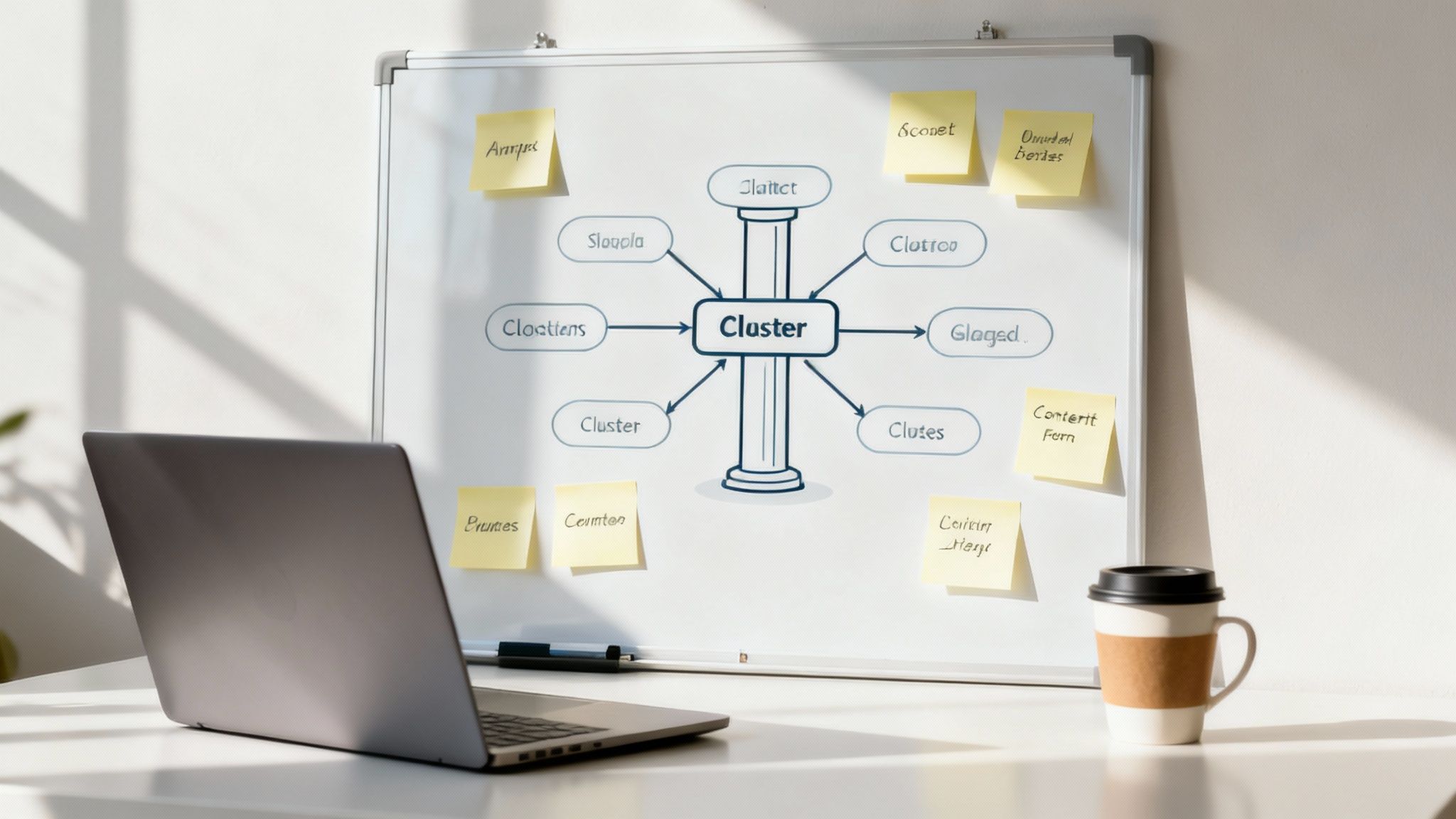
Identifying Your Pillar and Cluster Topics
The topic cluster model is built on two key components.
First, you have the Pillar Page. This is a massive, comprehensive guide covering a broad topic that's central to your product. Think of it as the ultimate resource, like "The Definitive Guide to Project Management Software."
Then you have your Cluster Content. These are shorter, more specific articles that dive deep into one particular aspect of the pillar topic. For example, you might write "How to Choose Project Management Software for a Small Team" or "Best Gantt Chart Features in PM Tools."
All of these cluster posts link back to the main pillar page. This creates a powerful, interconnected web of content that signals deep expertise to Google, helping your entire cluster rank higher. Your first move is to brainstorm those big-picture pillar topics that are directly tied to the problems your SaaS solves.
A Practical Keyword Research Process for SaaS
With a pillar topic in mind, the real work begins: finding the specific phrases your ideal customers are actually typing into Google. This isn't about chasing vanity traffic; it's about uncovering high-intent keywords that lead to sign-ups and demos.
A great way to start is by mapping keywords to the customer journey.
- Awareness Stage: People are just realizing they have a problem. They're asking questions like, "how to improve team collaboration remotely."
- Consideration Stage: They're now actively looking for solutions. Searches get more specific, like "best collaboration tools for marketing teams."
- Decision Stage: They're ready to pull the trigger. Keywords here are often comparative or brand-focused, such as "[Your Competitor] alternatives" or "Mick-Mar Inc. vs [Competitor]."
Tools like AnswerThePublic or just looking at Google's "People Also Ask" box are fantastic for finding real-world questions. These are pure gold for cluster content ideas. For a deeper look at this, our guide on combining content marketing and strategic communications can help you tie these keywords back to your larger business goals.
A keyword with 50 monthly searches that perfectly matches your product’s core use case is infinitely more valuable than a generic term with 5,000 searches that's only loosely related. Don't get distracted by big numbers.
Prioritizing Your Content Creation
After a few research sessions, you'll likely have a massive list of potential topics. It can feel pretty overwhelming. The key is to prioritize ruthlessly based on business impact. Instead of just writing what feels right, create a simple framework to decide what to tackle first. To see how others are approaching this, check out this piece on driving organic traffic through blog content.
For every potential topic, we recommend scoring it against three key factors:
- Commercial Intent: How likely is someone searching this to become a paying customer? "Project management templates" has much higher buying intent than "what is project management."
- Search Volume: How many people are looking for this each month? It’s not everything, but it helps you gauge the potential audience size.
- Product Relevance: How directly does this topic relate to a core feature of your SaaS? The tighter the connection, the higher it should be on your list.
To make this really tangible, you can use a simple prioritization table. It helps turn a long, messy list into a clear, actionable roadmap.
Content Pillar Prioritization Framework
This simple table can help you score and rank your topic ideas, ensuring you're always working on the content that will have the biggest impact on your bottom line.
| Topic Cluster Idea | Monthly Search Volume (Estimate) | Commercial Intent (Low/Med/High) | Direct Product Relevance (Score 1-5) | Priority Score |
|---|---|---|---|---|
| "Best software for agile teams" | 800 | High | 5 | High |
| "Kanban board examples" | 1,200 | Medium | 4 | Medium |
| "What is a sprint retrospective" | 2,500 | Low | 3 | Low |
By using a clear framework like this, you ensure every piece of content you create is a strategic asset. It shifts your organic seo optimization from a guessing game to a calculated plan for growth, focusing your limited resources on the articles most likely to attract and convert your ideal customers.
Fine-Tuning Your Content with On-Page SEO and Internal Links
Now that you have your content strategy and topic clusters mapped out, it's time to get into the details. This is where we focus on the elements that take a solid article and turn it into something that actually ranks. We're talking about on-page SEO and a smart internal linking plan.
Don't think of these as just checking boxes on a technical to-do list. They are critical for signaling to both people and search engines what your content is about and why it matters. Your content strategy is the blueprint for the house; on-page SEO is how you install the windows, doors, and signposts that make it easy for everyone to find their way around.

Crafting Titles and Descriptions That Earn Clicks
Your title tag and meta description are your first impression on the search engine results page (SERP). They’re your digital billboard. A great title and description can seriously boost your click-through rate (CTR), even if you’re not ranking in that coveted #1 spot.
A common mistake is just stuffing the primary keyword into the title and calling it a day. That's not enough. Your title needs to work like a compelling headline—it has to promise a real solution or spark enough curiosity to get the click, all while working your main keyword in naturally.
Then there's the meta description. While Google has said it’s not a direct ranking factor, it's essentially your ad copy. It's your chance to convince a searcher that your page is the one they're looking for. A great approach is to write it to answer the reader's "what's in it for me?" question.
Structuring Content with Clear Header Tags
Header tags (H1, H2, H3) are your best friends for creating a logical flow. They break up massive walls of text into easy-to-scan sections, which is absolutely essential for keeping readers engaged. But beyond that, they give search engines powerful contextual clues about how your information is structured.
Here's a simple hierarchy that works every time:
- H1 Tag: Only one per page. This is almost always your article's main title. It should state the page's core topic and feature your primary keyword.
- H2 Tags: Use these to break the main topic into its key components. Think of them as the chapters of your article. Try to weave in secondary keywords here whenever it makes sense.
- H3 Tags: These are perfect for breaking down your H2 sections even further. They’re great for organizing lists, steps, or specific examples.
This clean structure makes your content so much easier for people to read and for search bots to understand and index properly.
On-page SEO isn't about gaming the system. It's about clear communication. You're just organizing your content in a way that makes its value immediately obvious to both people and search engines.
The Art of Strategic Internal Linking
Internal linking is probably the most underrated tactic in an SEO's toolkit. It’s simply the act of linking from one page on your website to another. When you get this right, it achieves three incredibly important things.
First, it helps users find more of your content, keeping them on your site longer and guiding them from one relevant piece to the next.
Second, it passes authority—often called "link equity"—around your site. If you have a page that's earned a lot of high-quality backlinks, you can share some of that ranking power with other important pages just by linking out to them.
Finally, and most importantly for our strategy, it helps Google understand the relationships between your pages. This is where the topic cluster model truly shines. By consistently linking from your cluster articles back to their pillar page, you build a dense, semantically-related web of content. This reinforces your site's authority on the entire topic.
A non-negotiable rule: every new piece of cluster content must link back to its pillar page. After publishing, it's good practice to find at least 3 older, relevant posts and add a link pointing to the new one. This simple habit weaves a powerful internal web that strengthens your entire content hub over time.
Building Authority and Proving SEO's Worth
You've got a technically sound site and a smart content plan in place. Great. But that's just the foundation. Now comes the part where all that hard work translates into actual business growth: earning authority through backlinks and measuring what truly matters.
Without this, even the most brilliant organic seo optimization strategy is just a library of well-written articles no one ever finds.
Think of backlinks from other respected websites as votes of confidence. Every quality link signals to Google that your content is valuable and trustworthy, which is a huge ranking factor. The game isn't about getting the most links; it's about earning the right ones.
How SaaS Brands Can Actually Earn Links
Forget the spammy, outdated tactics you might have heard about. For a modern SaaS company, link building is really about creating things so genuinely useful that other sites want to talk about them. It’s less about "building" and more about "earning."
Here are a few approaches that consistently deliver results:
- Create a "Link Magnet" Tool: Build a simple, free tool that solves a nagging problem for your audience. It could be a niche calculator, a report generator, or a set of useful templates. These kinds of resources attract links naturally because they provide immediate value.
- Publish Original Data: Everyone loves fresh data. Run a survey, analyze anonymized usage data from your own platform, or compile hard-to-find industry stats into a compelling report. Journalists and bloggers are always on the hunt for new data to cite, and they'll link back to you as the source.
- Be a Smart Guest Contributor: Don't just blast out generic pitches. Hand-pick a few high-authority blogs where your ideal customers actually hang out. Offer them a genuinely helpful, non-promotional article that solves a real problem for their readers, with a natural link back to a relevant resource on your site.
Measuring What Moves the Needle, Not Just Rankings
Getting to the #1 spot for a keyword feels good, but it’s a vanity metric. Real success in organic seo optimization is measured by its impact on the business. Are you driving the right traffic? Is that traffic signing up for trials or booking demos?
To see the full picture, you have to track the right Key Performance Indicators (KPIs). This is all about connecting your SEO efforts to business outcomes.
The goal of SEO isn’t just to rank—it's to drive profitable customer action. Your measurement should always reflect that. Focusing only on keyword positions is like judging a car's performance by its paint color instead of its engine.
Your Go-To SEO Reporting Dashboard
A good dashboard tells a story, not just dumps data on a page. It should make it crystal clear how your work is fueling growth. You don't need a fancy, expensive setup to get started. A straightforward dashboard in Google Looker Studio can pull everything you need from Google Analytics and Search Console to give you a powerful overview.
Focus your dashboard on these key areas:
- Organic Traffic Growth: Keep an eye on the month-over-month and year-over-year growth in sessions from organic search. It's your highest-level health check.
- Lead and Conversion Quality: Don't just count sign-ups; qualify them. How many organic visitors started a trial? Requested a demo? Connect your analytics to your CRM to see which organic leads turn into paying customers.
- Top-Performing Content: Pinpoint which blog posts and landing pages are bringing in the most traffic and conversions. This shows you exactly what resonates with your audience so you can do more of it.
- Topic Cluster Visibility: Instead of getting lost tracking hundreds of individual keywords, monitor your overall visibility for your core topic clusters. Are you becoming the go-to resource for your main pillar topics?
Tracking these metrics isn't just about reporting; it's about proving the immense value of your work. The ROI of organic SEO is one of the highest in marketing. Research from 2023 shows that leads from SEO close at an average rate of 14.6%, which blows away the 1.7% from outbound methods. For B2B companies, a massive 57% of marketers say SEO is their top lead-generating channel. You can discover more insights about SEO ROI statistics and see how these numbers play out. When you build a clear dashboard, you’re not just tracking progress—you’re making the business case for investing in your organic growth engine.
Your First 90 Days of SaaS SEO
Knowing all the pieces of an SEO strategy is great, but figuring out where to actually begin can feel paralyzing. Let’s break it down into an actionable 90-day plan that helps you build momentum from day one. Think of this as your foundational sprint—the work you do here sets the stage for sustainable, long-term growth.
Month 1: Get Your House in Order
The first 30 days are all about laying the groundwork. You’ll kick things off with a thorough technical SEO audit to find and squash any underlying issues holding your site back. At the same time, you'll dive into keyword research to pinpoint those high-impact, low-hanging-fruit opportunities. Getting your technical house in order before you start creating new content is non-negotiable.
Month 2: Build Your Content Cornerstone
With a solid technical foundation, you can now shift your focus to content. The main goal for month two is to write and publish your very first pillar page. This is your cornerstone piece of content. While that's in the works, you'll also start the on-page optimization process for your most important existing pages, like your homepage and key product pages.
Month 3: Expand and Amplify
By the third month, you're ready to expand. The focus shifts to producing valuable cluster content—the supporting articles and blog posts that link back to and strengthen your new pillar page. This is also when you'll launch your first targeted outreach campaigns to start earning those critical backlinks.
It's this structured, compounding effort that ultimately drives real business results.
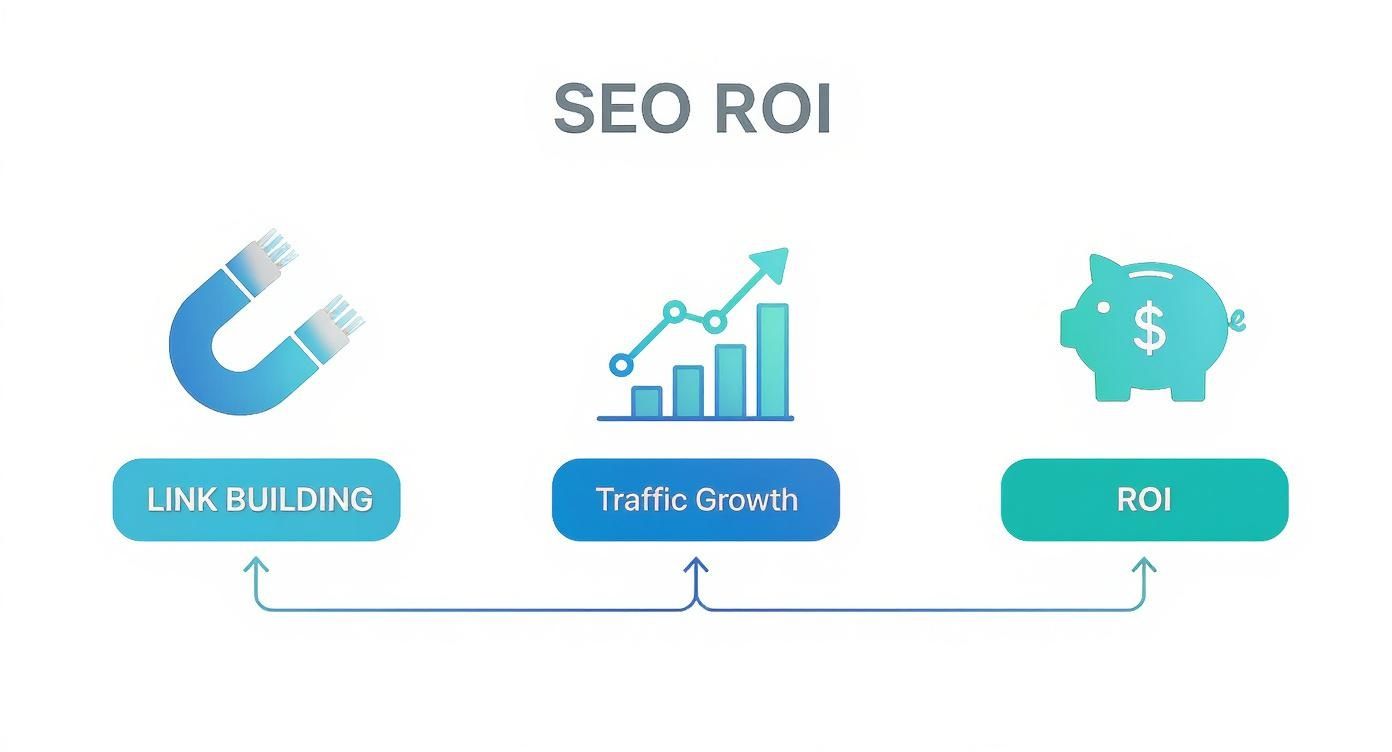
As you can see, strategic link building fuels traffic growth, which in turn leads to a measurable return on your investment. To keep this whole operation running smoothly as you grow, it’s worth exploring a framework like the content marketing operations maturity model to make sure your processes can scale with your success.
Frequently Asked Questions
When you're diving into the world of organic SEO optimization, a lot of questions pop up. That's completely normal, especially for SaaS businesses trying to build a solid growth engine. Here are a few of the most common questions we hear to give you some quick, straightforward answers.
How Long Does Organic SEO Optimization Take To Show Results?
This is always the first question, and the honest-to-goodness answer is that it takes time. You’re playing the long game here.
While you might see a small jump in a few weeks after fixing a major technical bug, the kind of significant, business-changing results from SEO generally start to become visible after 6 to 12 months.
Think of it less like a sprint and more like building a valuable asset for your company. The initial work—your technical audit, content foundations—is about laying the groundwork. Momentum builds from there as you consistently publish great content and earn authority in your space. Consistency beats short, intense bursts every single time.
What Is The Difference Between Organic And Technical SEO?
It's easy to see these terms as interchangeable, but they have a clear relationship. Organic SEO is the big picture—the entire strategy of getting your site to rank in search engines without paying for ads. It covers everything from content and link building to user experience.
Technical SEO is a crucial piece of that puzzle. Its job is to make sure search engines can easily crawl, index, and understand your website's structure and content.
You can think of it like this: If organic SEO is the race car you're building, technical SEO is the engine and chassis. You can have the slickest design and the best driver, but if the engine isn't sound, you're not going to win the race.
Should I Do SEO Myself Or Hire An Expert?
For an early-stage SaaS, tackling the basics of SEO in-house is a great move. It’s a fantastic way to really understand what drives growth for your specific business. A guide like this one, combined with free tools from Google, is more than enough to get an initial strategy moving.
But as you grow, SEO becomes a much bigger and more complex machine. The time commitment alone can be huge. That's when bringing in an experienced agency or consultant can really accelerate your results. They can bring deep competitive analysis, scaled-up content strategies, and advanced link-building that would be difficult to manage internally. Ultimately, it frees up your team to do what they do best—build an amazing product.
Ready to stop guessing and start growing? At Mick-Mar Inc., we build strategic SEO roadmaps that turn your website into a predictable lead-generation engine. Find out how we can help you grow.