B2B social media isn't about chasing the latest viral dance or meme. It’s a precision tool for building your company's authority, forging genuine relationships with potential buyers, and directly fueling revenue. Forget vanity metrics; this is about a focused playbook that drives real business growth.
Why B2B Social Media Requires a Different Playbook

It’s important to understand that what works for a B2C brand on TikTok or Instagram rarely translates to the complex world of B2B. A consumer brand might be chasing impulse buys with a flashy ad, but a B2B social strategy is a long game built on trust and credibility. Your goal isn't just to get a "like"—it's to earn a spot at the table when a company is making a major purchasing decision.
The B2B buyer's journey is the key reason for this difference. It's longer, far more considered, and usually involves multiple stakeholders. You're not trying to convince one person to buy a pair of sneakers; you're persuading a committee of decision-makers, each with their own unique problems and priorities.
From Vanity Metrics to Pipeline Influence
Success in B2B social media isn't measured by how many followers you have. We need to look past those surface-level numbers and focus on metrics that actually impact the bottom line.
Here’s what really matters:
- Lead Quality: Are you generating marketing qualified leads (MQLs) that the sales team is genuinely excited to follow up on?
- Pipeline Influence: Can you show how your social media touchpoints helped move a deal forward, even if social wasn't the final click?
- Account Engagement: Are you seeing likes, comments, and shares from key people at your target accounts? This is the lifeblood of any good Account-Based Marketing (ABM) program.
When you start tracking these metrics, social media stops being a simple broadcast channel and becomes a powerful sales intelligence tool. Seeing a key stakeholder from a dream account engage with your latest whitepaper gives your sales team the perfect, warm entry point for a conversation. If you're looking to lay this groundwork, our guide on how to build brand awareness is a great place to start.
The real power of B2B social media is its ability to educate, build authority, and warm up prospects long before they ever talk to a sales rep. It effectively shortens the sales cycle.
Adapting to a Mobile-First B2B World
The way business professionals consume information has changed. They're not just chained to their desks anymore; they're scrolling through their feeds on the go, just like everyone else.
Recent data backs this up. A 2023 report from Statista highlights that 43% of B2B buyers are now from the millennial generation, a demographic that grew up with mobile technology. This shift means your content—from your graphics to your video captions—has to be designed for the small screen if you want to capture their attention.
Laying the Groundwork for a Winning Strategy
A great B2B social media strategy isn't about guesswork or chasing viral trends. It’s built on a solid foundation. Before you ever write a single post, you need to get crystal clear on who you're talking to, what your competitors are doing, and what success actually looks like for your business. Skipping this groundwork is the difference between a social media presence that just makes noise and one that generates real, measurable revenue.
Stop Talking to Everyone: Define Your Ideal Customer Profile
Generic buyer personas can be a waste of time in B2B. You need to go deeper and build a rock-solid Ideal Customer Profile (ICP). This isn't just about a company's industry or size; it's about pinpointing the exact type of organization that gets massive value from what you do. Once you know the company, you can identify the key people inside it.
Think about the cast of characters involved in any B2B purchase:
- The End-User: This is your person in the trenches, maybe a "Marketing Manager" who's completely fed up with clunky reporting tools. What are their day-to-day headaches? What would make their job ten times easier?
- The Decision-Maker: This could be the "VP of Marketing" who holds the budget. They don't care about features; they care about ROI, efficiency, and making a sound business decision.
- The Blocker (or Enabler): Think IT, finance, or legal. They're focused on security, integration, and cost. Their biggest fear is a new tool that disrupts the existing tech stack or blows the budget.
When you map out these different roles, you realize they need completely different things from you on social media. The end-user craves practical tips and tricks. The VP wants to see a case study proving a clear financial win.
Do Some Smart Reconnaissance: Your Competitive Analysis
Once you know who you’re targeting, it helps to see what they’re already hearing from others. A B2B competitive analysis isn't about copying what others are doing. It's about finding the gaps in the conversation—the empty space where your brand can become the go-to expert.
Start digging. Ask yourself:
- What topics are my competitors focusing on?
- What formats seem to work for them? Is it video, long-form text, or simple infographics?
- What's the general vibe of their best posts? Is it formal and corporate, or more personal?
- And here's the most important question: What are they not talking about? This is your opportunity.
Let's say you notice every competitor is posting high-level, abstract "thought leadership." You can immediately stand out by creating super-practical, "how-to" content that solves an immediate problem. If their feeds are a sea of corporate blue and bland stock photos, you can win with a more human, behind-the-scenes feel.
A great competitive analysis doesn't lead to imitation. It leads to differentiation. It’s about finding the empty space on the court where you can play your own game—and win.
Set Goals That Your CEO Actually Cares About
Likes and shares are nice, but they don't pay the bills. If you want to prove your worth and secure a real budget, your social media efforts have to be tied to tangible business outcomes. The C-suite isn't as concerned about retweets as they are about revenue.
Ditch the vanity metrics and start building your reports around KPIs that show you're moving the needle. Your primary job is to guide potential customers from casual observers to qualified leads. These are the numbers that matter.
Here's what your leadership team wants to see:
| Metric Category | Key Performance Indicator (KPI) | Why It Matters to Leadership |
|---|---|---|
| Lead Generation | Marketing Qualified Leads (MQLs) | This shows social media is a direct source of potential customers. |
| Sales Enablement | Sales Qualified Leads (SQLs) | This proves your social leads are high-quality enough for the sales team. |
| Pipeline Impact | Pipeline Influence (Attributed Revenue) | This connects your social activities to actual deals in the works. |
| Financial ROI | Cost Per Acquisition (CPA) | This demonstrates how efficiently you're turning your budget into customers. |
When you nail down your ICP, size up the competition, and set these kinds of meaningful goals from day one, you've built a real strategic framework. This foundation ensures every post, video, and comment has a purpose, pulling you closer to measurable business success.
Choosing Platforms and Crafting Content That Converts
Trying to be everywhere on social media is a guaranteed way to dilute your impact and burn out your team. The secret to effective B2B marketing on social media isn't about blanketing every platform; it’s about making smart, strategic choices. You have to go deep on the channels where your Ideal Customer Profile (ICP) is actively looking for solutions and create content that genuinely helps them.
This focus is what separates a successful plan from a scattergun approach. This concept map breaks down the foundational steps: you start with your ICP, analyze what competitors are doing, and set clear KPIs. Those first steps then dictate every platform and content decision you make.
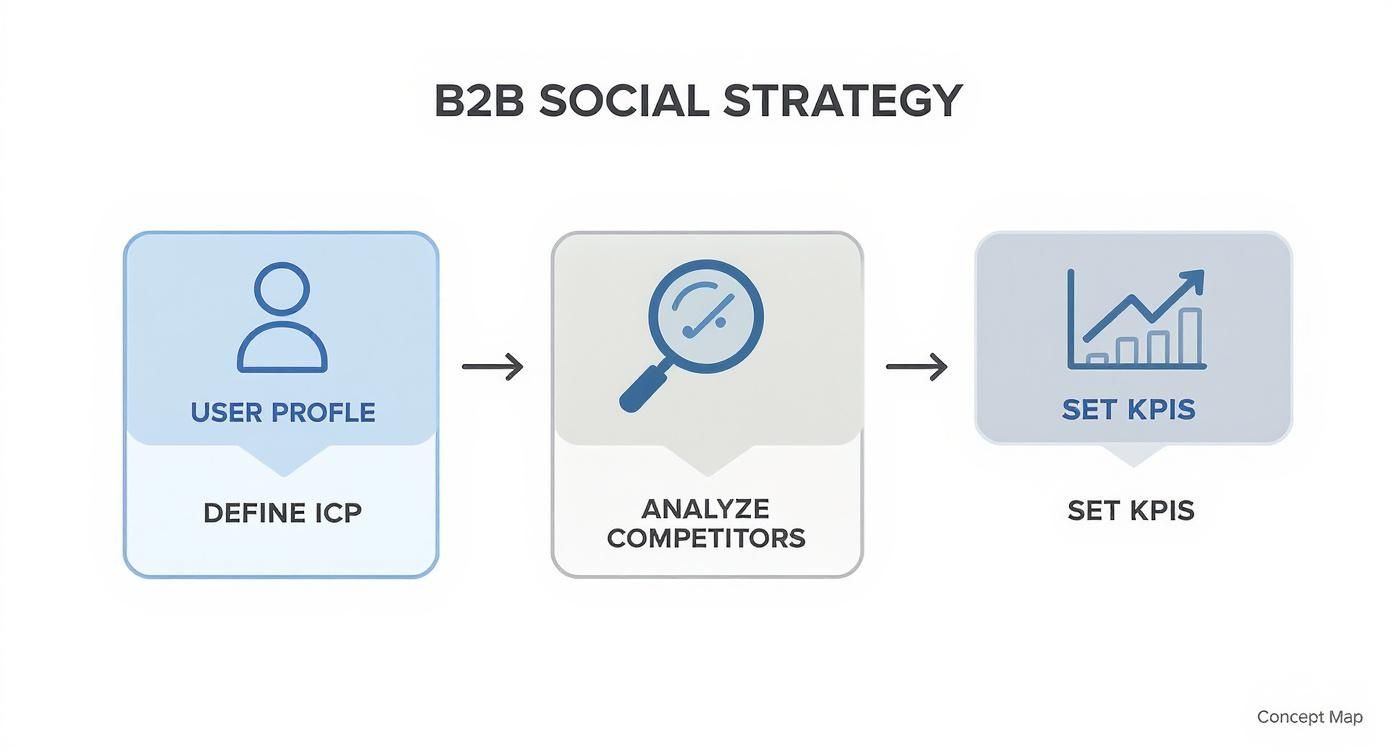
As you can see, each element builds on the last, ensuring your content strategy is targeted and measurable right from the get-go.
Mastering the B2B Powerhouse Platforms
Instead of spreading yourself thin, let’s focus on the heavy hitters in the B2B world. Each platform serves a distinct purpose. Mastering their unique strengths is the key to building a cohesive strategy that actually moves prospects through the buyer's journey.
Choosing the right mix of platforms is critical for a B2B social media strategy. This table breaks down the key strengths of the most effective channels, helping you align your efforts with your business goals.
B2B Social Media Platform Strengths
| Platform | Primary B2B Use Case | Best Content Formats | Key Strategic Focus |
|---|---|---|---|
| Lead generation, thought leadership, and professional networking. | In-depth articles, case studies, company milestones, expert analysis. | Building authority and connecting directly with decision-makers. | |
| X (Twitter) | Real-time engagement, industry news, and brand personality. | Quick insights, polls, short video clips, links to blog posts. | Joining timely conversations and monitoring industry pulse. |
| YouTube | Product education, customer storytelling, and in-depth tutorials. | Demos, webinars, customer testimonials, how-to guides. | Visually demonstrating value and building trust through transparency. |
| Top-of-funnel brand awareness and targeted advertising. | Short videos, infographics, employee spotlights, community building. | Leveraging powerful ad-targeting for specific industries or roles. |
By focusing your resources on the platforms that make the most sense for your audience and goals, you'll see a much greater return on your time and investment.
A Practical Framework for B2B Content
Now that you know where to post, let’s talk about what to post. A sustainable content strategy doesn’t require reinventing the wheel every day. It's built on a few core pillars you can return to again and again, which prevents the dreaded "what should we post today?" panic.
Your content should do one of three things: solve a problem, provide a unique perspective, or prove your value. If it doesn't do one of these, it's just noise.
Think of your content plan as a matrix built on these foundational pillars:
-
Thought Leadership: This is where you share your unique point of view. It's not about selling; it's about teaching. Post analyses of industry reports, make bold predictions, or offer a contrarian take on common wisdom. This pillar positions your brand—and its key people—as trusted experts. If you want to dive deeper, our guide on developing B2B thought leadership offers a complete roadmap.
-
Problem-Solving Guides: Your ICP has specific, nagging problems. Create content that directly addresses them. This could be a short "how-to" video, a checklist infographic, or a text post detailing a common mistake and how to avoid it. This content is incredibly valuable because it offers immediate utility and builds goodwill.
-
Compelling Social Proof: B2B buyers are risk-averse. They need to see that you've delivered results for companies just like theirs. Use social media to showcase customer testimonials, highlight impressive results from a case study, or share a powerful quote from a happy client. Exploring advanced video marketing strategies for social media can make this social proof even more impactful.
By building your content calendar around these pillars, you create a balanced and effective feed. You’ll consistently deliver value, build trust, and gently guide prospects toward a conversation with your sales team.
Using Paid Social to Amplify Your Reach
Let's be honest: relying only on organic social media for B2B growth is a slow, unpredictable grind. While it’s fantastic for building a genuine community, organic reach alone will never get your best content in front of enough of the right people.
This is where paid social completely changes the game. Think of it as a powerful amplifier, turning your organic foundation into a predictable, scalable lead-generation engine. It lets you cut through the noise of algorithms and speak directly to your Ideal Customer Profile (ICP).
Recent research underscores this shift. According to Sprout Social's 2023 data, 64% of marketers now see paid social as a more effective channel than organic social. It’s clear that paid campaigns are no longer optional—they’re a core part of any serious B2B marketing strategy. You can dig deeper into these numbers by exploring these B2B social media trends on intentsify.io.
Getting it Right with LinkedIn Ads
For most B2B companies, LinkedIn is the undisputed king of paid social. Its professional context and incredibly detailed targeting options make it the perfect place to connect with high-value decision-makers. But simply "boosting" a post and hoping for the best is a waste of money. You need to know the tools in your toolkit and when to use each one.
Here’s a breakdown of the key ad formats you'll be working with:
-
Sponsored Content: These are the native ads you see right in your feed, marked with a small "Promoted" tag. They blend in perfectly and are incredibly versatile. This is your go-to for promoting your best content—think whitepapers, case studies, or webinar recordings—to a much wider, but still highly relevant, audience.
-
Sponsored Messaging: Formerly known as InMail, this format lets you slide right into the LinkedIn inboxes of your target audience. It's a much more personal touch, making it ideal for high-value offers like event invitations or personalized demo invites. A word of caution: use this sparingly and only with a compelling offer, or you’ll quickly be seen as spam.
-
Lead Gen Forms: This is, without a doubt, the most powerful tool for B2B lead capture on the platform. When someone clicks your CTA, instead of being sent to an external landing page, a form pops up right inside LinkedIn, pre-filled with their profile info. This slashes the friction to almost zero and can massively boost conversion rates for content downloads and demo requests.
The real magic of LinkedIn Ads isn't just the ad formats themselves; it's the surgical precision of the targeting. You can go so far beyond basic demographics and build audiences based on job titles, seniority, company size, industry, and even specific skills people list on their profiles.
Building Hyper-Targeted Audiences
The granular targeting on LinkedIn is what truly sets it apart for B2B marketers. This is where your ICP research pays off, allowing you to ensure every dollar of your ad budget is spent reaching only the most relevant professionals.
Imagine you're a SaaS company selling project management software to enterprise tech firms. Instead of a "spray and pray" campaign, you can build an audience that includes:
- Job Titles: "Project Manager," "Head of Operations," "Program Director"
- Company Size: 1,000+ employees
- Industry: Computer Software, Information Technology and Services
- Location: United States, United Kingdom, Canada
Want to get even more specific for an Account-Based Marketing (ABM) push? You can upload a list of your target company names. LinkedIn will then match those companies to its user base, letting you serve ads exclusively to employees at your dream accounts. This level of precision is a game-changer for aligning sales and marketing.
Mapping Your Full-Funnel Paid Strategy
A smart paid social strategy doesn't just chase a single action. It guides people through their entire buying journey, from awareness to decision. This requires a full-funnel approach, with campaigns tailored to each specific stage.
-
Top-of-Funnel (Awareness): The goal here is simple: introduce your brand to a cold audience that may not know you exist. Use Sponsored Content to promote high-level thought leadership, industry reports, or engaging short videos. You’re providing pure value with no strings attached.
-
Mid-Funnel (Consideration): Now it's time to capture a lead. You'll retarget the people who engaged with your awareness content. This time, offer them something more substantial in exchange for their contact info—a webinar, an ebook, or a free tool. Use a Lead Gen Form to make it a no-brainer.
-
Bottom-of-Funnel (Decision): Here, you’re talking to high-intent prospects, like people who have visited your pricing page or downloaded a key asset. Use Sponsored Messaging or retargeting ads to offer a personalized demo, a free trial, or a powerful case study. The messaging needs to be direct, confident, and focused on solving their problem.
By mapping out this journey, you stop shouting into the void and start having strategic conversations. You create a cohesive experience that nurtures prospects over time, turning your paid social spend from a line-item expense into a direct driver of revenue.
How to Measure Success and Prove Your ROI

Let's be blunt: if you can't connect your social media activity to actual revenue, your budget will always be on the chopping block. Proving the value of B2B social media isn't just about feeling good—it's about survival. You have to move past vanity metrics like likes and shares and focus on what the C-suite actually cares about: leads, pipeline, and closed deals.
The real goal is to draw a straight, undeniable line from a LinkedIn post to a new customer contract. It sounds daunting, but it’s entirely possible with the right tracking and a clear understanding of what matters at each stage of the buyer's journey.
Connecting the Dots From Social to Sales
Before you do anything else, you need a rock-solid tracking system. Without it, you're just guessing, unable to attribute any downstream success back to your campaigns. The aim is to see precisely how a user who clicked on a post eventually became a paying customer.
This all starts with a simple but incredibly powerful tool: UTM parameters. These are just little snippets of code you add to the end of a URL that tell your analytics tools exactly where a visitor came from.
For example, a well-structured UTM link for a LinkedIn post promoting a new ebook might include:
- Source:
utm_source=linkedin - Medium:
utm_medium=social-organic - Campaign:
utm_campaign=q4-ebook-launch
When someone clicks this link, their entire journey gets tagged. This data then flows into your marketing automation platform (like HubSpot) and your CRM (like Salesforce), letting you see exactly which social media activities are bringing in the highest-quality leads.
Key Metrics to Track at Every Funnel Stage
A great B2B social media report tells a story. It shows how you’re building an audience of the right people, converting them into leads, and ultimately influencing revenue. You need to present the metrics that reflect this entire journey.
Don't just show what happened; explain why it matters. Frame every metric in the context of business goals. Instead of "We got 500 likes," try "Our engagement with target accounts increased by 20%, leading to 15 new MQLs."
Here are the essential KPIs to have in your reporting dashboard:
-
Top-of-Funnel (Awareness & Engagement):
- Follower Quality: Forget raw numbers. What percentage of new followers actually match your Ideal Customer Profile (ICP)?
- Engagement Rate by Post: Pinpoint which topics and formats genuinely resonate with your target audience.
- Reach & Impressions (by ICP): How many of the right eyeballs are seeing your content?
-
Mid-Funnel (Lead Generation):
- Click-Through Rate (CTR): Are your CTAs compelling enough to get people to your website or landing pages?
- Marketing Qualified Leads (MQLs): How many leads coming from social channels meet the baseline criteria to be handed over to sales?
- Cost Per Lead (CPL): For paid campaigns, how efficiently are you acquiring new leads?
-
Bottom-of-Funnel (Revenue & ROI):
- Sales Qualified Leads (SQLs): How many of those social MQLs has the sales team actually accepted and started working?
- Pipeline Influence: How much potential revenue sitting in the sales pipeline had a social media touchpoint?
- Customer Acquisition Cost (CAC): What's the all-in cost to acquire a new customer through your social channels?
Building Your Monthly Performance Report
Your monthly report needs to be a clean, concise dashboard that screams business impact. Don't drown your stakeholders in data; focus on the numbers that tie directly back to revenue. To really drive the point home, a social media ROI calculator can help you translate your efforts into clear financial terms.
By consistently tracking these metrics, you change the entire conversation around B2B marketing social media. It stops being a "nice-to-have" and becomes a predictable, measurable engine for growth.
Got Questions? We've Got Answers on B2B Social Media
Even the most well-planned strategy runs into real-world questions. Once you get into the daily grind of managing your social media, you’ll inevitably wonder about the details. From posting schedules to dealing with that one grumpy comment, here are the answers to the questions we hear most often from B2B marketers.
How Often Should We Be Posting?
This is the classic "it depends" question, but we can give you a more satisfying answer than that. The goal isn't just to fill the feed; it's to consistently be a valuable voice in your industry. Quality always trumps quantity.
Think about it: a B2B company that shares one genuinely insightful, data-backed post on LinkedIn twice a week will perform better than a competitor that spams out five generic articles a day. Start with a pace you can actually maintain without your content quality taking a nosedive.
Here’s a good starting point:
- LinkedIn: Aim for 3-5 high-quality posts a week. This is your professional stage, so focus on sparking conversations, sharing deep expertise, and celebrating company wins.
- X (formerly Twitter): This is where you can be a bit more conversational and frequent. Posting 1-3 times a day is common, mixing your own content with relevant shares and jumping into industry chats.
- YouTube: Video takes serious effort, so don't burn yourself out. Aiming for one polished, valuable video every 1-2 weeks is a fantastic goal for building a dedicated audience.
The right posting frequency is whatever you can stick to without compromising the quality of what you share. If you're feeling stretched, it’s far better to post less often and make every single post count.
How Should We Handle Negative Comments?
First off, don't panic. A negative comment isn't a crisis—it's actually an opportunity. You have a chance to show everyone watching how you handle feedback. Ignoring it is the worst possible move; it makes you look like you don't care. A quick, professional response, on the other hand, can turn a bad situation around.
The trick is to have a simple game plan ready. Acknowledge their point publicly, right there on the post. Then, immediately offer to take the conversation offline to DMs or email to sort out the specifics. This approach shows you're responsive and take feedback seriously, all without getting dragged into a public back-and-forth.
Should Social Media Be Integrated With Our Other Marketing?
Yes, absolutely. Your social media presence shouldn't be an island. A truly powerful B2B marketing social media strategy is woven directly into everything else you're doing. It’s both a megaphone for your message and a listening device for your audience.
Here’s how it should connect:
- Content Marketing: You create a brilliant whitepaper. What next? You promote it on social media. The questions and comments you get from that promotion? That’s fuel for your next blog post. It's a perfect feedback loop.
- Email Marketing: Use your social channels to get people excited about your newsletter and grow your subscriber list. You can also run highly targeted ads to specific segments of your email list, making sure your message hits them on multiple fronts.
- Paid Search: The language your customers use on social media—their specific pain points, their questions, the slang they use—is absolute gold. Use those exact phrases to write more effective ad copy for your PPC campaigns.
It’s no surprise that paid social media now ranks among the top five channels for B2B ROI. This success is built on tight integration and smart targeting. For example, some findings on B2B social media trends show that retargeting ads on LinkedIn can boost click-through rates by up to five times. That’s the power of a connected strategy.
At Mick-Mar Inc., we specialize in building these kinds of cohesive marketing strategies that turn social media into a predictable engine for business growth. If you're ready to move beyond just posting and start building a real revenue-driving machine, let's talk. Explore our B2B marketing services.