
Your competitive market position is simply the space you own inside your ideal customer’s mind. It's the gut feeling they have about your B2B SaaS product and the clear, compelling reason they'd pick you over anyone else.
Think of it as your brand's unique identity in a sea of competitors. It answers the two most important questions: how are you different, and why should anyone care?
What Is Competitive Market Position in B2B SaaS
Let’s make this real. Imagine you're at a crowded farmer's market. You could set up your stall right between two other vendors selling the exact same red apples. Or, you could find a great spot on the corner and sell artisanal honey. That unique corner spot—the one that draws a specific crowd—is your competitive market position. It’s a deliberate choice to stand out rather than blend in.

In the B2B SaaS world, this isn’t just some fluffy marketing idea. It's a critical factor for survival. When you have a strong market position, your sales and marketing efforts just work better. Your message lands because you’re talking to the right people about the right problems. You stop fighting on price and start winning on unique value.
To get a clearer picture, let's break down the core elements that define your position.
Core Components of Competitive Market Position
This table outlines the fundamental building blocks of a strong market position. Think of these as the ingredients you need to get right to create a compelling identity for your SaaS.
| Component | Description | Example for a SaaS Company |
|---|---|---|
| Target Audience | The specific segment of the market (ICP) you serve best. | A project management tool not for everyone, but specifically for agile software development teams of 10-50 people. |
| Unique Value Proposition | The primary benefit you deliver that no one else can match. | While other tools offer general task tracking, this one provides AI-powered sprint predictions to prevent delays. |
| Key Differentiators | The specific features, services, or business model that set you apart. | It's the only tool that integrates directly with both GitHub and a company's financial planning software. |
| Brand Perception | The way customers think and feel about your company and product. | Known as the "developer's choice"—reliable, powerful, and built by people who understand code. |
Getting these four components aligned is the first, most crucial step. When they work together, they create a powerful and defensible position in the market.
Why Your Position in the Market Matters
A well-defined market position is the foundation for your entire business strategy. Seriously. It touches everything from the features you decide to build next to the tone of voice your support team uses.
Without one, you're just another commodity. You’re stuck in an endless loop of reacting to competitors, slashing prices, and fighting feature-for-feature battles you can’t win.
A solid position gives you real, tangible advantages:
- It Clarifies Your Value: You're forced to get crystal clear on what problem you solve and for whom. This makes it incredibly easy for the right customers to "get" what you do.
- It Focuses Your Efforts: Your position becomes the North Star for every team. It ensures product, marketing, and sales are all pulling in the same direction, which is a core tenet of effective product marketing.
- It Creates a Brand Moat: When customers mentally link your brand to a specific solution (e.g., "the best tool for X"), it becomes incredibly difficult for a competitor to steal them away, even with a lower price.
A strong competitive market position isn't about being better than everyone else at everything. It’s about being meaningfully different in a way that your ideal customers truly value.
The Growing Need for Differentiation
If you think it's noisy out there now, just wait. The pressure to differentiate is only getting more intense. A 2023 report projects the global B2B marketing market will grow significantly, underscoring a massive influx of new players and strategies. You can get more details on this expanding market from 360iResearch.
What does that mean for you? More competition. More noise. More generic messages that customers have learned to ignore.
In this environment, a powerful market position is your signal in the noise. It cuts through the chaos to attract the customers you're built to serve and helps you build a business that lasts.
How to Diagnose Your Current Market Position
Before you can chart a course forward, you need to know exactly where you’re standing. Think of diagnosing your competitive market position as a check-up for your SaaS business. It’s an honest, unflinching look at your strengths, your weak spots, and the real opportunities hiding in plain sight.
This isn't about bringing in expensive consultants. You can conduct a powerful positioning audit yourself just by asking the right questions. It’s how you replace gut feelings and assumptions with a clear, data-driven picture of where you stand today.

Modernizing the SWOT Analysis for SaaS
The old SWOT analysis (Strengths, Weaknesses, Opportunities, Threats) is a decent starting point, but let's be honest, it can feel a bit academic. To make it genuinely useful for a SaaS company, we need to adapt it to the realities of the software world.
Instead of thinking in broad strokes, ask sharper, more specific questions:
- Strengths: What do we actually do that our customers would be lost without? Forget your feature list for a second. Focus on the unique value they get from you and only you.
- Weaknesses: Where are we consistently losing deals? Get brutally honest. Is it a product gap? Is our pricing model wrong? Is our onboarding a nightmare?
- Opportunities: Is there an underserved niche or an unsolved problem that perfectly fits our core strengths? This is where you might find your next big growth lever.
- Threats: What could a competitor launch that would make a core part of our product obsolete overnight? Think about disruptive tech like new AI integrations or a surprise new player entering your space.
Framing it this way shifts the focus from an internal naval-gazing exercise to a practical, market-facing one. It’s all about seeing your business through your customers' eyes.
Your Diagnostic Checklist
To get the full picture, you need to collect intelligence from three places: your customers, your team, and the market itself. Use this checklist as your guide. The answers you find will piece together to show you your true position.
1. Customer Perception Questions
This is where the real truth is. Your position isn’t what you claim in your marketing copy; it's what your customers actually believe.
- What three words do your best customers use when they describe your product to a colleague?
- If you went out of business tomorrow, who would they use instead, and why?
- What was the specific "aha!" moment when they knew your tool was the right choice?
The goal is to uncover the "mental real estate" you currently own. As marketing pioneers Al Ries and Jack Trout explained, positioning is a battle for the mind. Understanding what's already in your customer's mind is the first step.
2. Internal Team Questions
Your sales and support teams are on the front lines every single day. They hear the unfiltered feedback, know the real objections, and spot patterns that leadership can easily miss.
- What’s the #1 reason we win a deal? Be specific.
- What’s the #1 reason we lose a deal? Don't sugarcoat it.
- If we were forced to keep only one feature, which would it be and why?
3. Market Landscape Questions
Finally, zoom out and look at the world around you. In an environment where search engines like Google dominate the landscape, your online presence and reputation are everything.
- Who are the top three competitors showing up in search when you look for your own solution?
- What's their core message, and who are they clearly trying to attract?
- Where are they getting mentioned (on review sites, blogs, podcasts) where you aren't?
Answering these questions honestly gives you the raw material you need. You'll uncover hidden strengths to lean into, critical weaknesses to fix, and most importantly, a clear starting point for building a winning strategy.
Grasping your competitive market position isn't about relying on a gut feeling. It’s about deciphering the story your data is telling you. To truly understand where you stand, you have to move past vanity metrics and dig into the key performance indicators (KPIs) that reveal the real health of your business in the market.
These numbers are your compass. They guide your strategy, helping you spot both dangers and opportunities long before they become critical issues. It’s all about building a dashboard that gives you an honest, real-time view of your competitive strength. A huge part of this is diagnosing your current standing, and mastering competitive intelligence for SaaS is non-negotiable.
When you track the right metrics, you can turn those vague feelings about your position into solid, actionable insights.
Leading vs. Lagging Indicators
To build a useful dashboard, you first need to know the difference between two kinds of metrics: leading and lagging indicators.
Think of it like driving a car. Lagging indicators are your rearview mirror—they tell you where you’ve been and confirm the results of your past actions. Leading indicators are your windshield—they show you what’s coming up ahead and help you anticipate the future.
- Lagging Indicators are the result of past performance. Metrics like Market Share or Customer Lifetime Value (LTV) fall into this camp. They confirm whether your past strategies actually worked.
- Leading Indicators help predict future outcomes. Things like Share of Voice (SoV) or Net Promoter Score (NPS) are leading. They can signal a shift in the market long before it ever hits your revenue reports.
A smart measurement strategy always includes a healthy mix of both. Lagging indicators validate your journey, while leading indicators help you steer.
A KPI Dashboard for Competitive Health
To put this into practice, you need a clear view of which metrics to track and what they're telling you. Some give you a look at past performance (lagging), while others offer a glimpse into the future (leading). Here’s a breakdown of the essential KPIs that paint a full picture of your competitive health.
| KPI Category | Metric | What It Tells You About Your Position |
|---|---|---|
| Customer Perception | Net Promoter Score (NPS) | A leading indicator of customer loyalty and advocacy. A high score means your value resonates deeply and you have a strong brand moat. |
| GTM Efficiency | Customer Acquisition Cost (CAC) | A crucial leading indicator. If your CAC is climbing, it might mean your differentiation is fading and you're having to pay more to be heard. |
| Product Stickiness | Customer Lifetime Value (LTV) | A powerful lagging indicator of a healthy, valuable product. A high LTV confirms your product is solving a real, ongoing problem for customers. |
| Market Dominance | Market Share | The ultimate lagging indicator. It's the final score, showing the percentage of the market you've successfully captured. |
| Brand Visibility | Share of Voice (SoV) | A critical leading indicator that measures your brand's presence in the conversation versus competitors. A rising SoV often precedes growth in market share. |
This blend of metrics is what transforms data from a simple report card into a strategic tool. You get to see the results of your work while also getting early warnings about what you need to do next.
Customer-Centric Positioning Metrics
At the end of the day, your customers are the ultimate judges of your market position. The following metrics reveal just how strong your brand and product really are from their perspective.
- Net Promoter Score (NPS): This classic metric simply asks, "How likely are you to recommend us?" A high NPS is a fantastic leading indicator of a strong, defensible position built on genuine loyalty. It means your product isn't just a tool; it's something people are willing to vouch for.
- Customer Acquisition Cost (CAC): This is what it costs you, in total, to win a new customer. A steadily rising CAC can be an early warning that your message is getting lost in the noise or your differentiation is weakening, forcing you to spend more to get noticed.
- Customer Lifetime Value (LTV): This metric predicts the total revenue you can expect from a single customer. A high LTV, especially when your LTV-to-CAC ratio is healthy (ideally 3:1 or higher), is a powerful lagging indicator. It proves you've built a sticky product that customers value over the long haul.
Tracking these metrics together tells a much richer story. For instance, a high NPS combined with a low CAC points to a powerful brand that pulls customers in organically—a clear sign of a winning competitive position.
Market-Focused Performance Metrics
While customer metrics give you an internal view, market-focused KPIs measure your influence and standing relative to everyone else. They tell you how much space you command in the broader industry conversation.
These external-facing metrics are vital. Having effective marketing operations is what allows you to not only track these KPIs but also turn that data into a real strategic advantage.
- Market Share: The classic lagging indicator. This is your company's slice of the total sales pie in your industry. While it can be tricky to measure with 100% accuracy in niche SaaS markets, it’s the ultimate confirmation of dominance.
- Share of Voice (SoV): A crucial leading indicator, SoV measures your brand's visibility compared to your competitors. It includes social media mentions, press, and review site traffic. A growing SoV is often a precursor to growing market share.
- Category Ownership: This is less a single number and more a qualitative goal. It’s about how often your brand name comes up when people discuss a specific problem or software category. Becoming synonymous with a category (like HubSpot is with "inbound marketing") is the absolute pinnacle of a strong competitive market position.
Four Levers to Sharpen Your Competitive Position
Knowing where you stand in the market is just the start. The real work—and the real advantage—comes from actively improving that position. Once you have a clear diagnosis of your strengths and weaknesses, you can start making targeted moves.
Think of it like this: your strategy has four main levers you can pull. Pulling the right one at the right time can dramatically sharpen your competitive market position. These aren't just isolated tactics; they are the core tools you'll use to carve out a stronger, more defensible space in your market.
Let's break down each one: Product, Pricing, Messaging, and Go-to-Market (GTM).
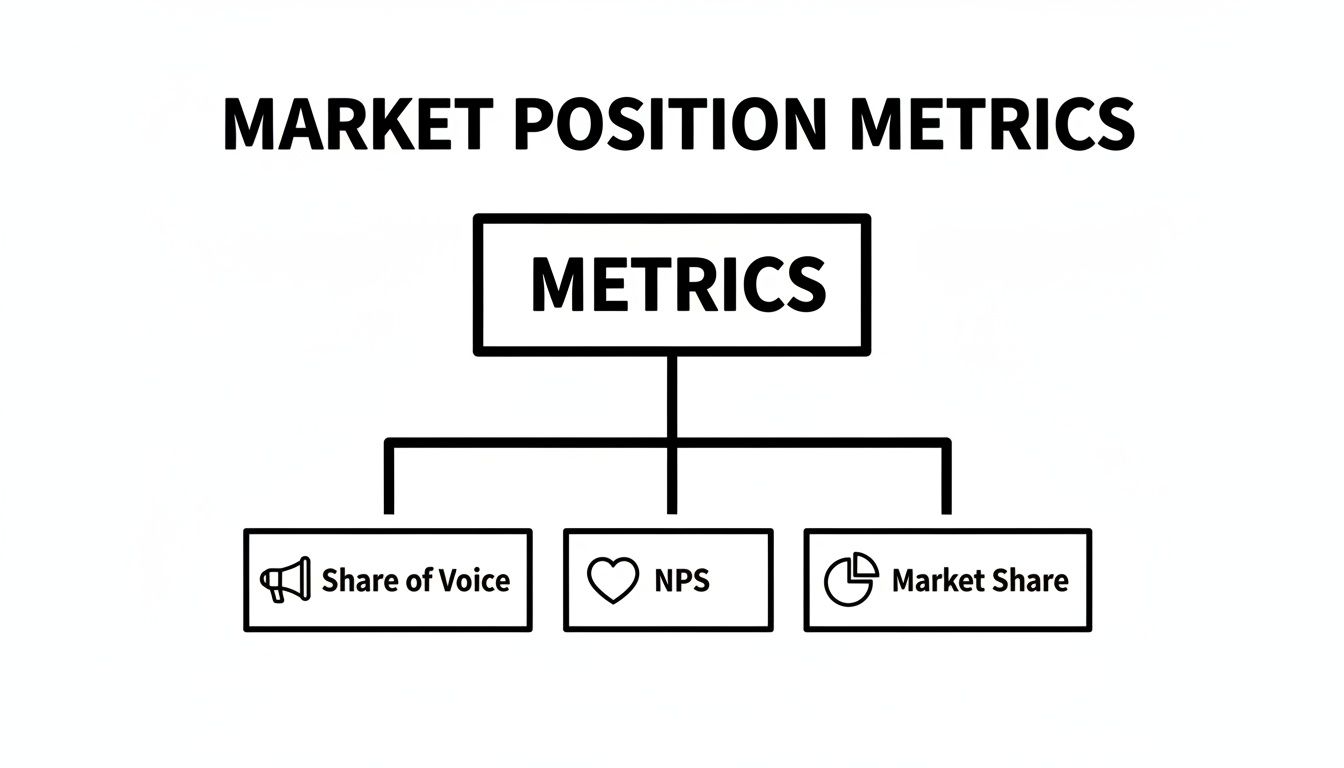
These metrics—Share of Voice, Net Promoter Score (NPS), and Market Share—are the vital signs of your market health. A fantastic product fuels a high NPS, while a sharp GTM strategy boosts your Share of Voice. Get those two right, and you're well on your way to capturing more Market Share.
Lever 1: Product Innovation
Your product is arguably the most powerful lever you can pull. A truly standout product creates its own gravity, pulling in customers and making competitors feel like a distant afterthought. This isn’t about just tacking on more features; it’s about building a “feature moat.”
A feature moat is a capability that solves a customer's core problem so perfectly that it becomes the reason they buy from you and a massive headache for anyone trying to copy you. It’s not a checklist item; it’s a core part of your DNA.
To dig that moat, you need to:
- Solve a Niche Problem Perfectly: Don't try to be a decent solution for everyone. Instead, become the absolute must-have solution for a very specific group.
- Build Proprietary Integrations: Forge connections between workflows that your competitors can't easily replicate. Make your tool the central hub.
- Offer Unique Data or Insights: Use the data you're collecting to provide predictions, benchmarks, or insights that customers simply can't get anywhere else.
Lever 2: Strategic Pricing
Pricing is so much more than a number on a page—it's a billboard for your brand. How you price your SaaS sends a loud and clear signal about who you are, what kind of value you deliver, and who you’re built for.
Moving to value-based pricing, for example, is a classic power move. By tying your price to the economic value and ROI your customer gets, you immediately anchor yourself as a premium, results-driven solution. The conversation shifts from "How many features do I get?" to "What business outcomes can I expect?" which is a much stronger position to defend.
Your pricing shouldn't be based on what your competitors charge or what it costs you to run your servers. It should be a direct reflection of the value you create for your customers. This mindset shift is central to establishing a premium market position.
Other pricing strategies can also shape perception:
- Freemium Models: Can help you attract a huge user base and quickly become the industry standard, making it hard for new entrants to get a foothold.
- Tiered Pricing: Creates clear on-ramps for different customer segments, allowing you to position specific tiers for specific needs and budgets.
Lever 3: Compelling Messaging
If your product is the "what" and your pricing is the "how much," your messaging is the "why anyone should care." This is how you translate all your internal strategy and product value into a story that actually connects with your ideal customer. A strong position is often won or lost on the clarity and punch of this story.
The foundation of great messaging is a rock-solid positioning statement. This is an internal document, a North Star that crisply defines what you do, who you do it for, and what makes you the only real choice. It's the source code for every piece of copy your company produces.
A killer positioning statement is always:
- Audience-Focused: It speaks directly to the pain points and ambitions of your target customer.
- Differentiated: It clearly and simply articulates what makes you different and better.
- Provable: It's not just marketing fluff; it's backed by real features, customer results, and tangible proof.
Once you nail this down, every blog post, sales deck, and tweet should echo that core message, building a brand perception that’s impossible to ignore.
Lever 4: Go-to-Market Execution
Your Go-to-Market (GTM) strategy is the final, crucial lever. It’s the engine that delivers your product, pricing, and messaging to the world. A brilliant product with a perfect message will go nowhere if it isn't put in front of the right people through the right channels. Are you fishing in the right ponds?
A 2023 Gartner report found that B2B CMOs allocated a significant portion of their budgets to brand strategy and demand generation, highlighting the intense focus on reaching the right buyers effectively. This investment underscores that a great product is only half the battle. You can review more B2B marketing budget benchmarks to see how you stack up.
To sharpen your GTM, you need to constantly ask:
- Channel Effectiveness: Are we putting our money where our customers actually are? Or are we just doing what we've always done?
- Sales Process Alignment: Does our sales team truly understand our positioning and know how to use it to close deals?
- Content Distribution: Is our expert content actually reaching the right people and building the authority we need to drive leads?
By systematically working these four levers—Product, Pricing, Messaging, and GTM—you can stop passively occupying a market position and start actively building a dominant one.
How Winning B2B SaaS Brands Position Themselves
Theory is useful, but the real lessons are found in the wild. Success always leaves clues. If you look closely at the B2B SaaS brands that are truly winning, you’ll see they didn't get there by accident. They built a powerful competitive market position by making very deliberate choices.
These companies didn't just try to be better; they chose a specific hill to own and defend. Let's break down a couple of playbooks to see exactly how they carved out their space.
Miro: The Visual Collaboration Hub
Take Miro. They certainly didn't invent the digital whiteboard. What they did was far more clever: they positioned themselves as the essential hub for visual collaboration. Miro’s founders saw that creative and distributed teams were getting stuck, unable to brainstorm, plan, and work together in a way that felt fluid and natural.
So, what strategic levers did they pull?
- Product Innovation: They didn't just build a tool; they created an environment. The "infinite canvas" wasn't just a gimmick. It was a core tenet of their value proposition, fundamentally changing how teams could work by removing physical and digital boundaries.
- Go-to-Market (GTM) Strategy: Miro went all-in on product-led growth. Their freemium model was the perfect Trojan horse, allowing individuals and small teams to fall in love with the product for free. These passionate users then became internal champions, driving adoption up the chain to the entire enterprise.
This one-two punch of an incredibly intuitive product and a viral adoption model allowed Miro to first create and then completely dominate the visual collaboration category. They weren't just another project management tool. They became the canvas where ideas are born.
A strong brand position is a mental association that connects a specific buyer need with your unique solution. As FedEx did for "overnight shipping," winning SaaS brands aim to "own" a category in their customer's mind.
Dominating a Niche: A Vertical SaaS Example
But you don't have to be a massive, horizontal platform like Miro to win. In fact, some of the most durable businesses are built by going deep, not wide. Imagine a SaaS company built from the ground up to manage operations for multi-location restaurant chains.
Their positioning is incredibly sharp by design.
- Messaging: Every blog post, ad, and sales call speaks the language of restaurateurs. They aren't talking about "asset management"; they're talking about managing food costs, standardizing employee schedules across five locations, and streamlining supply chain logistics. They address the pains a generic tool could never grasp.
- Product: The platform is packed with features that would seem pointless to an outsider but are critical for a restaurant operator. Think direct integrations with niche POS systems or built-in modules for tracking food safety compliance.
This intense focus creates a defensive moat that's almost impossible for a generalist competitor to cross. When a growing restaurant group is looking for software, the choice is simple. Do they pick the generic project tool that might work, or the one built by people who live and breathe their industry? The vertical player has already won because they are, by far, the most relevant solution.
If you're looking for more great examples, you can explore other successful B2B SaaS case studies that show just how powerful this kind of sharp positioning can be.
Ultimately, these examples prove that a winning position is the result of deliberate, strategic choices. It’s about clearly defining who you serve, what unique value you alone can provide, and then aligning every fiber of your company to deliver on that promise, flawlessly.
Your Action Plan for Building an Unbeatable Position
Knowing where you stand in the market is one thing. Actually carving out a dominant position is a whole different ballgame. It’s time to move from analysis to action.
Great positioning isn’t a one-and-done project. Think of it as a continuous discipline—listening, learning, and making adjustments to stay a step ahead of everyone else. This plan is your roadmap to start improving your competitive market position today. Don't get overwhelmed; just focus on one manageable step at a time to build momentum.
Your Immediate Next Steps
You don't need a huge budget or a week-long leadership retreat to make progress. You can start right now with a few small, high-impact actions that will lay the groundwork for a much stronger market presence.
Here’s a simple checklist your leadership team can get done this quarter:
- Schedule a Positioning Workshop: Get your key people from product, marketing, sales, and customer success in a room for a half-day. The only goal? Review what you've learned and hash out a draft of your new positioning statement.
- Define Your Core KPIs: Coming out of that workshop, pick three to five metrics to be your positioning dashboard. You'll want a good mix: a leading indicator like Share of Voice (SoV), a customer-focused metric like Net Promoter Score (NPS), and a hard business metric like your LTV-to-CAC ratio.
- Prioritize One Strategic Lever: You can't fix everything at once. For the next 90 days, choose just one of the four levers—Product, Pricing, Messaging, or GTM—to focus on. Maybe that means tweaking a pricing tier or sharpening your website copy. Just pick one.
Execute and Iterate
Once your priorities are set, it’s all about execution. For winning B2B SaaS companies, a solid go-to-market (GTM) strategy is the engine that drives product launches and market share growth. If GTM is your chosen lever, commit to a tangible change, like testing a new content channel or giving your sales team a refined talk track.
The most important part of this entire process is the feedback loop. Don't just launch a change and forget about it. Watch your positioning KPIs like a hawk to see if your moves are actually working.
This constant cycle of analysis, action, and measurement is what separates true market leaders from everyone else. By following this plan, you’ll gain the clarity to not just compete, but to start setting the rules of the game in your market.
Frequently Asked Questions About Market Positioning
Stepping into the world of competitive market position can feel like opening a can of worms. It’s a dense topic, but getting it right is a cornerstone of any solid B2B SaaS strategy. Let's tackle some of the most common questions we hear from founders and marketing leaders.
How Often Should We Re-Evaluate Our Competitive Market Position?
That’s a great question, and something we get asked all the time. For a full, deep-dive re-evaluation, you should be looking at this annually or anytime you see a major shake-up in the market (like a new competitor or a technology shift). Think of it as a thorough yearly check-up for your entire go-to-market strategy.
But that doesn't mean you can set it and forget it for the other 11 months. You should have a pulse on your core positioning KPIs—like Share of Voice and Net Promoter Score—every month or quarter. These are the quick health checks that spot a problem before it grows into a full-blown crisis.
Can We Have a Strong Position in Multiple Markets?
It's tough, but absolutely possible. The biggest mistake you can make is trying to be everything to everyone with one generic message. When you do that, you end up being a weak choice for everybody.
The secret is treating each market as its own unique puzzle. To make it work, you almost always need:
- Distinct Messaging: This means creating value propositions that speak directly to the specific problems and language of each audience.
- Product Variations: In some cases, you might even need slightly different feature sets or pricing plans to hit the mark in each segment.
Your goal isn't to be vaguely relevant to a broad audience, but to become intensely relevant to a few, specific ones.
What's the Difference Between Brand Positioning and Market Positioning?
It’s easy to get these two tangled up, but they play very different roles. They're related, but one is about strategy and the other is about perception.
Market positioning is the analytical work of deciding where your product fits within the competitive landscape. Brand positioning is the creative work of shaping the story, feeling, and identity that exists in your customer's mind.
Here’s a simple way to think about it: Your market position is choosing your spot at the farmers' market—you decide to be the stall selling "artisanal, locally-sourced honey." Your brand position is everything else: the story you tell about your bees, the design of your jars, and the warm, expert feeling people get when they talk to you. Your market position tells you where to set up the stall; your brand position is how you make people love it.
Our Product Has Many Features How Do We Position It?
Every founder with a feature-rich product feels this pain. You have a powerful urge to just list everything your product can do, but that's a classic trap that leads to a confusing message. People don't buy a list of features; they buy a solution to a nagging problem.
Instead of rolling out a laundry list, focus.
- Pinpoint the one or two features that give you a truly unique and defensible advantage.
- Then, tie that advantage directly to a pain point felt by a specific audience.
For instance, "We have 20+ integrations" is a boring fact. "We are the only platform that instantly syncs your sales and support data, killing information silos for your revenue team" is a solution. That kind of focus is what a winning competitive market position is all about.
Ready to stop reacting and start defining your market? Mick-Mar Inc. specializes in building powerful marketing strategies that give B2B SaaS companies a true competitive edge. Schedule a consultation with us today and let's build your unbeatable position together.