Branding a service business is about so much more than a cool logo or a catchy name. It’s the art of shaping how clients perceive your expertise and trustworthiness long before they ever see a proposal. Think of it as carving out your unique space in the market, crafting a message that resonates, and building a reputation that not only attracts the right clients but also justifies your premium value.
Why Your Brand Is Your Biggest B2B Asset
In the B2B space—especially for services in SaaS, cybersecurity, or consulting—your brand isn’t just some fluffy marketing concept. It's the core of your growth strategy.
Think about it. Unlike a physical product someone can hold or test, your service is completely intangible. Clients can’t “test drive” your expertise. What they’re really buying is the promise of a result, and that promise is delivered and guaranteed by your brand.
A strong brand becomes a mental shortcut for your clients, instantly communicating your value, reliability, and what makes you different. In a sea of competitors offering seemingly similar services, your brand is what pulls the conversation away from "How much does it cost?" to "How can you solve our problem?".
The Financial Impact of a Strong Brand
Putting real effort and budget into your brand isn't just an expense; it’s a direct investment in your bottom line. It touches everything, from the quality of your leads to the loyalty of your clients.
The data backs this up. B2B service companies typically dedicate a hefty 10.33% of their revenue to marketing—significantly more than the 8.52% spent by B2B product companies. This isn't an accident. That extra investment underscores just how critical a strong brand is for building the trust needed to stand out.
A well-defined brand shortens the sales cycle. When prospects already trust your reputation and understand your value proposition, your sales team can focus on solving problems instead of building credibility from scratch.
Ultimately, your goal is to build a reputation that precedes you. When a potential client has a problem you can solve, your company should be the first one they think of. This guide is your friendly roadmap to building that kind of unforgettable, high-value brand.
Turning Your Brand into a Lead Magnet
A powerful brand is one thing, but it needs to be seen to be effective. This is where your marketing strategy comes in. To really turn your brand into a B2B asset that generates leads, a solid understanding of SEO for B2B is non-negotiable.
Here’s how a strong brand directly fuels better marketing results:
- Builds Trust at Scale: A consistent, professional look and message across your website, social media, and sales materials builds credibility with a much wider audience.
- Attracts Better-Fit Clients: A crystal-clear brand message naturally filters out bad-fit customers while pulling in the ideal clients who already get what you do and value it.
- Improves Marketing ROI: When your branding is cohesive, every marketing campaign, ad, and piece of content becomes more memorable and effective. You get a better return on every dollar spent.
Finding Your Unique Space in a Crowded Market
Let's be honest: building a brand on a hunch is a recipe for disaster. Your foundation has to be solid, built on a real understanding of the market you're walking into. The point isn’t to just be another player; it's to carve out a space where you become the only logical choice for a specific type of client. This means going way beyond a quick Google search of your competitors and really digging into where the opportunities are hiding.
The first move is always a practical, no-fluff competitor analysis. We're not talking about just making a list of names. You need to map out their messaging, figure out who they're really talking to, and—most importantly—identify the gaps they’re leaving wide open. To get a real edge, it helps to understand what the competition is up to, and modern Competitor AI Analysis Tools can give you a much clearer picture.
Define Your Ideal Customer Profile
Before you can position your brand, you have to know exactly who you're talking to. This is where your Ideal Customer Profile (ICP) comes in, and it's non-negotiable. An ICP isn't some vague demographic sketch; it's a living, breathing portrait of the company that gets the absolute most value from what you do—and in turn, brings the most value back to your business.
Go deeper than just company size and industry. Get into the weeds of their day-to-day problems:
- What are their biggest operational headaches? Are they drowning in inefficient workflows, worried about a data breach, or frustrated with slow growth?
- What event forces them to look for help? Did they just fail an audit? Is a new compliance rule coming down the pipeline? Is the board breathing down their neck?
- What does a "win" actually look like for them? Is it cutting operational costs by 15%? Getting their team to be more productive? Nailing a specific security certification?
Answering these questions turns your ICP from a classroom exercise into a powerful, practical tool. It ensures your branding efforts are laser-focused on solving real problems for the clients who will become your biggest fans.
Crafting a Powerful Positioning Statement
Okay, you've got a clear view of the competitive landscape and a sharp picture of your ideal client. Now it's time to craft your positioning statement. Think of this as your brand’s internal North Star—a short, punchy declaration that guides every single decision, from the copy on your website to the features you build next. This isn't a public tagline; it's your strategic anchor.
A strong positioning statement isn’t just about what you do. It’s about the unique value you deliver to a specific audience that no one else can match in quite the same way.
The formula is simple but incredibly effective:
For [Target Audience], who [has a specific need or problem], [Your Brand] is the [Category/Industry] that provides [Key Benefit/Differentiator] because [Reason to Believe/Unique Approach].
Let’s put it into practice with a SaaS example:
For mid-sized cybersecurity teams drowning in alert fatigue, SecureOps AI is the incident response platform that automates Tier-1 analysis, because our proprietary machine learning model filters out 99% of false positives.
Boom. That one sentence immediately clarifies the target, the pain point, the solution, and the "secret sauce." This kind of clarity is a cornerstone of any effective marketing strategy.
Choose Your Strategic Position
Every service business has to make a call on how it wants to be seen. Are you the disruptive innovator, the reliable premium partner, or the hyper-efficient expert? Each of these positions attracts a completely different kind of client and demands a unique brand voice, feel, and experience.
To help you find your footing, let’s look at a few common angles. Think of this as choosing your lane on the highway—picking the right one lets you move faster and with less friction.
Choosing Your Brand Positioning Strategy
| Positioning Strategy | Core Focus | Ideal For | SaaS Example |
|---|---|---|---|
| The Innovator | Pushing boundaries with new technology and forward-thinking solutions. | Businesses that want to be market leaders and gain a competitive edge. | A data analytics platform using predictive AI to forecast market trends. |
| The Premium Partner | Delivering exceptional, white-glove service and unparalleled expertise. | Companies that value deep relationships and are willing to pay for quality. | A bespoke CRM consultancy that offers 24/7 dedicated support and strategic guidance. |
| The Efficiency Expert | Streamlining processes, reducing costs, and maximizing ROI for clients. | Organizations focused on operational excellence and measurable bottom-line impact. | An accounting software that automates invoicing and cuts processing time by 50%. |
Deciding where you want to plant your flag is a pivotal moment. It doesn't just shape your marketing messages; it influences your pricing, your service delivery, and even the kind of people you hire. Once you’ve defined this unique space, you finally have the solid ground you need to build a brand that people actually remember.
Turning Strategy into a Living, Breathing Brand

Alright, you've done the hard work of defining your market position. Now for the fun part: giving your brand a voice, a face, and a personality. This is where we take all that abstract strategy and make it real—something your ideal clients can see, hear, and connect with.
We’re moving from the "why" to the "what." This means crafting the words and visuals that will show up in the market and do the heavy lifting for you day in and day out. It all starts with your brand messaging. And no, this isn't just about listing your features. It's about telling a story that makes people feel something, choosing a tone that sounds like a real human, and landing a tagline that sticks in their head.
Finding Your Core Message and Voice
Think of your core message as the central plot of your brand's story. It should weave together your unique value, your mission, and the problems you solve into a single, powerful narrative. Ask yourself this: if a potential client walked away remembering only one thing about us, what should it be? That's your message.
From there, you need to define a consistent tone of voice. This goes way beyond just being "professional." It’s about injecting real personality. Are you the authoritative expert, or more of a collaborative guide? It matters. A 2023 Sprout Social report found that 88% of consumers see authenticity as a key factor in deciding which brands to support.
Your tone should feel like a natural extension of your company culture while also resonating with your target clients. Here are a few archetypes to consider:
- The Mentor: Confident, wise, and reassuring. This voice works perfectly for consultants or complex software platforms that guide users to success.
- The Maverick: Bold, challenging, and a bit unconventional. This is the voice for disruptors who are here to shake up a stale industry.
- The Ally: Supportive, empathetic, and always reliable. This voice builds deep trust by proving you’re in your client’s corner, no matter what.
Pick a lane and own it. Consistency is everything—from your homepage copy to a quick tweet to a sales email.
Building a Cohesive Visual Identity
With your messaging locked in, it's time to build the visual world that brings it to life. We're talking about more than just a logo. A true visual identity is a complete design system where every single element—colors, fonts, photography, icons—works in harmony to broadcast your brand's promise.
Your visual identity is the silent ambassador for your brand. It should communicate your core values and positioning without a single word. A strong logo, color palette, and typography are fundamental parts of any creative design and branding effort.
When this is done right, people will recognize you instantly, even from a distance. Let's break down the key components.
Color Psychology and Typography
Color is a powerful shortcut to emotion. For B2B service brands, these choices are deeply strategic, not just aesthetic.
- Blue: The go-to for conveying trust, security, and professionalism. It’s no accident that it dominates the tech and finance sectors.
- Green: Instantly suggests growth, health, or sustainability. You see this everywhere with SaaS companies focused on scaling and with eco-conscious brands.
- Black/Gray: A classic choice to communicate sophistication, authority, and a premium feel. It's a favorite among high-end consulting firms.
Typography is just as crucial. The fonts you choose say a lot about who you are. A clean, sans-serif font like Helvetica or Inter can feel modern and approachable, while a traditional serif font like Garamond can convey experience and reliability. The goal is to choose a primary and secondary typeface that are legible, versatile, and, most importantly, aligned with your brand’s personality.
A Real-World Scenario: CyberTrust Rebrands for Growth
Let me give you a practical example. Imagine a cybersecurity firm we’ll call "CyberTrust." For years, their brand was cold and technical—all dark blues, grays, and impenetrable jargon. It worked for attracting hardcore security engineers, but it was completely alienating the C-suite executives who actually sign the checks.
Their strategic goal was to rebrand as a more approachable, human-centric security partner. Here’s how they translated that strategy into tangible assets:
- New Tagline: They ditched "Impenetrable Digital Fortification" for a much simpler and more powerful line: "Cybersecurity for Humans." Right away, this reframed their value from fear to empowerment.
- Updated Color Palette: They kept a deep, trustworthy blue but introduced a warm, optimistic orange as an accent. This one small change made their brand feel more dynamic and less sterile.
- Human-Centric Imagery: Out went the abstract network diagrams. In came professional photos of their actual team members collaborating with clients, visually reinforcing the promise of partnership.
- Tone of Voice Shift: They rewrote their website and sales materials to be clear, direct, and free of acronyms. They started using simple analogies to explain complex threats, making their expertise accessible to non-experts.
Every single one of these choices was a direct result of their new positioning. They didn't just get a cosmetic facelift; they built a comprehensive verbal and visual system designed to attract a specific audience. That’s the real secret to successfully branding a service business—making sure every choice has a purpose.
Weaving Your Brand into Every Client Touchpoint
For any service business, your brand isn't just a logo or a tagline—it's what you actually do. It’s the sum of every interaction, every email, every conversation. This is where the rubber meets the road, where your carefully crafted brand strategy leaves the slide deck and becomes a real-world experience for your clients.
Every single touchpoint is a chance to either solidify your brand promise or chip away at it. Think about the entire client journey, from that first tentative inquiry to the final project handoff. It’s not just about the quality of the work; it’s about how you make people feel along the way. Get this right, and you build the kind of trust that lasts.
Mapping the Moments That Matter
So, where do you start? The first step is to pinpoint the most critical moments in your client experience—the interactions where perceptions are formed and loyalty is won (or lost). While every company is unique, most B2B service journeys share a few make-or-break stages.
Let's walk through some of the big ones:
- The First "Hello": Whether it’s a discovery call, a contact form, or a LinkedIn message, this is your one shot at a first impression. Your brand's voice needs to come through immediately. Are you the deeply consultative expert, or the energetic, fast-moving innovator?
- The Proposal: This document is so much more than a price tag. It’s a physical (or digital) piece of your brand. Does the design feel like you? Does the language go beyond a list of services to articulate the unique value you deliver?
- Client Onboarding: A messy, confusing onboarding process signals chaos. In contrast, a smooth, thoughtful experience—think welcome kits, crystal-clear next steps, and proactive communication—tells a client they made the right decision.
- Day-to-Day Communication: How do you handle project updates? What’s the tone of your support tickets? How do you navigate tough conversations? Every email and call is an opportunity to reinforce who you are.
A meticulously branded onboarding can crush churn before it even starts. A proposal that truly embodies your brand can practically close the deal on its own. These aren't just details; they’re everything.
From Digital Clicks to Human Handshakes
While your digital presence is essential for scaling, never forget the power of genuine human connection, especially in high-value B2B relationships. Your brand feels most real when a client connects with the person behind the email signature. This is where events, both virtual and in-person, become an absolute game-changer.
When you sell an intangible service, a live event is what makes your brand real. It turns names on a screen into trusted partners and lets clients get a feel for your company culture firsthand.
This isn’t just a hunch; the data backs it up. When branding a service business like a B2B marketing agency, events are often the gold standard. A 2024 report by the Content Marketing Institute revealed that 74% of B2B marketers consider in-person events effective, while webinars remain a top-performing digital format. This insight helps explain why a strong event strategy is so vital for SaaS companies targeting executives in specialized fields like energy and cybersecurity. You can find more insights into what’s driving B2B marketing right now in the latest industry reports.
Practical Ways to Infuse Your Brand into Everything
Alright, how do you actually make this happen? It all comes down to being intentional with the details.
Here are a few actionable ideas to get you started:
- Standardize Your Templates: Create beautifully designed, on-message templates for proposals, invoices, project plans, and even email signatures. Consistency is key.
- Develop a "Signature" Onboarding: Think about what a unique welcome could look like for you. Maybe it's a personalized video from the account lead, a curated gift box with branded swag, or a dedicated onboarding specialist who truly embodies your supportive brand personality.
- Train Your Team on the Brand Voice: Your brand voice guide can't just be a file on a server. Run workshops with your client-facing teams. Role-play scenarios. Give them the tools and confidence to communicate in a way that feels authentic and on-brand.
- Host Events That Add Real Value: Ditch the sales pitch. Host an educational webinar or an exclusive roundtable dinner instead. Position your brand as a community builder and a thought leader, not just another vendor.
When you start focusing on these touchpoints, you stop just talking about your brand and start letting your clients live it.
Activating Your Brand Through Strategic Content
A powerful brand strategy is useless if it just sits in a PowerPoint deck. To really get traction and start branding a service business for growth, you have to bring that strategy to life where your clients actually are—online. This is where smart content marketing becomes your engine, turning your brand promise into tangible assets that build real trust and get people to act.
It’s all about weaving your core message into every single thing you create. Your website, sales decks, social media posts—everything should feel like it comes from the same place, speaking with the same voice, and reinforcing the same value. That consistency is what turns a brand from an abstract idea into a recognizable, trusted authority in your space.
Building Your Foundational Brand Assets
Before you start churning out blog posts and videos, you need to get your house in order. That means updating your core assets to reflect the new brand. These are the non-negotiable platforms where your brand lives and breathes every day. Think of them as your digital storefronts.
Here’s where we always recommend clients focus first:
- Your Website: This is your brand’s home base, period. It needs a top-to-bottom overhaul to align with your new messaging, voice, and visual identity. Every headline, button, and image has to work together to tell your story clearly and convincingly.
- Sales Collateral: You need to arm your sales team with materials they're genuinely proud to share. This means updating presentation decks, one-pagers, and case studies so they not only look the part but also nail your unique value proposition with crystal-clear language.
- Social Media Profiles: Your LinkedIn, X (formerly Twitter), or other relevant profiles need more than just a new logo. You’ve got to rewrite your bios, update your banners, and make sure any pinned posts reflect your brand's personality and core message.
Getting these foundational assets right ensures that no matter where a prospect first finds you, they get a consistent and compelling experience. This unified front is absolutely critical for building the initial trust needed to even start a conversation.
The Pillar and Cluster Content Model
If you want to establish your service business as the go-to expert, you can’t just publish random blog posts and hope for the best. You need a structured game plan. The "pillar and cluster" model is one of the most effective ways to build authority around your core areas of expertise.
A pillar page is a massive, comprehensive guide on a broad topic that’s central to your business—think something like "The Ultimate Guide to Cybersecurity Compliance for SaaS." This single piece of content becomes the definitive resource on that subject.
From there, you create shorter cluster content—individual blog posts, videos, or social media updates—that dive deeper into specific subtopics you touched on in the pillar page (e.g., "5 Common GDPR Mistakes" or "How to Prepare for a SOC 2 Audit"). Every cluster piece links back to the main pillar, creating a powerful web of interconnected content that signals deep expertise to both search engines and potential clients. It's a proven approach for building a solid foundation for your overall content marketing and strategic communications.
Nurturing Clients Through a Long Sales Cycle
In the B2B world, especially when you're selling high-value services, decisions don't happen overnight. The sales cycle can be long and often involves a whole committee of decision-makers. Content is your best friend for staying top-of-mind and building trust throughout that entire journey.
The data backs this up. In service-heavy B2B landscapes, content is a game-changer. An incredible 74% of B2B marketers report seeing more leads from their content marketing, with deals now averaging over 60 touchpoints. For B2B service firms, this just confirms that storytelling is how you build the trust required to win business over time.
This diagram perfectly illustrates how brand consistency is vital across those early client touchpoints.
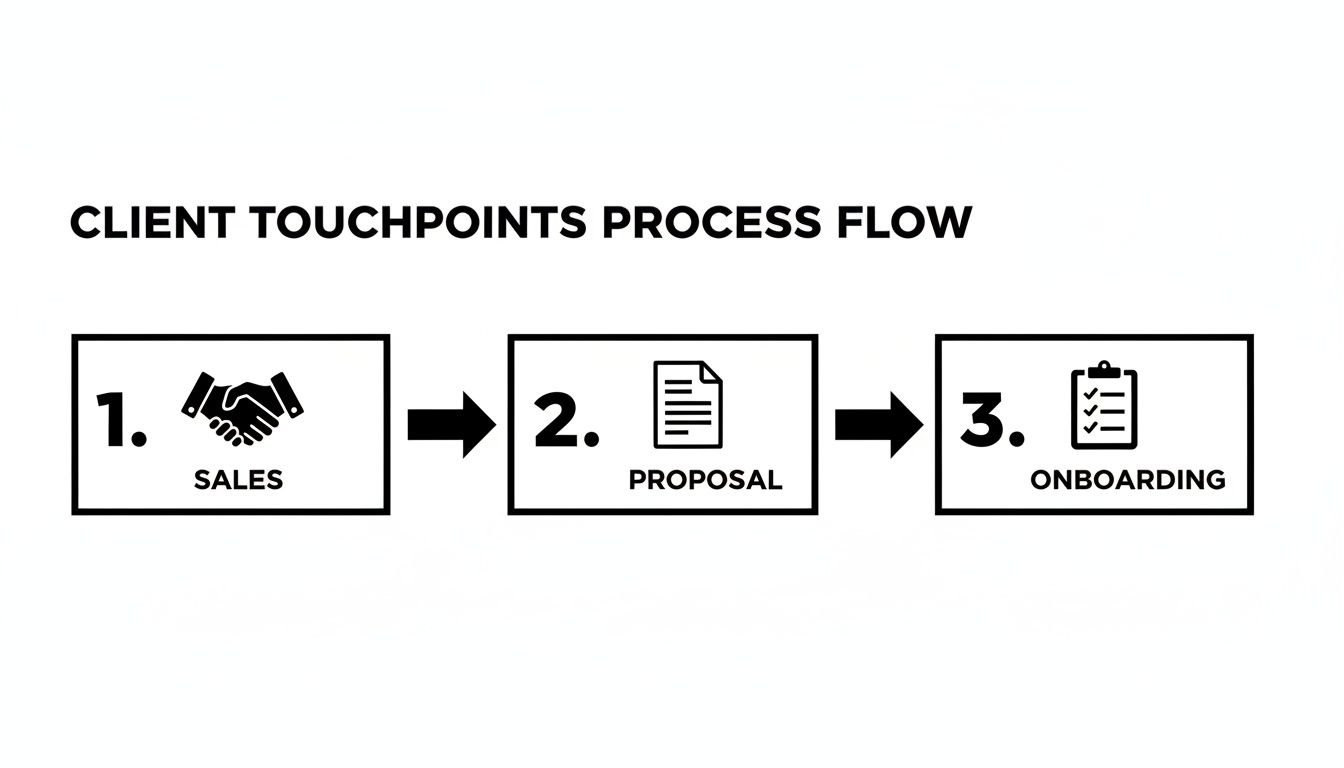
From the very first sales call to the final onboarding, it’s a cohesive brand experience that keeps a prospect moving forward.
Content’s job is to answer your prospect's next question before they even have to ask it. It demonstrates your expertise, handles objections proactively, and makes your sales team’s job infinitely easier.
Here’s how you can atomize your pillar content to nurture leads at every stage:
- Host a webinar based on one chapter of your pillar guide. This allows for real-time engagement and Q&A.
- Create an email drip campaign that breaks your guide down into a series of digestible emails sent to new subscribers.
- Design shareable infographics by pulling out key stats or process flows. These are perfect for social media.
- Produce short-form videos that explain a single, compelling concept from your guide for platforms like LinkedIn.
By strategically repurposing your core content, you create a constant stream of value that meets your clients where they are, building the credibility you need to finally close the deal.
Launching, Measuring, and Evolving Your Brand
Getting your shiny new brand out the door isn't the finish line—it’s the starting gun. A brand isn't a static project you check off a list and then forget. It’s a living, breathing asset that you have to nurture, measure, and thoughtfully evolve. The real work starts now, turning all that strategy into a name people in your market actually recognize and trust.
This whole process has to begin from the inside out. Your own team members are your most powerful brand ambassadors, so a successful launch absolutely depends on getting their buy-in. Before you even think about telling the world, you need to launch it internally. Every single employee should understand the "why" behind the shift and feel like they have a real part to play in bringing it to life.
Your Brand Launch Checklist
A coordinated launch is all about making sure every touchpoint is consistent, which is how you get the biggest bang for your buck. We like to think of it as a two-phase operation: get everyone on the same page internally first, then activate everything externally. Nailing this sequence is a critical piece of branding a service business that’s built to last.
Getting Your Internal House in Order
First, you have to rally the troops.
- Host an All-Hands Meeting: This is your big reveal. Walk everyone through the new brand story, the core messages, and the visual identity. Most importantly, explain the strategic thinking that led to the change and paint a clear picture of how it connects to where the company is headed.
- Distribute a Brand Guide: Don't leave it to guesswork. Give everyone a comprehensive guide that spells out exactly how to use the new logo, the color palette, the tone of voice, and the messaging pillars. Make it their single source of truth.
- Update Internal Systems: On launch day, everything needs to flip at once. This means all internal documents, email signatures, Slack profiles, and company-wide platforms should reflect the new brand.
Taking the Brand Public
Once your team is aligned, it’s time for the external push.
- Coordinate a "Go-Live" Moment: You want this to feel like a singular, unified event. Your website, social media profiles, and every other public-facing asset should switch over at the exact same time.
- Announce to Your Network: Craft a launch email for your clients, partners, and subscribers. Don't just show them the new look; explain the exciting new direction and what it means for them.
- Publish Launch Content: Get the story out there. A detailed blog post or a formal press release that shares the "why" behind the rebrand can generate buzz and give people a reason to care.
Measuring What Truly Matters
Once your brand is out in the wild, you have to track how it’s doing. But please, forget vanity metrics like social media likes. The real goal here is to measure the tangible impact your brand is having on the business.
You can’t manage what you don’t measure. When you move beyond surface-level data, you start to see how your brand is actually influencing revenue and how clients truly perceive you.
Effective brand measurement ties directly back to business goals. If you're not sure where to start, focus on these key areas:
- Brand Recall and Awareness: Are more people looking for your company by name? You can see this clearly in tools like Google Search Console, which will show you the growth in branded search queries over time. This is a fantastic indicator that your name is sticking.
- Share of Voice: How often is your brand being mentioned online compared to your top competitors? Social listening tools like Brandwatch or Mention can help you monitor this and get a real sense of your presence in the market.
- Sentiment Analysis: It’s not just about how often you’re mentioned, but how. Are the conversations positive, negative, or neutral? This qualitative data gives you the context that numbers alone can't provide.
- Lead Quality: A strong brand doesn't just bring in more leads; it brings in the right ones. Look at the data. Are leads coming from branded channels converting at a higher rate? Do they have a larger average deal size? That's your brand doing its job.
Finally, never, ever underestimate the power of just asking. Regular client surveys and tracking your Net Promoter Score (NPS) will give you priceless insights into how your brand is perceived by the people who matter most. This data is the fuel for your brand's future, ensuring it stays relevant, resonant, and powerful for years to come.
Frequently Asked Questions
When you're knee-deep in a branding project, it's natural for questions to surface. Here are a few of the most common ones we get, along with some straight-up answers to help you navigate the process with a bit more clarity.
What’s a Realistic Branding Budget for a Small Service Business?
There’s no one-size-fits-all answer, but a good rule of thumb for B2B service companies is to earmark 5-10% of your total revenue for marketing. When you're launching or rebranding, a significant slice of that should go directly to your branding efforts.
It helps to think about it in two stages. First, there's the one-time investment to nail down your core strategy, positioning, and visual identity. After that, you'll have an ongoing budget for bringing that brand to life through your marketing, content, and campaigns. B2B businesses, in particular, often need to invest on the higher end of that scale because their brand has to work much harder to build trust around an intangible service.
What's the Single Biggest Branding Mistake You See?
Easy. The most common and damaging mistake is getting fixated on the visuals—the logo, the color palette—while completely ignoring the strategic foundation. A slick logo is pointless if it doesn’t communicate a clear market position or a message that actually resonates with your ideal clients.
Your brand's promise has to be defined long before it can be designed. When you skip the hard work of research, positioning, and messaging, you end up with a brand that might look sharp but ultimately says nothing, connects with no one, and gets lost in the noise.
How Long Until We See Results from a Rebrand?
You'll likely spot some early wins within the first 3-6 months. Keep an eye out for things like better website engagement or positive comments from your team and clients. These are the green shoots that tell you you're heading in the right direction.
But building real brand equity—the kind that translates to deep-seated trust and recognition—is a long game. Seeing a measurable impact on your bottom line, like higher-quality leads, a bump in client lifetime value, or a stronger foothold in your market, usually takes 12-24 months of consistently living and breathing your new brand across every part of the business.
Ready to build a brand that doesn’t just look the part but actually drives growth? The team at Mick-Mar Inc. specializes in crafting powerful brand strategies for B2B service companies just like yours. Let's build something unforgettable together. Learn more about our branding services.