
It’s time to stop thinking about content as a simple lead-generation machine. Instead, let's explore brand content marketing as the bedrock of sustainable growth, especially for B2B and SaaS companies. Think of it as the difference between building a city's foundational infrastructure and just throwing up a few temporary pop-up shops. One creates lasting value and prosperity; the other delivers only fleeting gains.
How Brand Content Builds Lasting Business Value
Let’s move beyond using content just to sell. It’s time to start using it to build a reputation that naturally attracts loyal customers and advocates. In a market as crowded as SaaS, a strong brand isn't just nice to have—it's your most defensible moat. We’re going to walk through how to create content that builds a trusted brand, turning your unique point of view into your most powerful asset.

Shifting from Demand Capture to Demand Creation
Most content marketing is great at capturing existing demand. It’s designed to answer the questions of people who already know they have a problem and are actively looking for a solution. Brand content marketing plays a different, longer game: it works to create new demand entirely.
The strategy here is to educate your audience and establish a distinct point of view on their world, often long before they're in the market for a tool like yours. It’s about becoming the go-to resource in your space—the one they turn to for insight and education.
For instance, a cybersecurity SaaS company could produce a documentary series on the future of digital privacy. This doesn't directly push their software. What it does is position them as an insightful authority, building a loyal audience that will think of them first when a security need eventually arises.
The Foundation of Trust and Authority
In the B2B and SaaS world, buying decisions are rarely impulsive. They're complex, involving multiple stakeholders, big budgets, and a whole lot of trust. Brand content is perfectly suited for this high-stakes environment because its primary currency is building that trust over time.
When your content consistently delivers value and helps people do their jobs better, you're not just collecting leads. You're building a community of followers who see you as an essential guide in their professional lives. That kind of connection is far more durable than any simple transaction.
This approach elevates you from a vendor to a trusted partner. You're no longer just pitching a product; you’re offering guidance and expertise. A recent study from Semrush highlights this, showing that marketers who are "very successful" in 2023 reported that improving brand awareness and building credibility and trust were their top content marketing achievements. This confirms that educational, brand-led content drives real business outcomes.
So, how does this actually work? By consistently publishing content that speaks to your audience's bigger-picture challenges and goals, you establish:
- Authority: You become known as the definitive source of truth in your niche.
- Credibility: Your insights are seen as genuine expertise, not just marketing fluff.
- Connection: You form a real bond with your audience by sharing your unique perspective and values.
Ultimately, brand content marketing is an investment in your company’s future. It's about building an asset that grows in value year after year.
Defining Brand Content for Modern B2B Companies
Let’s get one thing straight right away: brand content marketing isn't just a new label for what you're probably already doing. While it uses the same tools—blogs, videos, reports—its fundamental goal is different. It represents a critical shift from simply capturing existing demand to actively creating it.
Think about it like this. Traditional content marketing is like being a helpful employee at a hardware store. A customer comes in asking for a specific type of drill bit, and you point them to the right aisle, maybe explaining the features. You’re fulfilling a need that already exists.
Brand content, on the other hand, is like hosting a free workshop on advanced woodworking techniques. You’re not there to sell drill bits. You’re there to teach people how to become master craftspeople, establishing your store as the go-to place for expertise. When they eventually do need a new tool, your store is the first and only one they'll consider.
The Shift from Product to Perspective
The most significant difference is what you're "selling." Traditional content and product marketing sell a product. Brand content marketing sells a point of view.
The real goal is to own a conversation in your industry, not just a keyword. It’s about becoming the ‘university’ for your niche, building an audience that trusts you long before they ever need to buy your solution. This is a massive advantage in the long and often complex B2B sales cycle.
This means you stop writing exclusively about your software's features and start exploring the bigger ideas, challenges, and opportunities your audience grapples with every day. It’s this educational focus that builds deep, authentic trust. For a closer look at how this works, you can explore the core principles of effective brand storytelling and see how strong narratives forge these connections with B2B buyers.
Brand Content vs. Traditional Content
To put a finer point on it, let's look at the practical differences between these two approaches. The table below breaks down their distinct goals, audience focus, and how you'd measure success for each.
| Attribute | Brand Content Marketing | Traditional Content Marketing |
|---|---|---|
| Primary Goal | Create new demand and build brand affinity. | Capture existing demand and generate leads. |
| Audience Focus | A broad audience interested in the topic. | A narrow audience with high purchase intent. |
| Key Metrics | Audience growth, share of voice, brand recall. | MQLs, conversion rates, cost per lead. |
| Time Horizon | Long-term asset building (12+ months). | Short-to-medium term campaign results. |
| Core Message | "Here's how to think about your world." | "Here's how our product solves your problem." |
This strategic pivot toward long-term value creation isn't just a passing trend—it's a direct response to a major market shift.
The global content marketing industry is on an incredible growth trajectory, with its value compounding as tech companies realize the power of content for thought leadership and customer education. As businesses see how content's value grows over time, their investment strategies are wisely following suit.
Ultimately, the power of a brand-led approach is its ability to build an audience that chooses you proactively, not just reactively. For today's B2B marketers, mastering a brand-focused strategy is no longer a "nice-to-have." If you're ready to build out your own plan, we have a number of guides and templates available to help shape your B2B marketing strategy.
A Strategic Framework to Build Your Brand With Content
Great brand content doesn't just happen. Throwing content at the wall to see what sticks is a recipe for wasted resources and a muddled message. It’s like trying to build a house without a blueprint—you might be busy, but you’re not building anything that will last.
To build a brand that actually means something to people, you need a framework. This is your strategic roadmap, ensuring every blog post, video, and whitepaper works together. It’s how you reinforce your brand’s unique message and guide people from being strangers to becoming your biggest fans. The best frameworks we’ve seen all boil down to three core steps that work in tandem.
Define Your Unique Point of View
First things first: you need a Point of View (POV). In a crowded B2B or SaaS market, trying to be everything to everyone is a fast track to being nothing to anyone. Your POV is your specific, sometimes even contrarian, take on your industry. It's the unique lens you see the world through.
Think of it as your brand's core belief or thesis statement. It’s what you stand for and, just as important, what you stand against. A strong POV is the bedrock of all your brand content marketing; it gives you a distinct voice and a compelling reason for your audience to tune you in and tune your competitors out.
For example, a project management SaaS might decide its POV is that "hustle culture is a myth and real productivity comes from deep, focused work." This angle immediately sets them apart from tools that sell speed and multitasking. Every piece of content they create would then flow from this idea, attracting an audience that feels the same way.
Identify Your Core Content Pillars
With your POV set, you can now build out your 3-5 core content pillars. These are the big-picture topics your brand is going to own. Think of them as the main chapters in the book you're writing about your industry. They should flow directly from your POV and play to your team’s strengths.
These pillars give your content creation much-needed focus. Instead of chasing every shiny new topic, you can concentrate on building a deep well of authority in a few key areas.
When choosing your pillars, make sure they:
- Align with Your POV: Each pillar must support your central belief system.
- Address Audience Pain Points: They have to be genuinely relevant to the problems your ideal customers face.
- Showcase Your Expertise: Pick topics where your team has real, credible knowledge to share.
For our project management SaaS with the "deep work" POV, the pillars could be:
- Asynchronous Communication Strategies
- Mindful Productivity Techniques
- Building a Sustainable Work Culture
This focused approach helps you become a recognized authority far more quickly than a scattered strategy ever could. To get all the details right, it's worth following a complete guide to Branded Content Marketing Success to ensure every effort is perfectly aligned.
Map Content Across the Entire Funnel
The final piece of the puzzle is connecting your big-picture strategy to the real-world customer journey. This means mapping different types of content to each stage of the marketing funnel: Awareness, Consideration, and Decision. While brand content is often seen as a top-of-funnel play, its influence should be felt all the way through.
Brand content's real power is its ability to create a seamless, value-driven experience. It doesn't just attract an audience; it nurtures them with consistent, helpful insights at every step, making the eventual "sale" feel like a natural conclusion to a trusted relationship.
This requires a smart mix of assets designed for different levels of intent.
Top of Funnel (Awareness): At this stage, your content should be broad, interesting, and even entertaining. The goal is to introduce your POV to the widest possible audience. Think original research reports, documentary-style videos, and insightful podcast episodes.
Middle of Funnel (Consideration): Here, the content gets more practical and solution-focused. People know they have a problem and are now actively exploring solutions. This is the perfect place for in-depth webinars, tactical guides, and comparison articles. Our own agency's deep dives into content marketing and strategic communications are a great example of this.
Bottom of Funnel (Decision): Content here needs to be highly practical, building confidence in your specific solution. This includes detailed customer case studies, implementation guides, and product tutorials that show your POV in action.
By mapping your content this way, you create a connected journey that builds trust and proves your value from the very first click.
The Content Formats That Actually Build Authority
With your strategy mapped out, it’s time to decide how to bring your brand’s voice to life. A great blog post will always have its place, but true brand content marketing goes deeper. It’s about creating signature content that builds real connections and cements your authority in the minds of your audience.
This isn't about doing everything at once. The goal is to pick a few high-impact formats that truly fit your brand’s unique point of view and give your expertise a platform to shine.
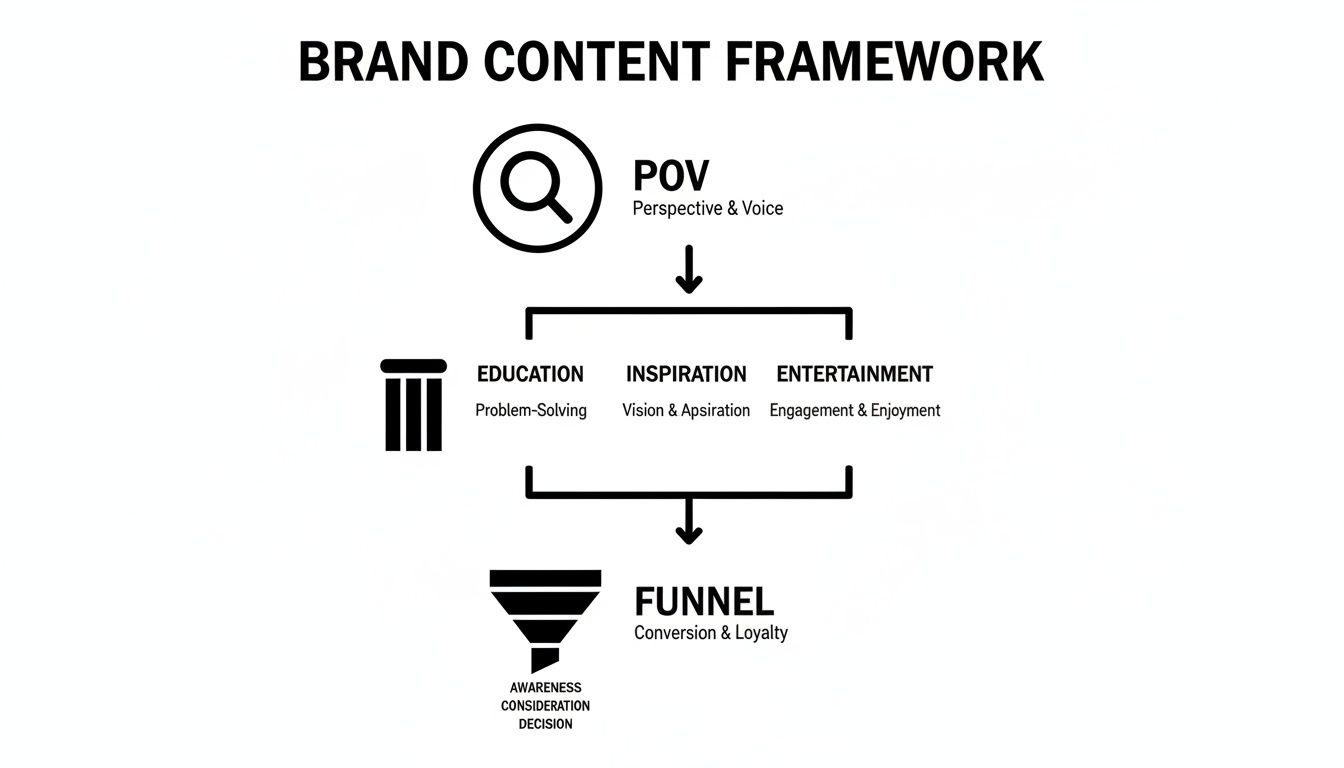
Think of this framework as your guide. Notice how every piece of content, regardless of format, flows directly from your core Point of View (POV). This ensures that whether you're educating, inspiring, or entertaining, every asset works together to build a cohesive and powerful brand experience.
Original Research Reports
Want to become the source everyone else in your industry quotes? Start creating your own data. Original research reports are one of the most effective ways to own a conversation, because you're contributing brand-new insights instead of just commenting on existing trends.
Imagine a fintech SaaS publishing an annual "State of Embedded Finance" report. By conducting their own surveys and analysis, they aren't just creating another PDF download. They're building an asset that journalists, investors, and ideal customers will reference for months. It’s a powerful move that generates high-quality backlinks, media coverage, and undeniable market leadership.
A Signature Podcast Series
Podcasts offer a unique level of intimacy. Think about it: someone might skim a blog post for a few minutes, but a podcast listener often invites you into their world for 30-60 minutes at a time, week after week. That kind of consistent engagement builds a powerful sense of familiarity and trust.
A great B2B podcast is never a sales pitch. It’s a genuine show that delivers value, whether through candid interviews with experts, deep dives into industry problems, or just great storytelling. The real goal is to build a "subscribed" audience—a loyal following that actively looks forward to what you have to say next.
A podcast turns your brand into a trusted voice in your listener's ear. It's one of the few formats where you can build a personal connection at scale, making your company feel more human and accessible.
In-Depth Video Documentaries
If you really want to show who you are—your company's personality, deep expertise, and mission—nothing tells a story quite like a well-produced video documentary. This format moves far beyond the typical webinar to create a memorable, emotional connection with your audience.
For example, a cybersecurity company could produce a docu-series that explores the human impact of major data breaches. That’s infinitely more compelling than a dry whitepaper on the same subject. It not only educates the audience on why security matters but also builds brand affinity through a powerful, narrative-driven experience.
Customer-Centric Stories
We've all seen B2B case studies that feel sterile and predictable. Brand content marketing takes this idea and flips it, focusing instead on customer-centric stories about real transformation. These aren't just about how a customer used a feature; they're about their journey, their struggles, and their hard-won success.
Ditch the old "Problem/Solution/Result" template and tell a real story.
- Introduce the hero: Your customer and what they were trying to achieve.
- Detail the conflict: The very real business challenges holding them back.
- Show the journey: How they navigated the obstacles, with your brand as a helpful guide.
- Reveal the resolution: The tangible impact on their business, their team, and their own careers.
This approach makes your customers the heroes of their own stories, positioning your brand as the trusted mentor who helped them win. It feels authentic, relatable, and is far more persuasive than any list of product benefits could ever be.
Using AI to Scale Content Without Losing Authenticity
Let's be honest: AI in content creation isn't some far-off concept anymore. It's here, and for busy marketing teams, it’s a powerful tool for scaling output, speeding up research, and finding new ideas. But when it comes to brand content marketing, there's a fine line to walk.

The trick is to treat AI as a smart assistant, not an author. Think of it as a co-pilot. It can handle the grunt work—the data crunching and the initial drafting—which frees up your team to focus on the things a machine can't fake: real empathy, compelling stories, and your brand's unique voice.
The Human-in-the-Loop AI Strategy
The only way an AI-assisted workflow succeeds is by keeping your human experts firmly in the driver's seat. This "human-in-the-loop" approach means AI makes your process better without watering down what makes your brand special. It's the difference between churning out generic articles and amplifying your team's best work.
According to a 2023 HubSpot report, marketers are embracing AI, but they also recognize its limits. You can see the full research on these content marketing trends to understand this dynamic. The data suggests that while AI can boost efficiency, authentic, human-led storytelling remains a key differentiator. This creates a real opening for marketers who get the balance right.
This just proves that a blended strategy is non-negotiable.
AI is incredible at creating outlines and summarizing research. What it can't do is invent a groundbreaking point of view or share a personal anecdote that truly connects with your audience. That final layer of creativity and authenticity has to come from your people.
Practical Ways to Use AI as a Co-pilot
Instead of giving a vague prompt like "write a blog post," give your AI specific, strategic jobs that support your human writers. That’s how you boost efficiency without sacrificing quality.
Here are a few high-impact ways to bring AI into your workflow:
- Accelerated Research: Have AI synthesize information from dozens of sources, pull out key statistics, or summarize dense topics. It turns hours of research into minutes of review.
- First Draft Generation: Give the AI your core topic, your target reader profile, and your unique angle. It will produce a solid first draft that your writer can then polish, personalize, and inject with your brand's personality.
- Content Repurposing: Feed AI a finished asset, like a webinar recording or a detailed report. Then, ask it to generate social media posts, email snippets, and short video scripts from that material. You instantly multiply the value of your original work.
- Identifying Content Gaps: AI tools can scan your competitors' content—or even your own—to find topics you’ve missed. This is a quick way to ensure your content pillars are truly comprehensive.
By assigning AI these kinds of operational tasks, you empower your team to do what they do best: build a brand that people actually want to connect with. To dig deeper into building these kinds of workflows, check out our guide on The Content Marketing Operations Maturity Model to see how you can build more efficient systems.
How to Measure the ROI of Brand Content Marketing
So, how do you actually measure something as seemingly fuzzy as "brand awareness"? It’s a fair question, and honestly, it’s one that stops many teams from fully committing to brand content. But proving its value isn't about guesswork. It’s about connecting the dots between your top-of-funnel influence and real, bottom-line results.
The trick is to stop obsessing over vanity metrics like social media likes and shares. Instead, it helps to adopt a "Brand-to-Demand" measurement model. This framework shows how the momentum you build with your brand content flows directly into your demand generation pipeline.
Measuring Top-of-Funnel Impact
At the top of the funnel, the goal is to become the go-to voice in your niche and grow an audience that trusts you. You're essentially building brand gravity. Success here isn’t about counting immediate leads; it's about seeing clear signals that your influence is growing and your message is hitting home with the right crowd.
You can track this impact with a few key performance indicators (KPIs):
Share of Voice (SoV): How often is your brand mentioned in your industry's conversation compared to your competitors? A rising SoV means your point of view is cutting through the noise.
Branded Search Volume: Are more people typing your company’s name directly into Google? A spike in branded searches is a surefire sign that people remember who you are.
Direct Traffic: This one’s powerful. When people type your website URL straight into their browser, it means your brand is top-of-mind. A steady increase in direct traffic is a fantastic indicator of strong brand health.
Owned Audience Growth: This is about the channels you control—your email newsletter, podcast subscribers, or YouTube followers. These aren't just passive viewers; they've actively chosen to hear from you. This is your core audience.
When these numbers go up, you have proof that you're successfully building an audience that knows, remembers, and trusts your brand.
Connecting Brand to Revenue
Now for the important part: connecting that top-of-funnel momentum to actual business. This is where you prove that brand content isn't just a "feel-good" activity but a direct contributor to revenue.
Measuring brand-driven demand is about tracking how your audience moves from being educated and aware to being interested and qualified. It’s the journey from "I trust their insights" to "I need their solution."
Here’s how to measure the impact further down the funnel:
Content-Influenced Pipeline: Use your marketing automation platform to see how many of your leads and opportunities engaged with your brand content (like a report or podcast) before they talked to sales. A 2023 Semrush study found that 67% of marketers report content marketing is a key driver for generating demand and leads.
Lead Quality from Brand Initiatives: Are the leads who come from your brand content channels better? Compare the MQL-to-SQL conversion rates for people who consumed your brand content versus those who didn’t. The answer is often a resounding yes.
Sales Cycle Velocity: A strong brand builds trust, and trust speeds everything up. Measure how long it takes for leads who've engaged with your brand content to become customers. A shorter sales cycle is a direct efficiency gain for your entire company.
By pulling these top-of-funnel and bottom-funnel metrics together, you can create a dashboard that tells a compelling story. It shows exactly how your investment in brand content marketing is building a powerful, long-term engine for business growth.
Answering the Tough Questions About Brand Content
Whenever I talk with B2B and SaaS leaders about shifting focus toward brand content, the same practical concerns always pop up. It’s a big change, moving away from a world of pure lead generation. It demands a different way of thinking about your budget, your timeline, and your expectations.
Let's tackle those big questions head-on.
How Much of My Budget Should Really Go to Brand Content?
There’s no magic number here, but a balanced portfolio approach is a great starting point. For a company just dipping its toes into brand content marketing, a 70/30 split can work well. This means 70% of your budget stays with the proven, bottom-of-funnel activities you already know, while you invest the other 30% in top-of-funnel brand plays.
Think of it as a strategic investment. As your brand content starts to gain traction—which you'll see in your direct traffic and branded search numbers—you can start to rebalance that portfolio. I’ve seen mature brands with a strong market presence eventually get to a 50/50 split or even more, simply because their brand’s gravity is doing so much of the demand-gen work for them.
Okay, But How Long Until I See a Real Return?
This is the big one. Brand building is a marathon, not a sprint. While performance marketing can give you a boost in a matter of days, brand content is about creating an asset that appreciates over time. Honestly, it's best to be thinking on a 12-18 month horizon before you see a significant, measurable impact on the business.
You'll spot early signs of life much sooner. Things like audience growth on your own channels and a bump in people searching for your brand by name often appear within the first 6-9 months. But the real payoff—a shorter sales cycle, higher quality leads, and better-fit customers—only shows up after that trust and authority have had time to compound.
Can My Small Startup Actually Pull This Off?
Absolutely. In fact, startups often have an advantage. Being great at brand content isn't about having the deepest pockets; it's about having the sharpest point of view. A smaller team can be far more authentic and agile than a massive corporation bogged down by red tape.
The key is not to try and do everything. Instead, be surgical with your efforts:
- Own one format. Don't try to be on every channel. Launch a niche podcast, a highly-focused blog series, or a killer video show. Just one. And do it better than anyone else.
- Go deep on one topic. Find a specific content pillar where your team has genuine expertise and become the name in that space. Own a small but important conversation.
- Lean on your founder's voice. People connect with people. Use your leadership’s unique perspective to build a personal brand that, in turn, lifts the company's. Authenticity costs nothing but is incredibly valuable.
For a startup, it all comes down to consistency and focus. A small, dedicated effort can build a brand that punches way above its weight class.
At Mick-Mar Inc., we help B2B and SaaS companies build strategic roadmaps that turn their unique point of view into a revenue-driving asset. Discover how our approach to content and branding can accelerate your growth.