
An SEO content audit is a comprehensive health check for your website's content. It’s how you discover what’s working, what's not, and what might be holding you back from reaching your goals. Think of it as a friendly process for sorting your high-growth assets from the dead weight.
This guide will walk you through, step-by-step, how to conduct an audit that not only tidies up your site but also lays the groundwork for sustained, measurable growth.
Why SEO Content Audits Drive Sustainable Growth
Let's be honest, most websites accumulate content over time. Some of it performs beautifully, while other pieces might be underperforming or even hurting your search rankings. That’s why a systematic SEO content audit isn't just an optional "nice-to-have" task—it's a critical driver of sustainable growth. This isn't just about cleaning up old blog posts; it's a strategic realignment of your content assets with your business goals.
When done right, an audit provides the data-backed clarity you need to stop guessing and start making smart, informed decisions. It helps you diagnose the hidden issues holding your best content back and transforms your website from a simple collection of pages into a reliable organic growth engine.
Uncovering Hidden Content Problems
Without a formal audit, it's easy to miss the slow-burning issues that can gradually affect your site's performance. For example, you might have pages suffering from content decay, where a once-popular article is now outdated and losing traffic. Or you could be your own worst enemy with keyword cannibalization, where multiple pages compete for the same search terms, which can confuse search engines and dilute your authority.
The real power of an audit is turning a messy, overwhelming pile of data into a prioritized action plan. It helps you focus on the handful of changes that will actually move the needle.
Technical roadblocks are another common blind spot. It's surprising how often simple mistakes go unnoticed. For instance, 54% of websites have duplicate title tags, and a staggering 50% have duplicate meta descriptions. For any business, that’s not a small problem—unaddressed duplicates can reduce your click-through rate (CTR).
Recent data also shows that a significant number of top-ranking pages don’t even have a meta description. Just by finding and fixing these issues after an audit, you can often boost CTR significantly, making your content more visible and effective.
This is precisely the kind of low-hanging fruit a thorough audit is designed to find. Below is a quick summary of the common, high-impact problems we frequently uncover and why they matter to your bottom line.
Common Issues Uncovered by a Content Audit
| Problem Area | Common Symptom | Impact on Business |
|---|---|---|
| Content Decay | High-traffic pages experiencing a steady decline in rankings and visitors over 6-12 months. | Loss of valuable organic leads, decreased brand visibility, and competitors taking over top spots. |
| Keyword Cannibalization | Multiple blog posts or landing pages ranking for the same primary keyword, often with fluctuating positions. | Diluted ranking signals, lower CTR as users see confusing results, and wasted crawl budget. |
| Thin or Low-Value Content | Pages with low word counts, no unique insights, and zero user engagement (e.g., high bounce rates, low time on page). | Damages site-wide authority, hurts user experience, and can attract Google penalties. |
| Poor On-Page SEO | Missing meta descriptions, duplicate title tags, poorly structured headings, and unoptimized images. | Reduced organic visibility, low click-through rates from search results, and a poor user experience. |
| Broken Internal Links | Links pointing to 404 pages or incorrect URLs, creating a dead-end for users and search engine crawlers. | Wasted "link equity," frustrating user journeys, and preventing Google from properly indexing the site. |
Fixing these issues isn't just about checking off SEO boxes; it's about directly improving the user journey and strengthening your site’s ability to convert visitors into customers.
From Data Dump to Strategic Roadmap
One of the biggest pitfalls is when an audit ends with a giant, intimidating spreadsheet of problems and no clear next steps. The whole point is to turn that data dump into an actionable roadmap.
Your goal is to prioritize fixes based on their potential impact and the effort required. This is how you create real momentum.
- Pinpoint High-Impact Opportunities: Find the pages that are almost ranking on page one. Sometimes, a simple content refresh, a few new internal links, or an updated title tag is all it takes to see a massive jump in traffic.
- Eliminate Content Bloat: Be strategic about finding and pruning low-quality, zero-traffic content. This dead weight can drag down your entire site and dilute its topical focus.
- Align Content with Business Goals: Every piece of content should have a job. Make sure yours directly supports your core marketing strategy, whether that’s driving demo requests, getting trial sign-ups, or simply building brand awareness.
Ultimately, a good audit gives you a clear, honest picture of what’s working, what isn't, and why. It’s the foundation for making informed decisions that improve user experience, build your site's authority, and drive measurable business growth. To get the full picture, it helps to understand how audits fit into the larger cycle of SEO Content Performance Reviews.
Before you pull a single URL or open a spreadsheet, let's talk about the most common mistake people make: diving headfirst into the data. A truly effective SEO content audit starts with strategy, not data collection. This is your foundation, where you get crystal clear on what a "win" actually looks like for your business.
Jumping into an audit without clear goals is like setting out on a road trip with no map. You’ll certainly end up somewhere, but it probably won’t be where you needed to go.
Define Your Audit's Goals and Scope
First things first: what are you actually trying to accomplish with this audit? Your answer will shape every decision you make. Are you hoping to:
- Drive more MQLs or demo requests? This immediately tells you to focus on bottom-of-funnel content and the conversion paths tied to it.
- Build brand authority in a new category? In this case, your audit will likely zero in on top-of-funnel blog posts and how well they establish topical expertise.
- Improve user engagement and reduce high bounce rates? This points you toward a deep dive into on-page experience and the actual quality of your content.
Once you have a primary goal, you can set a realistic scope. It's wise not to try to boil the ocean. Auditing an entire 5,000-page website can be overwhelming. Instead, start with a high-impact section. For most businesses, the blog is the perfect place to begin—it’s usually a major driver of organic traffic and often the source of the most content bloat.
Think of this first phase as a pilot program. By focusing on a specific area like your blog or resource center, you can refine your process, show some quick wins to stakeholders, and build the case for a site-wide audit later.
This targeted approach makes the whole project manageable and helps you deliver meaningful results much faster.
Assemble Your Audit Toolkit
You don’t need a dozen expensive subscriptions to do a great job, but a few core tools are non-negotiable for getting the data you need. Here's what your starting stack should look like:
- A Website Crawler: Something like Screaming Frog or the Site Audit tool in Semrush is essential. This is how you'll get a complete list of your URLs and diagnose technical issues.
- Performance Analytics: Your source of truth for traffic and user behavior. You'll live in Google Analytics (GA4) and Google Search Console (GSC).
- Keyword & Backlink Data: You need a platform like Ahrefs or Semrush to analyze what individual pages are ranking for and what their backlink profiles look like.
These tools are designed to work together. For instance, you'll use Screaming Frog to find all your pages, then export that list and enrich it with traffic data from GA4 and keyword data from Ahrefs.
Create Your Master Content Inventory
The final piece of prep work is building your master content inventory. This is the spreadsheet that will become the command center for your entire audit. The goal here is simple: pull a complete list of every single URL that falls within your scope.
This process is what turns a chaotic mess of content into a clear, actionable plan. It’s all about creating structure where there was none.
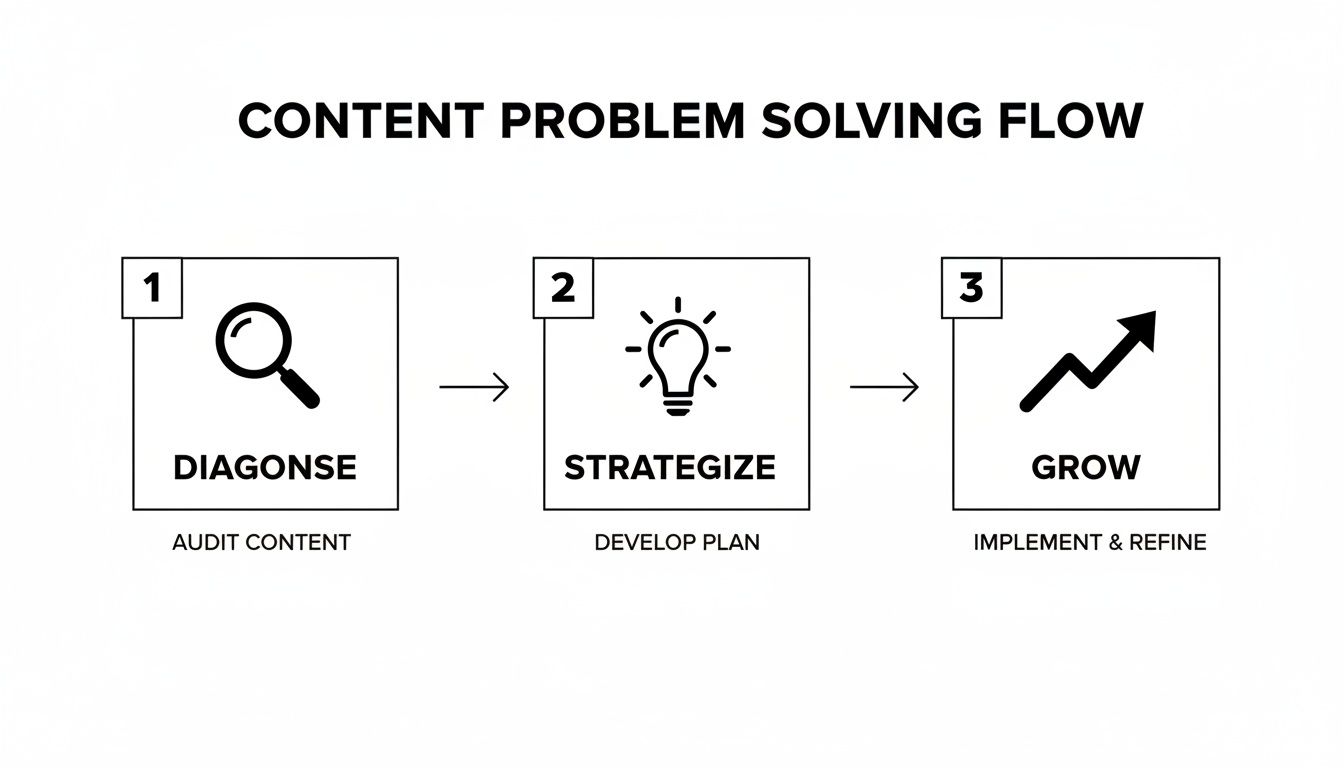
This simple "diagnose, strategize, grow" workflow is the heart of an effective audit. You're turning problems into opportunities. Once you have this complete inventory, you’re ready to start layering in the performance data. This foundational work is what elevates your audit from a simple data-pulling exercise into a strategic project that drives real business results.
For a deeper look at tying these efforts to bigger business objectives, check out our guide on content marketing and strategic communications.
Gathering the Right Data and Metrics
Once you have your audit goals set and a master inventory of all your content URLs, the real detective work begins. This is where we move from planning to data-driven investigation. The goal is to collect the specific metrics that tell the true story of your content's performance, blending the hard numbers (the "what") with the human analysis (the "why").

Numbers alone can be deceiving. I’ve seen pages with barely any traffic turn out to be bottom-of-funnel workhorses that convert high-value leads. On the flip side, I've seen blog posts with huge traffic numbers but a high bounce rate, meaning they do very little for the business. This is why combining hard data with your own expert judgment is so important—it’s how you get the full picture and make decisions with confidence.
Collecting Your Quantitative Metrics
Quantitative metrics are the objective, hard numbers that measure performance. This data forms the backbone of your analysis. You'll be pulling this information from your go-to tools—think Google Analytics, Google Search Console, and Ahrefs—and then plugging it into your master inventory spreadsheet as new columns for each URL.
To avoid getting lost in the data, start by focusing on these core metrics:
- Organic Sessions: How many people found this page from organic search over your chosen time period (I typically look at the last 6-12 months)? This is your baseline for SEO visibility.
- Keyword Rankings: How many keywords does the page rank for? More importantly, what are its top 3-5 primary keywords? This gives you a clear sense of its search footprint.
- Backlinks: The number of referring domains pointing to the page. This is a direct signal of its authority and trustworthiness in the eyes of Google.
- Conversions or Goal Completions: How many leads, demo requests, or sign-ups did this page drive? This is the ultimate test, tying content performance directly to business value.
- Bounce Rate / Engagement Rate: Are users actually sticking around and interacting, or are they leaving immediately? This is a huge indicator of content quality and how well you're matching search intent.
Pulling all this data is easily the most time-consuming part of an audit, but it’s absolutely critical. This is the evidence you’ll use to justify every recommendation you make later on.
Remember, the goal isn't just to collect data, but to create a unified view. Your spreadsheet should let you see the full story of each URL at a glance—from traffic and rankings to backlinks and business value.
This unified view is where you'll start spotting the first interesting patterns. You’ll immediately see your rockstar pages, your underperformers with zero traffic, and everything in between.
Layering in Qualitative Analysis
With your spreadsheet full of numbers, it's time for the human touch. Qualitative analysis is where you step in to assess each piece of content against a set of more subjective, but equally important, criteria. This part is less about data tools and more about your expertise and deep understanding of your audience.
Go through your key content and ask yourself a few important questions. I find it helpful to assign a simple score (like 1-5) to turn these "feelings" into data you can work with.
- Content Quality & Accuracy: Is this information still correct and relevant? Is it truly comprehensive, well-written, and free of embarrassing errors? Research from 2023 shows that republishing old blog posts with updated content and images can boost organic traffic by over 100%, so quality and freshness really matter.
- Search Intent Alignment: Does this page perfectly deliver on what the user was looking for? Does it solve their problem better than what competitors are offering?
- Brand & Voice Alignment: Does this sound like it came from your company? Does the tone and personality feel authentic to your brand?
- Visual Appeal & UX: Is the page easy to scan and read? Or is it a giant, intimidating wall of text? Look for good use of headings, images, and white space.
This scoring process transforms subjective analysis into a semi-objective data point you can use for sorting and prioritizing. It helps you quickly spot content that has great SEO metrics but is poorly written, or a fantastic article that just isn't visible in search. A page with high traffic but a low "Quality" score, for example, is a perfect candidate for a content refresh.
To make this clear, here’s a quick breakdown of how these two types of metrics work together.
Quantitative vs. Qualitative Audit Metrics
This table contrasts the essential data points with the subjective factors you need to evaluate.
| Metric Type | Key Metrics to Collect | What It Tells You |
|---|---|---|
| Quantitative (The "What") | Organic Sessions, Keyword Rankings, Backlinks, Conversions, Bounce Rate. | Measures the outcome of your content's performance in search engines and on your site. |
| Qualitative (The "Why") | Content Accuracy, Search Intent Match, Brand Voice, Visual Appeal, Readability. | Diagnoses the reasons behind the quantitative performance and identifies areas for improvement. |
By blending these two perspectives, you create a complete, 360-degree view of every single content asset. This dual-lens approach is the foundation for the next step: analyzing your findings and building a powerful, data-driven action plan.
Analyzing Your Findings and Making Decisions
Alright, you've waded through the data and your spreadsheet is packed with numbers. This is where the magic happens. All that crawling and data pulling was just the setup; now we turn those raw numbers into an actual, strategic plan. This is the point where a spreadsheet full of metrics becomes an SEO content audit that can genuinely move the needle.

Before you start tinkering with title tags or adding a few keywords, it's helpful to have a clear framework. You end up making random changes and getting lost. To avoid this, every single URL needs to be sorted into a specific action bucket. It’s the only way to focus your energy where it will count the most.
The 'Keep, Improve, Prune, Consolidate' Framework
This simple decision-making model is the engine of any successful audit I’ve run. It's not fancy, but it's incredibly effective because it forces you to assign a concrete action to every piece of content. There's no "maybe" or "later"—just a clear path forward.
Let's walk through what each category really means and what it takes for a page to land in one.
Keep Your Winners
These are your stars. They're the articles and landing pages that are already performing well, pulling in solid organic traffic, ranking for valuable keywords, and helping people move toward your business goals.
Criteria for 'Keep':
- High Organic Traffic: Consistently one of your top-performing pages in Google Analytics.
- Strong Keyword Rankings: Sits comfortably in the top-5 spots for valuable, high-intent keywords.
- Healthy Engagement: People are actually reading, which you can see in high engagement rates or time on page.
- Measurable Conversions: It’s a workhorse, directly contributing to leads and other business goals.
The plan here is simple: protect these assets! Your main job is to understand why they’re working so you can replicate their success in future content.
Improve Your High-Potential Content
This is usually the biggest and most promising bucket. It’s full of content that shows potential but isn't quite living up to it. Think of these as your "B+" students that could easily become "A" students with a bit of extra credit.
Criteria for 'Improve':
- Ranking on Page 2 or 3: Google sees the value, but it needs a nudge to get into the prime real estate of page one.
- High Impressions, Low Clicks: Your page is showing up in searches, but the title and description might be too bland to earn the click.
- Outdated Information: The post was a hit back in the day, but now its stats, examples, or advice are stale.
- Good Traffic, No Conversions: It draws a crowd, but there's no clear call-to-action to guide them.
"Improving" can mean anything from a full rewrite to align with search intent, updating old data, adding fresh visuals, or just punching up the on-page SEO. This category is where you'll often find the biggest ROI for your effort.
Prune Your Dead Weight
This can be tough for a lot of people—we get it. But it's absolutely essential. Pruning means removing the content that does nothing for your audience or your business. These pages can sometimes harm your SEO by diluting your site’s authority and wasting Google's crawl budget.
One 2023 study found that 90.63% of content gets no traffic from Google. Pruning the underperforming pages that make up this majority allows search engines to focus on your best content, which can improve your site's overall visibility. You can learn more about strategic pruning over at LinkinTechSEO.
Criteria for 'Prune':
- Zero or Near-Zero Traffic: These pages haven’t seen a meaningful number of organic visitors in the last 12 months.
- No Backlinks or Engagement: The content has no external validation and users aren't interacting with it.
- Completely Irrelevant: The topic is way off-brand or so outdated it’s not worth saving.
Pruning usually means deleting the page and 301 redirecting the URL to a similar, valuable page, or simply telling search engines to de-index it. Be strategic and deliberate.
Consolidate Your Cannibals
Keyword cannibalization is when you have multiple pages accidentally fighting each other for the same keyword. It’s a quiet but serious problem that confuses Google and splits your ranking power across several weaker pages instead of one strong one.
Criteria for 'Consolidate':
- Multiple Pages on Similar Topics: You have three different blog posts that all essentially say the same thing.
- Fluctuating Rankings: You notice two of your pages are constantly swapping positions in the SERPs for the same keyword.
The fix is to merge the weaker, overlapping content into the strongest page, creating one definitive "super-post." Then, you 301 redirect the URLs of the retired pages to the new pillar page. This pools their authority and sends a crystal-clear signal to Google about which page should rank.
Building Your Action Plan and Measuring Success
A content audit is only as good as the action it inspires. Too many brilliant analyses die a slow death in a forgotten spreadsheet. Your 'Keep, Improve, Prune' decisions gave you a clear map; now it's time to actually start the journey. This is where you translate all that data into a real-world project that drives tangible growth.
The first move is simple: turn your findings into concrete tasks. Every 'Improve,' 'Prune,' or 'Consolidate' action needs a clear owner and a realistic deadline. This simple act of assignment creates accountability and transforms a massive, intimidating list into a series of manageable steps.
Creating Your Prioritized Roadmap
Okay, so you have a list of tasks. Now what? You can’t do everything at once. The key is to prioritize ruthlessly based on a simple formula: potential impact versus the effort required. This framework helps you stack early wins, build momentum, and show your stakeholders some immediate value.
Think of it as a four-quadrant matrix:
- Quick Wins (High Impact, Low Effort): Jump on these immediately. This is your low-hanging fruit—things like fixing broken internal links, rewriting the title tags on high-impression but low-CTR pages, or refreshing a high-potential article with new stats.
- Major Projects (High Impact, High Effort): These are the game-changers. Plan for these in the coming quarter. This could be a huge content consolidation project, turning five competing blog posts into one authoritative pillar page, or a complete rewrite of a core service page.
- Fill-in Tasks (Low Impact, Low Effort): These are great for filling small gaps in your content calendar. Think of tasks like improving the internal linking on a few less-critical pages or slightly tweaking a meta description.
- Time Sinks (Low Impact, High Effort): Seriously question these. Do you really need to spend 20 hours redesigning a page that gets 50 visits a month? Probably not. Deprioritize or discard these tasks.
This framework instantly gives you a plan of attack. You can knock out the Quick Wins this month while you scope and schedule the Major Projects for the next quarter.
Leveraging AI to Accelerate Execution
Let's be honest: executing an audit's findings, especially the 'Improve' list, can feel like a mountain of work. If you have dozens of pages needing updates, the manual labor can be daunting. Thankfully, AI is completely changing how we approach this.
AI's role in SEO content audits is dramatically reducing manual work. According to one 2023 report, marketers estimate that using AI for content creation saves them an average of three hours per piece. This efficiency is a massive advantage when tackling a long list of improvements from an audit. It turns a tedious process into a strategic tool for growing revenue.
Instead of just telling a writer to "improve" an article, you can use AI tools to generate a comprehensive content brief in minutes. Feed the tool the URL and target keyword, and it can spit out a recommended outline, questions to answer, and semantic keywords to include.
This massively short-cuts the research phase and ensures every update is grounded in solid SEO principles. A huge part of your action plan should be implementing best practices for how to write SEO friendly blog posts across all your refreshed content.
Measuring Success and Proving ROI
Your job isn't over when the last task is checked off. To get buy-in for future projects, you have to prove that this whole exercise was worth it. Tracking your post-audit KPIs is non-negotiable—it's how you show real ROI.
Once your changes are live, keep a close eye on the metrics for the pages you touched:
- Organic Traffic Growth: Are your 'Improved' pages seeing a real lift in organic sessions?
- Keyword Ranking Improvements: Did your target pages jump from page two into the top-10 for their main keywords?
- Conversion Rate Lift: Are those optimized pages driving more demo requests, trial sign-ups, or qualified leads?
- Engagement Metrics: For refreshed content, has the bounce rate dropped? Is time on page going up?
Set up a simple dashboard to track this data. It allows you to create a clear before-and-after narrative for stakeholders. Nothing speaks louder than results. When you can say, "We invested 20 hours in this audit and it led to a 25% increase in organic leads," you're no longer talking about a cost center. You're talking about a revenue driver.
To take this a step further, consider where this process fits in your overall strategy. You can evaluate and improve your entire workflow using The Content Marketing Operations Maturity Model.
Got Questions About SEO Content Audits?
An SEO content audit is a serious undertaking, so it's natural to have a few questions before you dive in. We get it. You want to make sure the juice is worth the squeeze.
Here are straightforward answers to the questions we hear most often.
How Often Should I Run a Content Audit?
For the vast majority of businesses, a deep, comprehensive content audit is an annual event. Think of it as a yearly physical for your website's content. It's the perfect time to diagnose what's working, what's not, and make sure your entire strategy is still aligned with your goals.
Now, if you're in a highly competitive market or managing a massive site with thousands of pages, you might want to tighten that up to a bi-annual review. This faster pace helps you react to market shifts and stay ahead of the curve.
Content decay is a real phenomenon. Great content can start to lose its edge in as little as 6-12 months as search results change and information becomes dated. Regular audits are your best defense.
What Are the Biggest Mistakes People Make?
The single biggest mistake is judging content solely on traffic. It’s a classic pitfall. That low-traffic page you're about to remove might be a critical, bottom-funnel asset that speaks directly to your ideal, high-value customer. Looking only at pageviews can lead to poor decisions.
Another common issue is doing all the analysis but failing to create a concrete action plan.
An audit without a prioritized action plan is just a fancy spreadsheet. It collects digital dust and delivers zero value. The entire point is to drive meaningful change.
Finally, try to avoid a "one-size-fits-all" approach to pruning content. Before you delete anything, ask a few questions:
- Can this be saved? Maybe it just needs a content refresh or some on-page SEO love.
- Could I merge this with a similar page to create a single, powerhouse resource?
- Does this page serve a non-SEO purpose, like supporting a specific sales conversation or a paid campaign?
Can This Really Improve My Website's ROI?
Absolutely. When done right, a content audit has a direct and powerful impact on your ROI. By pruning weak content and optimizing your high-potential pages, you increase your site's overall authority and quality signals. This can lift rankings across the board.
You’re also inherently improving the user experience, which leads to lower bounce rates and more time on page—metrics that search engines pay close attention to.
But most importantly, you’re making sure your content is tightly aligned with what your customers are searching for and what your business needs to sell. This is how you stop attracting random visitors and start generating qualified leads, demo requests, and measurable revenue.
What Tools Are Truly Essential for a SaaS Content Audit?
You don't need a massive software budget, but a few tools are non-negotiable if you want to do this properly. Here's our go-to toolkit:
- A Website Crawler: You need to find every single URL on your site. A tool like Screaming Frog or the Site Audit feature in Semrush is the industry standard for this.
- Performance Analytics: Your own data is king. You'll need access to Google Analytics and Google Search Console for traffic, engagement, and keyword impression data.
- Keyword & Backlink Data: To understand a page’s authority and ranking potential, you need a platform like Ahrefs or Semrush to analyze keyword positions and backlink profiles.
- A Spreadsheet Program: This is where the magic happens. Google Sheets or Microsoft Excel is your command center for organizing, scoring, and prioritizing everything.
Lately, many teams have started weaving in AI tools to speed up the analysis phase. We've run experiments using AI to help generate optimized content briefs for pages that need a refresh, and the results are promising. It can turn a mountain of raw data into a clear, actionable plan much faster.
Ready to turn your content from a cost center into a reliable growth engine? The team at Mick-Mar Inc. specializes in building data-driven marketing strategies for B2B SaaS companies. Let us help you conduct an SEO content audit that uncovers hidden opportunities and delivers measurable ROI. Get your custom roadmap today!