Let's be honest, "increasing customer engagement" can feel like a vague, fluffy marketing goal. But it's not about sending more emails or getting more social media likes. It’s about creating meaningful interactions that build real relationships and, most importantly, have a direct, measurable impact on your revenue.
The goal is simple: turn passive subscribers into active, invested partners by showing them you're committed to their success at every turn.
Why Customer Engagement Is Your Most Valuable Metric
Forget the buzzwords for a second. Let's talk about what actually makes a SaaS business thrive. True customer engagement is the engine that drives predictable, sustainable growth. It’s the difference between a customer who just pays the bills and one who couldn’t imagine their workflow without you.

Think about it. A disengaged user is always just one renewal notice away from churning. To them, your software is just another line item on an expense report, easily cut when budgets get tight.
But an engaged customer? They see your product as essential. They’re constantly finding new features, giving you valuable feedback, and actually hitting their own goals using your tool. That’s a partnership.
The Financial Impact of True Engagement
This isn't just about feelings; it's about the financial health of your company. Your most engaged users are the ones who stick around, slashing your churn rate and boosting your Customer Lifetime Value (CLV). They're also the first in line for upsells because they already see the value you deliver every single day.
Let’s use a project management tool as a real-world example:
- The Disengaged Customer: Logs in once a week, maybe updates a single task. They only use one core feature and have never clicked on a product update or contacted support. This user is a major churn risk.
- The Engaged Customer: They're in the tool daily, managing multiple projects, inviting their team members, and integrating it with other apps. They might even send you feedback on a new feature. They're not just a user—they're an advocate in the making.
This difference in activity is a powerful leading indicator of retention and future growth. That’s why figuring out how to increase customer engagement should be on everyone’s mind, not just the marketing team’s.
Key Takeaway: Customer engagement isn't a soft metric. It is a direct predictor of retention, expansion revenue, and brand advocacy. A user who is actively involved in your product ecosystem is fundamentally more valuable than one who is passively subscribed.
Connecting Engagement to Your Bottom Line
When you look at the data, the ROI of building strong customer relationships is crystal clear. It’s no longer a debate. In fact, many marketers now see that connecting engagement efforts directly to business outcomes is the best way to secure budget and prove their value.
Here's a table that breaks down how specific engagement metrics you're probably already tracking can translate into tangible business results.
How Engagement Metrics Translate to Revenue
| Engagement Metric | Lifecycle Stage | Business Impact | Example Tactic |
|---|---|---|---|
| Feature Adoption Rate | Onboarding & Product | Reduces Churn: Users who adopt key features are 45% more likely to stay past 90 days. | Trigger an in-app tour when a user first navigates to a high-value feature. |
| Weekly Active Users (WAU) | Product & Retention | Increases LTV: Higher frequency of use correlates directly with higher lifetime value. | Send a weekly summary email with personalized usage stats and tips. |
| Support Ticket Volume | Onboarding & Retention | Improves Retention: A 10% decrease in "how-to" tickets can signal better onboarding. | Create a proactive help center and promote it during the first-week experience. |
| NPS/CSAT Score | Retention & Advocacy | Drives Referrals: Promoters are 3x more likely to refer new customers. | Ask for a review or referral immediately after a user gives a high satisfaction score. |
Seeing these connections makes it obvious: every effort to improve the customer experience is an investment in your company's financial stability.
The numbers back this up across the board. Recent research from 2024 highlights that companies focusing on customer engagement outperform their peers by 200% in revenue growth. Even more telling, companies with a strong omnichannel engagement strategy retain an average of 89% of their customers. You can explore the research on B2B engagement strategies to dig deeper into these stats.
This data all points to a simple truth: investing in your customers' success is really just an investment in your own. Every tactic we'll cover is designed to strengthen that bond, turning casual users into loyal champions who not only stick around but help you grow.
Nail the First Impression
You only get one shot to make a first impression. Those first few moments a new user spends with your product are absolutely critical. It’s your chance to prove they made the right choice, show them the value you promised, and set the stage for a long-term relationship.
A simple feature tour just won't cut it. To create a truly memorable start, you need to offer proactive, contextual guidance that helps users feel smart and successful right away. The goal isn't just to show off features; it's to guide them to that first "aha!" moment—that instant they solve a real problem and see what your product can do for them. This is what turns a curious trial user into a paying customer.
Ditch the One-Size-Fits-All Onboarding
Your users are all different, so why would you give them the exact same welcome? Segmenting your onboarding is one of the most powerful things you can do to boost engagement from day one. Instead of a generic path, create tailored journeys that speak directly to what a user actually needs.
Here are a few ways this works wonders:
- Segment by Goal: During signup, just ask them what they're trying to accomplish. A user who wants to "collaborate with my team" needs a different first experience than someone who wants to "organize my personal tasks."
- Segment by Company Size: An enterprise user from a 500-person company has different security and integration needs than a founder running a three-person shop. Show them the features that matter to their context first.
- Segment by Role: If you have a project management tool, a marketer needs to see the campaign tracking features. A developer, on the other hand, should be pointed straight to the sprint planning and bug-tracking boards.
This kind of personalized approach is a core tenet of effective product marketing. It shows users you get their world and are there to solve their specific problems, which dramatically shortens their time to value and cuts down on early churn.
Use Welcome Emails to Get Ahead of Problems
Think of that first email you send as your first real conversation, not just a confirmation. A great welcome email doesn’t just say, “Thanks for signing up.” It anticipates a user's needs and solves a problem before they even have it.
For instance, if you know that users who create their first project within 24 hours are 70% more likely to stick around, then your entire email should be laser-focused on getting them to do just that. Give them a clear CTA, a link to a quick 2-minute tutorial, and an obvious way to ask for help.
Speaking of help, integrating live chat solutions on your site and in your app gives new users an immediate way to get unstuck. Removing that friction in the first few minutes is huge.
Pro Tip: Don't stop at one email. Set up a welcome series of 3-5 emails over the first week. You can use it to introduce core features, share tips based on what they've done (or haven't done) in the app, and celebrate small wins with them.
Build Momentum with In-App Checklists
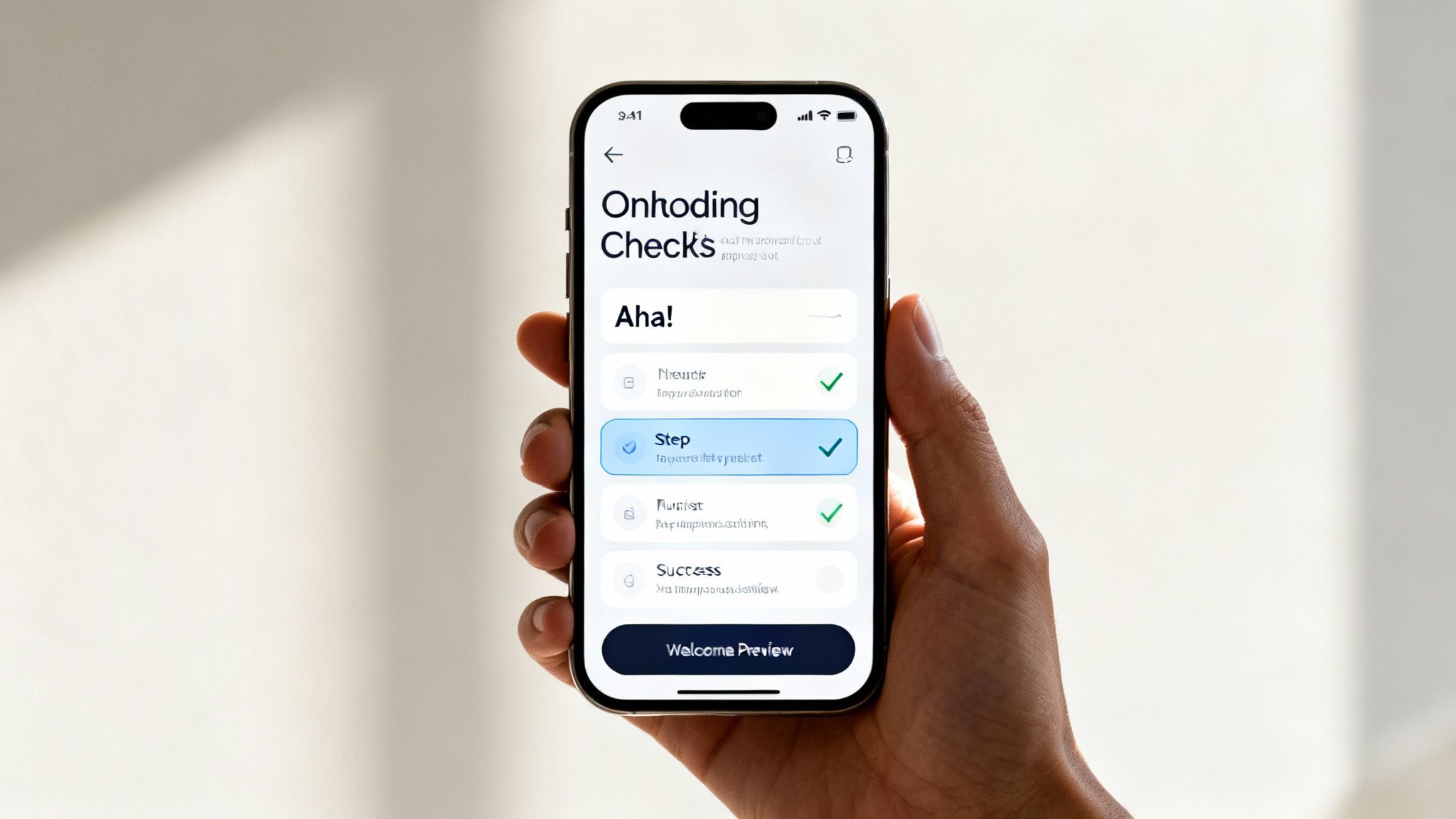
Progress feels good. In-app checklists are a fantastic way to create a sense of momentum by guiding users through key setup actions without being overbearing. It gamifies the process, turning what could be a chore into a series of small, satisfying wins.
A great checklist focuses on just 3-5 core actions that get the user to value as quickly as possible.
- Create Your First Project: The foundational step.
- Invite a Team Member: Sparks collaboration and gets more people invested.
- Integrate with Another Tool: Shows how your product fits into their existing workflow.
- Complete Your Profile: An easy win that personalizes their experience.
Each time a user checks off an item, they get a little dopamine hit and a clear visual of the progress they're making. It’s a simple but powerful tool that makes them feel accomplished and more invested with every single click.
Using Personalization to Build Deeper Connections
Let's be real: a {{first_name}} merge tag in an email isn't real personalization. It’s the bare minimum. In a world where customers feel overwhelmed by generic noise, the fastest way to get ignored is to treat everyone the same.
True personalization is about using what you know about your customers to create experiences so relevant and timely they feel like a one-on-one conversation. It’s about making your users feel seen and understood, not just marketed to. This means digging deeper than surface-level details and using real data—like their industry, their job title, or which features they actually use—to shape every single interaction.

When you get this right, you stop broadcasting messages and start solving problems. Imagine sending a new feature announcement only to the users who will actually benefit from it. Or tailoring an in-app tutorial to someone's specific skill level, guiding them from novice to expert without making them feel lost. That’s the real power of a smart personalization strategy.
Moving Beyond Basic Segmentation
The first step is to recognize the different layers of data you already have. A great starting point is effective customer profiling, which helps you understand who your buyers are and how to talk to them with precision. The magic happens when you start combining different data points to create hyper-specific segments.
Here’s a breakdown of the data types you should be looking at:
- Behavioral Data: This is all about what users do inside your product. Think feature adoption, login frequency, and key actions they take. A user who has adopted 80% of your core features is ready for advanced tips, not a beginner's guide.
- Firmographic Data: This is about who they are and where they work. Details like industry, company size, and revenue can dramatically change the conversation. A user in e-commerce has completely different needs than one in healthcare.
- Contextual Data: This is crucial information from your other systems, like your CRM or helpdesk. If a user has three open support tickets about a specific feature, the last thing they need is a marketing email promoting it. Instead, you could send a helpful guide or offer a one-on-one session.
When you bring these together, you unlock some powerful possibilities. For example, you could create a segment for "Power users in the finance industry who haven't adopted our new reporting feature." That allows you to send a highly targeted message that feels less like a sales pitch and more like a helpful heads-up from an expert.
The Personalization Perception Gap
There's a massive disconnect between how well businesses think they're personalizing and how customers actually feel about it. The data is pretty eye-opening. A 2023 report found that while 76% of executives feel their company understands its customers well, only 34% of consumers agree.
Closing this gap is a huge opportunity. Why? Because 80% of B2B buyers are far more likely to buy after a highly personalized experience, and 60% of customers become repeat buyers when they feel understood. You can dig into this and more in the 2025 customer engagement trends report.
Key Insight: Personalization isn't just a marketing tactic to bump open rates. It's a core strategy for building trust. When customers feel you get their unique challenges and goals, they're much more likely to stick around and become your biggest fans.
Implementing a Practical Personalization Strategy
Putting this into practice doesn't require a massive data science team. Modern marketing automation and product analytics tools have made this more accessible than ever. It's really about having the right mindset and a clear plan.
Here’s a simple checklist to get you started:
- Identify Key Engagement Signals: What 3-5 actions inside your product signal that a user is getting real value? These "aha moments" are the foundation of your behavioral data.
- Integrate Your Data Sources: Connect your product analytics tool with your CRM and email platform. This creates a single source of truth, giving you a complete picture of each user's journey.
- Start with One High-Impact Campaign: Don't try to personalize everything at once. Pick one area where it will make a big difference, like onboarding or a feature announcement, and nail it.
- Measure and Iterate: Track the results. Did your personalized campaign increase feature adoption? Did it lower support tickets for that topic? Use what you learn to refine your approach and find your next opportunity.
A smart approach to content marketing and strategic communications is the thread that ties all of this together. It ensures every message is perfectly aligned with your customer's needs, making them feel genuinely supported and turning them into passionate advocates for your brand.
Keeping Customers Engaged Long After the Sale
Getting a customer to sign up isn’t the end of the road—it’s just the beginning. So many B2B companies put all their effort into the initial sale, then let that hard-won relationship go cold. But the real, sustainable growth? That comes from turning that first purchase into a long-term partnership.
This means you have to stop thinking about just closing deals and start focusing on delivering value week after week, month after month. The idea is to keep your customers active, seeing results, and growing alongside you. This is how you transform a casual user into a power user who can't imagine their work life without your software.
How to Nurture Your Existing Customers
One of the biggest mistakes we see is businesses treating all their customers the same. You wouldn't do that with your prospects, so why do it with your user base? An effective nurturing program isn't about blasting out a generic monthly newsletter. It’s a targeted strategy designed to get them deeper into your product and help them solve their next big problem.
Think of it as an ongoing onboarding process. Your customers’ goals will change, their teams will expand, and your product will get better. Your communication has to keep up.
A great place to start is by segmenting users based on how they actually use your product:
- The Dabblers: These are the folks who log in but only use one or two core features. They need a gentle nudge to discover other parts of the tool that could make their lives even easier.
- The Power Users: These are your champions. They've mastered the essentials and are now hungry for advanced tips, new use cases, and a sneak peek at what's coming next.
- The Newly Upgraded: Someone just put more budget behind your product. Now’s your chance to send them content that proves they made a smart decision and helps them get a quick win with their new features.
Once you know who you're talking to, you can create content that actually resonates. For the "Dabblers," maybe a quick video series on "Five Features You're Missing Out On." For your "Power Users," an invite to an exclusive webinar with your head of product will feel like a VIP experience.
Mapping Out a Customer Journey Content Calendar
To do this right and without losing your mind, you need a content calendar built specifically for the post-sale journey. This isn't the same as your top-of-funnel blog calendar. This one is all about delivering the right message at the right moment to make their product experience better.
Your calendar should align content with key milestones in the customer's lifecycle, so you're always showing up with something helpful.
A solid nurturing program doesn't just keep customers around; it makes them more valuable. The data is clear: nurtured B2B leads consistently result in bigger deals.
This holds true long after the initial sale. When you keep educating and empowering your customers, you’re not just fighting churn—you’re setting the stage for expansion revenue. The numbers don't lie: nurtured B2B leads can lead to 47% larger purchases. And with 77% of B2B buyers preferring email, it's still the workhorse for any nurturing strategy. You can find more B2B marketing stats that paint a clear picture.
Content That Actually Drives Engagement
The content you create for existing customers has one job: be incredibly helpful. Every single piece should aim to make them better at what they do, thanks to your product.
Here are a few types of content that always get great results:
- Advanced Playbooks: Forget basic "how-to" articles. Create strategic guides that solve a bigger problem. If you sell a marketing automation tool, a playbook on "How to Build Your First Lead Scoring Model from Scratch" is pure gold.
- Customer-Only Webinars: Host live sessions where you do a deep dive into an advanced feature or, even better, showcase how other top customers are getting amazing results. This builds a sense of community and delivers real value.
- "Behind the Scenes" Case Studies: Go beyond the glossy success story. Show the nitty-gritty details of how a customer in a similar industry achieved a specific outcome. This gives other users a proven roadmap to follow.
- Feature Adoption Campaigns: When you launch something new, one email isn't enough. Build a mini-campaign around it with an announcement email, a follow-up in-app message, and a short tutorial video to drive immediate adoption.
When you consistently show up with this kind of value, the entire relationship changes. You're no longer just another software vendor on their credit card statement. You become an indispensable partner in their success. That ongoing conversation is what creates deeply loyal customers who not only stay with you but become your biggest fans.
How to Measure and Improve Your Engagement Strategy
If you're not measuring your customer engagement efforts, you're flying blind. It's easy to pour resources into new tactics that feel productive, but without data, you're just guessing. This is the fastest way to burn through your budget with little to show for it.
A data-driven approach is what separates a strategy that seems smart from one that actually moves the needle. To truly understand how to increase customer engagement, you have to get beyond the surface-level noise and focus on the numbers that tell you if users are healthy, active, and getting real value.
Identifying the KPIs That Truly Matter
Vanity metrics like page views or social media followers are fool's gold. They look shiny but don't tell you much about how deeply customers are woven into your product. You need to zero in on metrics that have a direct line to retention and long-term success.
Here are a few essential KPIs that should be on your radar:
- Feature Adoption Rate: What percentage of your users are actually using the key features that deliver that "aha!" moment? If you just shipped a new tool and adoption is low, it could point to a confusing UI, a need for better in-app guidance, or a targeted email campaign to highlight its benefits.
- Session Duration and Frequency: Are people logging in daily? How long are they sticking around? An uptick here is a fantastic sign that your product is becoming an indispensable part of their workflow.
- Net Promoter Score (NPS): It’s a classic for a reason. Asking "How likely are you to recommend us?" is a powerful and simple way to get a pulse check on overall customer sentiment and loyalty.
Key Takeaway: Measuring engagement is about turning data into action. Every KPI you track should have a "so what?" behind it. If a number drops, you need a plan to find out why and a process for fixing it.
Build a Simple Customer Health Dashboard
You can’t fix what you can’t see. A customer health dashboard is your command center, giving you a quick, at-a-glance view of how your user base is doing. This doesn't have to be some complex, custom-coded solution from day one. You can get started with a simple spreadsheet or a product analytics tool like Mixpanel or Amplitude.
The goal is to create a "health score" for each customer by combining a few of those key metrics. For example, a "healthy" customer might be someone who logs in daily, has adopted 75% of your core features, and recently gave you a positive NPS score. On the other hand, a customer who hasn't logged in for 30 days and has an open support ticket is flashing red.
This dashboard is what allows you to be proactive instead of reactive. Instead of waiting for a cancellation email to land in your inbox, you can see the warning signs early and intervene with targeted help or a personal check-in. It's a fundamental part of building a mature content marketing operations model that supports users from onboarding to advocacy.
The flow chart below shows a simple but effective way to nurture users at different stages with targeted content, guiding them toward deeper engagement.
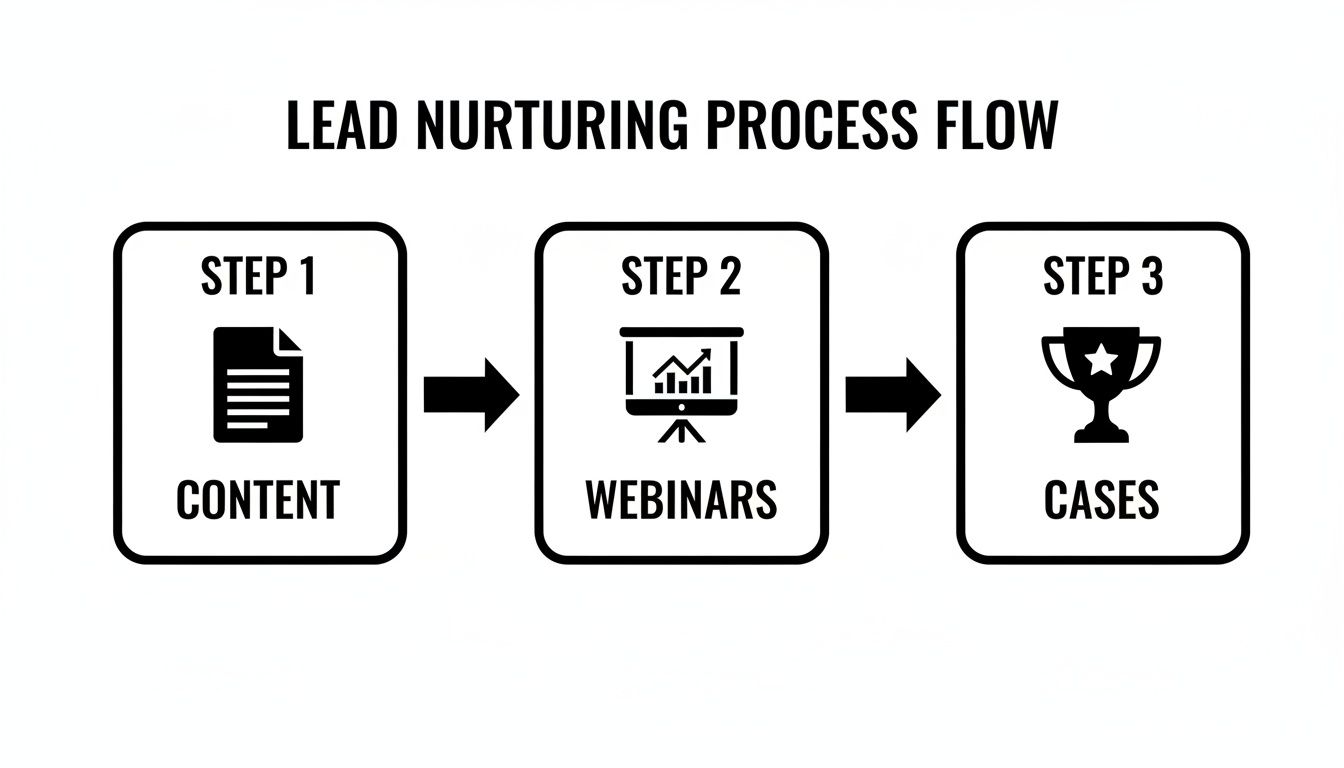
This kind of systematic approach ensures you're offering the right value at the right time to keep users moving forward.
Run Small, Iterative Engagement Experiments
The best engagement strategies weren't born from a single brilliant idea. They were built on a foundation of small, validated experiments. This agile approach lets you test your hunches, learn from real user behavior, and double down on what works—without betting the farm on a single initiative.
This process transforms your team from one that just ships features to one that solves real customer problems. To get started, you need a way to structure your tests. A simple template can bring clarity and focus to your efforts.
Your Customer Engagement Experiment Template
| Experiment Component | Description | Example |
|---|---|---|
| Hypothesis | A clear, testable statement about what you believe will happen. | "We believe adding a 3-step checklist to our onboarding will increase the adoption of our 'reporting' feature by 15% within a user's first week." |
| Audience | The specific user segment you will be testing this on. | New users who signed up in the last 30 days. |
| Success Metric | The single, primary KPI that will determine if the experiment worked. | Feature adoption rate for the 'reporting' feature. |
| Implementation | The specific actions you need to take to run the experiment. | A/B test: 50% of new users see the checklist, 50% see the original onboarding. Run for 4 weeks. |
| Outcome & Learnings | After the test, document the results and what you learned. | "The checklist increased adoption by 18%. Users who completed it were also 10% more likely to return in week two. We will roll this out to 100% of new users." |
This cycle of hypothesizing, testing, and learning is how you build a dynamic engagement strategy that gets better and better over time. It’s a repeatable process for generating real, measurable growth.
Common Customer Engagement Questions Answered
Even with the best strategy in place, you're going to have questions once you start getting your hands dirty. Learning how to boost customer engagement is a constant process of asking the right questions and finding answers that actually work in the real world.
Let's tackle some of the most common hurdles and questions we see from B2B and SaaS marketers. This should give you some clear, straightforward guidance to keep you moving forward.
What’s the Single Most Effective Tactic to Increase Customer Engagement Quickly?
Look, there's no magic wand here. But if we had to pick one thing that delivers the fastest, most visible impact, it's almost always improving the new user onboarding experience.
Think about it: a smooth, value-packed onboarding process sets the tone for the entire customer relationship. It can slash early-stage churn and build a solid foundation for everything that comes after. Your number one job is to get users to their first "aha moment" as fast as humanly possible. This isn't about throwing every feature at them; it's about showing them the one thing that solves the specific problem they hired your product to fix.
You can nail this with a few key tactics:
- An interactive, goal-oriented product tour that guides, not just points.
- A simple "getting started" checklist right inside the app.
- A personalized welcome email that points them straight to the most relevant feature based on how they signed up.
A strong start creates momentum. It proves your product's value right out of the gate, building the trust you need for deeper engagement down the road.
How Do You Re-Engage Customers Who Have Gone Dark?
Trying to win back inactive customers requires a thoughtful, value-first approach. Let’s be honest, those generic "we miss you" emails are lazy, easy to ignore, and can even feel a bit desperate. You have to give them a compelling reason to come back.
The secret is to show them new, tangible value or remind them of the specific problem your product was supposed to solve for them in the first place.
First, you need to segment your inactive users. A power user who suddenly went quiet needs a totally different message than someone who barely completed onboarding. Once you’ve done that, you can launch a targeted re-engagement campaign.
A few ideas that have worked for us:
- Announce a new feature they haven't seen that's super relevant to their industry.
- Share a fresh case study showing how a similar company got incredible results.
- Offer a free one-on-one session with a product specialist to help them get unstuck.
Sometimes, the most direct route is the best. A simple survey asking why they’ve been inactive can give you priceless feedback. More importantly, it reopens the conversation and shows you care about their experience, not just their recurring revenue.
The biggest mistake you can make when re-engaging a customer is focusing on what you want (their business) instead of what they need (a solution). Always lead with value. The engagement will follow.
What's the Difference Between Customer Satisfaction and Customer Engagement?
This is a critical distinction that people mix up all the time. While they’re related, satisfaction and engagement measure two completely different things about your customer relationships, and they have very different implications for the health of your business.
Customer Satisfaction is a backward-looking metric. It tells you how a customer feels about a past interaction, like how a support ticket was handled or their overall experience so far. We usually measure this with CSAT surveys. A satisfied customer is happy, but they might just be passively content—and still very much at risk of churning if a better deal comes along.
Customer Engagement, on the other hand, is a forward-looking indicator. It's about their ongoing, active relationship with your product and brand. You measure it by what they do:
- How often are they logging in?
- Which features are they actually using?
- Are they participating in your community or reading your content?
An engaged customer is actively invested in your ecosystem. They're far more loyal and, ultimately, much more valuable to your business in the long run. You can have satisfied customers who aren't engaged, but it's nearly impossible to have engaged customers who aren't satisfied.
At Mick-Mar Inc., we help B2B and SaaS companies build and execute marketing strategies that create deeply engaged customers who stick around for the long haul. If you're ready to turn your users into passionate advocates, we can show you how.