Trying to scale your company in the hyper-competitive software world? It's a tough race, and you're certainly not alone. The secret weapon many are turning to is a specialized B2B SaaS marketing agency—a team built from the ground up to tackle the unique challenges of marketing subscription software. It's a world away from what a generalist agency can offer.
Why a B2B SaaS Marketing Agency Is Your Growth Engine
Picture your SaaS company as a high-performance Formula 1 car. Sure, you could take it to a standard auto shop. They’d manage an oil change and rotate the tires. But to win, you need a pit crew—engineers who live and breathe high-performance mechanics, use advanced data for split-second decisions, and have the exact tools to fine-tune for pure speed.
That pit crew? That's your B2B SaaS marketing agency.

The Specialist Advantage
Generalist marketing agencies often fall short because they just don't get the SaaS model. They might chase vanity metrics that look impressive in a report but do nothing for your actual revenue. A specialized agency is wired differently.
They get it. They understand:
- Your Metrics: They live in a world of Monthly Recurring Revenue (MRR), Customer Acquisition Cost (CAC), and Lifetime Value (LTV).
- Your Sales Cycle: They know how to guide prospects through long, complex buying journeys that often involve an entire committee of decision-makers.
- Your Audience: They have deep experience creating content for savvy, technical buyers who demand real value, not just flashy campaigns.
This focused expertise is no longer optional. With the median annual growth rate for public SaaS companies hitting 22% in early 2023, the pressure is on. Specialized marketing isn't a luxury; it's a fundamental part of staying ahead. You can explore more B2B SaaS marketing statistics to see how agencies are fueling this growth.
More Than Just a Vendor
At the end of the day, picking a specialized partner is about finding a team that feels like an extension of your own. They aren’t just a task-doer you hand things off to. They’re strategic thinkers who help you navigate the high-stakes, fast-paced SaaS environment.
A true B2B SaaS marketing agency doesn't just deliver leads; they build a predictable and scalable revenue machine. They connect every marketing action directly to business outcomes, turning your marketing budget into a powerful investment for long-term growth.
This partnership is your ticket to moving beyond "random acts of marketing." It’s about building a cohesive strategy where every element—from a blog post to a PPC campaign—works in concert to attract the right customers, shorten the sales cycle, and drive predictable revenue. They become a critical part of your growth engine, built to help you win the race.
The Core Services That Actually Drive SaaS Growth
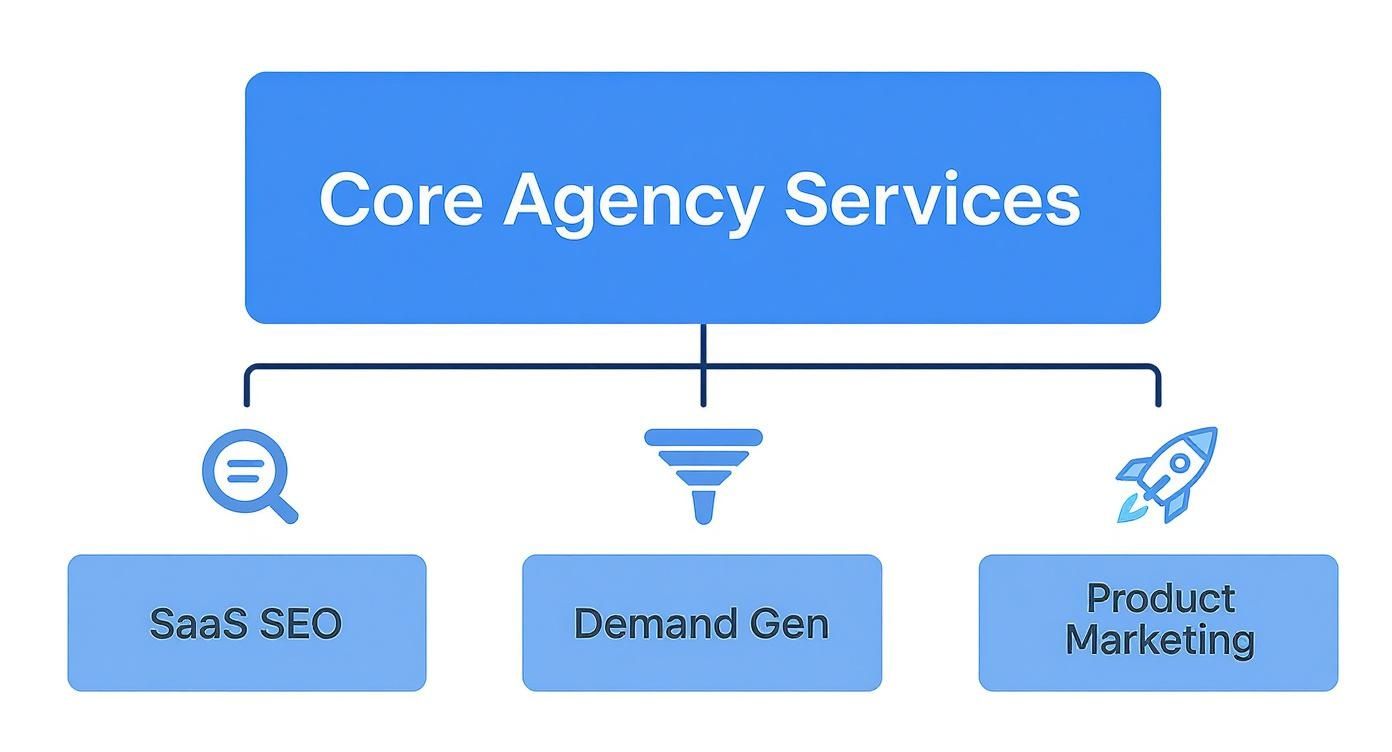
So, what does a top-tier B2B SaaS marketing agency really do all day? It's a whole lot more than just cranking out blog posts or tinkering with social media. Think of them as architects and engineers building a predictable growth engine—a system designed to turn complete strangers into paying customers and, eventually, die-hard fans.
This isn't about throwing spaghetti at the wall to see what sticks. It's a strategic, interconnected system. Each service plays a crucial part in hitting the metrics that matter, like boosting Monthly Recurring Revenue (MRR) and driving down your Customer Acquisition Cost (CAC). Let's pull back the curtain on the functions that fuel real, sustainable growth.
Strategic Demand Generation
At its core, demand generation is about creating genuine interest and desire for your product. A B2B SaaS marketing agency implements proven SaaS B2B lead generation strategies to fill your pipeline with qualified opportunities, not just a list of random email addresses. The goal is to attract the right people—those who have the exact problems your software was built to solve.
This typically involves a smart mix of tactics:
- Paid Media: Running laser-focused ad campaigns on platforms like LinkedIn, Google, or niche industry sites to get in front of decision-makers who are actively looking for a solution like yours.
- Content Syndication: Getting your most valuable assets—think whitepapers and in-depth ebooks—onto third-party networks to capture new leads well beyond your current reach.
- Webinars and Events: Hosting engaging sessions that educate your audience and show them exactly how your product can make their lives better.
High-Impact SaaS SEO and Content
SEO for SaaS is a completely different beast. You're not just chasing high-volume keywords; you're trying to attract high-intent users who are ready to sign up for a trial or book a demo. This means zeroing in on bottom-of-the-funnel phrases that signal a real need, like "best project management tool for remote teams."
An expert agency builds its entire content strategy around this principle. They create in-depth articles, side-by-side comparison pages, and compelling case studies that answer your ideal customer's most urgent questions. This establishes your brand as a trusted authority while systematically capturing organic traffic that actually converts. A smart strategy for content marketing for SaaS is the bedrock of long-term, compounding growth.
The need for specialized expertise in areas like SEO and content is a major driver for SaaS companies partnering with agencies. Projections for 2025 estimate that 80% of B2B SaaS sales will happen online, making a seamless digital experience paramount.
This digital-first reality is where agencies deliver immense value. Recent data shows that SaaS companies partnering with an agency see 2.3 times faster organic traffic growth compared to those relying solely on in-house teams. Discover more insights about 2025 B2B SaaS marketing benchmarks and how specialized execution drives results.
Focused Product Marketing
Product marketing is the crucial bridge between what your product does and why the market should care. An agency helps you translate complex features into clear, compelling benefits that hit home with your target audience. They stop talking about what your software is and start explaining what it helps your customers achieve.
This service is all about:
- Go-to-Market (GTM) Strategy: Crafting a bulletproof launch plan for new features or products to ensure you make the biggest splash possible.
- Positioning and Messaging: Nailing your unique value proposition and making sure it's communicated clearly and consistently everywhere.
- Sales Enablement: Arming your sales team with the materials they need—like killer slide decks, battle cards, and one-pagers—to close more deals, faster.
Efficient Marketing Automation
Finally, marketing automation is the technical backbone that makes all of this scalable. A great agency will set up and manage platforms like HubSpot or Marketo to nurture leads, score their engagement, and hand them over to sales at the exact right moment.
But it’s not just about setting up email drips. It’s about creating personalized journeys that guide prospects from their first touchpoint all the way to becoming a customer and beyond. By automating the repetitive work, your team is freed up to focus on high-value conversations, making the whole operation more efficient and ensuring no lead ever falls through the cracks.
Measuring Success: The SaaS Marketing KPIs That Actually Matter
How do you know if your B2B SaaS marketing agency is actually delivering? It’s far too easy to get caught up in flashy numbers like a sudden spike in website traffic or a jump in social media followers. These are what we call vanity metrics. They feel good, but they don’t pay the bills.
A real marketing partner cuts through that noise. They focus squarely on the Key Performance Indicators (KPIs) that connect directly to your revenue and the long-term health of your business. They help you build a solid framework to measure what’s working, making sure every marketing dollar pulls its weight.
Let's break down the KPIs that truly matter, organized by the goals they help you achieve.
KPIs For Customer Acquisition
Getting new customers in the door is obviously crucial, but it has to be profitable. A great agency won't just report on the number of leads; they'll show you the quality and cost-effectiveness of acquiring them.
The two metrics you should live by here are:
- Customer Acquisition Cost (CAC): This is your all-in cost—every sales and marketing dollar spent—to land one new customer. The goal is simple: a good agency works to push this number down over time, making your growth more sustainable.
- MQL-to-SQL Conversion Rate: This tracks how many of your Marketing Qualified Leads (MQLs) the sales team agrees are legitimate Sales Qualified Leads (SQLs). A high rate here is a fantastic sign that marketing isn't just sending over names; they're attracting the right people who are ready to talk business.
KPIs For Revenue Growth
At the end of the day, marketing's job is to make the company money. Generating a pile of leads is meaningless if they don't contribute to a healthy, growing sales pipeline.
Your conversations with your agency should always circle back to these numbers:
- Monthly Recurring Revenue (MRR) Growth: For any subscription business, this is the holy grail. All marketing activities should ultimately point toward a steady, predictable increase in MRR.
- Marketing-Originated Pipeline: This metric puts a dollar value on the sales opportunities created directly by marketing campaigns. It's the cleanest way to show marketing's direct contribution to the sales team's success.
KPIs For Customer Retention
In the SaaS world, a one-time sale is just the beginning. Keeping customers is just as critical—if not more so—than finding new ones. An experienced agency knows this and builds strategies that foster long-term loyalty, not just quick wins.
These are the retention KPIs that tell the real story:
- Customer Lifetime Value (LTV): This is the total revenue you can expect from a single customer over the entire course of your relationship. You want to see your LTV consistently climbing, which means you're not just selling, you're building value.
- Churn Rate: This is the percentage of customers who cancel their subscriptions in a given period. A primary goal for a B2B SaaS marketing agency is to help you lower churn by bringing in better-fit customers from the very start.
The true test of a specialized agency is their ability to connect marketing activities to real business results. They'll shift the conversation from, "How many clicks did we get?" to, "How much qualified pipeline did we generate?" That focus on actionable metrics is what separates a vendor from a genuine growth partner.
This is where you can see how all the pieces fit together. Core services like demand generation, product marketing, and SEO are all designed to impact these specific business outcomes.
Moving Beyond Vanity Metrics
The key is to distinguish between metrics that make you feel good and metrics that help you make good decisions. This table breaks down the difference.
SaaS Marketing KPIs: Vanity Metrics vs Actionable Metrics
| Business Goal | Vanity Metric (Avoid) | Actionable KPI (Focus On) |
|---|---|---|
| Awareness & Traffic | Raw Website Visits, Page Views | Organic Traffic to Key Pages, New Users from Target ICPs |
| Lead Generation | Total "Leads," Form Fills | Marketing Qualified Leads (MQLs), Demo Requests |
| Sales Alignment | Number of MQLs | MQL-to-SQL Conversion Rate, Sales Cycle Length |
| Revenue Impact | Cost Per Lead (CPL) | Customer Acquisition Cost (CAC), Marketing-Sourced Revenue |
| Customer Success | Social Media Likes, Follower Count | Customer Churn Rate, Customer Lifetime Value (LTV) |
By focusing on the "Actionable KPI" column, you can have much smarter, data-backed conversations with your agency. You'll know exactly how their work is impacting the metrics that your C-suite and investors actually care about.
For a deeper look at this, you can read our guide on how to measure marketing ROI. It will give you an even clearer picture of what a successful, accountable partnership looks like.
How to Choose the Right Agency Partner for You
Picking a B2B SaaS marketing agency is a big deal. It’s a decision that can shape your growth for years to come. You're not just hiring someone to check off boxes on a to-do list; you're bringing a strategic partner into your inner circle. Getting this right is critical, and a misstep can be incredibly costly.
Think of this as your practical buyer's guide. We'll walk through a clear checklist to help you tell the real SaaS experts from the generalist agencies that just have a "SaaS" page on their website.
Verify Their SaaS-Specific Expertise
First things first: you need undeniable proof that they live and breathe the SaaS world. A slick website means nothing if they don't get the fundamental mechanics of a subscription business. A generalist agency might talk a good game about "leads," but a true specialist will be talking about "qualified trials," "demo requests," and pipeline velocity.
Here's how to spot the real deal:
- Relevant Case Studies: A wall of client logos is just window dressing. Ask to see detailed case studies from SaaS companies that look like yours. They should be able to walk you through the initial challenge, the strategy they deployed, and—most importantly—the specific, measurable results. Think MRR growth, lower CAC, or a higher LTV.
- Industry Niche Experience: The SaaS universe is vast. An agency that excels in FinTech will understand the language of compliance and security-conscious buyers. One that specializes in HealthTech will know the ins and outs of HIPAA and clinical personas. Don't be shy about asking about their experience in your specific vertical.
- Team Backgrounds: Find out who will actually be working on your account. Look for people who have spent time working in-house at other SaaS companies. That kind of firsthand experience is gold because they’ve walked in your shoes and understand your challenges from the inside.
Assess Their Process and Communication Style
The most brilliant strategy in the world will crash and burn without a solid process and clear communication. You're looking for a partner who feels like a natural extension of your team, not some mysterious black box you just send money to.
A strong agency partnership is built on transparency and alignment. Their process shouldn't be a secret recipe; it should be a collaborative framework that you understand and can contribute to, ensuring everyone is pulling in the same direction toward the same goals.
During your initial calls, really dig into how they work. Is their process documented? How often will you meet? What do their reports actually show you? A great partner will set clear expectations from day one and have a plan for keeping you looped in every step of the way.
Ask the Tough Questions
Once you’ve got a shortlist of a few serious contenders, it's time to get past the sales pitch. The answers to these questions will tell you everything you need to know about their strategic depth, their character, and how they handle things when they don't go according to plan.
Here are a few critical questions to get you started:
- How do you approach the first 90 days? A pro will have a structured onboarding plan that’s heavy on discovery, audits, and planning before a single dollar is spent on execution.
- Can you share a campaign that failed and what you learned? This is a test of humility and their commitment to learning. Things go wrong. You want a partner who owns their mistakes, analyzes them, and gets better because of them.
- How do you measure success for a client like us? Their answer should immediately jump to core SaaS KPIs—pipeline, MRR, CAC—not vanity metrics like website traffic or social media impressions.
- Who will be my day-to-day contact and what is their experience? Make sure you have a direct line to strategic thinkers, not just a junior account manager.
Choosing the right partner is a pivotal moment for scaling your company. For more advice, check out our insights on selecting a top B2B marketing agency that truly fits your growth goals. By following this structured process, you're setting yourself up to find a partner who will become a genuine engine for your growth.
Decoding Agency Pricing and Engagement Models
Figuring out how a B2B SaaS marketing agency prices its work is crucial. It’s not just about the cost; it’s about finding a structure that fits your company's stage, budget, and what you need to get done right now. There’s no single "best" model, but understanding the common ones will help you plan your budget and set clear expectations from the start.
Think of these models as the operating system for your relationship with the agency. They dictate the scope, flexibility, and how deeply the agency will be involved in your strategy. Getting this right is the first step toward a great partnership.
The Monthly Retainer Model
This is the bread and butter of most agency relationships, and for good reason. With a retainer, you pay a fixed fee each month for a set scope of work and guaranteed access to the agency’s team. It’s the standard for companies that are serious about long-term, sustainable growth.
A retainer model makes the most sense when you're looking for:
- Continuous Growth: It's built for executing an ongoing, multi-channel strategy—think consistent SEO, content creation, and demand generation that builds on itself month after month.
- A True Strategic Partnership: This model allows the agency to really sink its teeth into your business, becoming a genuine extension of your team that understands your product, customers, and market inside and out.
- Predictable Budgeting: No surprises here. You know exactly what you’re spending every month, which makes life much easier for your finance team.
Choosing a retainer signals you're ready to build a real growth engine, not just check a few tasks off a list.
Project-Based Pricing
Got a specific, one-time initiative with a clear finish line? A project-based fee might be the perfect fit. This is great for things like a complete website overhaul, a big product launch campaign, or building out your foundational content strategy.
You'll agree on a fixed price for the whole shebang before any work begins. This structure offers total clarity on cost and is a fantastic way to "test drive" an agency before diving into a longer commitment. The only catch is its rigidity—anything that falls outside the original scope will usually mean a new proposal and a new cost.
A Word of Caution: Be skeptical of any agency that wants to tackle ongoing efforts like SEO or regular content marketing with a project-based fee. These disciplines are marathons, not sprints. They need sustained, consistent effort to deliver real results, and chopping them up into projects often leads to a disjointed strategy that goes nowhere.
Performance-Based Agreements
On paper, performance-based models sound like a dream. You only pay the agency when they hit specific, agreed-upon goals, like delivering a certain number of SQLs or demo requests. It directly ties the agency’s paycheck to your success, which creates some powerful alignment.
In reality, this model is pretty rare and comes with a few strings attached. It usually involves a higher base fee to cover the agency's risk and requires you to have rock-solid definitions for what counts as a "qualified lead" or a successful conversion. This really only works for companies that already have a dialed-in sales process and clear conversion data to build on.
Ultimately, the best B2B SaaS marketing agencies are flexible. They'll work with you to land on a model that makes sense for your business goals. Great partnerships are always built on transparency, clear expectations, and a mutual agreement on what winning looks like for your SaaS.
Your First 90 Days with a SaaS Marketing Agency
Bringing on a B2B SaaS marketing agency is a big move, and like any strong partnership, it works best when everyone knows what to expect. Let's be clear: the first 90 days aren't about flipping a switch and watching a flood of leads pour in. It’s all about laying the groundwork for real, sustainable growth.
Knowing what this critical onboarding period looks like helps get both teams on the same page and sets the stage for a successful relationship.
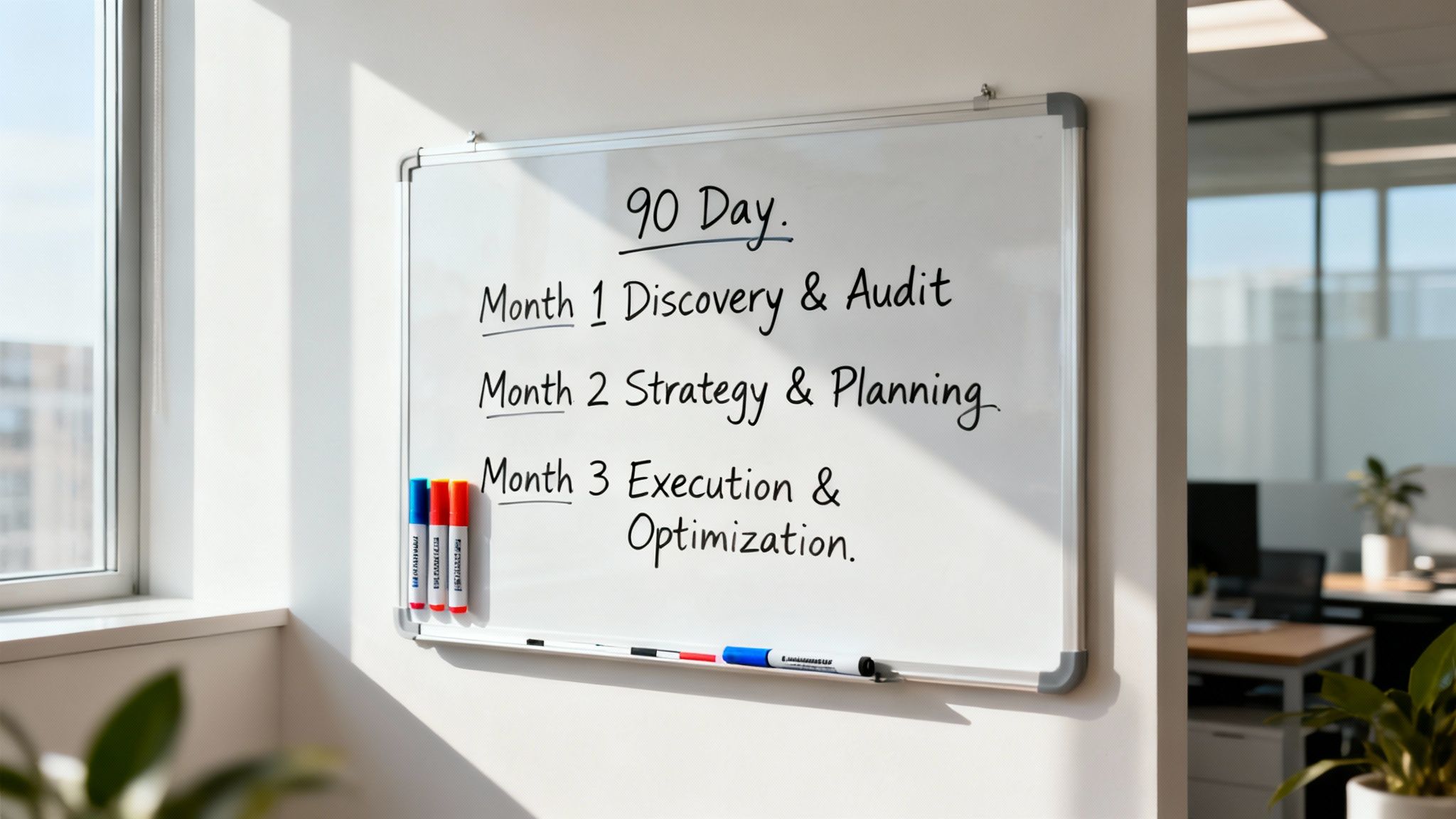
Think of this initial phase as a three-act play: you start with deep discovery, move into strategic planning, and finish with the first wave of execution.
Month 1: Discovery and Audits
The first 30 days are an immersion. Your new agency partners essentially become students of your business, your market, and your customers. They need to understand your company's DNA, not just read your website's about page. It’s like a doctor running diagnostics before writing a prescription—you can't fix what you don't fully understand.
During this time, the agency will likely:
- Conduct Stakeholder Interviews: They'll sit down with your sales, product, and leadership teams to really get a handle on your value proposition, business goals, and any internal hurdles.
- Perform Technical Audits: This means digging into your website's SEO health, checking your current analytics setup, and reviewing your marketing technology stack to find any technical roadblocks or quick wins.
- Analyze Competitors: They'll put your top competitors under the microscope, figuring out what they’re doing right (and wrong) to pinpoint gaps in the market you can own.
This foundational work is absolutely essential. It’s what ensures the strategy they build is truly yours, not just a generic template pulled off a shelf.
Month 2: Strategy and Planning
Armed with all that discovery data, the second month is where the agency connects the dots. They shift from learning to architecting, taking all their findings and building a comprehensive, data-driven marketing roadmap.
The goal here isn't just to produce a document; it's to create a strategic blueprint. This plan will spell out which channels to focus on, what core messaging will resonate, and the specific KPIs that will measure success for the next several quarters.
This is a very collaborative period. You should expect to be in the weeds with them, reviewing the proposed strategy and giving feedback to make sure it aligns perfectly with your business objectives. This roadmap will detail everything from campaign ideas and content calendars to budget breakdowns, giving everyone a clear vision of the path ahead.
Month 3: Execution and Optimization
In the final month of onboarding, the plan comes to life. The first campaigns go live, the first blog posts are published, and the initial data starts trickling in. This is where the rubber finally meets the road.
Now, this phase is less about seeing massive returns and more about setting a baseline. The main goal is to gather early performance data, test the initial hypotheses from the strategy, and start making small adjustments. It's about building momentum and creating the feedback loops needed for continuous improvement.
By the end of this 90-day sprint, you’ll have a solid foundation, a clear strategy, and the first tangible results of your new partnership.
Common Questions About B2B SaaS Marketing Agencies
Even after seeing all the services and benefits laid out, you probably still have a few questions rolling around in your head. That's completely normal. Choosing a B2B SaaS marketing partner is a big move, and you want to be sure you've covered all the angles before signing on the dotted line.
Let's walk through some of the most common questions we hear from SaaS founders and marketing leaders. Here are some straight answers to help you feel confident in your decision.
When Is the Right Time to Hire an Agency?
The sweet spot is usually right after you've nailed product-market fit, but your growth curve is starting to flatten out. If you know you need to scale marketing but don't have the internal expertise or sheer manpower to do it, that's your cue.
An agency isn't coming in to replace your team. Think of them as a specialized extension of your crew—a force multiplier that brings deep skills in areas like demand gen or SEO to get your growth engine firing on all cylinders again.
What Really Separates a Generalist from a SaaS Specialist?
A general marketing agency can do a bit of everything, but they rarely get the nuances of the SaaS world. They might not understand why you're obsessed with metrics like MRR, CAC, and LTV, which are the lifeblood of your business.
A true B2B SaaS marketing agency lives and breathes your world. They get the long, complex sales cycles with multiple stakeholders. They know how to market a technical product to a niche audience and are already pros with the MarTech stack you’re using.
That specialized knowledge means better strategies, quicker wins, and a much higher return on your investment. They speak your language from day one, which saves a ton of time and friction.
How Much Should I Actually Budget for an Agency?
There's no single price tag; budgets really depend on your company’s stage, your goals, and the scope of work you need. But we can talk in ranges.
- Early-Stage Startups: Often dip their toes in with project-based work. This could be anywhere from $5,000 to $10,000 for a specific outcome, like building a foundational content strategy.
- Scaling Companies: Usually go for a monthly retainer to keep the momentum going. These partnerships typically run from $10,000 to $25,000+ per month and cover ongoing strategy, execution across multiple channels, and performance reporting.
The key is to stop thinking of it as a "cost" and start seeing it as an investment in your growth engine. The conversation should always circle back to the expected ROI and the metrics that will prove the partnership is working.
Ready to stop guessing and start growing? Mick-Mar Inc. builds predictable revenue engines for B2B SaaS companies just like yours. Schedule a consultation today and let's build your growth roadmap together.