At its core, B2B tech marketing is all about connecting complex technology solutions with the businesses that need them. It's the art of translating dense, technical features into tangible business outcomes—solving a company's specific problems, streamlining their operations, and helping them hit their strategic goals. Think of it as being a translator between brilliant tech and real-world business value.
What Makes B2B Tech Marketing Different

Let's step away from the textbook definitions for a second. Selling a consumer app can be like selling a great kitchen knife. You can highlight its sharp blade, comfy handle, and sleek design. The value is immediate and easy for one person to grasp.
On the other hand, B2B tech marketing is more like designing and installing an entire commercial kitchen. You’re not just selling one tool; you're delivering a complex, integrated system. This requires a much deeper, more consultative conversation that touches on multiple parts of a business's operations.
Navigating a Complex World
The real difference is in the buying process itself. B2B tech purchases aren't quick, emotional decisions. They are long, logical, and involve a significant financial investment. That reality changes everything about how you approach marketing.
Your success hinges on proving long-term ROI and winning over a committee of stakeholders. You might have the hands-on IT manager, the strategic department head, and the budget-conscious CFO all weighing in. Each one has different concerns and speaks a different professional language.
B2B tech marketing is less about slick persuasion and more about genuine education. The goal is to build trust by showing you deeply understand your customer's business challenges and can clearly explain how your tech offers a reliable, profitable solution.
Key Differentiators in B2B Tech
Understanding these unique traits is the first step toward building a marketing plan that actually works. The B2B tech space is shaped by a few key factors that make it a world away from consumer marketing. You can explore more about what makes a great B2B marketing strategy in our detailed guide.
- Your Buyers Are Experts: B2B tech buyers really do their homework. They're digging into research, reading technical documentation, and checking peer reviews long before they ever consider speaking with a sales rep.
- Sales Cycles Are a Marathon, Not a Sprint: A final decision can take months, sometimes even over a year. The journey is filled with multiple touchpoints, from demos and consultations to security reviews and contract negotiations.
- Decisions Are Made by Committee: It’s almost never one person making the call. Research from 2023 shows the average B2B buying group involves between 6 to 10 decision-makers, and each one brings their own priorities—and objections—to the table.
This complex environment means a specialized, relationship-focused approach isn't just a nice idea; it's essential. Your marketing must be built on a rock-solid foundation of expertise, trust, and a clear demonstration of business value.
Why B2B Tech Marketing Is Your Growth Engine
Thinking of marketing as just another expense on the spreadsheet is a fast track to getting left behind. In the tech world, smart B2B tech marketing isn't a cost center; it’s the engine that drives predictable, sustainable growth. It’s what separates a great product from a market-leading business.
This engine doesn't just make noise—it produces real, measurable results. It’s the connective tissue between a solid marketing plan and the financial health of your company. Think of it as building a highway for your product: it creates clear, reliable paths for customers to find you, understand your value, and ultimately, make a purchase.
Building Deep Brand Credibility
In a market flooded with competitors all claiming to be the next big thing, your credibility is everything. Effective B2B tech marketing isn't about shouting the loudest; it's about establishing your company as a trusted authority.
This goes way beyond a slick logo. We're talking about consistently publishing expert content, sharing original research, and building a genuine community around your solution. The goal is for buyers to see your name and immediately think, "These people know what they're doing."
It’s no surprise that even with massive budgets flowing into performance marketing, brand building is making a major comeback. A 2023 LinkedIn report found that 77% of B2B marketers now see brand building as a top priority for long-term growth. This signals a huge shift in the industry toward balancing immediate lead generation with lasting brand equity.
Creating a Predictable Sales Pipeline
A high-performing marketing engine doesn’t just cross its fingers and hope for leads—it manufactures them. You're dealing with savvy buyers who need deep technical and business insights. By providing that education, you build a steady pipeline of qualified opportunities for your sales team. It's the difference between waiting for the phone to ring and having a calendar packed with promising meetings.
This process breaks down into a few key steps:
- Attracting the Right Audience: Using targeted content and smart SEO to pull in prospects who are already searching for answers to problems you solve.
- Nurturing Potential Buyers: Guiding prospects along their journey with valuable resources like webinars, in-depth case studies, and detailed whitepapers.
- Qualifying Leads: Pinpointing which prospects are truly ready for a sales conversation, so your sales reps can focus their energy where it counts.
A well-oiled marketing function turns lead generation from a game of chance into a repeatable science. It gives your business the foresight to plan for future growth with confidence because you have a clear view of the opportunities coming down the line.
Directly Impacting Financial Health
At the end of the day, the true test of B2B tech marketing is its impact on the bottom line. Every successful marketing campaign directly moves the needle on the core financial metrics that your CEO and investors actually care about.
A solid strategy drives down your Customer Acquisition Cost (CAC) by attracting better-fit customers more efficiently. It also boosts Lifetime Value (LTV) because you’re bringing in clients who understand your value, are more likely to succeed, and will stick around for the long haul. Ultimately, understanding the role of B2B PPC advertising experts can amplify this growth, but underinvesting in marketing is a huge risk that often leads to lost market share and difficulty securing future investment.
Navigating the Modern Tech Buyer's Journey
The path a B2B tech buyer takes to make a purchase has completely changed. Gone are the days of a simple, linear funnel. Today, it’s more like a maze of independent research, deep dives into peer reviews, and quiet internal discussions. Buyers are firmly in the driver's seat, educating themselves long before they ever think about speaking to a salesperson.
This new reality is largely driven by a generational shift. Millennials now make up a significant portion of B2B buyers, and they bring a different set of expectations to the table. They’ve pushed B2B marketing toward performance-based strategies where every action has to connect back to real revenue. This means your brand’s credibility and your demand generation efforts can't operate in silos—buyers are sizing up your reputation and your product’s features all at once. For more on this, you can dig into how B2B marketing is evolving for 2025.
The Rise of the Self-Serve Buyer
Today's buyers don't sit around waiting for a sales pitch; they go out and find the answers themselves. Armed with Google and an endless sea of information, their journey starts with self-diagnosing a problem. They’re plugging in super-specific, long-tail search queries to get a handle on their challenges and start mapping out potential solutions.
What does this mean for you? Your content has to be there to meet them right at the start. A slick product page isn’t enough anymore. You need a library of helpful blog posts, in-depth articles, and technical guides that answer the exact questions your ideal customers are typing into their search bars.
The infographic below really drives home how a modern b2b tech marketing engine has to be built on a foundation of brand credibility and buyer education to keep the pipeline full.
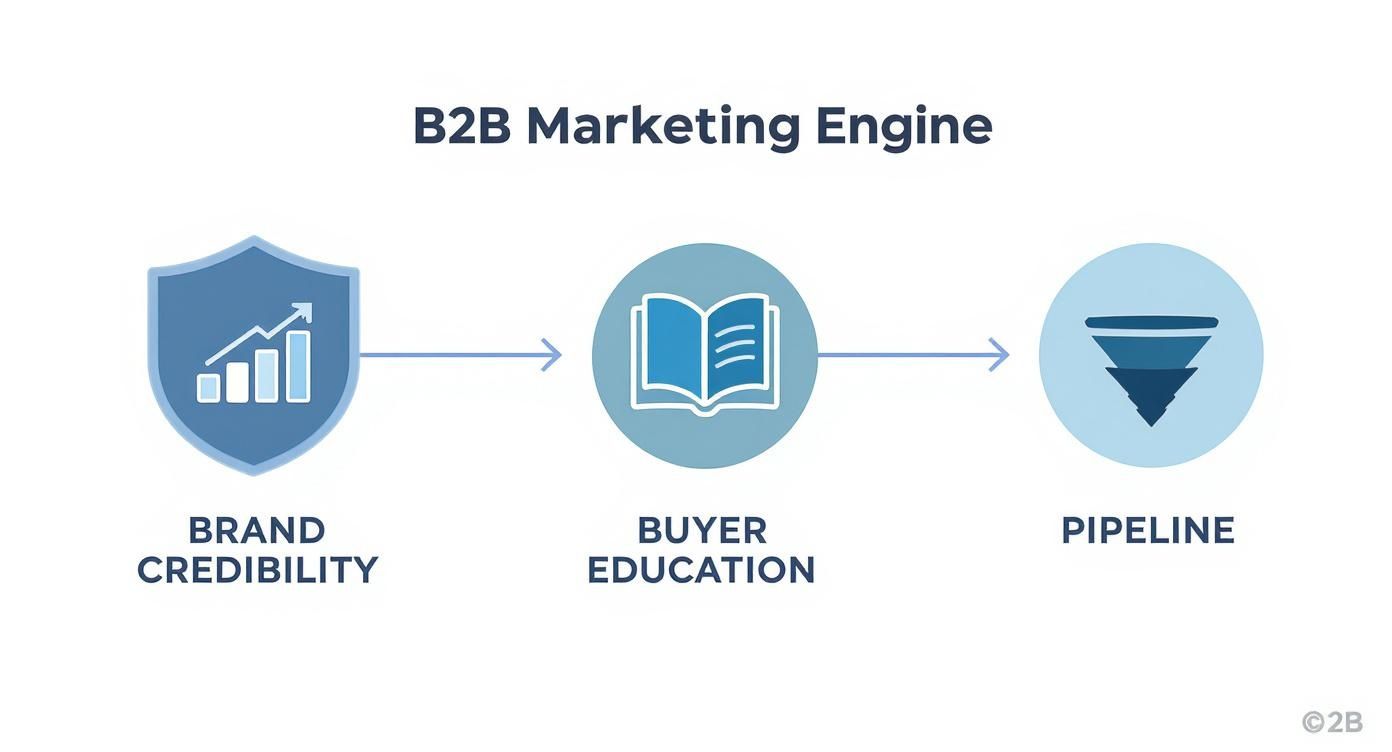
As you can see, if you haven't built that baseline of trust and committed to educating your market, your efforts to generate leads are going to fall flat.
Key Touchpoints in the Modern Journey
As buyers move from simply identifying a problem to actually shortlisting vendors, they turn to a wide range of resources to guide their decision. Knowing where they go is the key to showing up where it counts.
- Peer Review Sites: Platforms like G2 and Capterra are now essential stops. Buyers place far more trust in unfiltered reviews from actual users than they do in a company’s polished marketing copy.
- Private Communities: This is where the real talk happens. Buyers head to niche Slack channels, industry forums, and private LinkedIn groups to ask for candid advice from peers who've been in their shoes.
- Analyst Reports: For big-ticket purchases, reports from firms like Gartner or Forrester still carry a lot of weight. They offer an authoritative, third-party view of the entire market landscape.
The modern buyer's journey is decentralized. Your brand needs a presence across multiple channels, not just the ones you own. The goal is to provide value and build trust wherever your potential customers are having conversations.
From Anonymous Research to Active Consideration
For a long time, this entire journey happens in the shadows. Buyers are consuming your blog posts, watching your on-demand demos, and reading your case studies without ever giving you their email address. They are quietly building a mental shortlist and vetting solutions entirely on their own terms.
This "dark funnel" activity is a huge part of the process. A buyer only moves from an anonymous researcher to a known lead when they feel confident that talking to your team is a valuable use of their time.
Your b2b tech marketing strategy has to be built for this world. It’s about offering value freely, establishing your authority, and building trust. The goal is to ensure that when a buyer is finally ready to raise their hand, your solution is already at the top of their list.
To do this effectively, you need a clear roadmap for which marketing tactics work best at each stage of the journey. This helps you deliver the right message at exactly the right time, guiding buyers from their first flicker of awareness to a confident purchase decision.
Aligning Marketing Tactics with the B2B Tech Buyer Journey
| Buyer Journey Stage | Buyer Goal | Key Marketing Tactics |
|---|---|---|
| Awareness | "I have a problem, but I'm not sure what to call it or what solutions exist." | SEO-optimized blog posts, educational webinars, industry reports, social media content, top-of-funnel paid ads. |
| Consideration | "I understand my problem and am now comparing different types of solutions and specific vendors." | In-depth guides, comparison sheets, case studies, customer testimonials, product demos, peer review sites (G2, Capterra). |
| Decision | "I have a shortlist of vendors and need to make a final choice. I need to justify this purchase internally." | Free trials, implementation guides, pricing pages, ROI calculators, sales consultations, security and compliance documentation. |
By aligning your marketing this way, you create a seamless experience that meets your buyer's needs at every step, making it much easier for them to choose you when the time is right.
Core Channels and Tactics for Driving Growth
Knowing the buyer's journey is like having a map. Now, you need to pick the right vehicles to make the trip. A solid B2B tech marketing plan doesn't just throw everything at the wall to see what sticks. It’s about strategically picking and blending the right channels and tactics that actually align with the way your customers research and buy.
This is your tactical playbook. We're moving beyond a simple checklist to explore strategies that genuinely work in the tech world. Each tactic is designed to build on the others, creating a cohesive growth engine instead of a bunch of disconnected efforts.
Authoritative Content Marketing That Educates
In B2B tech, content isn't just about feeding your blog. It’s about becoming an indispensable educational resource for your audience. Your potential customers are wrestling with complex technical and business problems, and they’re looking for expert guidance, not another sales pitch. Your goal is to create high-value assets that build unshakable authority and trust.
Think beyond the standard 800-word blog post. Focus on creating cornerstone pieces that you can promote and repurpose for months.
- Original Research Reports: Don't just regurgitate stats—create them. Survey your industry, analyze unique data, and publish the findings. This instantly positions you as a primary source of information and attracts high-quality backlinks.
- In-Depth Webinars: Host live sessions that dive deep into a specific, painful problem your audience has. Bring on your subject matter experts and include a live Q&A to spark real-time engagement.
- Technical Whitepapers: Develop detailed guides that unpack a complex technology or methodology. These are lead-gen gold for prospects who are deep in the consideration stage and hungry for details.
When you focus on this kind of substantive content, you attract serious buyers and arm your sales team with powerful tools for their conversations. For a deeper look, check out our complete guide on content marketing for technology companies.
Precision-Targeted SEO and ABM
Search Engine Optimization (SEO) and Account-Based Marketing (ABM) are two sides of the same coin. Think of SEO as casting a wide, intelligent net to catch problem-aware prospects, while ABM is like using a spear to target specific high-value accounts. Use them together, and you've got a powerful lead-generation machine.
With SEO, the key is to go after technical, problem-oriented keywords. Your buyers aren’t just Googling "best CRM software." They’re searching for things like, "how to integrate sales data with customer support tickets." Your content has to provide the answer to those specific, long-tail questions.
Account-Based Marketing flips the traditional marketing funnel on its head. Instead of marketing to a broad audience and hoping for a few good leads, you identify your dream customers first and then run hyper-personalized campaigns to win their business.
This targeted approach is incredibly effective. An ABM campaign isn’t a single ad; it might involve running custom ads on LinkedIn for decision-makers at one specific company, sending them a personalized video from a sales rep, and inviting them to an exclusive virtual event. It’s a multi-touch, multi-channel effort designed to show key accounts that you understand their unique challenges.
Leveraging LinkedIn and Emerging Channels
In the B2B world, LinkedIn is still the undisputed champion of social media. The secret, however, lies in genuine thought leadership—not spammy connection requests. The goal is to use the platform to share valuable insights, jump into meaningful industry conversations, and build your personal and company brands as the go-to experts.
But don't stop at LinkedIn. Other channels are proving highly effective for engaging tech audiences who are frankly tired of the same old playbook:
- Niche Podcasts: Sponsoring or appearing as a guest on podcasts your target audience actually listens to is a fantastic way to build brand affinity and share your expertise in a more personal, conversational format.
- Technical Video Demos: Create short, clear videos that show your product in action, solving one specific problem. It's so much more compelling than a dense feature list.
- Community Engagement: Actively participating in relevant Slack communities or industry forums (without being salesy) builds massive credibility and keeps you tuned in to your customers' real-world challenges.
By integrating these core tactics, you create a marketing strategy that meets buyers at every stage of their journey with the right message, on the right channel, at precisely the right time.
Measuring What Matters Most in B2B Tech
https://www.youtube.com/embed/s3_GmVeXT7o
In B2B tech marketing, if you can’t measure your impact, you can't improve it—or prove your value to the C-suite. The days of pointing to vanity metrics like social media likes are long gone. Today, it’s all about drawing a straight line from your marketing activities to tangible business outcomes.
Think of your marketing metrics like the dashboard in an airplane cockpit. Some dials show your immediate speed and altitude, while others monitor engine health and fuel levels for the long haul. A skilled pilot—and a skilled marketer—knows how to read the entire panel to ensure a smooth flight.
Let's break down the essential KPIs you should be tracking.
Key Performance Indicators (KPIs) for B2B Tech Marketing
Tracking the right metrics is the only way to understand what's working, what's not, and where your budget is best spent. This table organizes the most critical KPIs by their strategic focus, helping you see the full picture from initial lead generation to long-term profitability.
| Category | KPI | What It Measures |
|---|---|---|
| Pipeline Health | Marketing Qualified Leads (MQLs) | The number of leads who have shown interest through marketing efforts (e.g., ebook download). |
| Sales Qualified Leads (SQLs) | The number of MQLs vetted and accepted by the sales team as ready for direct outreach. | |
| MQL-to-SQL Conversion Rate | The percentage of MQLs that successfully become SQLs, indicating lead quality. | |
| Sales Cycle Velocity | The average time it takes for a lead to move from first contact to a closed deal. | |
| Business Impact | Customer Acquisition Cost (CAC) | The total sales and marketing cost required to acquire a single new customer. |
| Lifetime Value (LTV) to CAC Ratio | Compares a customer's total value over time to the cost of acquiring them (a healthy ratio is 3:1). | |
| Marketing-Sourced Revenue | The total revenue generated from leads that originated from your marketing campaigns. | |
| Brand Equity | Share of Voice (SOV) | Your brand's visibility and presence in the market compared to your direct competitors. |
| Branded Search Volume | The number of people searching specifically for your company name, indicating brand recall. |
These metrics tell a story. They show how effectively you're filling the pipeline, how efficiently you're converting leads into revenue, and how your brand's reputation is growing over time.
Tracking Your Pipeline Health
Your sales pipeline is the lifeblood of the company, and marketing’s core mission is to keep it flowing with high-quality opportunities. Monitoring its health is about more than just counting leads; it’s about understanding the quality and momentum of those leads as they journey toward a sale.
Start with these fundamentals:
- Marketing Qualified Leads (MQLs): These are prospects who’ve raised their hands by taking an action like downloading a whitepaper or signing up for a webinar. It's the first real signal of interest.
- Sales Qualified Leads (SQLs): An MQL becomes an SQL once the sales team reviews it and confirms there’s a real need, budget, and authority to buy. This is the official handoff.
- Sales Cycle Velocity: This metric tells you how fast leads are moving from that first touchpoint to a closed deal. A speedy velocity suggests your marketing and sales alignment is humming along nicely.
A healthy pipeline isn't just about volume; it's about flow. Stagnant leads or a poor MQL-to-SQL conversion rate are like a clog in the system—they're early warning signs that your targeting or messaging needs a tune-up before it impacts your revenue goals.
Proving Your Business Impact
This is where the rubber meets the road—connecting your marketing efforts directly to dollars and cents. These are the numbers that get your CFO’s attention because they speak the universal language of business growth and financial efficiency.
To demonstrate your real contribution, you have to focus on:
- Customer Acquisition Cost (CAC): Simply put, how much does it cost to win a new customer? This is your total sales and marketing spend divided by the number of new customers acquired. The lower, the better.
- Lifetime Value (LTV) to CAC Ratio: This powerful metric pits the total value a customer brings in against the cost to acquire them. A healthy 3:1 ratio or higher is the gold standard, proving you're acquiring profitable customers who stick around.
- Marketing-Sourced Revenue: This is your ultimate proof point. It tracks the total revenue from deals that started with a marketing campaign, tying your work directly to the bottom line.
Getting a handle on these numbers is non-negotiable. For a more detailed walkthrough, our guide on how to measure marketing ROI provides a complete framework.
Measuring Long-Term Brand Equity
Finally, not everything that counts can be counted in a spreadsheet at the end of the quarter. Your brand is your long-term competitive advantage. It's the invisible force that makes sales conversations easier and your company more resilient during tough times.
While it's trickier to quantify, you can still track its influence:
- Share of Voice (SOV): This KPI measures how much of the conversation in your industry you own compared to your competitors. Are you a leading voice or just part of the background noise?
- Branded Search Volume: This is a simple but telling metric. When you see a steady increase in people typing your company’s name directly into Google, it's a clear sign that your brand awareness and reputation are on the rise.
Preparing for the Future of B2B Marketing

The only constant in technology is change, and that’s especially true in B2B tech marketing. You don't need a crystal ball to see what's coming, but you do need to pay close attention to the trends reshaping our world right now. Getting ready for tomorrow means getting smart about the forces at play today.
This isn’t about chasing every new, shiny object. It’s about making strategic moves that give you a real, practical edge. From artificial intelligence to a massive new focus on privacy, the next chapter of marketing will favor teams that are agile, data-savvy, and genuinely connected to their customers.
The Practical Impact of AI on Marketing
Artificial intelligence has officially graduated from a buzzword to a non-negotiable part of the modern marketing toolkit. Its real value isn't in replacing marketers but in empowering them, freeing up their time for high-level strategy. As we look ahead, getting comfortable with resources like these 12 AI tools for business growth is crucial for staying in the game.
AI is already making a huge difference in a few key areas:
- Hyper-Personalization at Scale: AI algorithms can sift through mountains of data to serve up personalized content and recommendations for each prospect. This is something a human team could never do manually.
- Predictive Lead Scoring: Forget basic demographics. AI can predict which leads are most likely to convert by analyzing hundreds of subtle behavioral signals, allowing sales to focus their energy where it counts.
- Efficient Content Creation: From generating rough drafts of blog posts to optimizing headlines for clicks, AI tools are drastically cutting down the time it takes to get quality content out the door.
The point of AI isn't just automation; it's intelligence. It's about using technology to make smarter, faster decisions that put the customer first and drive real growth.
Navigating a Privacy-First World
The ground is shifting beneath our feet. With third-party cookies on their way out and tough data privacy laws becoming the norm, the old methods of tracking users across the web are going extinct. But this isn't a problem—it's an opportunity to build stronger, more honest relationships with your customers.
The future belongs to companies that earn and protect their customers' trust. This demands a major pivot to a solid first-party data strategy. In plain English, that means you need to focus on collecting data directly from your audience through valuable exchanges, like newsletter sign-ups, webinar registrations, or interactive tools on your site. This data is not only more accurate and ethically gathered, but it also gives you incredible insight into what your customers actually want.
The Rise of Community-Led Growth
Finally, one of the most exciting trends is the explosion of community-led growth. More than ever, B2B buyers are looking to their peers for honest advice. They put far more faith in the unfiltered opinions they find in Slack channels and private forums than they do in any company’s slick marketing copy.
Building a genuine community around your product isn't just a "nice-to-have" anymore; it’s becoming a core marketing responsibility. It’s a powerful way to cultivate brand advocates, get priceless product feedback, and build a loyal customer base that feels like a true partner on your journey. This people-first mindset is at the very heart of where B2B tech marketing is headed.
Got Questions? We’ve Got Answers.
Jumping into B2B tech marketing can feel like learning a new language. Let's clear up some of the most common questions that pop up.
What’s the Toughest Nut to Crack in B2B Tech Marketing?
Hands down, the biggest challenge is translating incredibly complex tech features into simple business benefits. It's so easy to get bogged down in the technical weeds, listing specs and jargon. But your buyers—even the technical ones—ultimately care about business outcomes.
Your real job is to connect the dots for them. How does your sophisticated algorithm translate into lower operational costs? How does that new integration save their team 10 hours a week? It’s all about shifting the conversation from what your product is to what it achieves for their bottom line.
On top of that, you're dealing with notoriously long sales cycles. Keeping a prospect engaged for six, nine, or even twelve months is a marathon, not a sprint. It demands a steady drumbeat of valuable content that meets them exactly where they are, from the "just browsing" phase all the way to the final vendor bake-off.
How Is This Different From Marketing to Consumers (B2C)?
The difference is night and day, really. It all boils down to the buyer and their mindset.
B2C marketing usually targets an individual. The decision is often emotional, personal, and made pretty quickly. Think about buying a new pair of headphones or signing up for a streaming service. It’s a low-risk, personal choice.
B2B tech marketing is the complete opposite. You aren't selling to one person; you're selling to a committee. This group—often including a CIO, a finance director, a department head, and the end-users—is making a high-stakes, logical decision based on ROI. They're not just buying software; they're making a strategic investment that could impact their entire company.
A B2B sale is a carefully considered business decision, not an impulse buy. That's why the marketing playbook is built on education, building trust, and proving financial value—a world away from the emotional triggers used in B2C.
So, Where Does Content Fit Into All This?
Content isn’t just part of the strategy—it is the strategy. It’s the engine that drives everything else.
Think about it: most B2B buyers do a huge amount of research on their own before they ever want to talk to a salesperson. Your content is your digital salesperson, working 24/7 to attract the right people, answer their questions, and build credibility.
And we're not just talking about blog posts. To really succeed, your content arsenal needs depth:
- Technical Whitepapers: For the engineers who need to know exactly how it works.
- In-depth Webinars: To demonstrate your expertise in real-time and answer tough questions.
- Original Research Reports: To position your company as a thought leader that understands the industry's future.
- Detailed Case Studies: To provide rock-solid proof that you deliver on your promises.
Every piece of content you create should solve a problem or answer a question for your ideal customer, gently guiding them along their journey.
Ready to build a marketing engine that drives real growth for your SaaS company? The team at Mick-Mar Inc. specializes in creating strategic, data-driven marketing roadmaps that connect with technical buyers and deliver measurable results. Let's build your growth plan together.