When you hear “content creation services,” it’s easy to think of simply hiring someone to write a blog post. But that's just scratching the surface. In reality, it’s about bringing in a strategic partner to build the digital assets—blogs, videos, whitepapers, you name it—that actually attract, educate, and convert your ideal customers. It’s the difference between shouting ads at people and creating genuine value for them.
What Are Content Creation Services, Really?

Think of it this way: you could build a house by hiring individual contractors for every little thing, but you’d probably end up with a messy, disjointed result. Or, you could hire a skilled architect who designs a cohesive blueprint where every room and every feature has a purpose. Professional content creation services are that architect for your marketing.
This is especially true for B2B and SaaS businesses wrestling with long, complex sales cycles. The goal isn’t just to churn out more articles. It's to build a library of resources that establishes trust, answers sophisticated questions, and ultimately shortens the journey from a curious prospect to a loyal customer. You're not just buying words; you're investing in a well-oiled system designed to bring in qualified leads and boost your bottom line.
Beyond Production to Strategic Partnership
The best content services today have moved far beyond just taking orders. A true partner digs deep into the entire content lifecycle, making sure every asset is pulling its weight and moving you closer to your business goals.
This integrated approach typically includes:
- Audience-First Strategy: It all starts with a deep dive into your ideal customer. What keeps them up at night? What questions are they Googling? The goal is to create content that speaks directly to their pain points.
- Asset Creation: This is the hands-on work of producing high-quality, relevant content in all the formats your audience loves, from in-depth articles to snappy social media updates and compelling case studies.
- SEO and Distribution: Creating great content is pointless if no one sees it. This piece ensures your work gets discovered by the right people through search engines and other channels. To really get this, it helps to understand What Is Content in SEO and how it drives visibility.
- Performance Measurement: A good partner doesn't just deliver content and disappear. They track key metrics, show you what’s working, and constantly fine-tune the strategy to get even better results.
This strategic mindset is exactly why the industry is booming. A 2023 report from HubSpot found that 62% of marketers now measure their content marketing ROI, proving that businesses are treating content as a core driver of revenue. It's a clear signal that strategic content isn't just a "nice-to-have"—it's a non-negotiable part of modern business growth.
We explore these trends and what they mean for businesses in our guide on content marketing and strategic communications.
In the end, top-tier content creation services don’t just fill your content calendar. They build a powerful engine for demand generation, shifting your business from one that interrupts with ads to one that earns attention by providing real value.
Exploring the Core Types of Content Services
When you start looking at content creation services, it's easy to get lost in the jargon. But it's not about buying words or videos; it's about investing in a specialized toolkit. Each type of content is a different tool, meticulously designed for a specific job—from catching the eye of a potential customer to convincing a serious prospect that you’re the only solution.
Knowing which tool to use, and when, is what separates a content strategy that just exists from one that actually drives revenue. You wouldn't use a sledgehammer to hang a picture frame, right? In the same way, a quick LinkedIn post won't do the job of a detailed technical whitepaper meant for a CTO. The real skill is in matching the format to the mission.
Getting on Their Radar: Top-of-Funnel Content
The first job of any content program is simply to be found. This means creating assets that directly answer the questions your ideal customers are typing into Google every single day. Think of this content as the friendly, welcoming front door to your brand.
Here are the essential services for this stage:
- SEO Blog Posts and Articles: These are the absolute workhorses of modern marketing. When done right, they're not just keyword-stuffed pages; they are genuinely helpful resources that target specific pain points, drawing in a steady stream of organic traffic month after month.
- Social Media Content: This is all about building a presence and starting conversations where your audience already hangs out. It’s less about direct selling and more about showing your brand’s human side, sharing valuable insights, and fostering a community around your expertise.
It's no surprise that social media content creation is a hot market. A 2023 analysis by Research and Markets highlights that over 90% of U.S. businesses now use social media for marketing, with a huge emphasis on authentic engagement over simple broadcasting. That growth reflects a massive shift in how B2B companies use platforms like LinkedIn for genuine connection. If you're serious about this, you need to understand how to create a winning B2B social media strategy and what it really takes to stand out.
Building Trust: Content for the Consideration Stage
Once you’ve got someone's attention, the next challenge is to earn their trust and hold their interest. This calls for more substantial, high-value content that solves a bigger problem, often offered in exchange for their contact information.
This is where mid-funnel content services are crucial:
- Whitepapers and Ebooks: Think of these as your lead generation powerhouses. They offer a deep, authoritative look into a complex topic, showcasing your expertise and delivering so much value that a prospect is happy to provide their email address to get it.
- Webinars and Virtual Events: These formats give you a direct, interactive line to your audience. They're perfect for demonstrating your product in action, answering tough questions on the fly, and building a much more personal connection than a static piece of content ever could.
The real magic happens when your content stops just answering a question and starts solving a real business problem. That's the pivot point that transforms a casual browser into a qualified lead.
Sealing the Deal: Content That Converts
When a prospect is down to their final few options and a decision is imminent, you need content that reinforces their confidence and makes your solution the obvious choice. These assets are all about proof, clarity, and removing any last-minute friction. When it comes to creating these critical assets, using an AI writing assistant can be a game-changer for speed and consistency.
Key services for this final, critical stage include:
- Case Studies: Let’s be honest, nothing sells like a success story. A well-crafted case study tells the story of how you solved a real-world problem for a client just like them, complete with hard numbers, tangible results, and direct quotes.
- Product Demo Videos: Show, don't just tell. A crisp, clear demo video can walk a prospect through your product's most valuable features, answering their technical questions visually and dissolving any lingering hesitation about how it works.
- Sales Enablement Decks: These are the tools your sales team needs to close with confidence. They arm them with compelling data, ROI calculators, and side-by-side competitor comparisons to handle objections and prove value.
To tie this all together, here’s a quick-reference table to help you connect your business goals directly to the most effective content types.
Matching Content Type to Your Business Goal
| Business Goal | Primary Content Service | Key Performance Indicator (KPI) |
|---|---|---|
| Increase Brand Awareness | SEO Blog Posts, Social Media Content | Organic Traffic, Social Engagement, Keyword Rankings |
| Generate Qualified Leads | Whitepapers, Ebooks, Webinars | Form Submissions, MQLs, Email Sign-ups |
| Improve Sales Conversion | Case Studies, Product Demos, Sales Decks | Demo Requests, Conversion Rate, Sales Cycle Length |
| Establish Thought Leadership | In-depth Articles, Webinars, Ebooks | Media Mentions, Speaker Invitations, Branded Search Volume |
This table serves as a starting point. A truly effective content strategy will blend these elements, creating a seamless journey that guides a prospect from their first search to their final signature.
Choosing Your Content Creation Partner
Deciding who will create your content is one of the most important calls you'll make for your marketing. This isn't just about finding a good writer or a slick video editor. You're choosing the team that will shape your brand's voice, build your strategy, and forge a real connection with your audience.
The path you take here directly affects your budget, your ability to grow, and what your own team spends their time on every day.
You really have three options: build a team in-house, hire freelance specialists, or bring on an agency. Each comes with its own world of benefits and headaches. The right choice for you has everything to do with where your company is today and where you want to be tomorrow. Let's dig into what each path actually looks like.
The In-House Team
There’s no substitute for having people who live and breathe your company every single day. An in-house team is completely immersed in your culture, they know the product inside and out, and they can walk down the hall to grab an expert for a quick quote.
This total dedication leads to incredibly authentic content. The downside? It's a serious investment. You're not just paying salaries; you're covering benefits, training, software licenses, and equipment. Plus, a small team can rarely do it all. Your superstar writer probably isn't a video editing wizard, which can create frustrating bottlenecks.
The Freelance Specialist
Freelancers offer incredible flexibility. Need a hyper-technical whitepaper on a niche cybersecurity threat? You can find a writer with a PhD in that exact field and hire them just for that one project. It's an amazing way to tap into elite, specialized talent without the commitment of a full-time hire.
The trade-off is the management load. Juggling multiple freelancers for blogs, social media, and video scripts can be a huge time-sink. Suddenly, your marketing manager is spending more time coordinating deadlines and processing invoices than thinking about strategy.
The Agency Partner
Working with an agency is like plugging in an entire marketing department from day one. You instantly get a team of strategists, writers, SEO pros, designers, and video producers who are all managed under one roof. They don't just take orders; they act as a strategic partner.
An agency brings a high-level view, established workflows, and the ability to scale your content output way up or dial it back down as your needs change.
An agency’s true value is connecting the dots between content and actual business goals. They’re not just making stuff. They’re building and running a full-blown strategy designed to hit specific targets, whether that's boosting traffic, getting more leads, or helping your sales team close bigger deals.
This is where you start thinking less about individual assets and more about the entire funnel. For instance, different content types serve very different purposes.
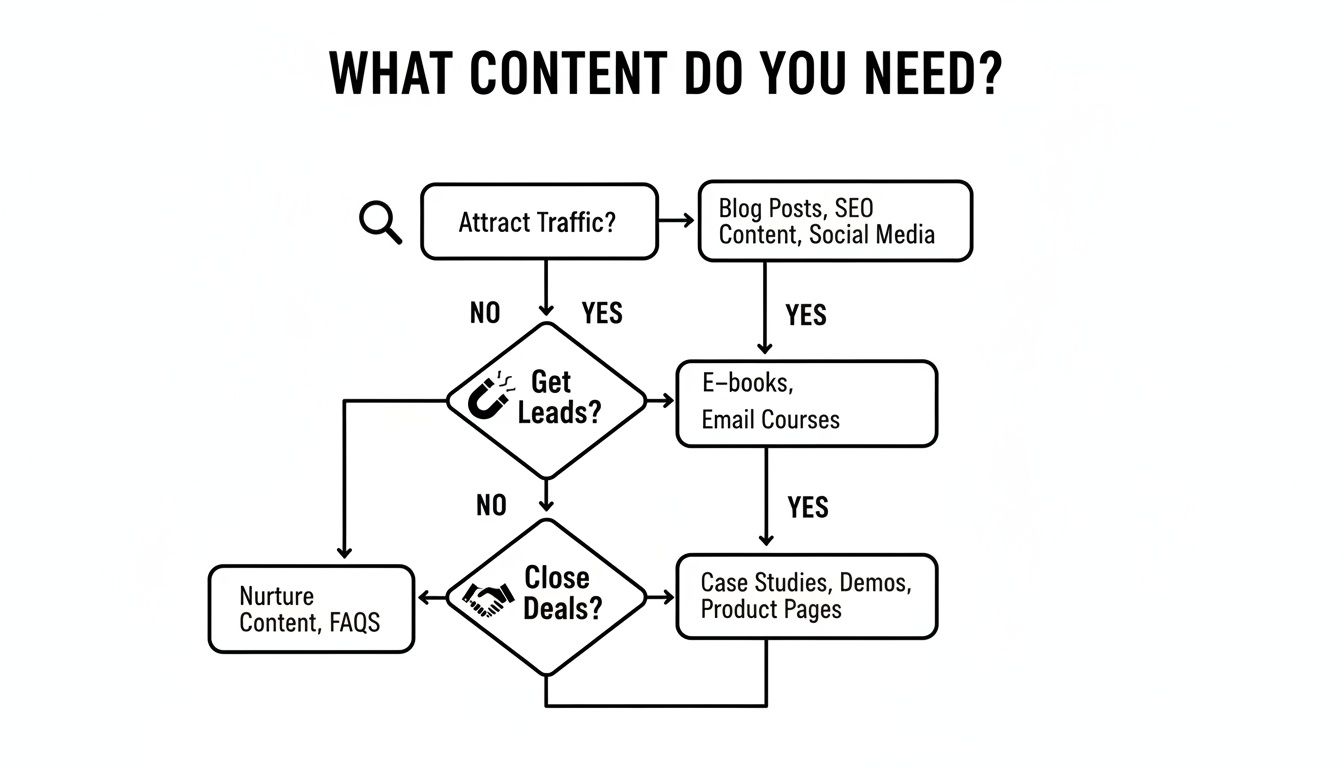
As the flowchart shows, the right content—from a blog post to a detailed case study—is entirely dictated by your main objective. That kind of strategic thinking is what a great agency partner brings to the table.
The agency model is the perfect fit for companies that are serious about scaling their marketing. The sticker price might seem higher than a single freelancer, but it often delivers a far better ROI when you factor in the hidden costs of managing everything yourself and trying to piece together a coherent strategy.
To get a better sense of what a mature, scalable program looks like, check out our guide on The Content Marketing Operations Maturity Model. It maps out the journey from simply getting things done to running a finely tuned content engine.
How to Understand Pricing and Calculate ROI

Let's talk about the money. Figuring out the financial side of content creation services really boils down to two things: finding a pricing model that fits how you work and, just as important, knowing how to prove that investment was worth it. This is where you build a rock-solid business case for content.
And it’s an investment more and more companies are making. A 2023 Content Marketing Institute survey revealed that 71% of B2B marketers said content marketing has become more important to their organization over the last year. The most successful of these companies are the ones who track their ROI religiously—a practice now common for over half of all marketing teams. You can get a deeper look at these social media content creation market trends to see exactly where the industry is heading.
Common Pricing Models for Content Services
When you start talking to agencies or freelancers, you'll generally run into three common ways they charge. There’s no single "best" option; the right choice for your B2B or SaaS company hinges entirely on your need for consistency, budget predictability, and the specific work you need done.
- Monthly Retainer: This is the go-to for long-term, ongoing work. You pay a set fee every month for an agreed-upon list of deliverables—say, four blog posts, one whitepaper, and the social media content to promote them. It's perfect for companies that want a steady stream of content and a predictable marketing expense.
- Project-Based Fee: Got one big thing you need to get done, like a cornerstone ebook or a batch of customer case studies? A fixed project fee is your best bet. You agree on the total price upfront for the entire scope, which means no surprises on the final invoice.
- Hourly Rate: This model gives you the most flexibility, making it great for strategic consulting, workshops, or smaller tasks where the scope is a bit fuzzy. While it's nimble, forecasting the total cost can be tougher than with a fixed-fee arrangement.
Picking the right model is the first step. The next—and the one your CFO really cares about—is proving it all pays off.
Moving Beyond Cost to Calculate True ROI
Calculating the return on your content investment isn't as straightforward as tying a sale to a single ad click. Content is a long game. It builds trust, educates your audience, and guides them through a complex B2B buying journey. That means you have to look past simple "vanity metrics" and connect your content's performance to actual business results.
The real goal isn't just to track views or shares. It's to prove that a specific blog post led to a demo request, or that a downloaded whitepaper produced a sales-qualified lead that eventually became a customer.
To get this right, you need to focus on the metrics that directly link marketing activities to revenue.
Key Metrics for Measuring Content ROI
The trick is to connect your content to tangible business outcomes. Instead of just celebrating 10,000 page views, you need to track how many of those views turned into something meaningful.
Here’s where to start:
- Lead Generation from Gated Content: Every time someone downloads a whitepaper or ebook, you get a lead. The key is to use your CRM to track those specific leads through the entire sales pipeline. How many of them ultimately converted into paying customers? That’s your ROI.
- Attribution to Blog and SEO Content: Use your analytics tools to trace a new customer's journey back to its origin. If they first discovered you through a blog post on Google, that article deserves credit for the sale. This directly shows the bottom-line impact of your top-of-funnel content.
- Engagement as a Buying Signal: Some metrics are powerful indicators of purchase intent. Things like time spent on your pricing page, repeat visits from the same company, or high engagement with a case study are strong signals. Your sales team can use this intel to identify their most promising prospects.
What a Successful Onboarding Process Looks Like

The ink on the contract is barely dry, but this is where the real partnership begins. The first few weeks of onboarding are more than just setup and paperwork; they set the entire tone for the relationship and can genuinely determine its success or failure.
Think of it like hiring an architect to build your dream home. You wouldn't expect them to start laying bricks without first understanding your lifestyle, your family's needs, and the exact feel you want for every room. A great onboarding for content creation services works the same way. It's a deep, collaborative process to ensure every piece of content is custom-built to hit your specific business goals.
The Initial Discovery and Alignment Phase
A good content partner will kick things off with a serious deep dive into your business. Forget a quick 15-minute call—this is a dedicated discovery session where they get to the bottom of what your company is all about.
This should feel more like a strategic workshop than a Q&A. They're trying to get inside your head and understand your world. You can expect them to dig into:
- Your Ideal Customer Profile (ICP): Beyond the basics. Who are they? What keeps them up at night? What specific questions are they Googling before they even know a solution like yours exists?
- Brand Voice and Tone: How should you sound? Are you the wise, academic authority in the space, or the friendly, approachable guide? They’ll want to see examples of content you love and, just as importantly, content you can't stand.
- Business Objectives: What does winning look like in six months? Is it a flood of new demo requests, dominating the search results for a few key terms, or making your CEO the go-to expert on LinkedIn?
Building the Strategic Blueprint
Once they have all that information, a great partner starts turning those insights into a concrete plan. This is where the strategy goes from a conversation to a document you can actually use—a blueprint for everything that comes next.
The single most important thing to come out of onboarding is a shared content strategy. This document ensures both teams are aligned on why you're creating something, not just what you're creating. It’s the difference between creating content and creating content that works.
This blueprint almost always includes a content calendar, which becomes your shared roadmap. It will detail topics, formats, target keywords, and deadlines, giving you full visibility into the production pipeline.
And this isn't a static document. The best calendars are living, breathing plans that can adapt to new opportunities or shifting priorities while still keeping everyone perfectly aligned and moving forward.
Your Checklist for Selecting the Right Partner
Choosing a content creation partner is a big deal. This isn't just about hiring a vendor to pump out articles; it's about finding a true extension of your team who will shape your brand's voice, drive leads, and ultimately, grow your business.
Get it wrong, and you'll waste months and thousands of dollars. To sidestep the flashy sales pitches and find a partner with real substance, you need a plan. This checklist is your playbook for asking the right questions—and more importantly, for knowing what a great answer actually sounds like.
Strategy Before Production
First things first: strategy. A genuine partner doesn't start by asking, "So, what do you want us to write?" They ask, "What business problem are we trying to solve?" That one distinction changes everything.
Think about it: a 2023 study by Ahrefs found that 90.63% of content gets no traffic from Google. That doesn't happen by accident. It’s the direct result of a lack of a cohesive, strategic content plan. You’re looking for someone who builds the roadmap before they ever put pen to paper.
- How do you develop a content strategy? A solid answer will involve deep discovery, combing through audience research, running a competitive analysis, and building a keyword strategy. They should be talking about mapping content to the entire buyer's journey, not just spitballing a list of blog topics.
- How will you connect content to our business goals? The best partners will immediately pivot the conversation to your revenue targets, MQL goals, and sales cycle. Their plan needs to draw a clear line from the content they create to the business metrics you actually care about.
A partner focused on production talks about deliverables and deadlines. A partner focused on strategy talks about outcomes and ROI. That difference is what separates a good vendor from a great investment.
Team and Expertise
Next, it’s time to pull back the curtain and see who will actually be doing the work. You’re not buying a logo; you’re investing in the brains and experience of the people on your account. When you consider that the average blog post takes nearly four hours to write—and that’s before strategy, editing, or design—you need to be confident the team is up to the challenge.
Get specific, especially if you're in a complex B2B or SaaS space.
- Who exactly will be on our team? Push for clarity on roles. Will you have a dedicated strategist, a project manager, and specialized creators? Vague talk about a "pool of talent" is often a red flag for an inconsistent, disjointed experience.
- Can you show us work you've done in our specific industry? This is a deal-breaker. Ask for case studies or portfolio examples that prove they get your niche, understand your audience’s pain points, and can speak your technical language. A partner who has already navigated your world will deliver results much, much faster.
Digging Deeper: Your Vetting Toolkit
To help you structure these crucial conversations, we've put together a list of essential questions. Use this table during your calls with potential agencies or freelancers to make sure you’re covering all your bases and making a truly informed decision.
Essential Questions to Ask Potential Content Partners
| Evaluation Category | Key Question to Ask | What to Look for in a Good Answer |
|---|---|---|
| Strategy & Planning | "Walk me through your process for developing a new client's content strategy from day one." | They should describe a phased approach: discovery/immersion, audience research, competitive analysis, keyword strategy, and content mapping. Bonus points if they mention aligning with sales and product teams. |
| Industry Expertise | "Show me 2-3 examples of your best work for a company in a similar B2B/SaaS niche as ours." | They should provide specific case studies or portfolio links with context, not just generic samples. Look for work that demonstrates a deep understanding of a complex product or audience. |
| Team & Workflow | "Who would be my day-to-day contact, and who would be creating the content? What does your review and feedback process look like?" | A clear answer identifies a dedicated point person (like a project or account manager) and outlines a structured workflow for drafts, revisions, and approvals using a tool like Asana or Trello. |
| Performance & ROI | "How do you measure the success of your content, and how would you report those results back to us?" | They should talk about more than just traffic. Look for answers that include lead generation (MQLs), conversion rates, keyword rankings, and pipeline influence. They should be able to show you a sample report. |
| Onboarding & Ramp-Up | "What does your onboarding process entail, and how long does it typically take before you're producing the first piece of content?" | A strong partner will have a structured 30- to 60-day onboarding plan that includes stakeholder interviews, brand immersion, and strategy finalization before production kicks off at full speed. |
Taking the time to ask these questions upfront can save you from a major headache down the road. The goal is to find a partner who is just as invested in your business outcomes as you are.
Your Top Questions About Content Services, Answered
If you're exploring content creation services, you probably have a few big questions. It’s a significant investment, and you need to know what to expect. We get it. Below are the straightforward answers to the questions we hear most often from B2B and SaaS leaders.
And it’s no wonder these questions are coming up. The global content creation market is absolutely exploding. A 2023 report projects that the market, valued at over $400 billion, will continue its rapid expansion, driven by demand for high-quality digital experiences. This isn't just a trend; it's a fundamental shift in how businesses grow. You can dig into the full content market projections to see just how massive this is.
How Long Does It Take to See Results?
This is always the first question, and the honest answer is: it’s a long game. Think of content marketing less like a switch you flip and more like building a valuable asset, piece by piece.
- For SEO-focused content: You're looking at about 3-6 months to see real movement. That's the time it takes for Google to find, index, and start trusting your new content enough to rank it for meaningful keywords.
- For lead generation: A targeted campaign, like one built around a high-value whitepaper, can start bringing in leads almost right away. But the real magic happens over time as you build a reputation and optimize your funnel.
The key here is consistency. The work you put in during month one is what creates the big wins you’ll see in month twelve. It’s all about compound growth.
What Is a Realistic Budget for Content Services?
Budgets can be all over the map. You could hire a freelance writer for a few hundred dollars to knock out a couple of blog posts, or you could partner with an agency on a comprehensive retainer for several thousand a month.
The question isn't really "What does it cost?" but rather, "What investment is required to hit our goals?" It's better to frame your budget around specific business outcomes, like hitting a certain number of MQLs or a revenue target.
For most small to mid-sized B2B companies just getting serious, a good starting point for an agency retainer is usually in the $3,000 to $7,000 per month range. That typically covers strategy, consistent content creation (like blog posts and a lead magnet), and some basic promotion.
Can't We Just Use AI to Create Our Content?
AI is an incredible assistant. It's fantastic for brainstorming ideas, structuring an outline, or even getting a rough first draft on the page. It can seriously speed up the process.
But it can’t replace human insight, strategic thinking, or the authentic voice that makes your brand yours.
Relying only on AI often produces bland, generic content that completely misses the mark with a sharp B2B audience. The smart play is an AI-assisted model: skilled human strategists and writers use AI as a co-pilot, not as the pilot. This gives you the best of both worlds—efficiency without sacrificing the quality and original thinking that actually builds trust.
Ready to build a content engine that actually drives business growth? The team at Mick-Mar Inc. has been crafting winning B2B marketing strategies since 2008. We become a true extension of your team to deliver content that doesn't just get clicks—it gets results. Let's start the conversation today.