A strategic marketing planning process isn't about creating more work—it's about creating clarity. Think of it as a framework that pulls your scattered tactics together into a single, revenue-focused machine. It's the real difference between just being busy with marketing and being truly effective at driving predictable growth. This friendly guide will walk you through how to get the alignment needed to make smarter decisions and prove marketing's impact on the bottom line.
Why a Marketing Plan Is Your Growth Engine

Let's be honest for a moment. Marketing without a documented plan is like driving in a new city without a map—you’re definitely moving, but who knows if you’re getting any closer to your destination. Too many businesses fall into the "random acts of marketing" trap, launching a social campaign here or running some ads there, with no clear thread connecting it all back to business goals.
This ad-hoc approach often leads to wasted money, muddled messaging, and a frustrating inability to figure out what’s actually working. A formal plan, on the other hand, encourages you to think critically about your market, your ideal customers, and exactly where you fit in.
The real purpose of a strategic marketing plan isn't to create a rigid document that collects dust. It's about building a living, breathing framework that guides your team, justifies your budget, and connects every dollar you spend to a real business outcome.
The Power of a Documented Strategy
The difference here isn't just a gut feeling; the data is quite compelling. Businesses that take the time for strategic marketing planning are significantly more likely to succeed. In fact, companies with a formal plan are 313% more likely to report success than those winging it. You can read more about the impact of strategic planning on your business outcomes.
So, what does this structured process actually give you, especially if you're in the competitive SaaS or B2B space?
- Clarity and Focus: It gets your whole team aligned on the same objectives, making sure everyone is rowing in the same direction.
- Proactive Decision-Making: You stop reacting to your competitors and start proactively shaping the conversation in your market.
- Smarter Resource Allocation: You can confidently put your budget and your team's valuable time into the channels and activities most likely to deliver a real return.
- Measurable Impact: It forces you to set clear KPIs from the start, making it much easier to track progress and show exactly how marketing is contributing to revenue.
This table clearly lays out the two different worlds of marketing: one driven by a clear plan and the other by disconnected tactics.
Strategic Plan vs Ad-Hoc Tactics
| Aspect | Strategic Planning Approach | Ad-Hoc Tactic Approach |
|---|---|---|
| Outcomes | Predictable, scalable growth tied to revenue. | Inconsistent results, "spikes" of activity. |
| Budgeting | Investments are allocated to proven channels. | Budget is spent reactively, often wasted. |
| Team Focus | Aligned on shared goals (OKRs), high efficiency. | Disjointed efforts, confusion on priorities. |
| Measurement | Clear KPIs track progress toward business goals. | "Vanity metrics" with no link to revenue. |
| Messaging | Consistent and targeted to the ideal customer. | Inconsistent, confusing brand message. |
The choice is pretty clear. A disconnected, tactical approach feels busy but rarely builds long-term value.
Ultimately, the strategic marketing planning process is the engine for sustainable growth. It's the roadmap you need to turn ambitious goals into real results, giving you a powerful competitive edge in a noisy market.
Uncovering Insights with Market and Competitor Analysis
You can't build a great strategy on guesswork. Before you can map out where you're going, you need an honest picture of where you stand right now. This discovery phase is the true starting point for any strategic marketing planning process, grounding every decision you make in reality, not assumptions.
Think of it as the foundation for your house. Without solid market research, you're building on sand. A typical strategic planning process kicks off by looking at internal strengths and weaknesses while also getting a handle on external market conditions. This research uncovers the kind of insights that reduce risk and ensure your business strategy connects with what customers actually want. You can learn more about the role of market research in strategic planning if you want to go deeper.
The point isn't to get lost in spreadsheets for weeks. It’s about pulling out the actionable data that will shape everything that comes next. Let's dig into how a B2B or SaaS company can do this well.
Conducting a Practical SWOT Analysis
The SWOT analysis (Strengths, Weaknesses, Opportunities, Threats) is a classic for a reason, but its effectiveness depends on your approach. To make it count, you have to be honest and ask the tough questions.
This is your company's self-assessment. Your strengths are what you do well internally, while weaknesses are the things holding you back. Opportunities are the external tailwinds you can ride, and threats are the market forces that could knock you off course.
A powerful SWOT analysis doesn't just list points; it forces a conversation about what's real. The insights you gain here should provide clarity, and maybe even make you feel slightly uncomfortable—that's how you know you're on the right track.
To get the conversation started, try asking these B2B-specific questions:
- Strengths: What do we genuinely do better than anyone else? Do we have unique tech, a standout feature, or a customer support team that turns clients into fans?
- Weaknesses: Why do we sometimes lose deals? Is our pricing clear? Are there product gaps that prospects bring up consistently?
- Opportunities: Is there an underserved niche our product could pivot to serve? Are competitors overlooking a new marketing channel we could explore?
- Threats: Is a new, well-funded player about to enter our space? Are there regulatory changes on the horizon that could affect our business model?
Spying on Your Competitors and Market Trends
Once you’ve taken a good look in the mirror, it's time to look out the window. Understanding your competitors and the broader market is how you find your unique space to win. And no, this doesn't require a massive budget or a dedicated intelligence team.
You can uncover a goldmine of information with free tools and a bit of digital sleuthing. The goal is to get a feel for their messaging, who they're talking to, and—most importantly—where they might be dropping the ball.
Start by analyzing their website, signing up for their newsletter, and observing their social media. Pay close attention to the language they use and the pain points they focus on. What kind of content gets the most engagement? This gives you a direct line of sight into their strategic priorities.
Leveraging Tools for Market Intelligence
Platforms like Google Trends are fantastic for spotting emerging patterns and seeing what your audience is actually interested in over time. For example, you could compare search volume for terms like "CRM software," "sales automation," and "lead generation tools" to see where the market's attention is shifting.

This kind of data helps you align your marketing with what’s top-of-mind for your potential customers right now.
Beyond search data, social listening tools are also invaluable. By monitoring conversations around your competitors or industry keywords, you can pick up on:
- Common complaints about rival products (which are basically opportunities handed to you on a silver platter).
- Unmet needs or feature requests that your product might already solve.
- Key voices and influencers in your niche who you could start building relationships with.
Remember, this research isn't a one-off task you complete and forget. It's a continuous discipline that keeps your strategy sharp. The insights you pull from this work will directly inform your ideal customer profile, your goals, and a marketing plan that actually moves the needle.
Defining Who You Serve and How They Buy
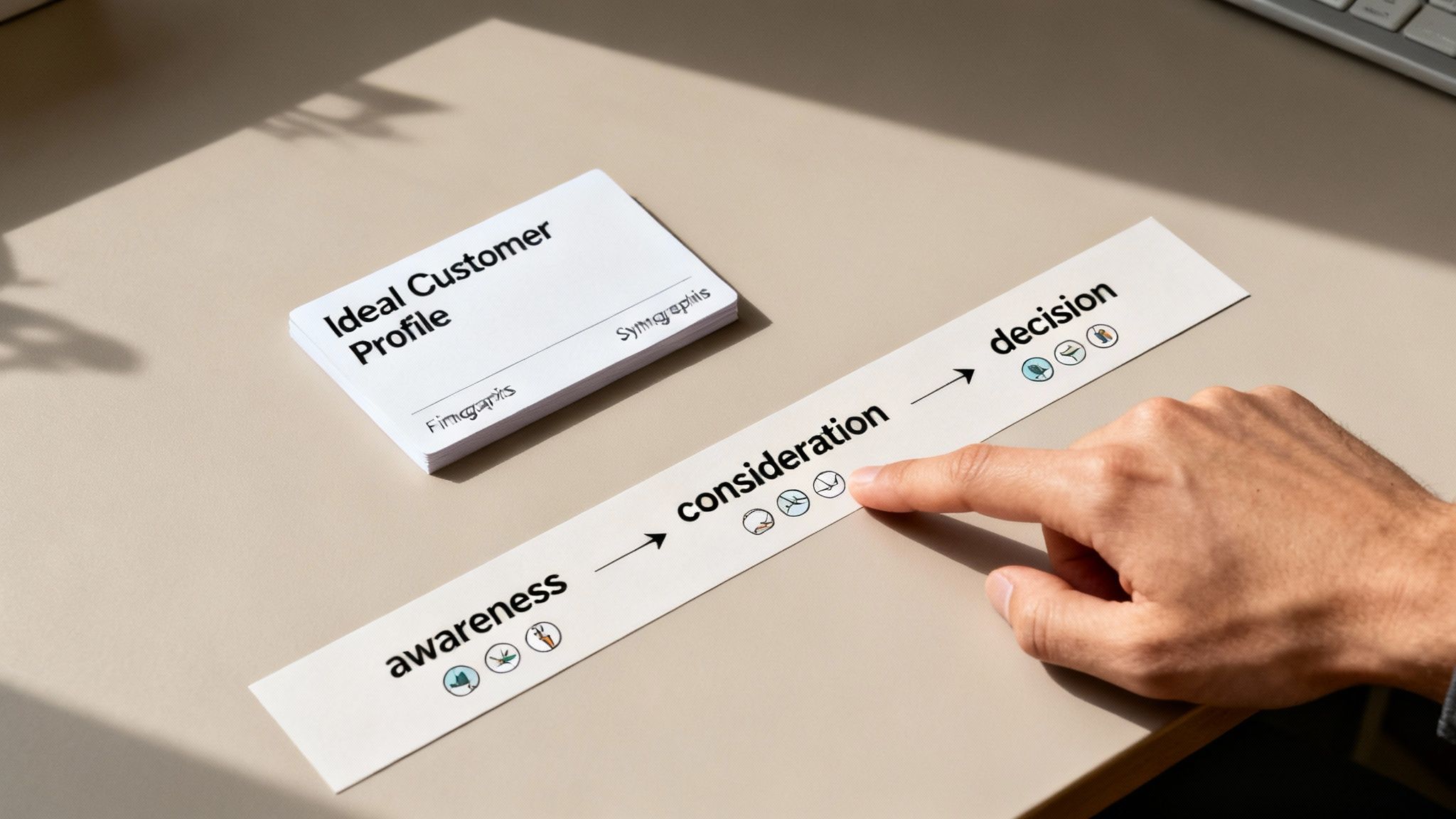
Alright, you’ve done your market research. Now comes one of the most critical parts of any strategic marketing planning process: getting crystal clear on your customer. We're not talking about a vague idea of who you sell to, but a sharp, data-backed profile of the exact organization you are built to serve.
Generic personas are a fine starting point, but in the B2B and SaaS world, we need to go deeper. We need to build an Ideal Customer Profile (ICP). This isn't just a semi-fictional character; it’s a detailed blueprint of the perfect-fit company—the one that gets a ton of value from your product and, in turn, provides maximum value back to you.
From Generic Personas to a Powerful ICP
An ICP goes way beyond basic demographics. It digs into the specific traits of your best customers—the ones who close faster, stick around longer, and recommend you to their colleagues. The whole point is to create a profile so clear that anyone in marketing or sales can spot a good-fit lead in a heartbeat.
To get there, you need to blend two kinds of data:
- Firmographics: These are the hard facts. Think industry, annual revenue, company size, location, and even the specific tech they already use.
- Psychographics & Behaviors: This is the human side of the business. What are their biggest operational headaches? What goals are keeping their leadership team up at night? What specific event triggers them to start searching for a solution like yours?
For example, a B2B SaaS company selling project management software might have an ICP that looks like this: A tech company with 50-250 employees that's struggling with messy cross-departmental projects and constantly blowing past deadlines as they try to scale. Their leaders are obsessed with efficiency and are actively looking for tools that integrate well with their existing stack, like Slack and Google Workspace.
To really nail this, it's worth exploring effective B2B market segmentation strategies to help you slice a broad market into more focused, manageable groups.
The best ICPs aren't just created in a boardroom; they're built from real-world data. Dig into your CRM and find your best customers. What do they all have in common? Better yet, talk to them. Ask them why they chose you. Their answers are gold.
Once you know exactly who you're talking to, the next step is to figure out how they buy. This is where you map out their entire journey.
Mapping the B2B Buyer's Journey
The B2B buying journey is rarely a straight line. It’s often a winding road with multiple stakeholders, extensive research, and plenty of internal meetings. Your job is to be their trusted guide at every turn, serving up the right information at just the right time.
Mapping this journey is a cornerstone of a solid marketing plan. It allows you to anticipate your customers' needs and create content that answers their questions before they even have to ask them.
Here’s a friendly breakdown of the typical stages and what's going through your buyer's mind at each one.
1. Awareness Stage
At this point, the buyer is just starting to feel a pain point. They know something is wrong—"our projects are always late," "our teams can't seem to communicate"—but they probably haven't put a name to the problem yet.
- Their Core Question: "Why are we struggling with this?"
- Your Marketing Goal: Educate, don't sell. Your content should be purely helpful, designed to help them diagnose their problem. Think insightful blog posts, original research reports, and simple diagnostic checklists.
2. Consideration Stage
Now they’ve defined their problem and are actively researching potential solutions. They're comparing different categories of tools and strategies. For our project management software example, they might be weighing specialized software against a custom-built tool or just sticking with spreadsheets.
- Their Core Question: "What are the different ways we can solve this problem?"
- Your Marketing Goal: Make the case for your category of solution. This is the time for comparison guides, detailed case studies, and webinars that show how your type of product solves their specific pain points. Understanding your product's value is crucial here; you can find more on this in our guide on effective pricing and positioning.
3. Decision Stage
The buyer has settled on a solution category and is now zeroing in on specific vendors. That means they're looking at you and your direct competitors. They're hunting for proof, validation, and every reason to trust you over the other options.
- Their Core Question: "Why is your product the best choice for us?"
- Your Marketing Goal: Build confidence and make the choice obvious. This is where you bring out the product demos, glowing customer testimonials, free trials, and transparent pricing.
By meticulously mapping this journey, you draw a straight line from your customer’s evolving needs to your marketing activities. Every blog post, ad, and email campaign has a clear purpose tied to a specific stage, ensuring your efforts are always relevant and genuinely helpful.
Translating Business Goals into Marketing Strategy
Okay, so you’ve done the hard work of digging into research and mapping out your customer's world. Now for the fun part—turning all those insights into a real plan. This is where we connect the company's big-picture ambitions to the specific marketing campaigns you'll actually run.
It’s surprisingly easy for marketing goals to become disconnected from the bottom line. Vague objectives like "boost brand awareness" or "generate more leads" sound nice, but they make it difficult to prove your value or justify your budget.
The secret is to draw a straight, unbreakable line from the C-suite's objectives directly to your marketing calendar.
Setting Powerful OKRs for Marketing
To build that bridge, a solid framework is essential. That’s where OKRs (Objectives and Key Results) come in. Think of it as a simple system for setting goals that are both aspirational and measurable.
Here’s the breakdown:
- An Objective is your big, ambitious goal. It's what you want to achieve, phrased in a way that’s inspiring and easy to remember.
- Key Results are the metrics that prove you hit your objective. They are always numbers-based, specific, and have a deadline.
This simple structure fosters a critical shift in thinking: from outputs to outcomes. Instead of patting yourself on the back for "posting on social media three times a week" (an output), you're laser-focused on "increasing social media engagement by 30% this quarter" (an outcome).
The real magic of OKRs is how they cascade. A top-level business goal, like hitting a new revenue target, gets broken down into clear, actionable goals for the marketing team. It connects everyone's work.
Let’s walk through a real-world example. Imagine a SaaS company has a business-wide goal to increase Annual Recurring Revenue (ARR) by $2M this year.
Here’s how marketing’s OKRs could align with that:
Marketing Objective: Fuel the sales pipeline with high-quality leads to support the ARR goal.
- Key Result 1: Generate 400 new Marketing Qualified Leads (MQLs) per month in Q3.
- Key Result 2: Achieve a lead-to-customer conversion rate of 5% by the end of the year.
- Key Result 3: Reduce Customer Acquisition Cost (CAC) from $500 to $450 by Q4.
Suddenly, every blog post, ad campaign, and webinar has a purpose. Your team isn't just "doing marketing"; they are hitting precise numbers that directly feed into the company’s financial success.
Choosing Channels That Actually Work
With your goals locked in, the next question is obvious: where do you spend your time and money? Your ICP and buyer journey map are your north stars here. The biggest mistake you can make is chasing the latest trendy platform or just copying what your competitors are doing.
You have to be where your customers are.
If your ideal customer is an enterprise CTO, sinking your budget into TikTok is probably not the best use of resources. Your research should guide you. It might point you toward channels like:
- LinkedIn Content & Ads: Perfect for targeting specific job titles and industries with meaty, thought-leadership content.
- Niche Industry Forums: Go where your buyers are already asking questions and having authentic conversations.
- Strategic SEO: Create in-depth, technical articles that answer the exact, complex questions they’re typing into Google. For instance, putting together an effective Twitter marketing strategy could be a fantastic way to engage a tech-savvy audience and hit specific lead-gen goals.
The aim isn't to be everywhere. It's to dominate the few channels that matter most. Quality over quantity, always.
Building a Cohesive Messaging Framework
Finally, what are you actually going to say? Consistent messaging is the glue that holds your entire strategy together. Without it, your brand can come across as chaotic and confusing, which erodes trust before it has a chance to form.
A simple messaging framework gets everyone—from sales to social media—singing from the same hymn sheet.
It should clearly define:
- Your Value Proposition: What's the one unique benefit you deliver that no one else can?
- Key Messaging Pillars: These are the 3-4 core themes that support your value prop. A cybersecurity firm’s pillars might be Proactive Threat Detection, Automated Incident Response, and Effortless Compliance.
- Tone of Voice: What’s your brand’s personality? Are you a deeply technical expert, or a friendly, approachable guide?
This doesn't mean every piece of content is a carbon copy. It just means that whether someone reads your blog, sees an ad, or gets a demo, the core story of who you are and what you do is crystal clear. This kind of alignment is what separates a good plan from a great one.
Activating Your Plan with a Practical Roadmap
A brilliant strategy is just a collection of good ideas until you put it into motion. This is where we move from the “what” and “why” to the “who,” “when,” and “how,” building a tangible roadmap that ensures your plan actually gets executed.
Without a clear activation plan, even the most well-researched strategy can fall apart. Conflicting priorities, fuzzy ownership, and poor communication are common hurdles. The goal here isn't to create a rigid, unchangeable schedule, but a flexible guide that keeps everyone aligned and moving in the same direction.
Building Your Marketing Roadmap
Think of your marketing roadmap as a high-level, visual overview of your major initiatives for the next few quarters. It's not a granular task list; it’s a strategic document that clearly shows what your team will focus on and when. This is crucial for managing expectations with leadership and keeping the team focused on what's important.
To get started, pull out the OKRs and channel strategy you’ve already defined. Plot your key campaigns and projects on a timeline, directly connecting each one back to a specific objective. For instance, a Q3 product launch campaign should clearly tie back to your objective of generating a specific number of new MQLs. For a deeper dive, our guide on creating a comprehensive marketing roadmap template offers more actionable steps and examples.
A great roadmap tells a story. It should clearly show how your team’s planned activities over the next six to twelve months will collectively achieve the larger business goals. If a planned activity doesn't support a key result, it doesn't belong on the roadmap.
Prioritizing Initiatives for Maximum Impact
You'll always have more ideas than you have resources. That’s why thoughtful prioritization is so critical. Instead of trying to do everything at once, you need to focus your energy on the projects that will make the biggest dent in your goals.
A simple but incredibly effective way to do this is with an Impact/Effort Matrix. This exercise helps you visually categorize your potential projects:
- High Impact, Low Effort (Quick Wins): Do these immediately. They're the low-hanging fruit that builds momentum.
- High Impact, High Effort (Major Projects): These are your big strategic bets. Plan for these carefully and dedicate the right resources to get them done.
- Low Impact, Low Effort (Fill-ins): Tackle these when you have downtime, but don't let them distract from bigger goals.
- Low Impact, High Effort (Time Sinks): Avoid these entirely. They drain resources with very little to show for it.
This simple exercise forces an honest conversation about the true value of each initiative, ensuring your team’s limited time is spent on what truly matters.
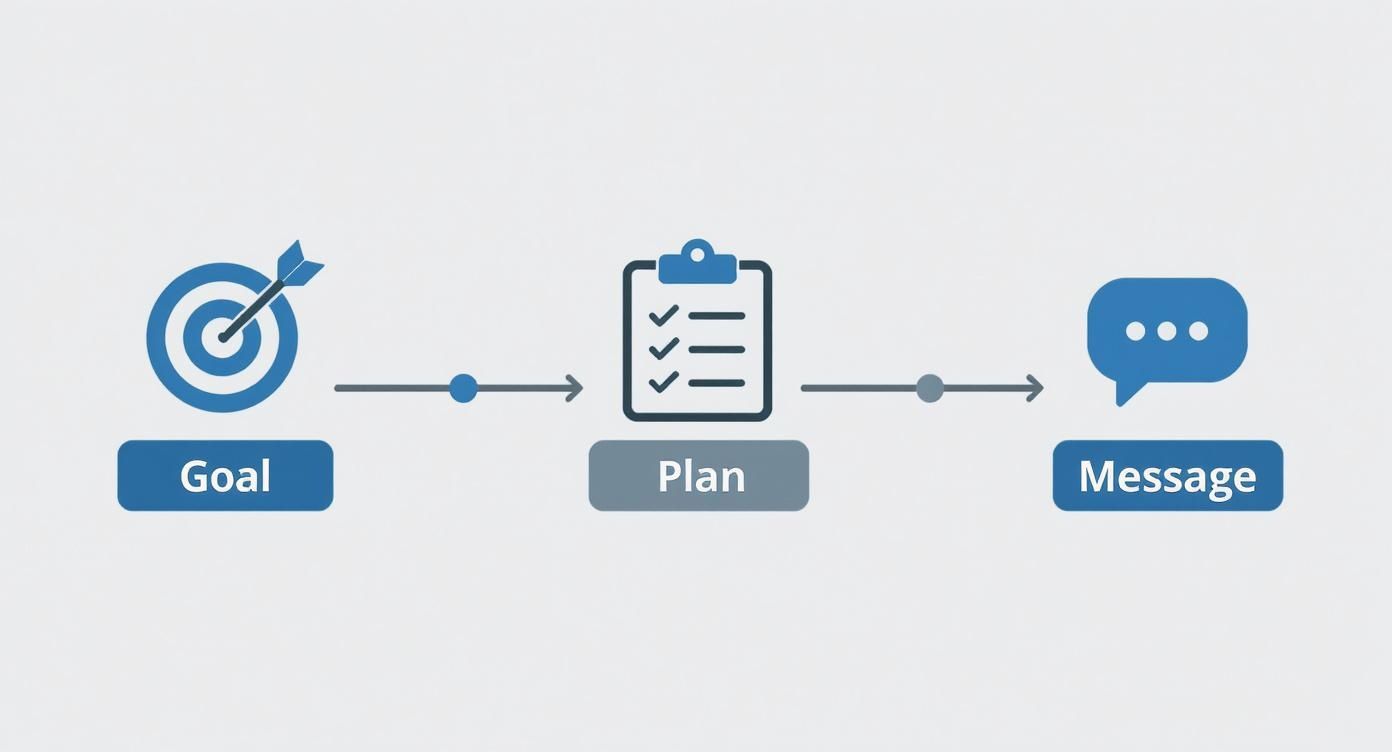
As you can see, effective execution relies on this logical progression. Without a clear goal at the start, your plan and messaging will inevitably lack direction.
Allocating Resources and Establishing Governance
With your roadmap and priorities locked in, the final piece is assigning resources and defining the rules of engagement. This is all about making sure everyone knows who is responsible for what and how communication will flow.
First, allocate your budget against your prioritized initiatives. A 2024 study highlights that successful marketing plans lean heavily on project management tools to track tasks and coordinate efforts. Using a platform like Asana, Trello, or another project management tool can centralize all campaign details, assignments, and deadlines, creating a single source of truth for the entire team.
Next, establish a simple governance model. This doesn’t need to be overly bureaucratic. It just needs to answer a few key questions:
- Who’s the DRI? Who is the Directly Responsible Individual for each major campaign or project?
- What’s our cadence? Will the team have a weekly check-in, bi-weekly project reviews, or a monthly performance meeting? Set a rhythm.
- How do we report? What is the format and frequency for sharing progress with stakeholders?
Defining these ground rules upfront prevents the silos and miscommunication that can derail even the best-laid plans. It creates a system of accountability that empowers your team to execute with confidence and clarity.
Measuring What Matters and Optimizing for Results
Your marketing plan isn't a "set it and forget it" document. The moment your first campaign goes live is when the real work begins. This is where we build a feedback loop that turns a static plan into a living, breathing engine for growth.
Far too many marketing teams fall into the trap of chasing vanity metrics. Things like impressions, social media likes, or even a spike in website traffic can feel like a win, but they don't directly translate to revenue. True success is measured by numbers that reflect the financial health of the business.
Separating Vanity from Value
The key is to focus on Key Performance Indicators (KPIs) that have a direct line to your business's bottom line. For any SaaS or B2B company, this means getting laser-focused on the metrics that tell a clear financial story.
Here’s what you should actually be tracking:
- Customer Acquisition Cost (CAC): What’s the total, all-in cost to land one new paying customer? If you don't know this number, it's hard to make informed spending decisions.
- Lifetime Value (LTV): How much revenue can you realistically expect from a customer over their entire relationship with you? A sustainable business must have an LTV that is multiples higher than its CAC.
- Lead-to-Customer Conversion Rate: This is the ultimate test of your funnel's effectiveness. What percentage of the leads you generate actually end up signing a contract?
Homing in on these KPIs forces you to make decisions based on data, not just on what feels trendy. Research from 2023 backs this up, showing that 73% of marketers now see conversion rates as their top metric for judging content marketing success. You can see more on aligning KPIs with business objectives at transifex.com.
The goal isn’t just to report what happened; it's to dig in and understand why it happened. A great performance review doesn’t end with a pretty chart. It ends with a list of smart, actionable tweaks to make for the next sprint.
Building a Rhythmic Review Process
All the data in the world is useless if you don't act on it. To make your insights count, you have to establish a consistent rhythm for reviewing performance and making course corrections. This structured process is what keeps your strategy sharp and adaptive.
Set a non-negotiable schedule for checking your metrics. This builds accountability and ensures optimization is always part of the conversation.
- Daily/Weekly Pulse Checks: Keep an eye on fast-moving numbers like ad spend, click-through rates, and new lead volume. This is your early warning system for catching problems or jumping on opportunities.
- Monthly Performance Reviews: This is where you go deeper on your core KPIs. How is your CAC trending month-over-month? Are your MQLs converting at the rate you projected?
- Quarterly Strategy Reviews: Time to zoom out. Are we on track to hit our quarterly OKRs? Based on the last three months, do we need to shift budget away from one channel and into another?
This rhythm of review, analysis, and adjustment is what separates a plan that collects dust from one that drives real results. If you want to dig deeper into the nuts and bolts, check out our guide on how to measure marketing ROI.
Common Questions We Get Asked
Even the best strategic planning process sparks questions. We've been through this process hundreds of times with B2B and SaaS leaders, and a few key questions always seem to come up. Here are some straightforward answers based on what we've seen work.
How Often Should I Actually Update My Marketing Plan?
A marketing plan that just gathers dust on a shelf isn't very helpful. It's best to treat it as a living, breathing document.
The big, foundational review? Plan on doing that annually. This is your chance to zoom out, check your strategy against the company's new yearly objectives, and react to any major market shifts.
But don't wait a full year to check in. We always recommend quarterly reviews to look at your performance against OKRs. This is where the real magic happens. It’s your opportunity to see what's working and what isn't, and to make those tactical shifts. If a channel is underperforming, this is when you pivot—not 12 months from now.
How Do I Get Other Teams to Actually Care About This Plan?
Getting buy-in from sales, product, and the C-suite is essential. If you want your plan to succeed, they need to be on board. The secret? Stop trying to "present" a finished plan to them.
Involve them from the very beginning.
Pull key stakeholders into the discovery phase. Ask for their honest feedback during the SWOT analysis. Get the sales team's unfiltered take on who the real ICP is. When they see their own insights and language reflected in the final strategy, they’re not just spectators—they become champions for the plan.
A shared plan fosters shared ownership. When the sales team helps build the strategy, they're far more invested in making sure it works.
Ready to build a marketing plan that actually drives growth? At Mick-Mar Inc., we partner with B2B and SaaS companies to turn strategy into revenue. Let's build your roadmap together.