When you hear "SaaS content marketing," what comes to mind? Hopefully, it’s not just blogging or randomly posting on social media. It’s the art and science of creating valuable, relevant content that pulls your ideal customers in, keeps them engaged, and ultimately turns them into loyal users.
Think of it this way: paid ads are like renting an audience. The moment you stop paying, the traffic disappears. Content marketing, on the other hand, is like owning your traffic source. You're building a library of resources that works for you around the clock, creating an asset that grows in value over time.
Why Strategic Content is the Lifeblood of SaaS
In the crowded Software-as-a-Service arena, content isn't just a "nice-to-have" marketing tactic. It's the engine that powers sustainable, long-term growth.
This approach is perfectly suited to tackle the two biggest headaches for any SaaS business: sky-high customer acquisition costs (CAC) and the constant battle against customer churn. Every article, guide, or video you create is a digital asset that continuously attracts, educates, and converts potential customers, chipping away at both of those problems.
Building Unshakeable Trust and Authority
For a SaaS product, trust is everything. Your customers aren't just buying a piece of software; they're investing in a solution they hope will solve a critical business problem. This is where high-quality content shines—it demonstrates your expertise and proves you genuinely understand their world.
A great content strategy transforms your brand from just another vendor into a trusted advisor. You start answering your audience's questions before they even know to ask them, building a foundation of trust that makes the entire sales conversation feel more natural and less forced.
By consistently delivering real value, you cement your authority in your niche. When a prospect is finally ready to make a purchase, your company is already at the top of their list because you've been the one guiding them all along. This educational journey turns problem-aware leads into product-savvy champions who are far more likely to stick around for the long haul.
Driving Real, Measurable Business Results
The synergy between great content and the SaaS recurring revenue model is incredibly powerful. In fact, SaaS brands see some of the highest returns from content marketing compared to other industries, boasting a median lead conversion rate of 14%. This really drives home how effective a solid content plan can be for generating qualified leads.
Yet, here’s the kicker: only 29% of marketers actually measure their content ROI effectively, which points to a huge opportunity for data-focused teams. For a deeper dive into these numbers, check out this research on content marketing statistics.
A well-oiled SaaS content machine ultimately helps you achieve several critical business goals:
- Drives Down Customer Acquisition Costs: Organic traffic from search is far more cost-effective in the long run than paying for every single click.
- Boosts Customer Retention: Helpful content like tutorials and best-practice guides ensures your customers get the most value out of your product, making them less likely to churn.
- Generates High-Quality Leads: Your content naturally attracts prospects who are actively looking for solutions, meaning the leads you get are better informed and closer to making a decision.
Now, let's put content's ROI into perspective. While it requires an upfront investment of time and resources, its long-term payoff often dwarfs other channels.
Comparing SaaS Marketing Channel ROI
| Marketing Channel | Average ROI (Return per $1 Spent) | Primary Goal |
|---|---|---|
| Content Marketing/SEO | $5 – $15+ (Compounding) | Sustainable organic growth, authority building |
| Paid Search (PPC) | $2 – $3 (Immediate) | Quick lead generation, targeted campaigns |
| Social Media Marketing | $2.50 – $4 (Varies) | Brand awareness, community engagement |
| Email Marketing | $30 – $40+ (Nurturing) | Lead nurturing, customer retention |
While email marketing boasts an incredible ROI, it relies on having an email list to begin with—a list that is often built and nurtured through high-quality content. This table shows that for acquiring new customers sustainably, nothing beats the compounding power of a great content strategy.
Building Your SaaS Content Strategy Framework
Great SaaS content marketing doesn't happen by accident. It's built on a solid, repeatable framework—a blueprint that ensures every article, webinar, and case study you create has a clear purpose and pushes your business goals forward.
Without a strategy, you’re just throwing content at the wall and hoping something sticks. A proper framework, on the other hand, creates a system where each piece works together, guiding potential customers from "I have a problem" to "Your product is the only solution I need."
The infographic below really nails the core functions of this framework: attracting, educating, and ultimately, converting your ideal audience.
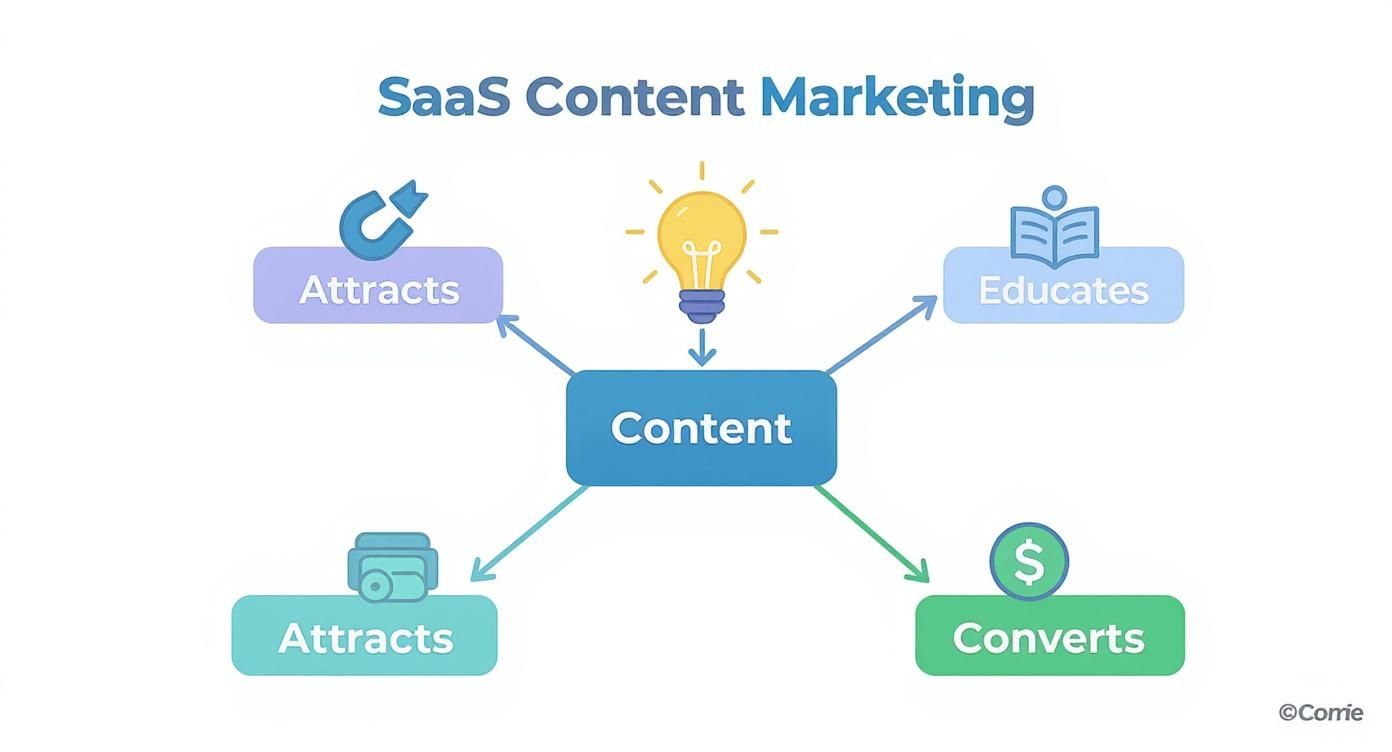
This shows how content isn't just one thing; it's a versatile tool that plays different roles at every stage of the buyer's journey. Let's break down how to actually build the strategy that brings this to life.
Map the SaaS Customer Journey
Before you even think about writing, you have to understand the path your customers take to find you. The SaaS customer journey is rarely a straight line. It's more of a winding road, and your content needs to be the helpful signage that keeps them moving in the right direction.
-
Awareness Stage: Here, the prospect feels a pain point but might not know what to call it. They're not looking for products; they're looking for answers. Your content should focus on educating them with high-level topics like, "how to improve team productivity."
-
Consideration Stage: They've put a name to their problem and are now actively researching solutions. This is your cue to introduce your product category through comparison guides, articles on specific use cases, and webinars that show how a tool like yours can fix their exact issue.
-
Decision Stage: The prospect is now comparing vendors and is this close to pulling the trigger. Your content here needs to build massive confidence. Think detailed case studies showing real results, sharp competitor comparison pages, and walkthroughs that make signing up for a trial a no-brainer.
Mapping your content to these stages ensures you're delivering the right message at precisely the right time.
Develop Sharp Buyer Personas
Let's be blunt: generic personas are a waste of time in SaaS. Knowing your buyer is a 35-year-old marketing manager is surface-level stuff. You need to go much deeper by focusing on their Jobs-to-be-Done (JTBD). What specific outcome are they trying to achieve where your software is the missing piece?
A great SaaS buyer persona goes beyond demographics. It captures the user's motivations, daily frustrations, and the technical or business hurdles they need to overcome. This insight is the raw material for content that truly connects.
Remember, most B2B SaaS deals involve a committee, not an individual. You need content tailored to each person at the table:
- The End-User: They care about features and how your tool makes their day-to-day job less of a headache.
- The Decision-Maker: This person is focused on ROI, team efficiency, and the bigger strategic picture.
- The IT Gatekeeper: They're worried about security, integrations, and compliance.
Your strategy has to speak to all of them. If you're struggling to nail these down, working with a specialized SaaS content marketing agency can be a game-changer for refining these critical profiles.
Conduct Intent-Driven Keyword and Competitive Research
Once you know who you're talking to and where they are in their journey, it's time to find your openings. This is where keyword and competitive research come in, but with a specific SaaS spin.
Forget just chasing keywords with high search volume. The real secret is focusing on search intent. What is the user actually trying to accomplish with that search query? When you align your content with their intent, you attract traffic that’s far more likely to convert. For a masterclass in building out your plan, check out this essential content marketing strategy guide. It does a fantastic job of connecting strategy to on-the-ground execution.
Finally, put your competitors under the microscope. See what they're ranking for, what topics they cover well, and—most importantly—where the gaps are. Your golden opportunity lies in creating content that's more helpful, more in-depth, or answers the questions they've completely overlooked.
Choosing SaaS Content Formats That Drive Results
Once your strategy is locked in, it's time to pick the right tools for the job. In SaaS content marketing, this means selecting the perfect content formats to connect with your audience, no matter where they are in their journey. A blog post that grabs a stranger's attention isn't the same thing that will convince a long-time user to upgrade their plan.
Think of your content formats like a mechanic's toolkit. You wouldn't use a sledgehammer to fix a watch. In the same way, you need to match the content format to the specific "job" you're trying to do—whether that's building awareness, generating solid leads, or helping your existing customers win.
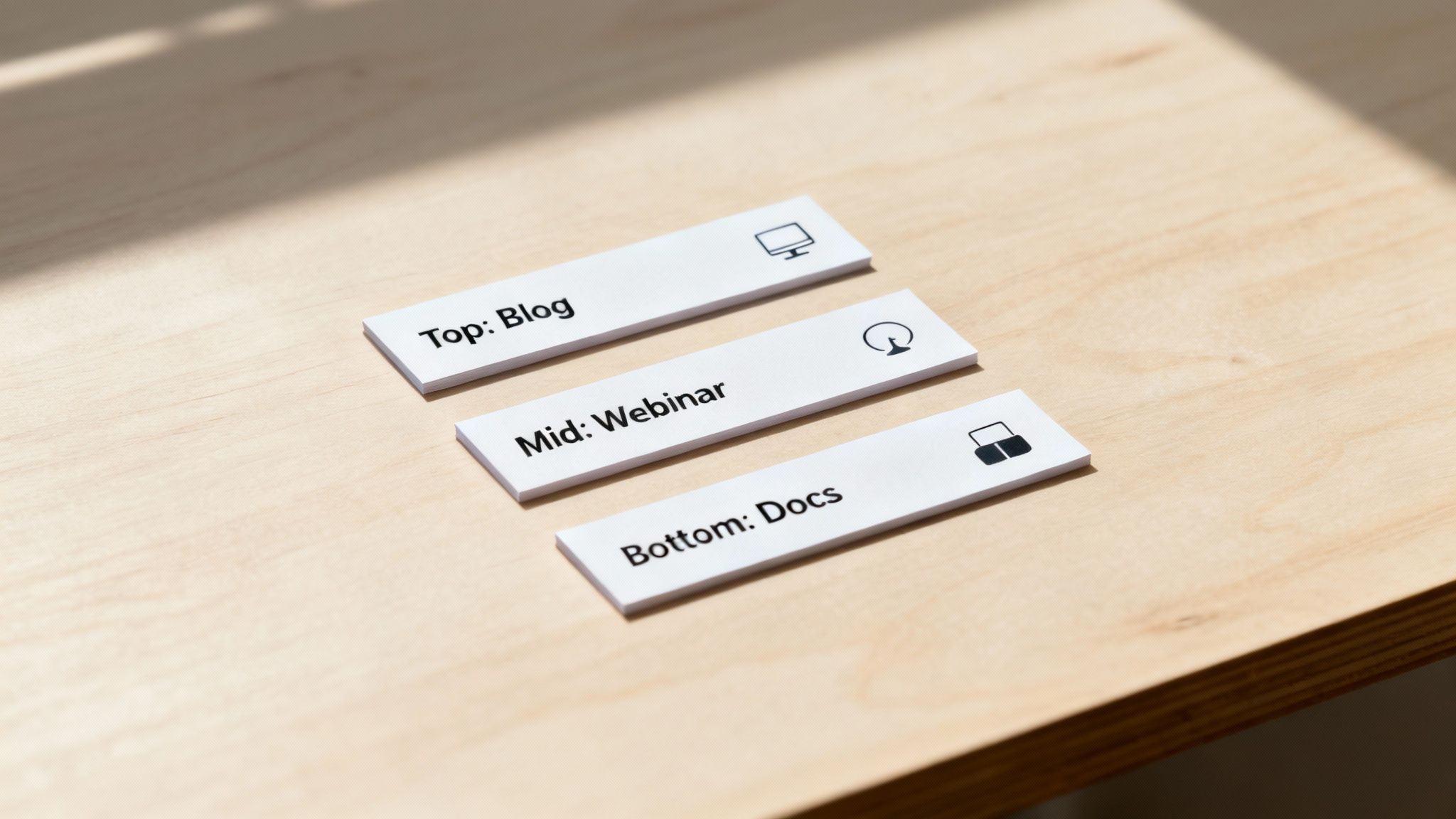
This kind of strategic thinking is what separates content programs that actually drive revenue from those that just make noise. When you align each piece of content with a specific funnel stage, you guide your audience through a seamless and persuasive experience.
Top-of-Funnel Magnets for Attracting Traffic
At the very top of the funnel (ToFu), the game is all about attracting organic traffic. You want to make people aware that you even have a solution for their problem. The content here needs to be educational, genuinely helpful, and easy to find on Google.
-
SEO-Driven Blog Posts and Guides: These are the absolute workhorses of any SaaS content strategy. By targeting the informational keywords your ideal customers are searching for, you pull in qualified prospects day in and day out. The trick is to create content that’s significantly more helpful and detailed than whatever your competitors are publishing.
-
Free Tools and Templates: Nothing hooks a potential lead like immediate value. Interactive content—think a free ROI calculator, a handy project management template, or even a lightweight version of your tool—can be an incredibly powerful magnet. It gives them a tangible taste of what your product can do right away.
These formats are all about casting a wide, yet targeted, net. You're building that initial brand awareness and trust by answering questions and solving small problems, positioning yourself as a helpful expert from the very first click.
Mid-Funnel Formats for Building Credibility
Okay, so you've got their attention. Now, in the middle of the funnel (MoFu), the goal is to build trust and really show off your product's value. We're shifting from broad education to specific, solution-focused content that nudges leads closer to making a decision.
At this stage, you're no longer just an expert; you're a potential partner. Your content needs to show prospects not just what to do, but how your software helps them do it better than anyone else.
This is where you prove your expertise and demonstrate how your product works in the real world.
-
Webinars and Product Demos: Whether live or on-demand, webinars let you dive deep into specific pain points and engage directly with your audience. They're perfect for walking through complex features and answering questions in real-time.
-
Case Studies and Customer Stories: Let's be honest, nothing builds credibility like social proof. Detailed case studies that tell a story—highlighting how a real customer solved a painful problem using your software—are pure gold for prospects who are seriously considering their options.
-
White Papers and Ebooks: For those complex B2B sales with multiple decision-makers, in-depth resources like white papers and ebooks can provide the detailed, data-driven information they need to justify the purchase to their boss.
Video and interactive content are especially powerful here. Fresh 2024 research shows that while 9 out of 10 SaaS businesses rely on blog posts, webinars remain an engagement powerhouse, with 93.5% of SaaS companies using them to connect with their audience. You can discover more insights about SaaS content trends to see just how essential these formats have become.
Bottom-of-Funnel Essentials That Convert and Retain
Finally, we've reached the bottom of the funnel (BoFu). Your content here has one mission: seal the deal. It also plays a crucial role in supporting new customers to make sure they stick around. This content is highly product-focused and designed to eliminate any last-minute hesitation.
These formats are what turn trial users into paying customers and paying customers into your biggest fans.
-
Detailed Tutorials and Help Docs: A comprehensive and easy-to-navigate knowledge base is completely non-negotiable. Clear, step-by-step tutorials empower users to find their own answers, which drives product adoption and takes a huge load off your support team.
-
Comparison Pages: Don't be shy about your competition. Create honest, detailed pages comparing your product to key alternatives. This is your chance to control the narrative and showcase your unique strengths right when a prospect is moments away from pulling out their credit card.
Getting Your Content in Front of the Right People
Creating great content is a fantastic start, but it's only half the job. The other half—where the real growth kicks in—is actually getting that content in front of your ideal audience. Without a smart distribution plan, even the most insightful article is like a brilliant product that stays locked in the warehouse.
Think of it like a product launch. You wouldn't spend months building a powerful piece of software and then just cross your fingers, hoping people stumble upon it. You'd plan a launch, build buzz, and get it into the right hands. Your content deserves that same strategic push to pick up speed and deliver a return.
The 3 Channels of Content Distribution
A solid distribution strategy for any SaaS company is built on three core channels: owned, earned, and paid. The most successful brands don't just lean on one; they weave all three together to create a powerful amplification engine. The goal is simple: be present wherever your ideal customer is already spending their time.
-
Owned Media: These are the platforms you control entirely. We're talking about your company blog, your email newsletter, and your corporate social media accounts. This is your home turf, where you build a direct line to your audience.
-
Earned Media: This is the digital version of word-of-mouth marketing. It’s the exposure you get when other people start talking about you—think mentions in industry publications, guest posts on popular blogs, or being featured on a podcast. You don't pay for it; you earn it with quality.
-
Paid Media: This is where you put money behind your content to reach a specific, targeted audience. This could be anything from sponsored posts on LinkedIn and targeted ads on X (formerly Twitter) to search engine marketing that gives your best content a boost.
When used together, these channels create a flywheel effect. Paid ads can drive traffic to your owned blog, which then gets shared by others, leading to earned media. Each one strengthens the others.
Mastering Your Owned and Earned Channels
Your owned channels are the bedrock of your distribution efforts. The first step is to optimize your blog, not just for search engines, but for genuine human engagement. Make sure you have clear calls-to-action (CTAs) that encourage people to sign up for your newsletter or share your post. This is how you turn a one-time visitor into part of your community.
Next, shift your focus to earning media by building real relationships. This isn't about blasting a generic pitch to a hundred journalists. It's about finding the key voices in your niche and offering them something of real value—maybe it's unique data you've gathered or a fresh perspective they can share with their own audience. Guest posting on well-respected industry sites is another fantastic way to tap into a pre-built audience and earn valuable backlinks.
Of course, none of this works unless you're creating content that people naturally want to find. You can learn more about the different ways to increase organic traffic in our detailed guide on the topic.
When you consistently create content that truly serves an audience, distribution gets a whole lot easier. Instead of constantly pushing your message out, you create a pull effect. Communities and influencers will want to share what you’ve built because it helps them, too.
This mindset turns distribution from a tedious task into a natural byproduct of creating great work.
Work Smarter: Repurposing and Paid Promotion
Why go through all the effort of creating one asset when that same effort could produce a dozen? Smart repurposing is the secret weapon of efficient SaaS content marketers. A single, one-hour webinar can be sliced and diced into a whole suite of assets that can fuel your marketing channels for weeks.
Just look at what you can get from one webinar recording:
- The Full Video: Host the on-demand version on your website, gated behind a simple lead-gen form.
- A Detailed Blog Post: Write a comprehensive summary of the webinar and embed the full video within the post.
- Short Video Clips: Pull out 5-7 of the best moments and turn them into bite-sized clips for LinkedIn, X, and YouTube Shorts.
- Quote Graphics: Design a few eye-catching graphics with powerful quotes from the speaker to share on Instagram and LinkedIn.
- An Email Nurture Sequence: Create a short series of emails for everyone who registered, sharing additional resources related to the topic.
Finally, be strategic with paid promotion. You don't need to boost every single post. Instead, identify your most valuable, bottom-of-funnel content—like a persuasive case study or a high-converting guide—and put a modest budget behind it on a platform like LinkedIn. This is how you guarantee your best assets reach a laser-focused audience of decision-makers, accelerating your pipeline and proving the ROI of your content.
Using AI and Tech to Scale Your Content Engine
In today's SaaS world, creativity alone won't cut it. A modern content marketing operation runs on a smart technology stack. To meet the constant demand for high-quality work without burning out your team, you need to build a content engine that puts technology to work for you. This is all about finding the right tools to streamline everything from brainstorming to measuring business impact.
The goal isn’t to replace your talented team with robots. It’s about augmenting their skills—freeing them up to focus on the big-picture strategy and compelling storytelling while technology handles the repetitive, data-crunching tasks. You're aiming to work smarter, not just harder.

How AI is Reshaping the Content Workflow
Artificial intelligence has officially moved from industry buzzword to an essential tool for any serious SaaS marketer. When you learn how to wield it properly, AI can dramatically accelerate the entire content lifecycle. The trick is to view it as a powerful assistant, not a substitute for a skilled writer or strategist.
Here are just a few ways AI can give your content operations a serious boost:
- Generating Topic Clusters: Instead of relying on manual brainstorming sessions, AI tools can instantly analyze search trends and competitor strategies to map out entire topic clusters, helping you build authority much faster.
- Drafting Initial Outlines: Staring at a blank page is a massive time-waster. AI can generate a comprehensive, SEO-friendly outline in seconds, giving your writers a solid foundation to start from.
- Optimizing Headlines and Copy: AI platforms can crunch massive datasets to suggest headlines with a higher click-through rate or help you refine copy for better readability and engagement.
The real breakthrough is using AI to enhance human insight. AI is a master at recognizing patterns and processing data at scale, but humans are still the experts at understanding nuance, emotion, and brand voice. The magic happens when you blend the two.
This tech-forward approach is already delivering real results. Budget allocation and new technologies are fundamentally changing content marketing for SaaS. Research from 2024 reveals that AI-powered thought leadership content can deliver 156% higher ROI than traditional formats. With 64% of SaaS companies now using AI in their marketing and 68% of them reporting better ROI because of it, the trend is undeniable.
Assembling Your Essential SaaS Tech Stack
Beyond just AI, a well-oiled content engine depends on a few other critical pieces of technology. These tools are what give you the competitive intel, performance data, and lead-nurturing power to turn your content into a predictable source of revenue.
Think of your tech stack as the command center for your entire content operation.
- SEO Platforms (like Ahrefs or Semrush): These are non-negotiable. They are your eyes and ears for competitive intelligence, helping you with keyword research, rank tracking, backlink analysis, and spotting content gaps your rivals have missed.
- Analytics Software (like Google Analytics): You can't improve what you don't measure. Analytics tools are essential for tracking traffic, engagement, and most importantly, conversions. This is how you connect your content directly to business goals like trial sign-ups.
- Marketing Automation (like HubSpot or Marketo): So your content generated a lead… now what? Marketing automation platforms take over, nurturing those leads with targeted email sequences, scoring their engagement, and handing them off to the sales team at just the right moment. By leveraging automated content marketing strategies, you can effectively scale your engine and maximize your reach.
When you integrate these technologies, you create a seamless, data-driven workflow. You’ll not only make your team more efficient but also gain the crucial insights you need to finally prove your content’s impact on the bottom line.
How to Measure Content Marketing ROI for SaaS
You've been cranking out content, building an audience, and getting your brand out there. But let's be honest, how do you actually prove it's making the company money? This is where measuring the return on investment (ROI) for your content marketing for SaaS becomes crucial. It's the step that turns your work from a "nice-to-have" expense into an undeniable engine for growth.
https://www.youtube.com/embed/qyk7YYJ3ZPU
The first thing we have to do is look beyond the easy-to-track vanity metrics. Things like page views and social media likes feel good, but they don't tell the whole story. They show reach, sure, but they don’t tell you if your content is actually helping to pay the bills. The real goal is to draw a straight line from your content to the metrics that matter most to a SaaS business.
From Vanity Metrics to Business Impact
For any SaaS company, the true measure of content success isn't just about eyeballs on a page; it's about inspiring action. We need to zero in on those moments when a prospect stops being a passive reader and starts actively engaging with your product. This means shifting your focus from "how many people saw this?" to "how many people did something because of this?"
What kind of actions are we talking about? Think about the specific steps you want someone to take after reading your content:
- Trial Sign-ups from Blog Posts: How many people read that deep-dive guide on a key feature and immediately signed up for a free trial? That’s a direct hit.
- Demo Requests from Webinars: Did your last webinar result in a wave of demo requests from high-quality leads? That’s a clear win.
- Content-Influenced Conversions: Which articles, case studies, or whitepapers did a user read before they finally swiped their credit card?
Answering these questions gives you a much richer, more accurate picture of your content's real-world value. For a full breakdown, you can learn more about how to measure marketing ROI in our detailed guide.
Connecting Content to Revenue with the Right Tools
So, how do you actually track all this? Trying to connect these dots manually is a recipe for a headache. You need a few key tools in your stack to get a clear line of sight from the first blog post someone reads to the recurring revenue they bring in.
Your CRM and analytics platforms are going to be your best friends.
By integrating your website analytics (like Google Analytics) with your CRM (like HubSpot or Salesforce), you can start to map out a customer's entire journey. You can see which articles they read, which webinars they attended, and how those interactions pushed them closer to making a purchase.
This whole process is called attribution modeling. It can sound intimidating, but the core idea is simple: give credit where credit is due. A basic "last-touch" model gives all the credit to the final piece of content a user saw, while more sophisticated models can spread that credit across every touchpoint in their journey.
Picking the right model helps you understand which content is working best at every stage, from attracting new visitors to closing the final deal. This data-driven approach gives you the power to walk into any meeting and show exactly how your content contributes to the company's bottom line.
Essential SaaS Content Marketing Metrics to Track
To make this practical, you need a dashboard of metrics that tell the full story. The table below breaks down the essential KPIs that connect your content efforts directly to SaaS business goals.
| Metric | What It Measures | Why It Matters for SaaS | Tools to Use |
|---|---|---|---|
| Lead Quality (MQL/SQL) | The number of marketing-qualified and sales-qualified leads generated from content. | This separates serious prospects from casual readers, focusing sales efforts where they count. | CRM (HubSpot, Salesforce), Lead Scoring Tools |
| Content-Sourced Trial Sign-ups | The percentage of free trial users who first engaged with a piece of content. | A direct link between content consumption and product interest. This is a core bottom-of-funnel metric. | Google Analytics, Mixpanel, Amplitude |
| Customer Acquisition Cost (CAC) | The total cost of your content marketing efforts divided by the number of new customers acquired through those efforts. | Helps you understand the efficiency of your content. A lower CAC means a better ROI. | CRM, Financial Software |
| Lead-to-Customer Conversion Rate | The percentage of leads generated from content who become paying customers. | Measures how effective your content is at nurturing leads down the funnel and turning them into revenue. | CRM Analytics |
| Content-Influenced Revenue | The amount of monthly recurring revenue (MRR) attributed to customers who interacted with content during their buyer journey. | The ultimate metric. This directly ties your content strategy to the company's revenue goals. | Attribution Software (e.g., HubSpot, Marketo) |
By consistently tracking these metrics, you move beyond guesswork. You’ll know precisely what’s working, what isn’t, and where to double down on your efforts for maximum impact.
Frequently Asked Questions
When you're deep in the weeds of content marketing for SaaS, a few questions always seem to pop up. Let's run through some of the big ones so you can move forward with your strategy, whether you're just starting out or fine-tuning an existing one.
Think of this as your personal cheat sheet for clearing the most common roadblocks—from figuring out your budget to wondering when you'll finally see results.
How Much Should a SaaS Company Budget for Content Marketing?
There’s no one-size-fits-all answer here; your budget really depends on your company's size, stage, and how fast you want to grow. That said, a solid rule of thumb for early-stage SaaS companies is to put 10% to 20% of the total marketing budget toward content.
As you grow and want to get more aggressive, that number can and should go up. The most important shift is to stop seeing content as an expense. It's an investment in a long-term asset, one that pays dividends over time.
If you're just starting, budget for what you can actually do well, consistently. It's far better to publish two amazing, well-promoted articles a month than to churn out eight mediocre posts that just gather dust. Quality and consistency will always beat sheer volume.
How Long Does It Take to See Results from SaaS Content Marketing?
This is where patience becomes your superpower. Content marketing isn't like flipping a switch on a paid ad campaign. It’s a long game. For content built around SEO, you should realistically expect to see a real impact—like a meaningful jump in organic traffic and leads—within 6 to 12 months.
Of course, that timeline can shift based on a few things:
- Industry Competition: Trying to rank in a crowded market is an uphill battle that takes more time.
- Publishing Cadence: The more high-quality content you publish, the faster you'll get on Google's radar.
- Promotion Game: Great content is only half the battle. A smart distribution plan can seriously shorten your time to results.
How Can We Create Content with a Small Team?
A small team isn't a blocker; it's a reason to get strategic. The key is to work smarter, not harder, by focusing on what delivers the most punch. I always recommend starting at the bottom of the funnel with content like convincing case studies or competitor comparison pages. These pieces often have the quickest and most direct impact on sales.
After that, it's all about repurposing. One great webinar can be sliced and diced into a blog post, a dozen social media clips, a downloadable slide deck, and a handful of powerful quotes for your sales team. This lets you multiply your output without multiplying the effort. And don't forget about bringing in skilled freelancers. They can fill knowledge gaps and give your team the bandwidth it needs to scale content production without adding full-time headcount.
Ready to build a content engine that drives predictable growth for your SaaS? Mick-Mar Inc. specializes in creating strategic content marketing roadmaps that turn your expertise into your most powerful lead-generation tool. Let's build your growth story together. Find out how at https://mick-mar.com/.