For tech companies, content marketing isn't just about churning out blog posts. It's about earning trust by consistently publishing valuable, educational material that helps your specific audience solve their toughest problems. It’s a shift away from the disruptive sales pitch and toward building a relationship by proving your expertise. In the end, that's what inspires customers to buy.
Let's be clear: this approach is no longer a "nice-to-have." It’s the primary growth engine for today's SaaS and B2B tech firms.
Why Tech Companies Win with Content Marketing

In a tech market that's more crowded than ever, a great product just isn't enough to stand out. Your buyers—whether they’re developers, IT managers, or CTOs—are doing their own research long before they even think about talking to sales. They're tired of the hard sell. What they really want are answers and solutions they can find on their own terms.
This is exactly where strategic content marketing for tech companies makes all the difference.
Instead of just pushing features, great content educates your audience and builds their confidence in your brand. You're demonstrating deep expertise before they even fill out a form or book a demo. For complex tech products where credibility is everything, this educational approach is non-negotiable. When you consistently deliver value, you stop being just another vendor and become their go-to resource.
The Shift from Selling to Educating
The numbers back this up. A 2024 Content Marketing Institute report found that 75% of B2B marketers agree that content marketing helps them educate their audience. More importantly, 68% say it successfully builds credibility and trust.
This investment is a direct response to the unique hurdles in the tech sales cycle:
- Complex Solutions: Your content can demystify sophisticated products. It breaks down the why behind your solution, not just the what, making it accessible and relevant.
- Multiple Stakeholders: You can create targeted content for everyone involved in the buying decision—from the engineer worried about integration to the CFO focused on ROI.
- High-Consideration Purchases: A solid library of resources nurtures leads through a long and often winding buying journey, keeping your brand top-of-mind when it's time to make a choice.
Content is the most sustainable investment for long-term growth. It's not just another marketing channel—it's a core business function that educates prospects who are actively avoiding a sales pitch, positioning you as a trusted partner.
Of course, none of this works without a solid plan. A strong strategy is the foundation of it all. Learning how to create a comprehensive content strategy is the first real step. This guide is designed to walk you through everything that comes next, from truly understanding your audience to measuring the results that actually move the needle for your business.
Defining Your Audience and Core Message
Before you write a single line of code or draft a single word of copy, you have to get almost obsessive about understanding your audience. This is where great tech content marketing begins and ends. If you create generic content trying to appeal to everyone, you can bet it will resonate with no one.
The goal is to move past vague demographics and build a razor-sharp picture of your Ideal Customer Profile (ICP). This isn't just some fluffy marketing exercise; your ICP is the compass for your entire content strategy. It tells you what topics to cover, what language to use, and which problems to solve. Without it, you're just adding to the noise.
Moving Beyond Surface-Level Demographics
A real ICP for a tech company goes way deeper than just job titles and company size. You've got to dig into the human side of things—the real-world frustrations, professional goals, and day-to-day workflows of the person you're trying to reach. This is where the gold is buried.
So, how do you get this information? Go straight to the source.
- Dive into Customer Support Tickets: Your support team is sitting on a treasure trove of customer pain points. Look through common tickets to spot recurring issues, frustrations with their old way of doing things, and the exact words they use to describe their problems.
- Interview Your Sales Team: Grab a coffee with your sales reps. Ask them about the deals they've won, and maybe more importantly, the ones they've lost. What questions do prospects always ask? What are the "aha!" moments that get a deal across the line?
- Survey Your Best Customers: Get on a call with your happiest, most successful customers. Ask them what their job was like before they found you and what specific results they’ve seen since. These conversations are the raw material for your most authentic case studies and testimonials.
The secret to effective content marketing isn’t about what your product does; it’s about what your audience can achieve with it. Once you truly get their challenges, you can create content that makes your solution feel indispensable.
Translating Insights into a Powerful Messaging Framework
After you've gathered all this qualitative data, it's time to organize it into a messaging framework. This is the document that keeps your entire team on the same page, ensuring every blog post, technical doc, and LinkedIn ad is consistent and speaks directly to your ICP. The first step, of course, is knowing how to identify your target audience in the first place.
This framework really stands on three pillars:
- A Unique Value Proposition (UVP): This needs to be a clear, punchy statement that explains what you do, who it's for, and why you’re different. It's not a fluffy slogan. For instance, instead of "We streamline workflows," try something specific: "Our platform helps DevOps teams cut deployment times by 50% by automating manual security checks."
- A Distinct Brand Voice: Are you the friendly, helpful colleague or the authoritative industry expert? Your brand voice should reflect your company culture and connect with your audience. An engineer will appreciate direct, data-driven language, while a C-suite executive probably wants to see high-level strategic insights.
- Core Messaging Pillars: These are the 3-5 key themes your brand is going to own. They must connect directly to your audience's biggest problems and your product's greatest strengths. For a cybersecurity company, these pillars might be "Threat Detection," "Compliance Automation," and "Incident Response." From here on out, every piece of content should support one of these pillars.
Nailing this foundation is a crucial piece of a much broader B2B marketing strategy that ties all your efforts together. When your content is grounded in a deep understanding of your audience and a crystal-clear message, you build a powerful engine for earning trust, proving your expertise, and driving real growth.
Choosing Content Formats That Actually Convert
Let's be honest: not all content formats are created equal, especially when you're trying to reach a B2B tech audience. Whether your ideal customer is a developer, a product manager, or a C-suite executive, they're smart, discerning, and almost always short on time. A one-size-fits-all approach is a fast track to wasting your budget and missing your mark.
The real key is matching the right format to the right person at the right stage of their buying journey. Think of it less as a creative whim and more as a strategic necessity. Different formats do different jobs—some build broad awareness, while others provide that final piece of evidence a buyer needs before signing on the dotted line.
Before you even think about formats, you have to nail down who you're talking to and what they actually need. This is the foundation of everything.
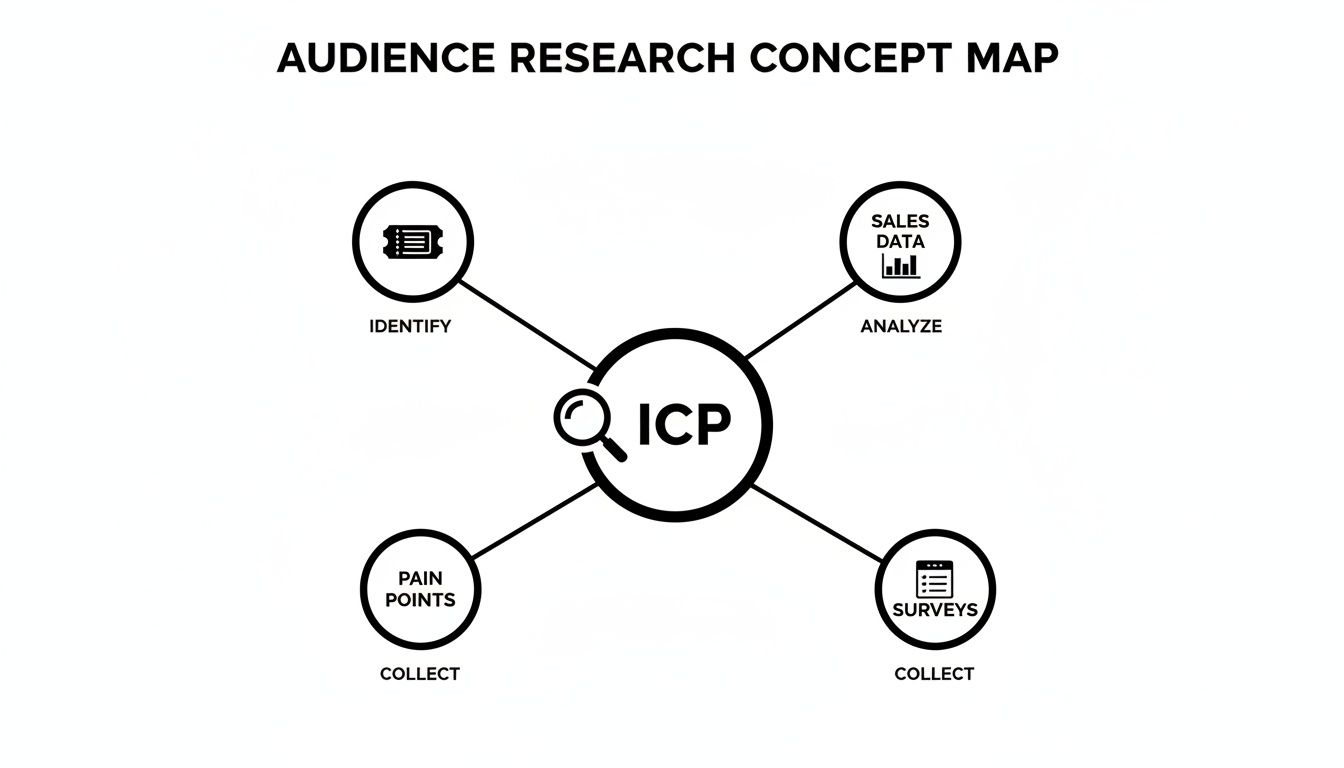
As you can see, a solid Ideal Customer Profile (ICP) isn't guesswork. It's built from real-world data—feedback from your sales team, pain points dug out of support tickets, and insights from direct customer surveys.
Aligning Content Formats with the B2B Tech Buyer's Journey
To make this practical, you need a map that connects what you create to where your buyer is in their decision-making process. The goal is to be helpful at every single step, from their first Google search to the moment they're ready to buy.
This table breaks down how specific content formats align with each stage of the buyer's journey, helping you choose the most effective asset for your goals.
| Buyer's Journey Stage | Primary Goal | High-Impact Content Formats | Example Use Case |
|---|---|---|---|
| Awareness (Top of Funnel) | Educate, build trust, and attract organic traffic | In-depth blog posts, white papers, short-form video explainers, industry reports | A developer searches for "how to fix a common API error" and finds your comprehensive blog post on the topic. |
| Consideration (Mid-Funnel) | Nurture leads, showcase expertise, and compare solutions | Product-led webinars, in-depth comparison guides, downloadable templates, interactive tools | A product manager evaluating tools downloads your guide comparing your solution against three top competitors. |
| Decision (Bottom of Funnel) | Validate the choice, provide proof, and enable sales | Case studies, technical documentation, on-demand product demos, ROI calculators | A CTO reads a case study showing how a similar-sized company reduced downtime by 40% using your platform. |
By mapping your content this way, you create a cohesive experience that naturally guides prospects forward instead of just throwing random assets at them.
Formats for Building Awareness and Trust
When someone is at the top of the funnel, your main job is to educate, not sell. They're just starting to put a name to their problem, and your content should be the resource that helps them understand it. This is how you establish your brand as a helpful, authoritative voice.
Here are the go-to formats for this stage:
-
In-Depth Blog Posts: These are the workhorses of your content strategy, perfect for driving organic traffic and answering very specific questions. A well-researched guide on a common coding challenge or a detailed comparison of two competing methodologies solves an immediate need and builds that first layer of trust.
-
White Papers & Reports: Got proprietary data or a unique perspective on an industry trend? A report or white paper is the ideal format. In fact, a 2023 study by Demand Gen Report found that 78% of B2B buyers used white papers in the last 12 months to research purchasing decisions, making them a powerful tool for capturing high-intent leads.
-
Short-Form Video: Don't sleep on video, even for deeply technical topics. A recent Vidyard report noted that 92% of businesses say video gives them a positive ROI. A quick, two-minute explainer can demystify a complex concept far more effectively than a wall of text ever could.
The most effective top-of-funnel content is laser-focused on the audience's problem, not your solution. When you lead with pure education, you build credibility that pays off big time when they're finally ready to evaluate products.
Formats for Driving Decisions and Closing Deals
As prospects move to the bottom of the funnel, they're close to a decision. They need proof. They need to see that your solution works and, more importantly, that it will work for them. This is where social proof and deep-dive product information become absolutely critical.
-
Case Studies: This is arguably your single most important sales enablement asset. A great case study isn't just a testimonial; it's concrete evidence of your product's value. With 78% of B2B buyers reviewing case studies before they buy, you can't afford to neglect them. Frame it as a simple story: the customer's challenge, the solution you delivered, and the measurable results they achieved.
-
Technical Documentation: For any product with a technical user base, your developer docs are marketing content. Period. Clear, comprehensive, and easily searchable documentation is often a major deciding factor. It signals that you respect your users' time and are committed to their success long after the sale.
An Unbeatable Content Distribution Strategy
Creating world-class content is a fantastic start, but it's only half the job. The most insightful white paper or brilliant technical blog post is useless if your ideal buyer—the developer, product manager, or CTO you built it for—never sees it. Getting your content in front of the right people is what actually drives results.
This is where a multi-channel distribution playbook, built specifically for savvy tech audiences, becomes your greatest asset. A great plan doesn't just push content out; it pulls the right people in. Think of it as an integrated system where every channel works together, turning each asset into a lead-generating machine. You have to move past just hitting "publish" and focus on strategic amplification.
The Power of Technical SEO
Search Engine Optimization (SEO) is the non-negotiable foundation of content marketing for any modern tech company. Recent 2024 studies from BrightEdge show that 68% of all trackable website traffic comes from organic and paid search. Your goal is to be the answer when your audience asks a question.
For tech brands, this means getting serious about technical SEO. It’s not about stuffing broad keywords everywhere; it’s about getting incredibly specific and solving real problems.
- Problem-Based Keyword Research: Your audience isn't searching for your product name. They're searching for their problems. Put yourself in a developer's shoes and research long-tail keywords around specific error codes, integration headaches, or "how-to" queries related to their tech stack.
- Optimized Developer Documentation: Don't sleep on your dev docs—they're a massive SEO opportunity. By structuring them with clear headings, helpful code snippets, and practical examples, you can start ranking for highly specific technical queries. This not only builds immense trust but also attracts qualified users directly to your platform.
Strategic Promotion Beyond Organic Search
While SEO is your long-term engine, you need some fuel to get it started. Promoting your content across other channels is essential for that initial traction and for reaching people who aren't actively searching yet. This is how you proactively find and engage your ideal customers where they already are.
- LinkedIn and Social Platforms: Go where tech professionals gather. On LinkedIn, this means sharing insightful snippets from your content, jumping into relevant industry groups, and running targeted ad campaigns for your high-value assets like white papers or webinars. For a deeper dive, our guide on The B2B Social Media Profit Playbook offers some powerful shifts for growth.
- Niche Online Communities: Your ideal customers are already talking on platforms like Reddit, Slack, and Stack Overflow. The key here is to add value, not spam. Become a helpful member of these communities. Answer questions, offer expertise, and only share your content when it directly solves a problem being discussed.
Creating exceptional content and then failing to promote it is like building a brilliant product and never telling anyone it exists. Distribution isn't an afterthought; it's a core function that determines the ROI of your entire content effort.
Amplifying Your Reach with Partnerships
You don't have to build your audience entirely from scratch. Tapping into existing networks through smart partnerships can dramatically amplify your reach and lend your content instant third-party credibility. It's one of the fastest ways to get in front of a pre-qualified audience that already trusts the source.
Consider these powerful partnership models:
- Co-Marketing with Non-Competitors: Find a company that serves the same audience but isn't a direct competitor. You could co-author a white paper, co-host a webinar, or simply agree to promote each other's best content to your email lists and social followers.
- Guest Posting on Industry Publications: Pinpoint the blogs and online magazines your target audience reads religiously. A high-quality guest post on one of these publications places your expertise—and by extension, your brand—directly in their line of sight.
- Engaging with Influencers: In the tech world, "influencers" are often respected developers, analysts, or founders with a dedicated following. Building genuine relationships with these people can lead to them sharing your work organically, which is some of the most valuable social proof you can get.
Ultimately, an integrated approach is what wins. When your SEO efforts, paid promotion, community engagement, and partnership activities all work in concert, you create a powerful flywheel that continuously drives traffic, builds authority, and generates a steady stream of qualified leads.
Scaling Content Operations with AI and Martech

The best content programs today are a blend of human creativity and machine-powered efficiency. To actually keep up with the demand for great content without your quality taking a nosedive, you have to scale your operations. This is where Artificial Intelligence (AI) and the right marketing technology (martech) stack become your unfair advantage.
Let's be clear: scaling isn't about replacing talented marketers with robots. It’s about giving them superpowers. By letting technology handle the repetitive, data-heavy lifting, your team is freed up to focus on what they do best—high-level strategy, deep technical accuracy, and creating a brand voice that machines simply can't replicate. The goal is to produce better content, faster.
Leveraging AI for Smarter Content Creation
AI is far more than a buzzword; it's a practical toolkit for supercharging your entire content workflow. When you use it right, it can slash the time spent on foundational tasks, freeing up your experts to add the nuance and depth that truly connects with a technical audience.
Think of AI as an incredibly smart assistant, not the final author.
Here are a few ways we see teams successfully integrating AI into their process:
- Ideation and Topic Clustering: Point AI tools at competitor content or have them sift through customer feedback on forums like Reddit. You can quickly spot content gaps, spit out dozens of relevant topic ideas, and group them into logical clusters that support your core product messages.
- Creating First Drafts and Outlines: The "blank page" problem is real. AI can generate a solid outline or a rough first draft in minutes, giving your writers a running start. This simple step can accelerate the entire process immensely.
- SEO and Content Optimization: AI-powered SEO platforms analyze top-ranking content in real-time. They can feed you live suggestions for improving your on-page SEO, from keyword usage and readability to finding the perfect internal linking opportunities.
The non-negotiable rule: A human expert must always have the final say. For tech content, accuracy is your currency. AI-generated drafts need rigorous fact-checking and a heavy edit from a subject matter expert to ensure technical correctness and protect your brand's unique voice.
Building a Lean and Powerful Martech Stack
The martech landscape is a jungle. With around 15,384 different solutions as of 2025, it’s easy to get overwhelmed. The secret is to build a lean stack that solves your specific problems, not to chase every shiny new tool that comes along.
Your martech stack should be a curated toolkit that supports the whole content lifecycle, from planning and creation all the way to performance analysis. It’s no surprise that recent surveys show between 64% and 68% of businesses see better content marketing ROI after bringing AI tools into the mix. You can learn more about the explosive growth of the martech landscape and AI adoption on chiefmartec.com.
Here are the essential categories you need to cover:
- Project Management: Tools like Asana, Monday, or Trello are the central nervous system of your content operation. They keep your calendar organized, tasks assigned, and workflows humming along.
- SEO and Keyword Research: You absolutely need a robust tool like Ahrefs or Semrush. This is the data engine that powers your entire organic growth strategy, from keyword research to rank tracking.
- Analytics and Performance Tracking: Google Analytics is the baseline, but the real magic happens when you integrate it with your CRM (like HubSpot or Salesforce) to see how content is actually influencing leads and pipeline.
- Content Automation and Distribution: Platforms like Buffer can automate your social media posting, while marketing automation tools like Marketo help nurture the leads your content generates.
Putting these systems in place is a core part of maturing your content operations. For a deeper dive on evolving your processes from the ground up, check out our guide on The Content Marketing Operations Maturity Model. By thoughtfully combining AI and martech, you can turn your content program from a series of one-off projects into a predictable, scalable engine for growth.
Measuring What Matters and Proving ROI
Creating great content is a serious investment of time, talent, and money. Sooner or later—usually sooner—the C-suite is going to ask the big question: what’s the return on all this effort?
Answering that means looking past feel-good numbers like page views and social media likes. To justify your budget and prove your worth, you have to connect the dots between your content and the company's bottom line.
It's all about showing how that blog post a prospect read three months ago influenced the deal that just closed. This is how you transform the content team from a cost center into a revenue-driving engine.
Tracking Beyond Vanity Metrics
The first move is to stop obsessing over top-of-funnel engagement and start measuring what actually signals business impact. Traffic is a decent starting point, but it's not the destination. The real prize is understanding how your content is fueling the sales pipeline.
Let's get specific. Here are the metrics that truly matter to the business:
- Content-Attributed Revenue: This is the holy grail. It answers the question, "How much closed-won revenue did our content touch?" It tracks every deal where a prospect consumed a piece of your content at any point in their journey.
- Pipeline Influence: This shows how many sales opportunities were created or nudged along after a lead engaged with a specific asset. It's about demonstrating momentum.
- Marketing Qualified Leads (MQLs) Generated: This is your classic lead gen metric—the number of high-intent leads you captured from gated content, webinar sign-ups, or demo requests that started with a piece of content.
- Reduced Customer Acquisition Cost (CAC): A powerful organic content engine brings in qualified leads without the steep price tag of paid ads, directly lowering your overall CAC.
Your goal isn't just to get clicks; it's to connect a click to a contract. By setting up proper tracking between your analytics platform and your CRM, you can draw a straight line from a blog post view to a closed deal.
Setting Up a Simple Reporting Dashboard
To make your case to leadership, you need a dashboard that tells a story, not an overwhelming spreadsheet that induces a headache. The key is to visualize the metrics that tie directly back to the company’s big-picture goals.
Your dashboard should be built to answer crucial questions at a glance:
- Which content formats are actually driving MQLs? Are webinars outperforming white papers?
- What are our top-performing blog posts for generating demo requests?
- How much pipeline value did our content influence this quarter compared to last?
This kind of focused reporting gives you a clear narrative. It proves your content isn't just being read—it’s actively bringing in qualified leads, speeding up the sales cycle, and making a real contribution to revenue growth.
Your Questions, Answered
If you're mapping out a content marketing strategy, you probably have a few questions. Let's tackle some of the most common ones I hear from tech companies so you can move forward with confidence.
How Long Does This Actually Take to Work?
Everyone wants to know when they'll see the payoff. The honest answer? Content marketing in tech is a long game. You're building a foundation, not flipping a switch.
You can expect to see meaningful, needle-moving results—think organic traffic, qualified leads, and a stronger brand presence—within 6 to 12 months. This isn't a hard-and-fast rule, of course. The timeline can shift based on how competitive your space is, the quality of what you're creating, and your promotion hustle. Those first few months are all about laying the groundwork and earning trust from your audience and search engines.
The biggest mistake I see tech companies make is pulling the plug too early. Consistency is everything. The real magic happens when the cumulative effect of your helpful content starts building its own unstoppable momentum.
What's the Single Biggest Mistake to Avoid?
It's easy to fall into this trap: making your content all about you. The most common pitfall is creating self-promotional, product-heavy content, especially for people who are just starting to explore a problem. The best tech marketing doesn't sell; it educates and solves problems. Trust is the primary goal.
Stop writing about your features. Instead, write about the problems your features solve. This simple shift from "telling" to "showing" will attract a much broader and more relevant audience, guiding them toward your solution in a way that feels natural and helpful, not salesy.
Should We Hire an Agency or Build Our Own Team?
This is a classic "it depends" situation, but the decision really boils down to your company's resources, timeline, and the expertise you already have on hand.
- Building an In-House Team: This route gives you unparalleled product knowledge. Your content creators will live and breathe your company culture, which is perfect for brands where deep technical understanding is a must.
- Hiring an Agency: This is your fast track to specialized skills. You get immediate access to proven systems, expert talent, and the ability to scale up or down without the overhead of hiring. It's often the quickest way to execute a sophisticated strategy.
Honestly, a hybrid approach is often the sweet spot. Many tech companies succeed with an in-house content lead who directs the strategy while partnering with a specialized agency for the heavy lifting, like technical SEO or complex video production. You get the best of both worlds: deep internal knowledge backed by expert external support.
Ready to build a content engine that actually drives revenue? The team at Mick-Mar Inc. specializes in creating powerful content marketing strategies for B2B tech companies that deliver real, measurable results. Let's build your growth roadmap together.