The simplest way to think about product marketing vs. brand marketing is to ask one question: are you trying to sell what you do or who you are? Product marketing is all about driving demand for a specific product, while brand marketing builds a lasting connection with your audience based on your company's identity and values.
Ultimately, your focus depends on whether you need to move inventory and hit a sales number now or build long-term brand equity that pays dividends for years to come. It's a strategic choice every SaaS leader has to make, but the good news is, you don't have to choose just one forever.
The Core Difference Between Product and Brand Marketing
Let's use a friendly analogy. Think of a product marketer as the architect and engineer of a rocket launch. Their world revolves around the vessel itself—its features, its destination, and the flight plan to get it there successfully. They are laser-focused on a successful go-to-market, user adoption, and hitting specific performance targets. It’s a tactical, data-driven role designed to connect the right solution with the right customer to trigger a specific action.
Brand marketing, in contrast, is the atmosphere and the gravitational pull of the entire solar system the rocket travels through. It's not about one specific mission; it's about shaping the entire environment. Brand marketing creates the reputation, trust, and emotional connection that makes your audience want to follow your journey in the first place, making every future launch that much easier.
Product Marketing vs Brand Marketing at a Glance
To really see how these two disciplines operate, it helps to put them side-by-side. The table below breaks down the fundamental differences in their goals, focus, and audiences, giving you a clear, educational overview.
| Attribute | Product Marketing | Brand Marketing |
|---|---|---|
| Primary Goal | Drive demand, adoption, and revenue for a specific product. | Build brand awareness, reputation, loyalty, and trust. |
| Core Focus | The product's features, benefits, and value proposition. | The company's mission, values, and overall identity. |
| Typical Scope | Go-to-market strategy, product launches, and sales enablement. | Broad, long-term storytelling, PR, and company culture. |
| Timeline | Short-to-medium term, aligned with product roadmaps. | Long-term and ongoing, building cumulative value over time. |
| Audience | Specific buyer personas and ideal customer profiles (ICPs). | A wider audience of customers, investors, employees, and the public. |
While they have different jobs, one can't truly succeed without the other. A strong brand makes it far easier to launch and sell products, and a fantastic product is the best proof of your brand’s promise.
Getting a handle on these foundational differences is the first step. For anyone looking to get more tactical, exploring a detailed product marketing framework can give you a repeatable process for planning and launching successfully. This kind of structure is essential for SaaS leaders trying to manage growth and carve out a durable position in the market.
A Tale of Two Marketers: Goals, Audiences, and Strategic Focus
When you get down to brass tacks, the real differences between product marketing and brand marketing jump out. It's not just theory; it’s about what these teams actually do every day. Think of product marketing as a special ops team executing a precision strike, while brand marketing is the diplomatic corps winning hearts and minds over the long haul.
Product marketing is all about urgency and specificity. The goals are concrete, measurable, and tie directly back to revenue. It’s the engine that keeps the business moving forward, quarter after quarter.
Brand marketing, on the other hand, is playing the long game. The objectives can feel a bit fuzzier in the short term, but they're building the foundation of trust and recognition that makes every other marketing effort work better. It’s about building a reputation that walks into the room before you do.
Product Marketing: Driving Action and Adoption
A product marketer's world revolves around getting people to do something. They’re laser-focused on convincing a specific person to take a specific step—sign up for a trial, try out a new feature, or upgrade their plan. Their focus is narrow and deep, obsessed with the buyer's journey and the user's experience.
You'll often see them working toward goals like:
- Driving trial sign-ups: Turning a curious visitor into an active evaluator.
- Increasing feature adoption: Making sure existing users are getting the most value out of the product.
- Reducing customer churn: Constantly proving the product's value to keep customers happy and paying.
- Improving conversion rates: Smoothing out every kink in the path from prospect to customer.
The audience here is a carefully segmented group of potential buyers or current users. These are people with a very specific problem that your product solves, right now. For example, Adobe’s product marketing for Photoshop hones in on professional designers and photographers, pushing new AI-powered editing tools that solve their immediate workflow headaches.
Brand Marketing: Building Connection and Trust
Brand marketing casts a much wider net. The goal is to shape perception and forge a genuine emotional connection with people. It’s about communicating the company's "why" in a way that resonates with an audience far larger than just immediate buyers.
The real mission of brand marketing isn’t to sell a product; it’s to sell a promise. It’s about building an identity that attracts not just customers, but also future employees, investors, and partners.
This team is chasing different metrics:
- Increasing brand awareness: When someone thinks of your industry, is your name the first one that comes to mind?
- Building customer loyalty and advocacy: Turning happy customers into your most passionate salespeople.
- Establishing industry authority: Becoming the go-to source of expertise and insight in your space.
- Enhancing brand sentiment: Cultivating positive feelings and associations around your company.
The audience is broad and diverse. While Adobe’s product team is talking to creatives, its brand campaigns like "Creativity for All" speak to a global audience, celebrating the universal desire to create. This builds a powerful, positive halo around the Adobe name itself. Mastering this kind of connection is the essence of great creative design and branding, which is what elevates a company from a simple vendor to a respected institution.
The difference is simple: one sells the tool, the other sells the entire idea of creation.
A Tactical Breakdown of Key Metrics and Activities
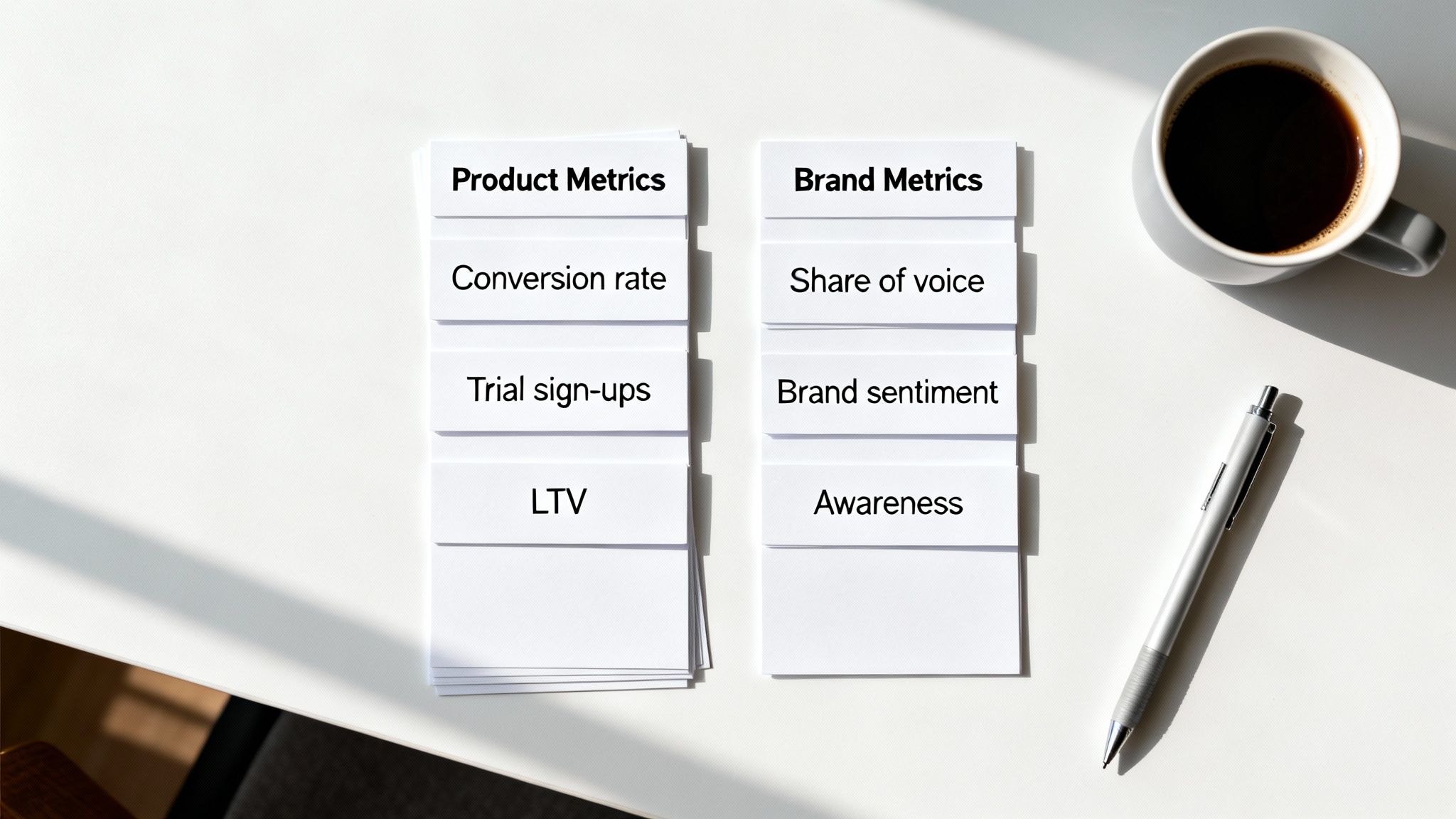
If goals are the destination, then your metrics and day-to-day activities are the map and the fuel. This is where the philosophical differences between product marketing and brand marketing become incredibly practical. Each discipline relies on its own toolkit and has a completely different scorecard for success.
Simply put, product marketing is a game of direct impact and measurable action. Brand marketing, on the other hand, is all about shaping perception and building influence over time. Getting this distinction right is key to creating a truly balanced growth engine.
Measuring Product Success: The KPIs That Drive Revenue
Product marketers are obsessed with data that connects directly to sales, adoption, and revenue. Their world revolves around funnels, conversion points, and user behavior. Success isn't a vague concept; it shows up on the balance sheet and in user engagement dashboards.
These are the numbers that keep a product marketer focused:
- Conversion Rates: This is the big one. It's the percentage of people who take a desired action—like a visitor signing up for a trial or a trial user upgrading to a paid plan. It's the ultimate proof that your go-to-market strategy is working.
- Customer Lifetime Value (LTV): A healthy LTV proves you're not just acquiring any customers, but the right ones who stick around. It confirms your product's long-term value.
- Feature Adoption Rate: It’s one thing to launch a cool new feature, but it's another to get people to actually use it. This KPI tells you how well your team is communicating value and driving deeper engagement within the product.
- Win/Loss Rate: In lockstep with the sales team, product marketers dissect why deals are won or lost. A strong win rate, particularly against top competitors, is a clear signal that the product's positioning and messaging are hitting the mark.
These metrics offer a real-time feedback loop. They tell you what’s working and what’s not, so you can quickly tweak messaging, adjust pricing, or update sales enablement materials. It's an iterative process geared toward optimizing every step of the customer journey.
Gauging Brand Impact: Metrics for Long-Term Growth
Brand marketing plays a different game entirely. Its metrics are often leading indicators of future success rather than direct drivers of this quarter's sales. These KPIs are all about measuring how your company is seen in the market and the strength of the connection you have with your audience.
Brand marketing success is measured in mindshare before market share. It’s about becoming the first name people think of in your category, which makes every downstream marketing activity more effective and less expensive.
To track this, brand marketers look at a different set of signals:
- Share of Voice (SOV): This metric sizes up your brand's visibility against your competitors. Is your voice getting louder in the industry conversation? A growing SOV says yes.
- Brand Sentiment: Are people talking about you in a positive, negative, or neutral light? Using social listening tools, brand marketers track sentiment to understand and help shape public perception.
- Direct and Organic Traffic: When someone types your URL directly into their browser or Googles your company name, that's brand recall in action. It’s a powerful sign that you’re memorable.
- Brand Awareness: This is the foundational metric, often measured through surveys and by tracking the search volume for your brand name.
These metrics don’t spike overnight; they build slowly and deliberately, creating a competitive moat around your business. A strong brand ultimately lowers customer acquisition costs, helps you attract top talent, and even earns you a bit of grace from customers when you make a mistake. It’s the long-term investment that pays compounding dividends.
How Team Structures and Workflows Compare
The difference between product and brand marketing isn't just theoretical—it's baked right into the org chart. The way these teams are built, who they report to, and how they work with other departments directly shapes what they produce. Getting the execution right starts with having the right people in the right places.
In most SaaS companies, you'll find these two functions live in different parts of the business, each with its own rhythm and key collaborators. Product marketing tends to be embedded deep in the company's operational core, while brand marketing usually operates from a more centralized, strategic hub.
The Embedded Nature of Product Marketing Teams
Product marketing can't succeed on an island. To be effective, the team has to be woven into the fabric of the groups that build, sell, and support the product. This closeness is non-negotiable; product marketers are the translators, bridging the gap between what the market needs and what the product actually does.
You’ll typically see product marketing teams set up in one of two ways:
- Reporting into the Product Organization: In this setup, product marketing and product management are joined at the hip. Their workflows are locked in sync with development sprints, beta programs, and release cycles. This structure guarantees that market feedback and competitive intel are part of the product roadmap from the very beginning.
- Reporting into the Marketing Organization: Here, product marketing serves as the go-to-market specialists for the broader marketing team. They work hand-in-hand with demand gen, content, and sales to give them the messaging, positioning, and tools they need to bring in leads and win deals.
No matter who they report to, their workflow is a fast-paced cycle tied directly to the product's lifecycle. A product marketer might spend their week jumping from user interviews and sales training to pricing analysis and planning a new feature launch, constantly collaborating with their counterparts in product and sales.
Brand Marketing as a Centralized Strategic Function
While product marketing is down in the trenches, brand marketing often operates from a higher vantage point. This team is usually a central function, reporting straight to a C-level executive like the CMO or sometimes even the CEO. Their mission is much broader and isn't tied to the cadence of specific product releases.
A brand marketing team’s closest allies are often executive leadership, HR, and public relations. Their job is to make sure the company's story is told consistently and powerfully everywhere—from an investor deck to a job posting.
This structure helps the brand team protect and project a consistent vision for the entire company. Their work isn’t driven by two-week sprints but by long-term campaigns and strategic projects designed to build the company’s reputation over years, not just quarters.
A typical workflow for a brand marketer is less about product launches and more about big-picture initiatives:
- Building and maintaining company-wide messaging frameworks.
- Running public relations and corporate communications.
- Managing large-scale brand advertising and sponsorships.
- Working with HR to shape the employer brand and internal culture.
The pace is strategic and deliberate. While a product marketer is thinking about the next launch, the brand marketer is thinking about how the world will see the company three to five years down the road. This fundamental difference in structure and workflow is a direct result of their very different goals.
A Decision Framework for SaaS Leaders
Trying to figure out where to focus—product marketing or brand marketing—isn't just a thought exercise. It's a fundamental strategic choice that dictates how you spend your money and where you find your growth. The right mix always comes down to your company's stage, where you stand in the market, and what you need to achieve right now. For anyone leading a SaaS company, knowing when to lean into one over the other is the key to building a business that lasts.
This isn't a decision you make once and forget about. It's constantly shifting as your needs change. Are you just trying to get your first users, or are you trying to defend your turf as a market leader? The answer tells you exactly where your next dollar and your next hire should go.
Early-Stage Startups: It's All About the Product
If you're an early-stage SaaS startup, you have one job: achieve product-market fit. You can’t build an iconic brand until you’ve proven your product solves a real, painful problem for a specific group of people. This is squarely in the product marketing wheelhouse, and it’s where almost all of your attention should be.
At this point, you're laser-focused on:
- Customer and Market Research: Getting into the weeds to understand your ideal customer profile (ICP) and what keeps them up at night.
- Positioning and Messaging: Crafting a value proposition so sharp and clear that your solution becomes the obvious choice.
- Go-to-Market Strategy: Finding and activating the right channels to get your product into the hands of those crucial early adopters.
- User Feedback Loops: Creating a system to constantly pull insights from your first users to make the product better.
Brand marketing isn’t totally off the table, but it shows up through the product itself. A great product that actually delivers on its promise is the strongest brand asset you have in the beginning.
Scaling Companies: Striking the Right Balance
Once you've nailed product-market fit and you're stepping on the gas, the equation changes. Now, the name of the game is scaling customer acquisition without breaking the bank, all while building a competitive moat. This demands a smart blend of both product and brand marketing.
A strong brand is a force multiplier for every single product marketing effort. When people already know who you are and trust you, every feature launch hits harder and your customer acquisition costs start to drop.
This flowchart gives a good look at how these two teams often get structured as a company grows.
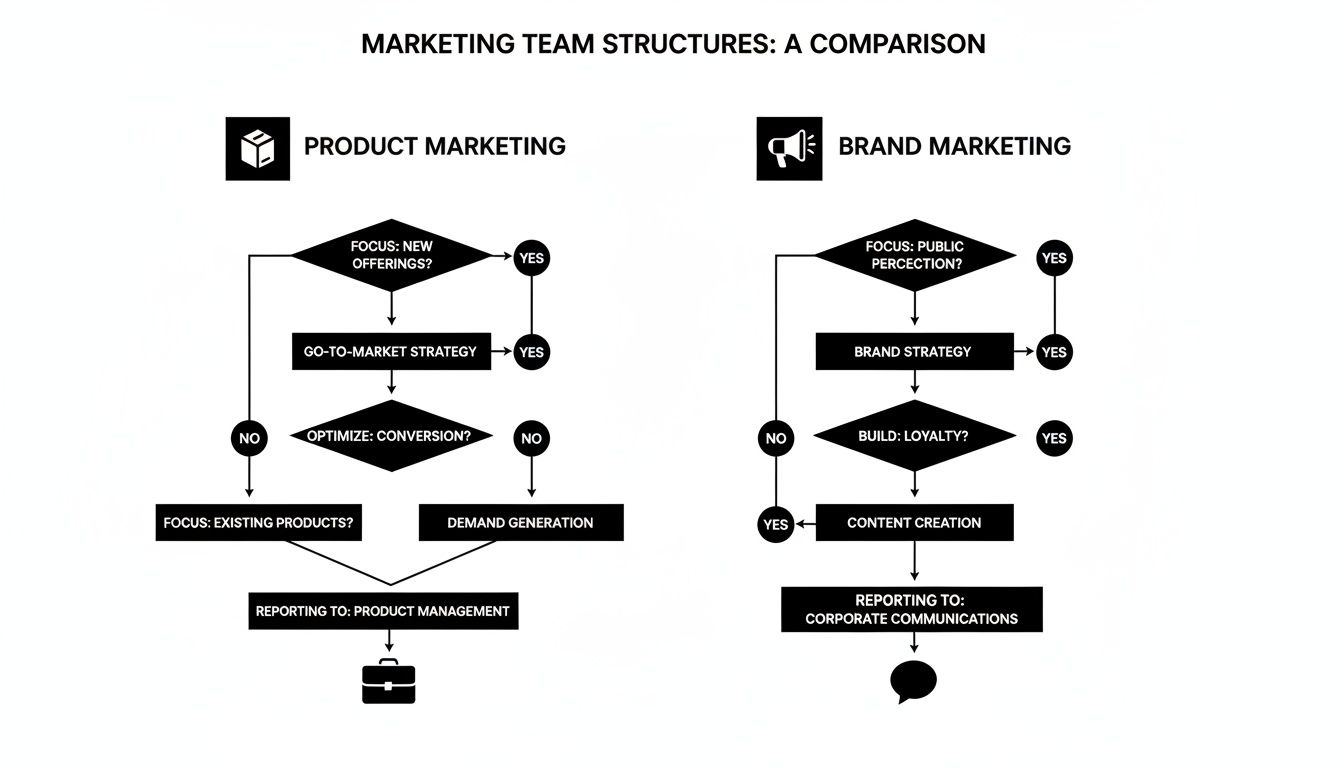
You can see how product marketing naturally sits closer to the product and sales teams, while brand marketing tends to be a more central, overarching function.
Even in B2B, people buy from brands they trust. According to a 2023 Edelman report, 71% of consumers say they need to trust a brand to buy from it, a sentiment that's increasingly influencing B2B SaaS decisions. Buyers are checking out a vendor's reputation just as much as its feature list. You can read more about this shift and how it’s changing purchasing habits.
Contextual Scenarios: Which Discipline Takes the Lead?
Beyond your company’s growth stage, specific situations will force your hand, making you prioritize one discipline over the other.
-
Entering a New Market: Product marketing leads the charge. You have to prove your solution works for a totally new audience. That means deep research, localizing your messaging, and running tightly focused launch campaigns.
-
Responding to a Competitor: You need a balanced attack. Product marketing has to sharpen its competitive positioning and highlight feature advantages, while brand marketing reinforces why your company is the better long-term partner.
-
Launching a New Product Category: Start with product marketing, then amplify with brand. At first, it's all about educating the market on what this new thing is and why it matters. Once you have some traction, brand campaigns can elevate the entire category and cement your company's place as the leader.
Integrating Both Strategies for Maximum Growth

The smartest SaaS companies have moved past the product marketing vs brand marketing debate. They know it’s not an either/or choice. The real magic happens when you build a symbiotic growth engine where each discipline amplifies the other.
Think of it this way: a fantastic product is the ultimate proof of your brand's promise. And a powerful brand gives every product launch an unfair advantage right out of the gate. This isn't just a nice idea—it's a strategic imperative for sustainable growth. When these two functions are in lockstep, they create a powerful flywheel where the momentum from one directly fuels the other.
Creating a Unified Messaging Framework
The first move is to establish a single source of truth for your company's messaging. This goes way beyond consistent logos and color palettes. It's about making sure the story your brand tells is lived out in the experience your product delivers.
A unified framework connects the high-level brand narrative directly to the concrete value propositions of your product. This means your product marketers are armed with a compelling story, and your brand marketers have hard evidence to back up their claims.
For this to actually work, both teams have to be in the same room:
- Brand marketers are the keepers of the flame. They define the company's core mission, values, and the overarching story that creates an emotional connection.
- Product marketers bring the receipts. They supply the "reasons to believe" with specific features, customer outcomes, and tangible benefits that make the brand story real.
Getting this right prevents that all-too-common disconnect where a company’s ads promise a revolution, but the product experience feels like more of the same.
Establishing Shared Goals and KPIs
While each team will always have its own core metrics, true alignment comes from sharing a handful of key performance indicators (KPIs) tied directly to business growth. This forces collaboration and gets everyone pulling the rope in the same direction.
A strong brand lowers customer acquisition cost over time, a metric that directly benefits product marketing efforts. Conversely, a product with high customer lifetime value provides the revenue and happy customers needed to fund ambitious brand-building campaigns.
A few shared KPIs to consider:
- Customer Lifetime Value (LTV): A high LTV is the ultimate proof that your brand promise attracted the right people and your product delivered enough value to make them stay.
- Customer Acquisition Cost (CAC): As your brand gains strength and recognition, your reliance on expensive paid acquisition should drop, lowering the overall CAC.
- Brand-Driven Product Sign-ups: Tracking how many new users find you through direct or organic search is a clear sign that your brand-building efforts are driving real product adoption.
This blended view of success helps everyone see the bigger picture. You can dive deeper into building a cohesive plan by exploring our complete guide to developing a marketing strategy.
Case Study: The Symbiotic Growth of Slack
Slack is a masterclass in weaving product and brand marketing together. From day one, their product marketing was laser-focused on a crystal-clear value proposition: a "less busy" workday and an end to the chaos of email. The message was sharp, specific, and all about the product.
At the same time, their brand marketing was telling a much bigger story—one about collaboration, better teamwork, and creating a more human and productive work life. This wasn't just about features; it was about championing a better way of working.
This integrated approach is critical for profitability and market advantage. Slack's product experience consistently delivered on its brand promise. Every single feature, from channels to integrations, was designed to make work simpler and more organized. This created an incredible feedback loop where happy users became passionate brand advocates, spreading the story for them. The product’s runaway success validated the brand's ambitious vision, and the brand's compelling story made the product feel like more than just a tool—it felt like a movement.
Frequently Asked Questions
When you're in the trenches of building a SaaS company, figuring out where to put your marketing dollars—product or brand—can feel like a high-stakes decision. Let's tackle some of the questions we hear most often from founders and marketing leaders in a friendly, helpful way.
Can a Small SaaS Startup Afford Both?
For a brand-new startup, the answer is almost always a hard no. Your first, most critical mission is product marketing. You have to nail product-market fit and start bringing in revenue just to keep the lights on. If the product doesn't work and solve a real-world problem, you don’t have a business, let alone a brand to build.
But that doesn’t mean you ignore your brand entirely. Brand building at the start isn’t about big-budget ads; it's about doing the small things right. It’s about having a clear mission, keeping your messaging consistent everywhere, and delivering customer service that people rave about. These things cost more in effort than in cash, but they lay the groundwork for a reputation that will pay dividends for years.
Which Team Should Own Customer Marketing?
Ah, the classic turf war. Customer marketing naturally lives at the intersection of product marketing, brand marketing, and customer success. Frankly, who "owns" it is less important than how well these teams work together.
Here’s a practical way to think about the division of labor:
- Product Marketing usually takes the lead on things that drive deeper product usage. Think feature announcements, onboarding campaigns, and collecting feedback that shapes the roadmap.
- Brand Marketing steps in to turn satisfied customers into your biggest fans. They're the ones creating compelling case studies, gathering testimonials, and building a thriving user community.
So, while one team might be the designated coordinator, successful customer marketing is always a joint effort. It has to be a seamless experience for the customer, and that requires genuine, cross-functional teamwork.
How Do You Measure the ROI of Brand Marketing?
This is the million-dollar question. Measuring the ROI of brand marketing isn't as straightforward as tracking demo requests from a product campaign, but it's far from impossible. You just have to know what to look for and be patient.
The trick is to connect a set of leading and lagging indicators. In the short term, you'll track leading indicators like an increase in your share of voice, a jump in positive brand sentiment online, or more people typing your URL directly into their browser (direct website traffic).
These early signals are great, but the real payoff comes later. Over the long haul, a strong brand directly impacts the bottom line by lowering your customer acquisition costs (CAC) and increasing customer lifetime value (LTV). A powerful brand simply makes every other marketing activity you do work better.
At Mick-Mar Inc., we help SaaS companies build integrated strategies where product and brand marketing work in concert to create real, sustainable growth. Book a discovery call with our SaaS marketing experts and let's build a roadmap that gets you where you want to go.