In the fast-paced world of SaaS, your marketing budget isn’t just a line item – it’s the fuel for your growth engine. But simply having a budget isn’t enough. The real challenge, and the greatest opportunity, lies in how you allocate it. Missteps can lead to wasted spend and stalled growth, while a strategic approach can unlock exponential ROI and secure market leadership.
The days of setting and forgetting an annual budget are over. Today’s landscape demands a more dynamic, data-informed strategy. A 2023 Gartner survey found that while marketing budgets were holding steady, CMOs are under immense pressure to demonstrate efficiency and drive profitable growth. This makes intelligent marketing budget allocation best practices more critical than ever. In an environment where every dollar is scrutinized, justifying investments with clear performance data is non-negotiable.
This guide moves beyond generic advice to provide a friendly roundup of seven powerful allocation models and frameworks, specifically tailored for the unique challenges and opportunities within the SaaS industry. We’ll explore practical, actionable methods that help you:
- Balance proven channels with experimental initiatives.
- Tie spending directly to long-term customer value.
- Adapt your budget in real-time based on performance data.
From leveraging advanced attribution to implementing agile management techniques, you’ll learn how to build a resilient and effective budget. Get ready to transform your spreadsheet from a static expense sheet into a dynamic, strategic tool for scalable and sustainable growth. We’ll give you the blueprints to ensure every marketing dollar works harder and smarter for your business.
1. 80/20 Rule for Media Mix
Navigating the complexities of marketing budget allocation can feel like a high-stakes balancing act. One of the most effective and enduring marketing budget allocation best practices is the 80/20 rule, also known as the Pareto Principle, applied to your media mix. This principle advocates for a structured yet flexible approach to spending.
The core idea is simple: allocate 80% of your budget to proven, reliable channels that consistently deliver a high return on investment (ROI). Think of these as your workhorses—the channels you can count on for predictable lead generation, customer acquisition, and revenue. The remaining 20% is dedicated to experimental campaigns and emerging channels, serving as your innovation lab to discover future growth opportunities.
Balancing Stability with Innovation
This balanced strategy ensures that your core business objectives are met with predictable outcomes from established channels, providing stability. Simultaneously, the experimental 20% allows you to test new platforms, messaging, and technologies without jeopardizing your entire budget. This prevents your marketing from becoming stagnant and ensures you stay ahead of market trends.
For example, a mature SaaS company might allocate 80% of its budget to Google Ads, LinkedIn marketing, and content marketing, which have historically driven high-quality leads. The other 20% could be used to experiment with TikTok influencer campaigns, programmatic audio ads in industry podcasts, or partnerships with new AI-driven marketing platforms.
This visual summary breaks down the core components of the 80/20 media mix rule.
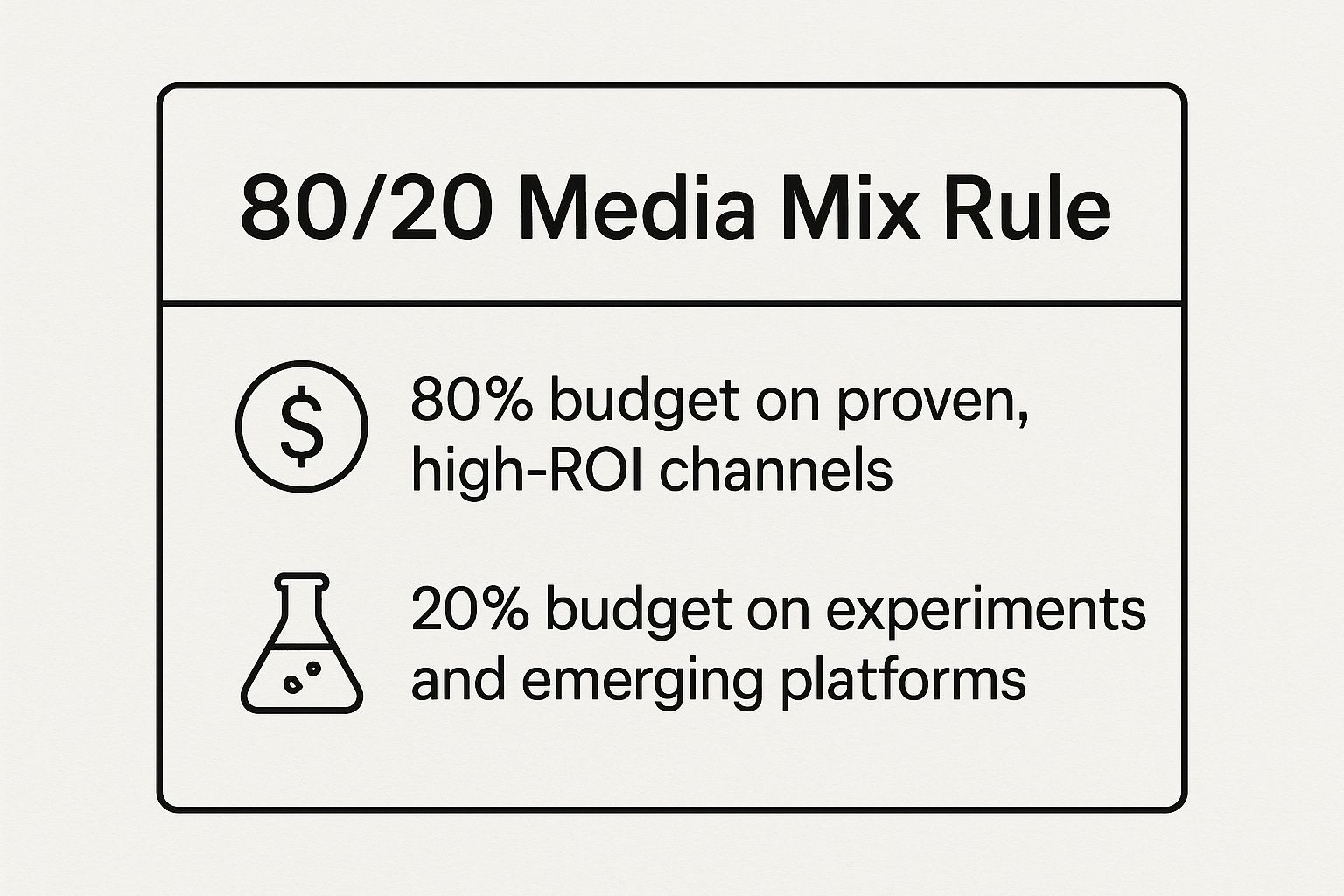
As the infographic highlights, the strategy’s power lies in its clear division between securing current revenue streams and exploring future ones.
How to Implement the 80/20 Rule
Effectively applying this rule requires discipline and a data-driven mindset.
- Define Your “80%”: Regularly audit your channels to confirm which ones are truly your top performers. Don’t rely on old assumptions. A channel that was a star last year might be underperforming now.
- Set Clear Metrics for the “20%”: Treat your experiments like a scientist. Define what success looks like before you launch. This could be lead volume, cost per acquisition (CPA), engagement rate, or brand lift.
- Create a Migration Path: When an experiment proves successful, have a clear process for graduating it into the core 80% budget. This ensures your high-ROI segment evolves and strengthens over time.
- Adjust Ratios as Needed: A startup in a high-growth phase might shift to a 70/30 or even 60/40 split to discover its most effective channels faster. A more established company in a stable market may stick closer to the 80/20 model.
This structured approach is a foundational element of a robust marketing plan. Learn more about how this principle fits into a broader marketing strategy on mick-mar.com to build a comprehensive framework for growth.
2. Customer Lifetime Value (CLV) Based Allocation
Moving beyond short-term acquisition metrics, one of the most sophisticated marketing budget allocation best practices involves focusing on Customer Lifetime Value (CLV). This approach shifts the goal from simply acquiring customers at a low cost to acquiring the right customers who will deliver the most value over their entire relationship with your business.
This strategy allocates marketing spend based on the long-term profitability of customers acquired from different channels. Instead of treating all acquired customers equally, it prioritizes channels that consistently attract high-CLV segments. The core principle is to invest more heavily where the long-term return is greatest, not just where the initial acquisition cost is lowest.
Maximizing Long-Term Profitability
A CLV-based model ensures that marketing investments are directly tied to sustainable business growth. It prevents over-investing in channels that bring in a high volume of low-value, high-churn customers and instead funnels resources toward acquiring loyal, profitable relationships. To truly understand the long-term value generated from your marketing efforts and effectively implement CLV-based allocation, a clear grasp of what Return on Investment (ROI) is and how to utilize it is paramount. While any manager or marketing leader can help review and dig into the details, normally leadership roles are ultimately responsible for ensuring ROI. This include Marketing VPs, SVPs, Directors, CMO’s and also Fractional CMO’s.
For instance, a SaaS company like Salesforce would prioritize enterprise-focused channels, such as targeted account-based marketing (ABM) on LinkedIn or high-value industry event sponsorships. While the initial Customer Acquisition Cost (CAC) for these channels may be high, the resulting enterprise clients have a significantly higher CLV, making the upfront investment far more profitable in the long run. Similarly, a subscription box service would analyze which channels, like specific influencer partnerships or organic search terms, deliver subscribers with the lowest churn rates and allocate their budget accordingly.
How to Implement CLV-Based Allocation
Shifting to a CLV-focused model requires robust data analysis and a commitment to long-term thinking.
- Implement Robust Attribution: Use multi-touch attribution models to accurately track the entire customer journey, from the first touchpoint to conversion and beyond. This is crucial for assigning CLV to the correct acquisition channels.
- Calculate CLV by Channel: Don’t rely on a single, blended CLV for your entire customer base. Segment your data to calculate the average CLV for customers acquired from each specific marketing channel (e.g., Google Ads, organic search, social media).
- Balance CLV with CAC: The ideal channel has both a high CLV and a low CAC. Analyze the CLV:CAC ratio for each channel to identify your most efficient and profitable avenues for growth. A ratio of 3:1 or higher is often considered a healthy benchmark.
- Use Cohort Analysis: Group customers into cohorts based on their acquisition date or channel. Tracking the behavior and value of these cohorts over time provides more accurate and predictive CLV calculations than static, one-time snapshots.
3. Full-Funnel Attribution Modeling
Moving beyond simplistic, last-touch metrics is a critical step in mastering marketing budget allocation best practices. Full-funnel attribution modeling provides a comprehensive view by tracking and assigning value to all marketing touchpoints throughout the customer journey. This approach acknowledges that a conversion is rarely the result of a single interaction, recognizing the vital role of awareness and consideration-stage activities.
The core principle is to allocate budget based on a channel’s true contribution to the entire sales cycle, not just the final click. This prevents overvaluing bottom-funnel channels like branded search while undervaluing crucial top-funnel activities like content marketing, social media engagement, or initial display ads that introduce a prospect to your brand.
Seeing the Complete Customer Journey
This holistic methodology ensures your budget decisions are based on a complete narrative of the customer journey, from first impression to final purchase. It provides the data-backed justification needed to invest in longer-term brand-building and educational content that nurtures leads over time. To effectively allocate your budget, it’s essential to have a clear grasp of how different channels contribute to conversions, which can be achieved through understanding marketing attribution.
For example, HubSpot uses full-funnel modeling to see how their blog content and educational webinars influence the length and success of sales cycles. This insight allows them to confidently allocate significant budget to content creation, knowing it directly impacts revenue down the line, even if it’s not the last touchpoint before a demo request.
This video provides a deeper dive into the mechanics and importance of multi-touch attribution.
As the video explains, a nuanced attribution model is key to unlocking more intelligent and effective marketing spend.
How to Implement Full-Funnel Attribution
Adopting this model requires a strategic and phased approach to ensure accuracy and buy-in.
- Start with Simpler Models: Before jumping to complex algorithmic models, begin with a linear or time-decay model. This helps your team get comfortable with multi-touch concepts and ensures your foundational data is clean.
- Ensure Data Quality: Your model is only as good as the data it’s built on. Prioritize data hygiene and ensure tracking is consistent across all platforms, from your CRM to your ad networks and analytics tools.
- Validate Models Against Outcomes: Regularly test your attribution model’s outputs against actual business results. Does shifting budget based on the model’s recommendations lead to a corresponding increase in qualified leads or revenue?
- Train Your Team: An attribution model is useless if the team doesn’t understand how to interpret its insights. Conduct training sessions on how to read the data and, more importantly, how to take action based on it.
4. Zero-Based Budgeting (ZBB) for Marketing
Traditional budgeting often involves making incremental adjustments to the previous year’s spend, a practice that can perpetuate inefficient habits. A more rigorous and strategic approach is Zero-Based Budgeting (ZBB), a method that forces marketers to justify every dollar of their budget from scratch for each new budget cycle.
The core idea is to build your budget from a “zero base,” rather than inheriting previous allocations. Every line item, from a major ad campaign to a software subscription, must be re-evaluated and defended based on its expected contribution to current business objectives. This ensures that every dollar is intentionally allocated to the highest-impact activities, making it one of the most effective marketing budget allocation best practices for driving efficiency and accountability.
Forcing Critical Evaluation and Alignment
ZBB’s primary strength is its ability to eliminate legacy spending and realign marketing investments with the company’s most pressing goals. It forces a critical look at all activities, preventing the “we’ve always done it this way” mindset. By starting from zero, you ensure your budget is a direct reflection of your current strategy, not an echo of past priorities.
For instance, companies like Kraft Heinz and Unilever have famously used ZBB to pivot their marketing spend. They shifted significant funds from traditional, less measurable advertising into high-performing digital, e-commerce, and data-driven channels. This allowed them to adapt to changing consumer behavior and optimize ROI by reallocating capital to where it would generate the most value today.
How to Implement Zero-Based Budgeting
Adopting ZBB requires a structured and disciplined process, but the payoff in efficiency is substantial.
- Establish Clear Success Metrics: Before planning begins, define the KPIs that matter most for the upcoming period, whether it’s Customer Acquisition Cost (CAC), Lifetime Value (LTV), or market share growth. Every budget request must tie directly back to these metrics.
- Standardize Justification Templates: Create a consistent template for all teams to use when submitting budget requests. This form should require them to detail the objective, expected outcomes, key metrics, and the rationale for the requested funds.
- Involve Cross-Functional Teams: The evaluation process should not happen in a silo. Involve finance, sales, and product teams to challenge assumptions and ensure marketing spend aligns with broader company objectives and realities.
- Document Every Decision: Maintain a clear record of why certain initiatives were funded and others were not. This documentation provides transparency and serves as a valuable reference for future budget cycles and performance reviews.
This methodical approach to marketing budget allocation transforms spending from a routine exercise into a strategic one, ensuring every dollar is put to its best possible use.
5. Agile Marketing Budget Management
In today’s fast-paced digital landscape, annual marketing plans can become obsolete in months, if not weeks. Adopting an Agile Marketing Budget Management approach is a powerful best practice that moves away from rigid, long-term allocations. Instead, it applies agile methodologies to your finances, enabling rapid adaptation and optimization based on real-time data.
The core principle is to manage marketing spend in shorter cycles, or “sprints,” typically lasting two to six weeks. This framework allows teams to test hypotheses, measure results, and reallocate funds to high-performing initiatives quickly. Rather than locking in a budget for a full year, you maintain the flexibility to pivot based on campaign performance, market shifts, or emerging opportunities.
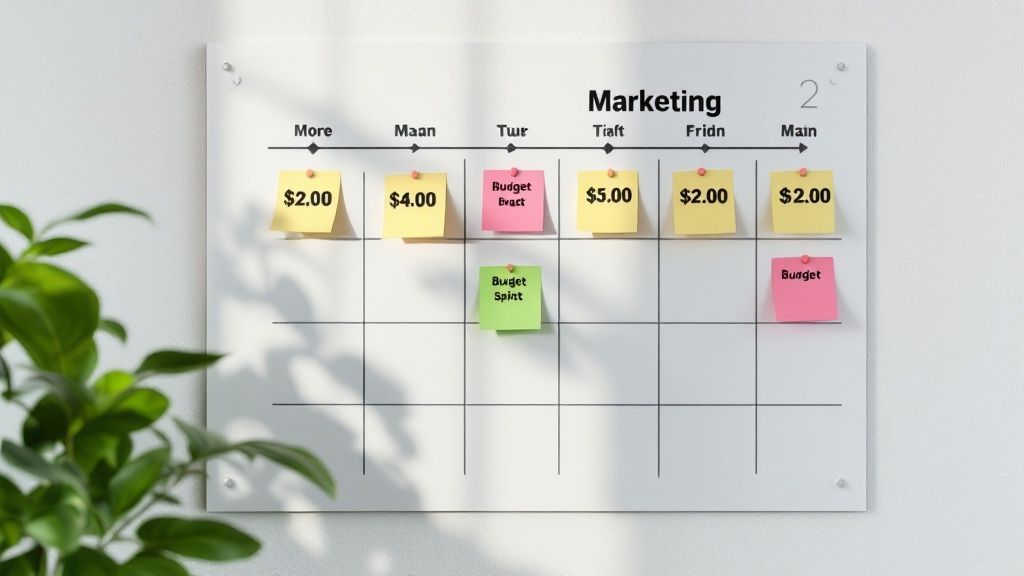
As the visual above illustrates, this iterative process of planning, executing, measuring, and adapting ensures your marketing dollars are always working as hard as possible.
Balancing Agility with Strategic Vision
This methodology thrives on a culture of continuous improvement, empowering teams to make data-backed decisions dynamically. It’s particularly effective for SaaS companies in high-growth phases or those operating in volatile markets where consumer behavior changes rapidly.
For example, digital-first brands like Warby Parker utilize sprint-based budget allocation to relentlessly test new ad creative, audience segments, and emerging social media channels. This allows them to quickly scale what works and cut what doesn’t, maximizing their return on ad spend (ROAS). Similarly, a startup like Airbnb in its early days used agile budgeting to optimize customer acquisition costs across various channels, fueling its rapid global expansion.
How to Implement Agile Budget Management
Shifting to an agile model requires a change in both process and mindset. Here are key steps to get started:
- Establish Clear Governance: Define who can make budget reallocation decisions and what the approval process looks like. This prevents chaos while enabling speed.
- Set Aside a Reserve Fund: Earmark a portion of the total budget as a flexible reserve. This fund can be deployed quickly to capitalize on unexpected opportunities, like a viral trend or a competitor’s misstep.
- Implement Robust Tracking Systems: You need real-time, reliable data to make informed decisions. Invest in analytics and reporting tools that provide a clear view of performance metrics across all channels.
- Train Your Team: Ensure your marketing team understands agile principles like sprints, stand-ups, and retrospectives. This shared language and methodology are crucial for successful execution.
- Balance Short-Term and Long-Term Goals: While agility focuses on short-term optimization, don’t lose sight of long-term strategic goals like brand building. Ensure your sprints align with the broader marketing objectives.
This flexible approach to marketing budget allocation best practices is a cornerstone of modern marketing operations. For a deeper dive into streamlining your processes, explore these resources on marketing operations from mick-mar.com.
6. Marketing Mix Modeling (MMM) Optimization
For businesses seeking a highly sophisticated, data-driven method for budget allocation, Marketing Mix Modeling (MMM) offers a powerful solution. This statistical analysis technique moves beyond channel-level attribution to provide a holistic view of how all marketing inputs, alongside external factors, collectively influence key business outcomes like sales and revenue.
The core idea is to use historical data to build a model that quantifies the incremental impact of each marketing activity. This allows you to understand not just if a channel works, but how much it contributes and when it reaches a point of diminishing returns. It answers critical questions like, “What is the ROI of our TV ads, and how would sales change if we shifted 15% of that budget to paid social?”
A Macro-Level View for Strategic Decisions
MMM provides a top-down perspective that is ideal for strategic, long-term planning. It helps organizations understand the interplay between different channels and external variables like seasonality, economic trends, or competitor actions. This comprehensive view is one of the most effective marketing budget allocation best practices for large-scale operations.
For example, a global CPG giant like P&G uses MMM to optimize its massive advertising spend across dozens of brands and countries. The models help them determine the most effective split between national brand-building campaigns and targeted digital promotions, ensuring every dollar is allocated for maximum impact on sales volume.
How to Implement Marketing Mix Modeling
Applying MMM requires a significant investment in data and analytical capabilities, but the payoff in efficiency can be enormous.
- Gather Comprehensive Data: The accuracy of your model depends entirely on the quality and breadth of your data. You typically need at least 2-3 years of clean, granular historical data covering all marketing spend, sales figures, and relevant external factors (e.g., holidays, economic indicators).
- Include All Influential Factors: A robust model must account for more than just marketing spend. Include variables like pricing changes, promotional activities, distribution levels, and competitor spending to isolate the true impact of your marketing efforts.
- Update Models Regularly: Markets are not static. Consumer behavior, channel effectiveness, and competitive landscapes change. Your MMM should be updated periodically (e.g., quarterly or annually) to reflect the current reality and maintain its predictive power.
- Combine with Other Methods: MMM is excellent for strategic allocation but can be less effective for real-time, tactical optimizations. Complement its macro-level insights with more granular attribution models (like multi-touch attribution) for a complete picture.
This advanced approach transforms budget allocation from a process of educated guessing into a data-backed science, enabling businesses to confidently invest in the channels that drive the most substantial growth.
7. Performance-Based Dynamic Allocation
In today’s fast-paced digital landscape, static, set-it-and-forget-it budgets are a recipe for inefficiency. One of the most agile marketing budget allocation best practices is a performance-based dynamic model. This approach involves continuously monitoring channel performance and reallocating funds in near real-time to capitalize on what’s working best at any given moment.
The core principle is to let data drive spending decisions dynamically. Instead of waiting for a quarterly review, budget flows from underperforming channels to high-performing ones based on predetermined performance thresholds. This ensures marketing dollars are always working as hard as possible to achieve key objectives like lead generation, customer acquisition, or revenue growth.
Capitalizing on Real-Time Opportunities
This fluid allocation strategy allows marketing teams to be incredibly responsive to market changes, campaign performance, and consumer behavior. It minimizes wasted ad spend on campaigns that aren’t delivering and doubles down on those that are exceeding expectations, maximizing overall return on investment (ROI).
For instance, a SaaS company might use automated tools to monitor cost per acquisition (CPA) across multiple platforms. If LinkedIn Ads are suddenly generating high-quality leads at half the CPA of Google Ads for a particular campaign, the system can automatically shift more budget toward LinkedIn to capture that efficiency. Platforms like Google Ads with Smart Bidding or Facebook’s Campaign Budget Optimization are built on this very principle, distributing spend across ad sets based on real-time performance data.
How to Implement Dynamic Allocation
Adopting this model requires a combination of technology, clear goals, and strategic oversight.
- Set Clear Performance Benchmarks: Define your key performance indicators (KPIs) and establish clear thresholds. For example, specify a maximum acceptable CPA or a minimum required return on ad spend (ROAS) for a channel to continue receiving its full budget.
- Balance Short-Term and Long-Term Goals: Be careful not to over-optimize for short-term conversions at the expense of long-term brand building. Maintain minimum budget levels for top-of-funnel awareness activities that may not have an immediate, direct ROI but are crucial for sustainable growth.
- Implement Safeguards and Oversight: While automation is powerful, it’s not infallible. Regular human oversight is critical to review automated decisions, prevent over-optimization on flawed data, and make strategic adjustments that algorithms might miss.
- Use the Right Tools: Leverage programmatic advertising platforms and the built-in optimization features of major ad networks. These tools are designed to make real-time, data-driven allocation decisions efficiently.
This dynamic approach transforms budget allocation from a periodic planning exercise into an ongoing, strategic optimization process. You can explore how this fits into a broader strategy by learning more about the tools and tactics used in digital marketing and advertising on mick-mar.com.
Marketing Budget Allocation Methods Comparison
| Approach | Implementation Complexity 🔄 | Resource Requirements 🔄 | Expected Outcomes 📊 | Ideal Use Cases 💡 | Key Advantages ⭐ |
|---|---|---|---|---|---|
| 80/20 Rule for Media Mix | Moderate – balanced complexity | Moderate – needs data and discipline | Stable growth with innovation opportunities | Established businesses balancing risk & growth | Risk-balanced portfolio, systematic testing |
| Customer Lifetime Value (CLV) Based Allocation | High – requires sophisticated analytics | High – advanced tracking & data science | Maximized long-term profitability | Subscription/SaaS & businesses with historical data | Focus on high-value customers, improved portfolio quality |
| Full-Funnel Attribution Modeling | Very High – advanced analytics & tools | Very High – analytics platforms & integration | Comprehensive marketing effectiveness view | Enterprises with complex customer journeys | Accurate ROI, supports integrated strategies |
| Zero-Based Budgeting (ZBB) | High – intensive budget justification | High – time and cross-functional involvement | Optimized spend aligned to current priorities | Firms needing cost optimization & strategic alignment | Eliminates legacy waste, detailed cost-benefit analysis |
| Agile Marketing Budget Management | Moderate to High – requires flexible processes | Moderate – frequent reviews & collaboration | Rapid response and continuous optimization | Fast-moving markets, startups, innovation-focused teams | Quick adaptation, promotes experimentation |
| Marketing Mix Modeling (MMM) Optimization | Very High – statistical expertise needed | Very High – historical data & expert analysis | Data-driven optimized budget & ROI forecasting | Large brands with long data history | Scientific optimization, accounts for external factors |
| Performance-Based Dynamic Allocation | High – real-time monitoring & automation | High – tech infrastructure & oversight | Maximized short-term efficiency | Digital marketing, programmatic advertising | Real-time optimization, reduces waste |
Building Your Custom Allocation Blueprint
Navigating the complexities of marketing budget allocation can feel like charting a course through an ever-changing sea. We’ve explored a fleet of powerful strategies, from the steadfast 80/20 rule for media mix to the nimble adjustments of agile marketing and the predictive power of Marketing Mix Modeling (MMM). Each best practice offers a unique lens through which to view and optimize your spend, transforming your budget from a simple line item into a strategic engine for growth.
The central theme connecting these approaches is a fundamental shift away from static, “set it and forget it” budgeting. Instead, the modern marketer must embrace a dynamic, data-centric mindset. The most effective strategies are not about finding a single, perfect formula but about building a custom, responsive framework that aligns with your specific business goals and market realities.
Synthesizing the Best Practices for Maximum Impact
Your journey toward mastering marketing budget allocation best practices begins with an honest assessment of your current state. Are you a startup in hyper-growth mode, prioritizing brand awareness and top-of-funnel acquisition at all costs? Or are you an established player in the SaaS space, focused on maximizing profitability and increasing Customer Lifetime Value (CLV)?
- For Growth-Focused Teams: Combining Zero-Based Budgeting (ZBB) with an Agile Marketing framework can be a game-changer. ZBB forces you to justify every dollar, ensuring your capital is directed toward the highest-potential growth initiatives, while an agile approach allows you to quickly pivot based on campaign performance and market feedback.
- For Profitability-Focused Teams: A blend of CLV-Based Allocation and Full-Funnel Attribution Modeling provides a powerful combination. By focusing your budget on acquiring and retaining high-value customer segments, you directly tie marketing spend to long-term revenue and profitability, moving beyond simple lead generation metrics.
- For Established Market Leaders: Integrating the 80/20 Rule with sophisticated Marketing Mix Modeling (MMM) offers both stability and strategic foresight. You can allocate the majority of your budget to proven, high-performing channels while using MMM to optimize the overall mix and explore new opportunities with the remaining 20%.
Your Actionable Next Steps
Mastering your budget isn’t a one-time project; it’s an ongoing discipline. To translate the insights from this article into tangible results, consider these immediate steps:
- Conduct a Technology and Data Audit: Do you have the necessary tools for accurate full-funnel attribution? Is your data clean and accessible enough to support CLV calculations or MMM? Identify your gaps and prioritize solutions.
- Pilot a New Framework: You don’t need to overhaul your entire budgeting process overnight. Choose one new approach, like implementing a ZBB process for a single upcoming campaign or running an agile “sprint” for a specific channel. Use this pilot to learn, adapt, and build buy-in.
- Establish a Rhythm of Review: Implement a regular cadence for budget review and reallocation. This could be monthly or quarterly, but it must be consistent. This transforms your budget from a static document into a living, breathing strategic tool that adapts to performance data.
Ultimately, the goal of adopting these marketing budget allocation best practices is to build a resilient, high-performance marketing function. It’s about creating a direct, undeniable link between investment and outcome, proving marketing’s value, and securing the resources needed to drive sustainable, predictable growth for your SaaS business. By moving from assumption-based spending to data-driven investment, you turn your marketing budget into your most powerful competitive advantage.
Tired of guessing where your marketing dollars should go? The experts at Mick-Mar Inc. specialize in developing data-driven budget allocation strategies that align with your unique SaaS growth objectives. Let us help you build a custom roadmap to turn your marketing spend into a predictable revenue driver. Explore our strategic marketing services at Mick-Mar Inc.