
Building a powerful email list isn’t just about collecting contacts. It’s about creating a direct line to your ideal clients by consistently offering real value. When you solve their problems, you earn their attention, turning your list from a simple database into a strategic asset that drives real revenue.
Your Email List Is Your Most Valuable B2B Asset

In a world of ever-changing social media algorithms and the rising costs of paid ads, your email list is the one marketing channel you actually own. Think of it as a stable, direct connection to your audience that isn't at the mercy of a third-party platform's whims. For any B2B or SaaS company, this is the foundation of sustainable growth.
This is much bigger than just blasting out a monthly newsletter. It’s about building relationships, one email at a time. Each person who subscribes is a potential partner, a future customer, or a powerful brand advocate. When you get this right, you’re not just gathering data; you’re building a community around your expertise.
Why Email Still Dominates B2B Marketing
The numbers don't lie. Year after year, email proves its worth. According to 2023 data from the Data & Marketing Association, email marketing continues to deliver an almost unbelievable average ROI of £35.83 for every £1 spent. This performance consistently overshadows many other digital channels.
And it's not slowing down. The number of global email users continues to climb, with projections showing it will reach a massive 4.6 billion in 2025. It’s where business happens.
Let's get practical. This isn't just theory; it's a playbook. For B2B companies, a high-quality email list is the engine for generating qualified leads and keeping them engaged. For a deeper look, check out this excellent guide to building B2B email lists that drive real growth for more specialized tactics.
To get the most out of this guide, you need to make a mental shift.
See your list not as a static database, but as a dynamic conversation with your most important stakeholders. It’s your direct line to the decision-makers who need your solution.
This requires a deliberate, focused approach. Before we dive into the specific tactics, here's a high-level overview of the core strategies we'll be covering. Think of this as your roadmap.
Your Core Email List Building Roadmap
This table gives you a quick look at the essential strategies we'll cover, breaking down what they are and why they are so effective in the B2B space.
| Strategy | What It Is | Why It Works for B2B |
|---|---|---|
| Audience Segmentation | Dividing your list into smaller groups based on specific criteria like industry, job title, or behavior. | Allows for hyper-relevant messaging that speaks directly to a prospect's specific pain points. |
| Value Exchange | Offering a valuable resource (like a guide, webinar, or tool) in exchange for an email address. | Positions you as an expert and gives prospects a tangible reason to subscribe. |
| On-Site Acquisition | Using forms, pop-ups, and dedicated landing pages on your website to capture emails. | Capitalizes on existing traffic from people who are already interested in what you do. |
| Off-Site Acquisition | Leveraging channels like social media, partnerships, and paid ads to drive sign-ups. | Expands your reach beyond your website to find new, untapped audiences. |
| Nurture & Onboarding | A series of automated emails that welcome new subscribers and guide them toward a solution. | Builds trust and educates prospects, moving them through the sales funnel effectively. |
Each of these pieces is critical. To truly integrate this into your wider efforts, explore our resources on B2B marketing strategy for frameworks that connect list-building with your core business goals. Now, let’s get into the step-by-step process for turning these strategies into a powerful, revenue-generating machine.
Crafting Lead Magnets Your Prospects Actually Want
At its core, a strong email list is built on a simple value exchange. You offer something genuinely useful, and in return, your ideal prospect gives you their email address. Simple, right?
But in the B2B world, a generic PDF checklist just isn’t going to move the needle. Your audience—the decision-makers, the budget-holders—are incredibly busy. Their inboxes are a warzone, and their business problems are complex and high-stakes.
To get their attention, you have to go beyond the basics. The real goal is to create sophisticated lead magnets, often called gated content, that speak directly to the challenges keeping them up at night. You’re aiming to create resources so valuable that signing up feels less like a transaction and more like a no-brainer business decision. If you're looking for a good starting point, there are some proven strategies for creating irresistible lead magnets that can help lay the groundwork.
Identify the Pain Before You Build the Solution
The most effective lead magnets don't start with a clever idea for a piece of content. They start with a deep understanding of an acute pain point.
Before you write a single word or design anything, you have to know what's really bugging your ideal customer. Are they a CISO struggling with new compliance regulations? An operations manager trying to justify the ROI of new tech? A director at a senior living facility desperate to improve operational efficiency?
Once you’ve locked onto a specific, urgent problem, then you can build the solution. This approach is what makes your lead magnet indispensable, not just another "interesting" download.
- For a Cybersecurity Firm: An exclusive report on "The Top 5 Undetected Security Threats of 2024" is going to get clicks. A generic e-book on "cybersecurity basics" won't.
- For an Energy Sector SaaS: Forget a whitepaper. Build an interactive calculator that estimates their potential savings from using your platform. That directly answers a key financial question.
- For Senior Living Software: A webinar recording on "Boosting Occupancy Rates with Modern Tech" offers immediate, actionable advice that solves a director's biggest headache.
When you adopt this problem-first mindset, your content stops feeling like a marketing gimmick and starts feeling like a genuine service. The value exchange becomes completely natural.
Aligning Lead Magnets with the Buyer's Journey
Here's another crucial detail: not all your prospects are in the same place. A CEO just starting to research a problem has entirely different needs than a project manager who is actively comparing vendors. Your lead magnets have to reflect that reality.
Your content strategy becomes truly effective when you offer the right resource at the right time. A top-of-funnel lead magnet should educate and build awareness, while a bottom-of-funnel offer should help evaluate and justify a purchase.
Matching your offer to their intent is everything. A truly mature content operation has resources mapped across the entire customer lifecycle. If you want to see what that progression looks like, this content marketing operations maturity model gives you a clear roadmap from reactive to fully optimized.
Let's break it down with some real-world examples:
-
Top of Funnel (Awareness): The goal here is casting a wide but relevant net. You're creating big-picture, educational content that doesn't ask for a huge commitment.
- Example: A comprehensive industry trend report or a state-of-the-market analysis.
- Why it works: It establishes your brand as an authority and captures emails from people who are just beginning to explore a topic.
-
Middle of Funnel (Consideration): Prospects at this stage are off the fence and actively looking for solutions. They crave detailed, practical information to help them weigh their options.
- Example: A case study-packed webinar showing how a company just like them solved a specific problem using a particular method or tool.
- Why it works: It offers powerful social proof and tangible evidence that a solution to their challenge actually exists.
-
Bottom of Funnel (Decision): Now we're talking. These leads are close to pulling the trigger. They need resources that help them justify the decision to their team and see the specific benefits for themselves.
- Example: A free tool, a limited product trial, or a personalized ROI calculator.
- Why it works: It removes the final barriers by offering a direct taste of your solution or a concrete financial justification they can take to their boss.
Optimizing Your On-Site and Off-Site Channels
Now that you have a killer lead magnet, it’s time to put it to work where your prospects actually hang out. Your website, social profiles, and other digital outposts are all opportunities to start a conversation. The goal isn’t to shout from every rooftop, but to place the right offer in the right context at the right time.
This is about being smart and intentional. We’ll break down how to master the real estate you own (on-site) and how to venture out to find new audiences (off-site).
Mastering Your On-Site Lead Capture
Your website is home base, and it's your single most powerful list-building asset. People on your site are already curious about what you do, making it the perfect place to offer them something more. The trick is to weave your opt-in forms into the user experience, not disrupt it.
A simple, highly effective tactic is embedding forms directly within your most popular content. If someone is deep into a 2,000-word article on preventing data breaches, offering them an in-depth checklist on the same topic feels like a natural next step. They're already invested, so signing up is an easy "yes."
Beyond static forms, don't be afraid to use dynamic elements—when they're done right. Exit-intent pop-ups, for example, are a popular way to capture visitors before they leave. When a user’s cursor heads for the exit, you can present a last-chance offer that speaks directly to the problem they were just reading about. It's a great way to turn a bounce into a new subscriber.
Finally, every significant lead magnet needs its own dedicated landing page. This page has one job: sell the download.
- Kill the distractions: No navigation, no sidebars, no competing calls to action.
- Talk about their wins: Focus the copy on the problem your resource solves and the benefits they'll get.
- Keep the form short: Ask only for what you absolutely need. We've seen forms with just three fields hit high conversion rates.
Think of your landing page as your best digital salesperson. It needs to be persuasive, clear, and laser-focused on that value exchange. A cluttered page will absolutely destroy your conversion rates, no matter how amazing the offer is.
The different types of lead magnets you can create all serve a unique purpose in addressing a prospect's needs.
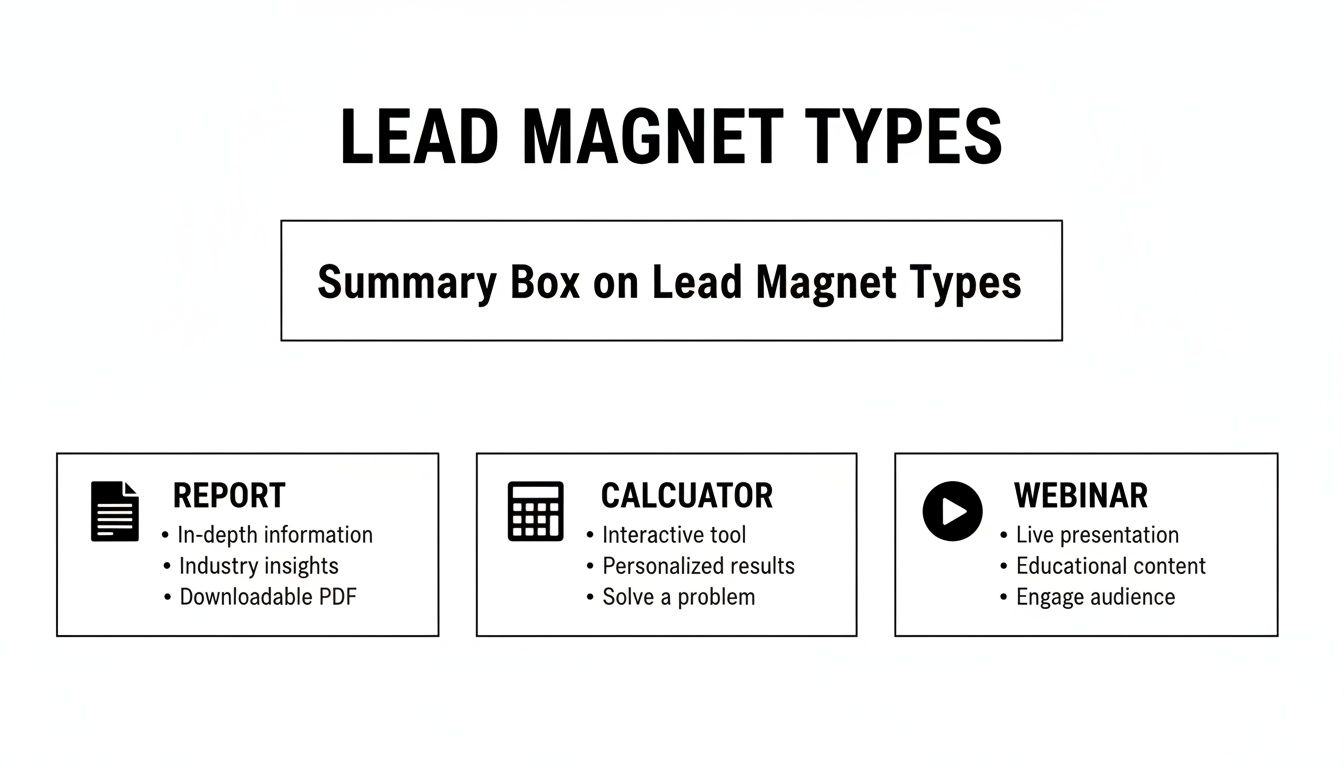
Reports, calculators, and webinars are classics for a reason—they deliver tangible value and match different stages of the buyer's journey perfectly.
To give you a better idea of where to focus your efforts, here's a look at how different on-site and off-site tactics stack up.
Comparing Lead Capture Tactics for B2B
This table breaks down some of the most common channels for list building, highlighting their strengths and what it takes to get them running.
| Tactic | Best For | Average Conversion Rate | Implementation Effort |
|---|---|---|---|
| Blog & Content Forms | Capturing high-intent readers already engaged with your expertise. | 1-5% | Low |
| Exit-Intent Pop-ups | Converting abandoning visitors into leads with a relevant offer. | 3-9% | Low-Medium |
| Dedicated Landing Pages | Maximizing sign-ups for a specific lead magnet from paid or referred traffic. | 10-25%+ | Medium |
| Paid Social Ads | Reaching hyper-targeted new audiences with a compelling resource. | 5-15% | High |
| Webinars & Events | Generating high-quality leads who have committed time to learn from you. | 20-40% (registrants) | High |
While the numbers vary, the takeaway is clear: a dedicated landing page for a high-value offer is often your best bet for pure conversion power. However, a balanced approach using multiple tactics will build a more resilient system.
Expanding Your Reach with Off-Site Channels
Relying solely on your website is like fishing in a single pond. To really grow, you have to go where the fish are. Off-site channels let you tap into new communities and drive qualified traffic back to your landing pages.
Social media is a great place to start, but you need a plan. Instead of just chasing follower counts, focus on turning those connections into subscribers. A simple win is optimizing your bio link on platforms like LinkedIn or Twitter. Ditch the generic homepage link and send that traffic directly to a high-value lead magnet.
You can also get incredibly precise with paid campaigns on these platforms, targeting by job title, company size, or industry to put your offer right in front of your ideal customer. For more on this, our guide on The B2B Social Media Profit Playbook is a great resource.
Virtual events are another goldmine. Every single person who registers for your webinar is a new lead. These are incredibly valuable contacts because they've actively set aside time to learn from you. The key is having a plan to segment and nurture them with tailored follow-up emails that keep the conversation going.
Finally, don't sleep on collaborations. Partnering with other businesses or influencers in your space can introduce your brand to a whole new, pre-vetted audience.
- Co-host a webinar: Find a non-competing company that serves a similar audience. You both promote it, and you both get the leads.
- Guest on podcasts or blogs: Share your expertise on other platforms and include a CTA that directs listeners or readers back to your landing page.
- Swap newsletter features: Feature a partner's content in your newsletter, and have them do the same for you.
By blending a smart on-site strategy with targeted off-site campaigns, you build a powerful, diversified system for generating leads. This approach ensures you're not putting all your eggs in one basket, creating a more stable and scalable growth engine for your business.
Turning New Subscribers into Engaged Relationships

Getting someone to sign up is a great feeling, but that's just the starting line. The real work—and where the real value is built—kicks off the second they hit "subscribe." You've earned a sliver of their attention; now you have to prove it was worth their time.
This is all about nurturing. It’s how you take a name on a list and turn it into an active, interested lead who actually looks forward to your emails. And the cornerstone of this entire process is a rock-solid welcome email sequence.
A great welcome series does more than just deliver the lead magnet they asked for. It’s your golden opportunity to make a killer first impression, set the tone for your entire relationship, and start delivering unexpected value from day one.
Designing a Welcome Sequence That Works
Your very first email is easily the most important one you’ll ever send. Its primary job is simple: fulfill the promise you made. If they signed up for a report, get that report into their hands immediately, with zero friction.
But you can't stop there. A truly effective welcome sequence is an automated, multi-part journey that unfolds over several days. Each email should build on the last, systematically establishing your expertise and building trust.
Here’s a simple but powerful three-part structure that works time and again:
- The Instant Delivery & Intro: This should land in their inbox within minutes. It delivers the goods (the lead magnet) and offers a warm, personal welcome. Briefly introduce your brand and what makes you different from everyone else in their inbox.
- The Problem & Solution Story: A day or two later, follow up with a relevant success story or a case study. Frame it around the problem your lead magnet helps solve. This gives you instant social proof and helps them connect their own challenges to your solution.
- The "What's Next" Email: Finally, set clear expectations. Let them know what kind of content they can expect and how often you'll be in touch. I also love ending this email with a direct question to encourage a reply—it's a great way to kickstart a genuine conversation.
Your welcome sequence is your one and only chance to make a first impression in the inbox. Don't waste it on a transactional delivery. Use it to start a story, show your personality, and prove you're a valuable resource, not just another newsletter.
This initial nurture is where you build the momentum that keeps people opening your emails for the long haul.
The Power of Day-One Segmentation
You'll quickly learn that not all subscribers are created equal. A VP of Sales who grabbed an ROI calculator has entirely different needs than a junior marketer who signed up for a webinar on content strategy. Sending them the same stuff is a fast track to low engagement and high unsubscribes.
This is exactly where segmentation comes in.
By sorting subscribers into different buckets the moment they join your list, you can send them hyper-relevant messages that actually resonate. This isn't just a "nice-to-have" tactic; it's a massive performance driver.
The numbers are staggering. Recent data shows that marketers who used segmented campaigns noted as much as a 760% increase in revenue. Those aren't small bumps—they're game-changing results. For B2B marketers, this level of personalization is non-negotiable. You can explore more powerful email marketing stats to get the full picture.
So, how do you start segmenting right away?
- Segment by Lead Magnet: This is the easiest place to start. Create a separate, tailored welcome sequence for each of your lead magnets. The person who downloaded a deep-dive technical whitepaper gets a completely different nurture track than the one who grabbed a high-level industry report.
- Segment by On-Site Behavior: With the right tools, you can segment people based on the pages they visited before signing up. This gives you incredible context into their specific interests and pain points.
- Segment by Self-Selection: Why guess when you can just ask? In your welcome email, include simple links like, "Click here if you're most interested in [Topic A]" or "[Topic B]." This lets subscribers tell you exactly what they want to hear about.
By personalizing their journey from the very first email, you're sending a clear signal: you understand their needs and you respect their time. That simple, strategic move is what turns a new contact into a loyal follower.
Keeping Your Email List Healthy and Compliant
It's easy to get caught up in the vanity metric of a huge email list. But the truth is, a massive list of subscribers means nothing if your emails are landing in the spam folder or being ignored completely.
A bloated, unhealthy list doesn't just sit there—it actively hurts your business. It tanks your deliverability, damages your sender reputation, and ultimately wastes your time and money. The real win isn't just growing a list; it's cultivating a healthy, engaged audience that actually wants to hear from you.
This is where the less glamorous but absolutely critical work of list hygiene comes in. Think of it as preventative maintenance for one of your most valuable marketing channels.
Why You Can't Afford to Skip List Cleaning
Your sender reputation is basically a credit score for your email domain. Email clients like Gmail and Outlook track how recipients interact with your messages. Are they opening them? Clicking links? Or are they marking you as spam?
Sending emails to a bunch of dead addresses or to people who haven't opened a message in a year sends all the wrong signals. It tells ISPs you might be a spammer, which lowers your score and sends your future emails straight to the junk folder.
Regularly cleaning your list solves two big problems at once:
- It boosts your deliverability. When you're only sending to people who are interested, a much higher percentage of your emails will actually land in the primary inbox. Better deliverability leads to better open and click-through rates.
- It cuts down your costs. Most email service providers charge you based on the size of your list. Why pay to send emails to people who aren't listening?
This isn’t about shrinking your list just for the sake of it. It's about focusing your efforts where they'll have the most impact.
I’ll take a smaller, highly engaged list over a massive, unengaged one any day of the week. The goal isn't just to collect emails, but to build a real audience that finds value in what you have to say.
How to Run a Re-Engagement Campaign
Before you hit the delete button on a chunk of your subscribers, it's good practice to give them one last chance to stick around. This is where a re-engagement campaign (sometimes called a "win-back" campaign) comes into play.
Start by creating a segment of subscribers who haven't opened or clicked an email from you in a while. A good starting point is 90 or 180 days of inactivity.
Once you have that segment, you can launch a short, targeted email series. Here’s a simple but effective flow I’ve seen work wonders:
- The Gentle Nudge: Start with an email that has a friendly, attention-grabbing subject line. Something like, "Is this goodbye?" or "Still want to get our emails?" works well. In the body, briefly remind them of the value they get from being a subscriber.
- The Last Call: If they don't bite, follow up a week later. Be more direct this time. Let them know you'll be removing them from your list soon to respect their inbox, but give them a big, obvious button to click if they want to stay.
If they still don't engage after that final email, it's time to let them go. You've done your due diligence, and now you can clean your list knowing it's full of people who actually want to be there.
Staying on the Right Side of the Law
Finally, let's talk about compliance. This isn't a "nice-to-have"—it's a must. Regulations like the CAN-SPAM Act in the U.S. and GDPR in Europe have strict rules about how businesses can use email.
The legal language can get dense, but the core principles are pretty straightforward:
- Get explicit permission. Never, ever add someone to your marketing list without their consent. A pre-checked box doesn't count.
- Make unsubscribing easy. Every single email you send must include a clear, one-click way for people to opt out. Don't hide it in the footer with a tiny font.
- Identify yourself. Your emails need to clearly state who they're from and include a valid physical mailing address for your business.
Following these rules isn't just about avoiding hefty fines; it’s about building trust. When subscribers know they have control, they're far more likely to engage with your brand in a positive way.
Your Questions Answered: A No-Nonsense Guide to Email List Building
Even with the best plan, you're going to hit a few bumps and have some questions when you start building your email list from scratch. I’ve been there. Getting the small details right from the beginning can make or break your success down the line.
So, let's clear up some of the most common questions I hear from B2B marketers.
What’s a Good Growth Rate for a New Email List?
This is the golden question, isn't it? The honest answer is: it really depends. A "good" growth rate for a well-known brand in a hot industry will look totally different from a startup just finding its footing. Your website traffic alone is a huge factor.
Instead of getting hung up on some universal number, focus on establishing your own baseline and then creating a consistent, positive trend.
As a starting point, aim for 1-5% monthly growth. If you’re starting with 1,000 subscribers, that means adding 10 to 50 genuinely interested people each month. It's a goal that will push you to do the right things without tempting you to take sketchy shortcuts. Once you hit that consistently for a few months, you can start setting more aggressive goals based on your own data.
How Often Should I Email My List?
Finding the right email cadence is a delicate dance. Come on too strong, and you’ll see unsubscribes spike. Wait too long between emails, and your audience will forget why they signed up in the first place.
For most B2B and SaaS businesses, a great rhythm to start with is once a week. It’s frequent enough to stay on their radar but not so much that it feels like you're cluttering their inbox.
But that's not a hard-and-fast rule. You have to consider:
- What did you promise? If someone signed up for a daily tip, send a daily tip. If it was a monthly newsletter, stick to that.
- Do you have something valuable to say? One truly insightful email per month is infinitely better than four fluffy, forgettable ones.
- Who are you talking to? You can, and should, email different segments at different frequencies. A hot lead in a buying cycle might get a targeted sequence over a few days, while your main list just gets the weekly update.
Consistency is key. Pick a schedule you can realistically maintain and always, always prioritize quality over quantity.
Should I Buy an Email List?
Let me be as clear as I possibly can be: No. Never, ever buy an email list.
It feels like a quick win, a way to jumpstart your growth. I get the temptation. But it’s a trap that will actively sabotage your marketing efforts and can do long-term damage to your brand’s reputation.
Here's exactly why it’s a terrible idea:
- It’s a Violation of Trust (and Law): Those people never asked to hear from you. Blasting them with unsolicited emails is spam, plain and simple. It also puts you in hot water with privacy laws like GDPR.
- It Obliterates Your Sender Reputation: Purchased lists are notoriously dirty—full of dead addresses, spam traps, and people who will immediately mark you as spam. This tells Gmail, Outlook, and others that you're a bad actor, and soon even your legitimate emails won't get delivered.
- The Results Are Awful: These people don't know you and don't care about you. Engagement will be in the gutter. You’ll be lucky to get a handful of opens, let alone a single qualified lead.
Building a healthy email list is a marathon, not a sprint. The real value is in earning permission and building trust with people who want to hear from you. There are no shortcuts to that.
What Is a Double Opt-In and Should I Use It?
A double opt-in is just a simple, two-step confirmation process. First, a person fills out your signup form. Second, they get an automated email with a link they have to click to confirm they really, truly want to subscribe. They aren't officially on your list until they click that link.
The alternative is a single opt-in, where they're added to your list the second they hit "submit." While that method will grow your list faster, the double opt-in has some massive advantages, especially in B2B.
- You Get Higher-Quality Leads: This process filters out typos, fake email addresses, and people who aren't that interested. Every single person on your list has actively confirmed they want to be there.
- Engagement Goes Way Up: It's no surprise that lists built with a double opt-in see much better open and click-through rates. You're emailing an audience that's already proven they're engaged.
- It Protects Your Deliverability: A clean, engaged list is the #1 signal to email providers that you're a sender to be trusted. This helps you stay out of the spam folder for good.
For any serious B2B marketer, lead quality is far more important than list quantity. A double opt-in is one of the best tools you have to ensure that quality from day one.
At Mick-Mar Inc., we help B2B and SaaS companies build and execute marketing strategies that drive real growth. If you're ready to turn your email list into a powerful revenue engine, let's talk about creating a customized roadmap for your business. Learn more about our strategic marketing services.