
Marketing attribution is all about connecting the dots. Think of it as the process of figuring out which of your marketing efforts are actually bringing in revenue and which are just making noise. It’s your game plan for understanding what’s truly working so you can do more of it.
What Is Marketing Attribution Really?
Let's say you just landed a big new client. That client’s journey was probably anything but a straight line. They might have first seen one of your LinkedIn ads, then stumbled upon a few of your blog posts a week later. Maybe they attended a webinar, and after that, finally clicked a link in a newsletter to book a demo with your sales team.
Without a proper attribution system, you might only give credit to that final email click. This completely misses the huge role the ad, the blog content, and the webinar played in getting them interested in the first place.
This is a classic trap. Relying on a simplistic view, like only crediting the last touchpoint, is like giving all the praise for a championship win to the person who scored the final goal. You're ignoring all the assists, the smart defensive plays, and the coaching that made the victory possible. In marketing, that narrow thinking leads to bad budget decisions and a lot of missed opportunities.

Why Attribution Is Critical for Growth
Good attribution draws a clear line from your marketing spend to your revenue. It helps you see which campaigns are driving real business, not just vanity metrics like clicks and impressions. This is especially vital for B2B SaaS companies, where sales cycles are notoriously long and complex.
Recent 2023 research confirms that the average B2B buying journey involves a whole committee of decision-makers and can easily stretch over several months, often requiring multiple touchpoints before a deal is finally done.
Marketing attribution is the process of identifying which marketing channels and specific touchpoints are responsible for generating leads, creating pipeline, and ultimately, closing deals. It’s how you track customer interactions to prove marketing’s direct impact on revenue.
In essence, attribution helps you nail down the answers to the big strategic questions:
- Which channels give us the best bang for our buck? Should we double down on paid search, content marketing, or maybe invest more in events?
- What kind of content actually moves the needle? Are our webinars driving more qualified leads than our in-depth whitepapers?
- How do we speed up our sales cycle? Are there certain touchpoints that help prospects move from just looking to making a decision faster?
When you can answer these questions with solid data, you can stop guessing. You start building a predictable growth engine, allocating your budget with confidence, and finally proving marketing's true contribution to the bottom line.
Marketing Attribution at a Glance
To really get a handle on how attribution works, it helps to see the core ideas laid out simply. This table gives a quick snapshot of the fundamental concepts we'll be digging into throughout this guide.
| Concept | Explanation |
|---|---|
| Who | Your audience—the prospects, leads, and customers who are interacting with your brand. |
| What | The specific marketing interactions, like ad clicks, email opens, page views, and webinar registrations. |
| Why | To understand the full customer journey, prove ROI, and make smarter, data-backed decisions on budget and strategy. |
| How | By using different attribution models (like first-touch or multi-touch) and tracking tools to assign credit for conversions. |
This framework gives us a solid starting point. Now, we're ready to dive deeper into the specific models, tools, and strategies that will help you build an attribution system that actually works for your business.
The Evolution From Ad Budgets to Data-Driven Insights
To really appreciate why modern marketing attribution is such a big deal, it helps to rewind and see how we got here. The core problem—proving marketing is actually working—isn't new at all. For decades, marketers struggled to draw a straight line from their efforts to actual sales, especially when they were working with print ads, radio spots, and TV commercials.
This drive for clarity led to a huge breakthrough back in the 1950s: Marketing Mix Models (MMM). This was a revolutionary approach at the time. It used statistical analysis to figure out how different marketing inputs, like TV ad spend or newspaper placements, actually influenced sales. For the first time, big brands could stop guessing and start making decisions based on data.
From Big Picture Models to Individual Journeys
Marketing Mix Models gave marketers a 30,000-foot view. They were fantastic for understanding the overall impact of massive campaigns over a long period. The early adopters, mostly big Fortune 500 companies, saw incredible results, with some reporting significant improvements in marketing ROI just by shifting their budgets based on what the numbers told them. You can learn more about the historical importance of marketing attribution if you want to dive deeper.
But then the internet happened, and everything changed. The explosion of digital channels—search engines, social media, email, and a million websites—created customer journeys that were way more complicated and scattered. MMM simply wasn't designed to follow the clicks, views, and downloads of a single person.
The core challenge of attribution has always been the same: connect marketing actions to business results. What changed was the sheer volume and variety of data, which demanded a much more precise, user-level way to measure it all.
This shift created a pressing need for a whole new way of thinking. Marketers couldn't just look at the big picture anymore; they had to understand the specific, winding path each customer took to their doorstep. This need for granular, person-level tracking is what ultimately paved the way for the digital attribution models we use today.
The Foundation of Modern SaaS Marketing
This whole journey, from broad statistical models to detailed user tracking, really sets the stage for how we operate now. It underscores a timeless truth: businesses that can accurately measure what works are the ones that win.
For SaaS marketers, this history is especially relevant. You’re in a world where every single touchpoint matters—from the first blog post a prospect reads to the final demo they sit through. Understanding this evolution makes it clear why sophisticated attribution isn't just a "nice-to-have" feature. It's the engine of a smart growth strategy, turning your marketing spend from a simple expense into a truly measurable investment.
Choosing the Right Attribution Model for Your Business
Okay, so you're on board with tracking your marketing. The next big question is how. Figuring out which marketing moment gets the credit for a sale is a bit like deciding who was the MVP in a championship game. Was it the person who scored the winning goal, the one who made the initial breakaway, or the whole team that worked together to get there? Each answer tells a very different story.
Picking an attribution model isn't just a technical task for your analytics team; it's a huge strategic decision. The model you choose will shape where you put your budget, what your team prioritizes, and how you understand what actually drives growth. A model that works perfectly for a fast-and-furious e-commerce brand could give you a completely warped view of reality in the B2B SaaS world.
The real key is to match the model to your business—your typical sales cycle, how complex your customer journey is, and what you’re ultimately trying to achieve. Let's break down the main contenders.
This decision tree gives you a simple way to think about which type of model might be a good fit, depending on whether you're focused on offline or digital advertising.
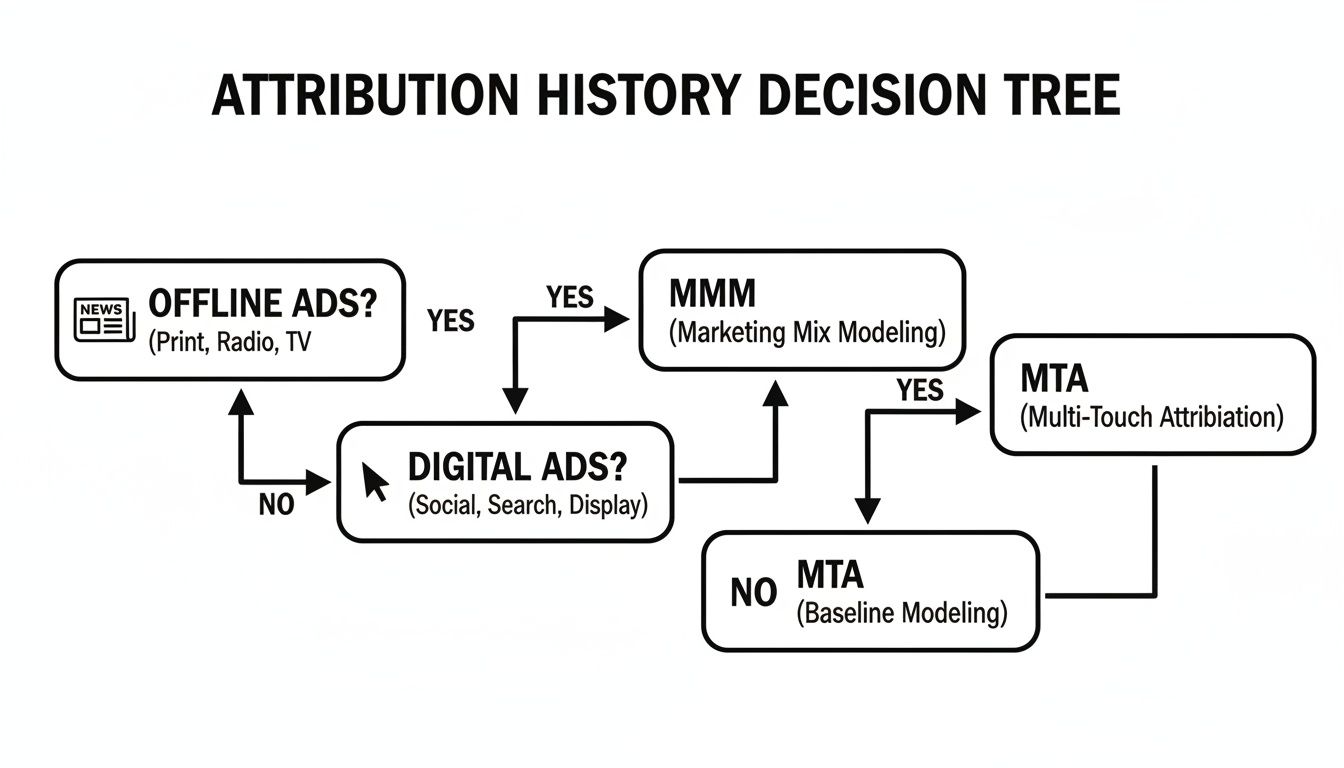
As the visual shows, different advertising channels often demand different ways of measuring them. Offline efforts might lead you toward Marketing Mix Modeling (MMM), while digital campaigns are a natural fit for Multi-Touch Attribution (MTA).
Single-Touch Models: The Sprinters
Single-touch models are the most straightforward way to approach attribution. They give 100% of the credit for a conversion to a single touchpoint. They're incredibly easy to set up and understand, but that simplicity is also their biggest downfall, especially if your sales cycle is anything longer than a few days.
-
First-Touch Attribution: This model gives all the glory to the very first interaction a customer had with you. It's fantastic for figuring out which channels are your best discovery engines—the ones bringing new faces into your world. If your top priority is just filling the top of your funnel, this model sends a clear signal.
-
Last-Touch Attribution: On the flip side, this model gives all the credit to the final touchpoint right before the conversion. It’s a great way to see what pushes people over the finish line. The problem? It completely ignores every single marketing effort that guided and nurtured that lead up to the final moment.
While they have their place, these simple models just don't reflect the reality of a modern B2B buyer’s journey, which we know can involve many different interactions over a long period.
Multi-Touch Models: The Team Players
This is where things get more realistic. Multi-touch models operate on the principle that multiple interactions contributed to the final sale. They work by distributing credit across several touchpoints, giving you a much more balanced and accurate view of your marketing performance. This approach is far better suited for B2B companies where building a relationship is everything.
A multi-touch approach recognizes that the customer journey is rarely a straight line. It's a series of conversations across different channels, and each one plays a part in the final decision.
To give you a clearer picture, let's compare the most popular models side-by-side.
Comparing Popular Marketing Attribution Models
| Model Type | How It Works | Best For | Pros | Cons |
|---|---|---|---|---|
| Linear | Spreads credit evenly across every single touchpoint in the customer journey. | Getting a simple, holistic view of all contributing channels without making assumptions. | Fair, simple to understand, and acknowledges every interaction. | Treats a quick blog view and a demo request as equally important. |
| Time-Decay | Gives more credit to the touchpoints that happened closer to the conversion. | Businesses with longer consideration phases where recent interactions are more influential. | Emphasizes what's working to close deals now. | Can undervalue crucial top-of-funnel activities that happened weeks ago. |
| U-Shaped | Gives 40% credit to the first touch, 40% to the lead-creation touch, and divides the remaining 20% among the middle touches. | Marketers who want to focus on what generates initial awareness and what creates a qualified lead. | Balances the importance of opening and mid-funnel milestones. | Might miss the importance of the touchpoint that turned a lead into a real sales opportunity. |
| W-Shaped | Assigns 30% credit each to the first touch, lead creation, and opportunity creation. The last 10% is split among other touches. | B2B SaaS companies with a clearly defined sales funnel (Awareness > Lead > Opportunity). | Aligns perfectly with the typical B2B marketing and sales funnel stages. | Can be more complex to implement and requires clear stage definitions. |
Choosing the right multi-touch model isn't just a technical exercise. It's a core component of building an effective marketing strategy, as it literally defines how you measure what's working and what isn't.
Data-Driven Attribution: The Smartest Approach
Finally, we have the most advanced option: data-driven attribution. Instead of using a predefined set of rules like the models above, this approach uses machine learning to figure out the credit for you. It analyzes all of your unique conversion data, comparing the paths of customers who converted against the paths of those who didn't.
By spotting the critical patterns, the algorithm assigns credit to each touchpoint based on its actual, statistical impact on driving a conversion. This completely removes the guesswork. You're no longer assuming the W-shaped model is right; the data is telling you what's most influential.
While it definitely requires more data and more sophisticated tools to pull off, the level of precision it offers is something the other models just can't touch. For any business that's serious about truly optimizing every dollar of marketing spend, this is the end goal.
Putting Your Attribution Strategy Into Action
Knowing what attribution models are is one thing. Actually getting one to work for your business is a whole different ball game. Moving from theory to practice means rolling up your sleeves and taking a clear, methodical approach. This is where you build the system that turns messy data into real business intelligence.
Let's be clear: a successful attribution strategy isn't just about picking a model from a dropdown menu. It's a full-on process. You have to define your goals, meticulously track customer interactions, get the right tools talking to each other, and commit to keeping your data clean. If you skip these foundational steps, even the fanciest software won't give you the answers you need.
Here’s a practical roadmap to get you started. Follow these steps, and you'll build a system that delivers insights you can actually trust, empowering you to make much smarter marketing decisions.

Step 1: Define Your Core Conversion Goals
Before you track a single click, you have to know what you’re aiming for. What does "success" actually look like? For a SaaS business, this is so much more than just the final sale.
Think of your conversion goals as the critical milestones along the customer journey that show you're making progress. Nailing these down is the first—and most important—step.
Your attribution system is only as good as the goals you measure against. Vague goals lead to vague insights. Be specific about what you want to track, whether it's demo requests, trial sign-ups, or closed-won deals.
For most SaaS companies, these are the goals that really matter:
- New Contact Creation: This is the moment an anonymous website visitor gives you their email, often for an ebook or whitepaper, and becomes a known lead.
- Marketing Qualified Lead (MQL): When a lead shows real buying intent, like registering for a product webinar.
- Sales Qualified Lead (SQL) or Demo Request: The point where a lead actively raises their hand and asks to speak with your sales team.
- New Deal Creation: Your sales team has qualified the lead and officially opens an opportunity in your CRM.
- Closed-Won Revenue: The ultimate goal. The prospect signs on the dotted line and becomes a paying customer.
Step 2: Map and Track Every Touchpoint
Once your goals are set, it’s time to play detective. Your job is to identify and track every possible interaction a potential customer might have with your brand, both online and offline.
A touchpoint is simply any interaction someone has with your company. To make attribution work, you have to capture these moments accurately. We're talking about page views, form submissions, ad clicks, marketing email opens—the works.
The secret to reliable tracking? Utter consistency, especially with your UTM parameters. These are just simple tags you add to your URLs that tell your analytics tools exactly where your traffic came from. A disciplined approach to UTM tagging is what saves you from a "garbage in, garbage out" situation, ensuring your data is clean enough to be useful. Many teams build this discipline through structured marketing operations, which you can explore in our other resources.
Step 3: Select an Aligned Attribution Model
Now you can finally choose an attribution model that actually fits how your business operates. As we've covered, a simple last-touch model might be fine for a quick, impulsive e-commerce purchase, but it will completely mislead a SaaS business with a nine-month sales cycle.
Your model has to reflect the real-world complexity and length of your buyer's journey. For most B2B SaaS companies, a W-Shaped or Time-Decay multi-touch model provides a far more balanced view. These models give credit to the key interactions that first created awareness, nurtured the lead, and ultimately influenced the final decision to buy.
Step 4: Choose Your Tools and Integrate Your Stack
Finally, you need the right tech to stitch all of this together. Your attribution tool has to connect seamlessly with the rest of your core platforms—especially your CRM (like Salesforce) and your marketing automation system (like HubSpot or Marketo).
This integration is the magic that connects marketing activities to actual sales outcomes. It creates a single source of truth where you can see the entire customer journey, from that very first ad click all the way to the final closed deal. And for newer channels like Connected TV, a solid CTV measurement and attribution guide can help you pick the right specialized tools for the job.
How Modern Attribution Adapts to a Privacy-First World
The ground is shifting beneath our feet as marketers. With third-party cookies slowly fading away and consumers rightly demanding more privacy, the old playbook for tracking customer journeys just doesn't work anymore. This new reality calls for a smarter, more resilient way to figure out what's actually driving growth.
Put simply, we can't follow individual users around the web with perfect precision anymore. But the answer isn’t to throw our hands up in defeat; it’s to evolve. Modern attribution is shifting toward hybrid models that cleverly blend different measurement techniques, giving businesses a much clearer and more future-proof view of their performance.
The Rise of Hybrid Measurement
Imagine trying to understand a football game by only watching one player. You’d completely miss the bigger strategy. Relying only on granular user-level tracking (like Multi-Touch Attribution) is fast becoming like that. The modern solution is to pair that detailed view with the high-level perspective you get from Marketing Mix Models (MMM).
This unified approach finally lets you see both the forest and the trees.
- Marketing Mix Models (MMM): These give you the big-picture, strategic view. They analyze how broad investments in channels like TV, paid search, and content marketing influence overall revenue over a longer period.
- Multi-Touch Attribution (MTA): This is your tactical, on-the-ground view. It connects the dots between individual user touchpoints and specific conversions, telling you which ads or emails someone interacted with before they bought.
By merging these two, you can finally connect a top-down budget decision with its bottom-up impact on individual customer journeys. This creates a single source of truth that helps put an end to the classic "attribution wars" between marketing and sales, where both teams claim credit based on their own siloed data.
The goal of modern attribution is no longer just to report on what happened last quarter. It's to build a predictive engine that uses all available data to guide future strategy, even when you can't track every single user click.
AI and Machine Learning as the New Foundation
This move toward hybrid models is really only possible because of huge leaps in AI and machine learning. These technologies are brilliant at analyzing massive, often messy datasets to spot patterns that older, rules-based models would completely miss. They're particularly good at filling in the gaps left by new privacy restrictions.
This evolution was born out of pure necessity. By the late 2010s, many marketers were deeply frustrated with the tools they had. In response, a remarkable 68% of enterprises had adopted AI-powered, data-driven attribution by 2023 to get a clearer picture, recognizing the limitations of older methods.
AI allows modern attribution platforms to connect an online ad view with an offline event, like a sales call or an in-store visit, creating a truly unified customer journey. This provides a much more robust understanding of the complex interactions in digital marketing and advertising.
Ultimately, as privacy continues to reshape our world, the teams that embrace these adaptive, AI-driven hybrid models will be the ones who can measure, optimize, and prove their impact with confidence.
Navigating Common Attribution Challenges and Pitfalls
Putting an attribution system in place sounds straightforward on paper, but the reality is almost always messy. Even with the best tools and intentions, marketers hit roadblocks that can muddy their data and make them question the whole effort. Knowing what these hurdles are before you start is half the battle.
The difference between a frustrating, abandoned project and an attribution system that actually gives you powerful insights often comes down to navigating these common pitfalls. It’s all about being realistic, planning ahead, and committing to a solid data foundation from day one.
The Challenge of Data Silos and Messy Tracking
One of the biggest, most classic obstacles is the data silo. Think about it: your customer data is probably spread out across a dozen different tools that don’t speak the same language. You’ve got your CRM, your marketing automation platform, your ad networks, and your analytics tools, and each one only has a small piece of the customer story. When those systems aren't connected, getting a complete picture of the customer journey is impossible.
This fragmentation leads to incomplete stories. A prospect might see a LinkedIn ad, download an ebook from your site a week later, and then chat with a sales rep at a conference. If those three touchpoints live in three separate systems, you’ll never connect the dots to see how that deal actually came to be.
The heart of good attribution is creating a single source of truth. Without it, you’re just looking at isolated snapshots of the customer journey, not the full feature film.
Inconsistent tracking is another huge problem. Messy UTM parameters—or worse, no UTMs at all—make it incredibly hard to figure out where your traffic is really coming from. Getting an accurate read on user journeys is a constant struggle, especially when you factor in data discrepancies like why GA4 under-reports ChatGPT traffic, which can throw a major wrench in your attribution accuracy.
Linking Offline and Online Worlds
For most B2B and SaaS companies, the customer journey isn't a purely digital affair. Some of the most important interactions happen offline—at trade shows, on sales calls, or during industry meetups. Tying these real-world touchpoints back to a digital journey is a major headache because they don't leave a neat little cookie crumb to follow.
If you don't have a process for capturing this offline data, you end up with massive blind spots in your attribution model. Marketing and sales teams might even start undervaluing high-impact activities just because they’re harder to track.
Here’s how you can start bridging that gap:
- Unique Identifiers: Create dedicated landing pages, vanity URLs, or QR codes for your offline campaigns so you can trace activity back to the source.
- CRM Discipline: This is a big one. Train your sales team to consistently ask, "How did you hear about us?" and, more importantly, to log that information properly in the CRM every single time.
- Event Integration: Use event management software that syncs with your marketing automation platform to automatically pull in attendee and registration data.
Overcoming Long and Complex Sales Cycles
The final major pitfall is the reality of B2B sales cycles. The path from a person’s first flicker of awareness to a signed contract can take months, sometimes even years. Along the way, you’re not just dealing with one person; you’re engaging with an entire buying committee from the same company.
This complexity makes simple models like last-touch attribution pretty much useless. That model gives 100% of the credit to the final interaction, completely ignoring all the blog posts, webinars, and ads that nurtured the lead for months. Choosing a model that doesn't fit your sales cycle will give you a warped view of what’s working. You'll end up putting money in the wrong places. For long, complex journeys, multi-touch models like a W-Shaped or Time-Decay model are far better equipped to give credit where credit is due.
Got Questions About Marketing Attribution? We've Got Answers.
Putting marketing attribution into practice always sparks a few questions. It’s one thing to understand the theory, but making it work for your business is another challenge entirely. Let's tackle some of the most common questions we hear from SaaS teams.
What’s the Best Attribution Model for a B2B SaaS Company?
There’s no magic bullet here—the "best" model really depends on your sales cycle and business goals.
That said, most B2B SaaS companies have a longer, more involved customer journey, which means multi-touch models are usually the way to go. A W-Shaped or Time-Decay model does a great job of crediting the various touchpoints that influence a lead over weeks or months, from that first blog post they read to the webinar they attended and the final demo they requested.
If you have a really solid data setup, a data-driven algorithmic model is the holy grail. It uses machine learning to figure out exactly how much credit each touchpoint deserves based on your actual customer data.
How Can I Track Offline Marketing, Like a Trade Show?
Tracking offline events is all about creating a digital breadcrumb trail from a real-world conversation. It’s a mix of clever tech and good old-fashioned process.
Here are a few proven ways to do it:
- Unique Digital Assets: Give event attendees an exclusive reason to connect online. Think dedicated landing pages with custom URLs or QR codes for downloading a special report or booking a follow-up call.
- CRM Discipline: This one is non-negotiable. Your sales team needs to be trained to ask, "So, how did you hear about us?" and then—this is the important part—log that answer in your CRM every single time.
- Integrated Event Platforms: Using event management software that plays nicely with your marketing automation platform can automatically sync attendee info, saving you a ton of manual work.
By piping this data from your CRM into your attribution software, you can finally connect those handshakes and booth conversations to the rest of the digital journey.
What Are Some Good Marketing Attribution Tools to Check Out?
The market is full of great tools, from simple and free to powerful and enterprise-grade.
If you're just dipping your toes in, the attribution features already built into Google Analytics are a fantastic starting point. When you're ready for more firepower, dedicated platforms offer much deeper insights. Tools like HubSpot's attribution reporting, Ruler Analytics, Rockerbox, and Dreamdata are built for this stuff. They offer more advanced models and better integrations with your core tech stack, like your CRM and ad platforms.
The trick is to pick a tool that solves your problems today but has the room to grow with you tomorrow.
At Mick-Mar Inc., we help companies build data-driven marketing engines that tie every dollar spent to real revenue. It’s time to stop guessing and start knowing what really works. Discover how we can help you implement a powerful attribution framework.