If you're looking to boost your email open rates, you'll need a strategy that goes beyond clever tricks. It's about a solid combination of compelling subject lines, genuine personalization, and good old-fashioned technical health.
The real goal is to make every email feel like a one-on-one conversation while ensuring it actually lands in the inbox in the first place.
Why Your B2B Emails Are Being Ignored
Let's face it—the B2B SaaS inbox is a warzone. Every day, your prospects are buried under a mountain of generic outreach, product updates, and newsletters that all sound the same. Standing out takes more than a slick template; it requires a totally different mindset about email.
If your open rates are stuck in a rut, it's usually a symptom of a much larger problem.
So many marketers fall back on the "batch and blast" approach, sending one message to their entire list. This completely ignores the fact that your audience isn't one giant, uniform group. A CTO at a cybersecurity firm cares about different things than a marketing manager at a startup. When your emails don't speak to those differences, they just become noise.
The core reason emails get ignored is a lack of perceived value. If the recipient can't see "what's in it for me" within seconds of glancing at their inbox, they will move on without a second thought.
This guide is designed to give you the same actionable playbook we use here at Mick-Mar Inc. to cut through that clutter. We'll walk you through how to build a strategy that gets your emails noticed, opened, and actually read.
Understanding the Core Problems
Before jumping into solutions, you have to diagnose what’s actually going wrong. The reasons your emails aren't performing usually fall into a few key areas.
- A Weak First Impression: Your subject line and preview text are your entire pitch. If they're generic, spammy, or vague, you’ve given the recipient zero reason to click. In fact, research shows that a whopping 47% of people decide whether to open an email based on the subject line alone.
- Lack of Personalization: Dropping in a first name is table stakes. Real personalization means showing you understand their pain points, their industry, or their past interactions with your company. Without that context, your message feels cold and automated.
- Poor Deliverability and Sender Reputation: Even the world's best email is worthless if it ends up in the spam folder. Technical missteps like improper domain authentication or a high bounce rate can signal to inbox providers that your messages aren't trustworthy.
To get ahead of these issues, you need a solid foundation. You can start building one with this great resource to optimize Mailchimp open rates with actionable tips. Getting these basics right is the first step toward turning unopened emails into engaged prospects.
Crafting Subject Lines That Demand a Click
Let's be honest. Your subject line is the gatekeeper to your entire email. In a crowded B2B inbox, it’s not just the first impression—it's often the only impression you get to make. This is where you win or lose the battle for attention in under five seconds.
Forget the generic, clickbait-style phrases you see everywhere. If you want to consistently boost your open rates, you need a repeatable system, one built on proven psychological triggers and a crystal-clear value proposition.

Go Beyond Basic Subject Line Formulas
Most advice out there recycles the same tired formulas that your prospects have seen a thousand times. The real key? Tapping into fundamental human drivers like curiosity, the desire for a benefit, and yes, even a little fear of missing out (FOMO).
A truly powerful subject line often combines two or more of these elements. It’s not about tricking someone into opening your email; it's about making the value inside so compelling that opening it feels like a no-brainer.
Here are a few core principles I’ve seen drive clicks time and again:
- Create a Curiosity Gap: Tease a piece of information without giving it all away. Instead of "Our New Integration," try something like, "The one tool your competitors are using." It immediately makes them wonder what they're missing.
- Signal Clear Value with Numbers: Digits jump off the screen in a sea of text and instantly signal tangible value. "How we increased MRR by 27%" is way more compelling than "How to increase your MRR."
- Use Urgency (But Be Authentic): Scarcity and deadlines work, but only if they’re genuine. "Last chance for 20% off your annual plan" is great if the offer is truly ending. Faking it just erodes trust and tanks your sender reputation.
Your subject line and preview text should work together as a one-two punch. The subject line grabs attention, and the preview text provides a compelling reason to follow through and click. Never let it default to "View this email in your browser."
The Untapped Power of Preview Text
That little snippet of text that appears next to or below your subject line? That’s the preview text, or preheader. It’s prime real estate that far too many B2B marketers completely waste.
Think of it as the subtitle to your subject line's headline. It should extend the story, add crucial context, or reinforce the main benefit.
For example, look at this combo:
- Subject Line: Your Q3 Cybersecurity Report Is Ready
- Preview Text: Find out the top 3 threats facing your industry now.
This duo is so much more effective because it presents a problem and hints at a specific, valuable solution, making the click feel necessary.
For a bit of inspiration, here are some proven formulas that work well in the B2B SaaS world.
Subject Line Formulas for B2B SaaS
| Formula Type | Template | SaaS Example |
|---|---|---|
| Question | Are you struggling with [Pain Point]? | Struggling with user churn? |
| How-To | How to [Achieve Desired Outcome] | How to triple your signups without ads |
| Benefit + Number | [Number] Ways to [Achieve Benefit] | 5 ways to cut your cloud costs by 30% |
| Social Proof | See how [Similar Company] got [Result] | See how Acme Corp. boosted productivity |
| Urgency | [Offer] ends in [Timeframe] | Your 20% discount ends in 24 hours |
| Curiosity | The one thing your team is missing | Your competition is doing this… |
These templates are a great starting point, but always remember to tailor them to your specific audience and offer.
A Quick Word on Emojis
In the right context, emojis can be a fantastic tool for B2B SaaS marketers. They add a splash of color and personality to an otherwise monochrome inbox, immediately drawing the eye. In fact, one recent study found that using emojis in subject lines can boost open rates by 10-15%.
This makes a lot of sense in today's mobile-first environment, where around 60% of emails are opened on smartphones. Visuals like emojis feel native and engaging. A simple 🔥 or 📈 can signal urgency or growth, which is perfect for product updates or webinar invites.
But a word of caution: moderation is key. Use emojis that are relevant to your message and brand. A single, well-placed emoji is effective; a string of them just looks like spam. For a deeper dive, I recommend exploring these email subject line best practices.
This focused approach to subject lines and preview text is a fundamental piece of a much larger strategy. To see how it fits into a broader plan, check out our thoughts on content marketing and strategic communications. By treating this first touchpoint with the care it deserves, you set the stage for better engagement across your entire email funnel.
Go Deeper with Personalization and Smart Segmentation
If your subject line is the friendly face at the door, personalization is the secret handshake. It’s what proves you belong in their inbox. We live in a world drowning in generic marketing blasts, so making a subscriber feel genuinely seen and understood is your single biggest advantage for getting more opens. This is about moving way beyond just dropping a [First Name] tag in the subject line and calling it a day.
The real goal is to make every email feel less like a broadcast and more like a one-to-one conversation. You need to show your subscribers that you get them—who they are, what problems they're trying to solve, and where they are in their journey with you.
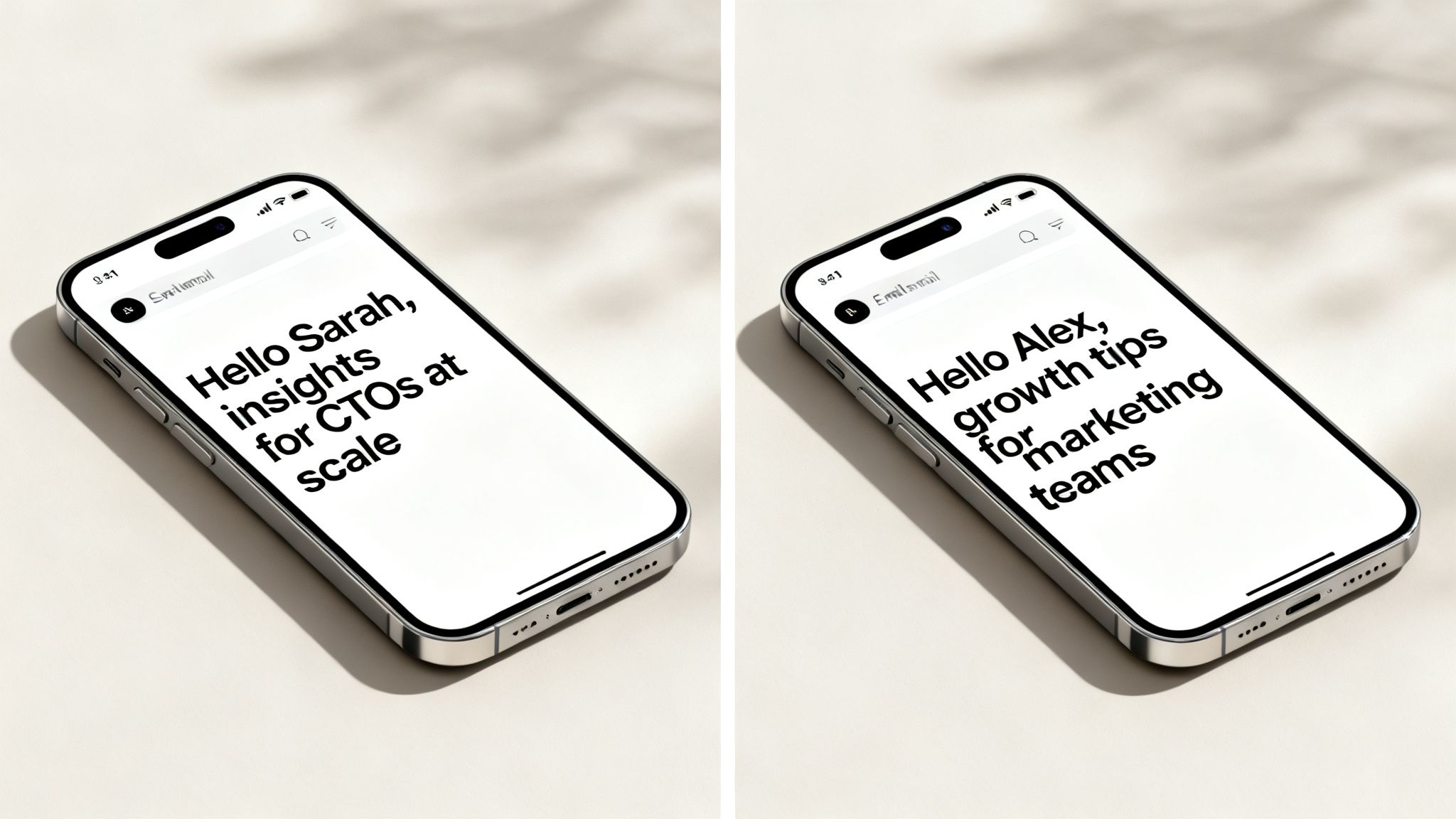
Ditch the "One-Size-Fits-All" Mindset
Real, effective personalization isn’t just about a name; it’s powered by smart segmentation. Stop thinking of your email list as one giant blob of contacts. Instead, picture it as a collection of smaller, highly specific groups. When you start dividing your audience based on what they have in common, you can finally craft messages that hit home.
This isn't just a "nice-to-have" strategy—it's a massive lever for engagement. Done right, personalization is what can push your B2B SaaS email open rates into the 35-45% range, which blows the global average out of the water. When you use data about a contact's company pain points or their past behavior, your emails start to feel like they were custom-built. And that makes them almost impossible to ignore. For a deeper look at the numbers, check out the data on how this impacts B2B email performance at InsiderONE.
You can get started by segmenting your list based on a few core data types.
- Firmographics: Think of this as the basic-but-essential layer. Group contacts by things like company size, industry, or even location. An email to a scrappy 10-person startup should have a completely different tone and focus than one going to a Fortune 500 enterprise.
- Technographics: This is a goldmine. Technographic data tells you what tools your prospects are already using. If you know a company uses Salesforce or Asana, you can tailor your message to talk about seamless integrations or highlight competitive advantages they'd care about.
- Behavioral Data: This is where the real magic happens. This is about segmenting people based on what they do. Did they visit your pricing page? Download an ebook on a specific topic? Are they an active trial user or a paying customer? Each of these actions is a signal you can use to send a perfectly timed, highly relevant message.
Bringing Smart Segmentation to Life
Let's make this tangible. Imagine you run a B2B SaaS that offers a project management tool. You’re about to launch a slick new AI-powered reporting feature, and you need to get the word out.
The old "batch and blast" method would involve sending the exact same email to every single person on your list. Yawn. With segmentation, you can turn a single announcement into a multi-faceted, high-impact campaign.
Here’s how you could break down your audience for this launch:
- Segment 1: The Power Users: These are your daily active users who live inside your product. Your email to them can get a bit more technical. Focus on how the new AI feature will shave hours off their existing workflows and make their team look like rockstars.
- Segment 2: The "At-Risk" Crowd: This group hasn't logged in for a month. Your email needs to be a compelling re-engagement hook. Frame it as, "A powerful new reason to come back," and show them how this new feature solves a universal project management headache.
- Segment 3: The Marketing Managers: You've identified these folks by their job titles. The message for them should be all about the outcome. Talk about how the AI reporting gives them unprecedented visibility into campaign performance and helps them finally prove marketing ROI to their boss.
- Segment 4: The Trial Users: These people are still on the fence. For them, the email positions the new feature as a killer differentiator. It's the compelling reason they need to pull out their credit card and upgrade before their trial expires.
By tailoring the message, a single product announcement delivers four distinct and deeply relevant experiences. You can tweak the subject line, the preview text, and the call-to-action for each group, which massively increases the odds that every recipient will open it because it feels like it was written just for them.
This level of detail transforms your communication from "marketing" into helpful, consultative advice. It's a cornerstone of any great product marketing strategy, ensuring the right message finds the right person at the perfect time.
Work Smarter with Dynamic Content
Here’s the best part: you don't actually have to build four separate emails from scratch. Most modern email marketing platforms support dynamic content. These are smart blocks within your email that automatically swap out content based on the recipient's segment.
You could have a single email template where the headline, the opening paragraph, and even a customer-quote graphic all change based on whether the person is a "Power User" or an "At-Risk" user. This is what makes sophisticated personalization scalable. You get all the credit for sending a hyper-relevant email without all the manual effort. That’s how you consistently earn the open.
Don't Let the Spam Folder Kill Your Campaign
Let's be honest: even the most compelling, perfectly crafted email is completely useless if it never lands in the inbox. Getting flagged as spam is the silent killer of email marketing, and the worst part is, it often happens without you even knowing it. The secret to sidestepping this pitfall is getting a handle on email deliverability.
Think of deliverability as your technical reputation with the gatekeepers—inbox providers like Gmail and Outlook. A solid reputation gets you a VIP pass right into the primary inbox. A shaky one gets you sent straight to spam jail. With a mind-boggling 48% of all emails ending up in spam, it's clear a lot of marketers are skipping these foundational steps.
Your Email's "Technical Passport"
First things first: you need to set up your email authentication. Think of these technical records—SPF, DKIM, and DMARC—as your domain's official passport. They prove to the world’s email servers that you are who you say you are, which makes it incredibly difficult for spammers to impersonate your brand.
SPF (Sender Policy Framework): This is basically a public list of all the servers authorized to send emails on your domain's behalf. It's like telling Gmail, "Hey, if an email claiming to be from us doesn't come from one of these approved spots, it's not legit."
DKIM (DomainKeys Identified Mail): This one adds a secure digital signature to your emails. When the email arrives, the receiving server looks for this signature to verify that the message wasn't altered or faked while in transit.
DMARC (Domain-based Message Authentication, Reporting & Conformance): This protocol is the final piece of the puzzle, tying SPF and DKIM together. It gives you the power to tell inbox providers exactly what to do with emails that fail those authentication checks—like quarantining them or rejecting them outright.
Getting these records in place isn't just a "nice-to-have" anymore. With major players like Gmail and Yahoo cracking down and enforcing stricter rules, skipping this step is a surefire way to torpedo your deliverability and your open rates along with it.
Why a Clean Email List is Non-Negotiable
Your sender reputation isn't just built on technical settings. It's also a direct reflection of who you're sending emails to. Blasting messages to a list cluttered with invalid addresses, inactive contacts, or unengaged subscribers sends all the wrong signals to inbox providers.
High bounce rates and abysmal engagement metrics scream "unwanted content," which puts a serious dent in your reputation. This is precisely why practicing good list hygiene is one of the most important things you can do for long-term success.
A clean, engaged email list is your most valuable marketing asset. Regularly removing inactive subscribers isn't losing contacts; it's protecting your sender reputation and ensuring your message reaches the people who actually want to hear it.
Make it a quarterly habit to create a segment of subscribers who haven't opened or clicked an email in, say, 90 or 180 days. You can always try to win them back with a targeted re-engagement campaign, but if they stay silent, it's time to let them go. This one simple action can give your sender score a massive boost.
Building and Protecting Your Sender Reputation
Your sender reputation is, quite literally, a score that inbox providers assign to your domain based on your sending habits. A higher score means better inbox placement. It’s that simple. While a lot of factors go into it, a few are especially critical for B2B SaaS marketers.
Keep Your Sending Volume Consistent: Avoid sudden, massive spikes in your email volume. Going from sending 1,000 emails a week to 100,000 overnight looks incredibly suspicious to an email server.
Warm Up Your IP Address: If you’re sending from a new IP address, you absolutely have to "warm it up." This means you start by sending a small batch of emails to your most engaged subscribers, then gradually increase the volume over several weeks. This process is all about building trust with inbox providers.
Watch Your Spam Complaint Rate: This is a huge red flag. Always make your unsubscribe link obvious and easy to find. If people can't figure out how to opt out, their only other choice is to hit the spam button, and that's a direct, damaging hit to your reputation.
When you treat deliverability as a core pillar of your strategy, you ensure that all the hard work you put into writing amazing subject lines and personalized content actually gets seen. It's the technical foundation that allows your creative work to shine.
Finding the Best Time to Send Your Emails
Figuring out when to send an email is just as crucial as deciding what to say. While there’s no magic time that works for every single business, a mountain of data gives us a powerful starting point. From there, the real breakthroughs happen when you start listening to your own audience's digital habits.
The goal isn't to find some universal, perfect time slot. It's about discovering your subscribers' engagement sweet spot. When do they actually have a moment to pause, scan their inbox, and decide your message is worth their time? It's a tricky balance between catching them at the right moment and getting buried in the dreaded inbox avalanche.
The Best Days and Times for B2B Audiences
For B2B SaaS, the conventional wisdom holds true for a reason—the middle of the week is prime time. Most decision-makers are deep in their work rhythm, actively checking their inboxes for important updates and solutions to whatever problem is on their plate that day.
Mondays are often a chaotic whirlwind of catching up and planning the week, making it incredibly easy for your email to get lost in the shuffle. Fridays? Engagement tends to dip as people wind down and shift their focus toward the weekend.
Based on loads of industry analysis, the most effective windows are:
- Best Days: Tuesday, Wednesday, and Thursday.
- Peak Times: Mid-morning (around 10 AM) and early afternoon (around 2 PM).
These time slots just plain work because they align with typical professional patterns. By 10 AM, the morning rush is over, and people are settled in. That 2 PM window often catches them right after lunch, as they're looking for a productive way to tackle the second half of their day.
Remember, these are just starting points, not unbreakable laws. The single most important factor is sending your email in the recipient's local time zone. An email that lands at 10 AM EST is a completely useless 7 AM send for someone on the West Coast.
Why Your Data is the Ultimate Guide
General benchmarks are fantastic for getting started, but your own analytics hold the keys to truly unlocking higher open rates. Every audience is different. Your subscribers might be night owls who catch up on emails after dinner or early birds who clear their inbox before their first coffee. You won't know until you look.
Start digging into your email marketing platform's reporting. Look for clear patterns in when your past campaigns got the most opens and clicks.
Ask yourself these questions:
- Which days consistently show the highest engagement?
- Are there specific hours when opens seem to spike?
- Does this pattern change for different segments of your audience (e.g., VPs vs. managers)?
This data-driven approach moves you from guessing to making informed decisions. It lets you tailor your send schedule to the real-world behavior of the people you’re trying to reach, which is a massive step toward getting more of your emails opened.
Don't Forget About Mobile and Cadence
The way we work has changed, and so has the way we check email. With executives constantly on the move, mobile optimization is table stakes. This also opens up new opportunities for timing your sends to align with moments like the morning train ride or the evening commute.
Timing is also deeply connected to your sending cadence—how often you email your list. Bombarding subscribers with daily messages is a fast track to fatigue and a spike in unsubscribes. But if you only email once a quarter, they might forget who you are.
The sweet spot is a consistent, predictable rhythm that provides value without being overwhelming. Test different frequencies, like once a week versus twice a month, and watch your engagement metrics like a hawk. The goal is to stay top-of-mind, not become a nuisance.
Sending emails at the right time can absolutely skyrocket your open rates, with data showing peak performance when you align with your recipients' habits. For B2B pros, that often means sending between 10 AM and 2 PM on Tuesday through Thursday in the recipient’s local time zone. When you consider that mobile users check email three times more often than desktop users, timing becomes even more critical. Get more insights on the latest email marketing statistics you need to know from CodeCrew. Finding that perfect blend of timing and frequency is an ongoing process of testing and refinement, but it's one of the most powerful levers you can pull to get your messages seen.
Putting It All Together: A Simple Framework for Testing and Measuring
Let's get practical. Shifting your email approach from just "sending stuff" to running a high-performance program boils down to one thing: a "test and learn" mindset. Every single email you send is a chance to get a little bit smarter. This isn't about massive, complex projects; it's about building a simple, repeatable process.
You can't improve what you don't measure. So, before you do anything else, you need a baseline. Pull the data from your last five campaigns and figure out your average open rate, click-through rate, and reply rate. That's your starting line.
Your Quick Pre-Flight Checklist
Before you launch your next campaign, use this checklist. It’s a quick gut check that covers the most critical elements we’ve talked about, ensuring you're not sabotaging yourself before you even start.
- Confirm Your Technical Health: First things first, are your SPF, DKIM, and DMARC records properly configured? This is non-negotiable. Get this wrong, and you’re heading straight for the spam folder.
- Segment Your Audience: Ask yourself: Who is this email really for? Avoid the generic list blast at all costs. Instead, create a tight segment based on user behavior, company details, or where they are in their journey with you.
- Craft a Compelling Subject Line & Preview Text: Don't just write one subject line—write at least two to A/B test. Make sure your preview text actually adds context and intrigue, rather than just repeating the subject.
- Personalize Beyond the First Name: Does the body of your email speak to the recipient's specific role, industry, or a problem you know they have? Use dynamic content to make it feel like a one-to-one conversation.
- Check for Mobile-Friendliness: Pop open the preview on your phone. Can you read it easily? Are the links and CTAs tappable? A clunky mobile experience will kill your engagement instantly.
This simple routine helps you catch the small mistakes that have a big impact.
This entire optimization loop—from analyzing your data to testing a new hypothesis—is a continuous cycle.
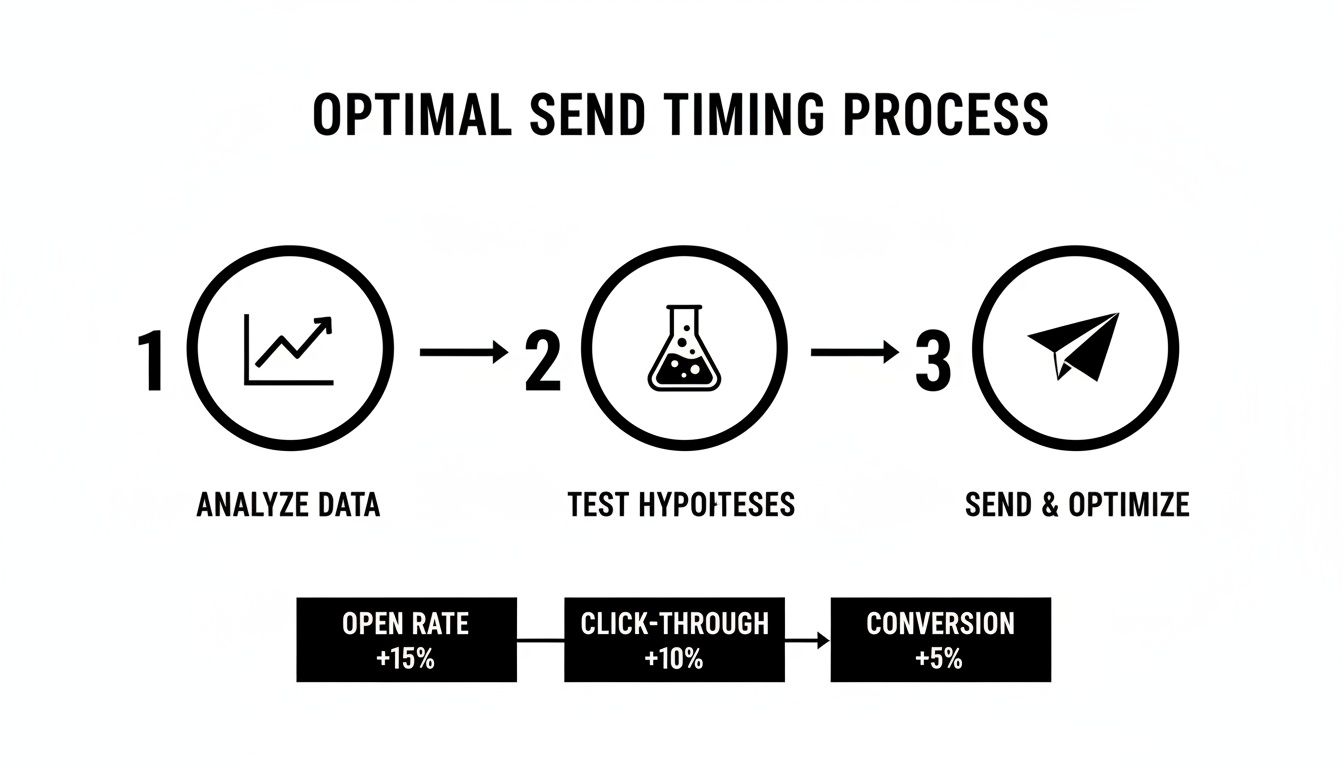
The real takeaway here is that you're never "done." Every send informs the next one.
Measuring What Really Matters
While this whole guide is focused on open rates, we need to be honest: the open rate is just the first domino. A truly effective email program looks at a few key metrics to understand the full story of what's working and what isn't.
Don't get tunnel vision on open rates alone. A high open rate with a rock-bottom click-through rate often means you wrote a killer subject line, but the email itself didn't deliver on the promise.
Look beyond the open and keep a close eye on these metrics:
- Click-Through Rate (CTR): This shows how many people actually took action. For B2B SaaS, a healthy CTR lands somewhere between 2-5%.
- Reply Rate: This is gold, especially for sales-focused or outbound campaigns. It tells you if your message was resonant enough to spark an actual conversation.
- Unsubscribe Rate: Pay attention to this. A sudden spike is a massive red flag that your content, audience, or send frequency is off. You want to keep this number well below 0.5%.
Tracking these numbers consistently is how you develop a sixth sense for what your audience wants. It's the feedback loop that drives real improvement. If you're looking for more ways to get your systems in order, we have a ton of other resources on marketing operations. Ultimately, building that culture of continuous improvement is what separates the good email marketers from the great ones.