In the crowded B2B SaaS market, it feels like everyone is shouting and no one is listening. Standing out isn't just a goal; it's a necessity for survival. This is where strategic marketing consulting comes in. It’s about ditching the random acts of marketing and building a focused, powerful engine for growth—giving you a clear, step-by-step plan to turn market noise into predictable revenue.
Your Blueprint for Navigating SaaS Market Complexity

Too many SaaS founders feel like they're just guessing. They're pouring money into PPC ads, churning out blog posts, and keeping social media channels active, but the growth needle barely moves. The problem usually isn't a lack of effort. It's the missing link—a solid strategy that ties all those activities directly to revenue.
Think of a strategic marketing consultant as the architect of your company’s growth. An architect doesn't show up and start throwing bricks on a pile. They begin with a detailed blueprint that accounts for the foundation, the structure, and the ultimate vision for the building. A consultant does the same for your marketing, designing a durable and scalable framework before a single dollar is spent on ads.
Moving from Tactics to Strategy
The real leap forward happens when you shift from disconnected tactics to a fully integrated strategy. This is what truly separates the high-growth SaaS companies from the ones that just tread water. A tactical mindset asks, "What should we post on LinkedIn next week?" A strategic one asks, "Where do we need to be in 12 months, and what is the most direct path to get there?"
This strategic approach is built on a few core pillars:
- Deep Market Analysis: Going beyond a simple competitor list to truly understand market trends, hidden opportunities, and the real-world problems your customers face.
- Ideal Customer Profile (ICP) Refinement: Sharpening your focus from broad demographics to a crystal-clear picture of your most valuable and profitable customers.
- Go-to-Market (GTM) Alignment: Making sure your product, pricing, sales process, and marketing messages are all perfectly in sync to attract and keep the right kind of clients.
A well-defined strategy ensures every dollar spent and every hour invested contributes directly to your most important business objectives, turning your marketing department from a cost center into a predictable revenue driver.
For any SaaS business, this strategic blueprint has to include powerful Lead Generation Strategies For SaaS to stay ahead. It's the fuel for the entire growth engine, feeding a steady stream of qualified prospects to your sales team.
In the end, strategic marketing consulting brings the clarity you need to stop wasting time and money on marketing that goes nowhere. It’s about building a repeatable system that delivers consistent, measurable growth, giving you the confidence to scale. You can learn more about building a powerful plan by exploring our detailed guide to a successful marketing strategy.
What Strategic Marketing Consulting Really Means for SaaS
Let’s be honest. When most SaaS founders hear "strategic marketing consulting," they might picture a mountain of slides packed with buzzwords and jargon. But that’s not what it’s about. Real strategic consulting is about building a predictable growth engine, not just ticking boxes on a marketing checklist.
It’s the crucial move from just doing marketing to building a cohesive strategy where every single action, every dollar spent, has a clear purpose.
Think of it like this: anyone can follow a recipe. But a master chef understands the science behind flavor, the art of plating, and how every element on the plate works together to create something special. A strategic marketing consultant is that master chef for your go-to-market plan.
Instead of jumping straight into running another ad campaign, they take a step back to see the whole board. They dig deep into your market dynamics, sharpen your Ideal Customer Profile (ICP), and make sure your marketing and sales teams are rowing in the same direction. The entire point is to connect every marketing activity directly back to a core business goal.
It's More Than Just Tactics; It’s About the Foundation
Here’s where a lot of companies get it wrong. They hire for tactical help—"how do we get more clicks?" or "how can we improve our email open rates?" Those things are important, but they’re just small gears in a much larger machine.
Strategic consulting focuses on the "why" and the "what" long before it ever gets to the "how." It's about answering the tough, foundational questions that ultimately determine if you succeed or fail:
- Why this specific market segment? What’s the real opportunity cost of ignoring others?
- What is the one thing we can say that makes our best-fit customers' ears perk up?
- How do all our channels—content, ads, sales outreach—tell one consistent story that guides a prospect from stranger to champion?
This kind of high-level thinking is often similar to what you’d get from C-suite advisory services, giving your leadership team the perspective needed to navigate a crowded market. Nail these answers first, and you stop wasting time and money on tactics that lead nowhere.
The Architect of Your Growth Engine
A consultant's real job is to be the architect of your growth blueprint. They design a system where you can clearly see how marketing efforts translate into revenue, creating a reliable path to bringing in and keeping happy customers.
This isn’t about chasing quick, flashy wins. It’s about building a solid foundation for growth that can scale with you. A great strategic partner helps you create a marketing function that doesn’t just generate leads—it fuels the entire business.
This need for deep expertise is why the marketing consulting world is booming. The global market, valued at USD 35.10 billion in 2025, is expected to climb to USD 45.52 billion by 2031. It’s a clear signal that more businesses are realizing they need an expert strategist to cut through the noise. You can dive into these market growth projections to see the full picture.
Ultimately, bringing in a strategic marketing consultant is an investment in clarity. It's for SaaS leaders who are tired of guessing and are ready to build a deliberate, data-backed marketing machine that gets real, sustainable results.
The Real-World Payoff of a Strategic Partnership
When you're fighting for every inch of market share, bringing in an outsider might feel like a strange move. Why spend money on a consultant when you could just hire another person for your in-house team? The answer isn't about adding more hands; it's about fundamentally changing how you play the game.
Think about a classic SaaS scenario. A great company has a brilliant product and a sharp team, but their marketing is all over the place. They’re burning cash on a dozen different tactics—a little SEO here, some social media there, maybe a random trade show sponsorship—but none of it connects. There's plenty of activity, but no real momentum or predictable growth.
This is where a strategic marketing consultant makes a tangible difference. We're not just talking about getting "more leads." We're talking about building a predictable revenue machine.
Gaining Unbiased Clarity and Laser Focus
The first and most immediate benefit is clarity. A consultant brings a fresh, objective perspective that cuts right through internal politics and the "we've always done it this way" mindset. They help you answer the tough questions that get buried in the day-to-day grind.
This process naturally leads to a much sharper go-to-market strategy. Instead of chasing every shiny object, you’ll focus your resources on the Ideal Customer Profile (ICP) that promises the highest lifetime value. This focus stops you from wasting effort and ensures every marketing dollar hits its intended target.
An expert's outside-in perspective is almost impossible to develop from within your own four walls. It shifts you from reacting to the market to proactively carving out your position in it, making every move intentional and impactful.
The data backs this up. Organizations that successfully align their sales and marketing teams see huge performance gains. Research from 2023 shows that companies with strong sales and marketing alignment achieve 32% higher revenue growth, while a staggering 73% of companies without this synergy miss their revenue targets. A great consultant's core job is to build that crucial bridge.
Building a Predictable Growth Engine
Once you have that clarity, the next step is building a predictable growth model. This isn’t about landing one big campaign; it’s about creating a repeatable system that consistently generates qualified opportunities and turns them into paying customers.
A strategic consultant helps you put proven frameworks in place that:
- Shorten Sales Cycles: When marketing messages and sales conversations are perfectly aligned, deals close faster. High-quality, sales-ready leads dramatically shrink the time from first contact to a signed contract.
- Optimize Your Marketing Spend: A consultant will help you pinpoint which channels are actually driving revenue and which are just making noise. This allows you to double down on what works and cut the dead weight.
- Establish the Right KPIs: Forget vanity metrics like likes and shares. They'll help you track what truly matters to the business, like Customer Acquisition Cost (CAC), Lifetime Value (LTV), and marketing-sourced revenue.
The True Shift in Thinking
Ultimately, the most profound benefit is the internal shift that happens. The goal isn't just to hand you a plan and walk away. It's to embed a strategic, growth-oriented mindset right into your company's DNA.
Your team learns how to tie every single initiative back to a business outcome, creating a culture of accountability and high performance. The result is a scalable, efficient, and data-driven marketing function that doesn't just support the business—it actively drives its growth. It’s the difference between hoping for growth and building a system that guarantees it.
Inside a Strategic Marketing Consulting Engagement
So, what actually happens when you hire a strategic marketing consultant? It’s not some black-box process filled with vague promises. A real engagement is a transparent, structured journey designed to build a powerful and sustainable growth engine for your SaaS business.
Think of it as a four-part roadmap. Each phase builds directly on the last, making sure every decision is backed by solid data and perfectly aligned with your core business goals. This is about taking the guesswork out of growth and replacing it with a methodical plan.
Phase 1: The Discovery and Audit
The first step is all about deep listening and investigation. A consultant can't just show up and start throwing out ideas; they need to get a complete picture of your business, your market, and your customers. This is where you'll challenge assumptions and replace them with cold, hard facts.
This is an immersive process. We’re talking about a thorough audit of your current marketing performance, a deep dive into your analytics, and a complete breakdown of the competitive landscape. Most importantly, it means having real conversations with your team—sales, product, leadership—and, crucially, your customers to get the unvarnished truth.
Key activities typically include:
- Stakeholder Interviews: Sitting down with key people on your team to understand business goals, past struggles, and internal viewpoints.
- Customer Interviews: Getting direct feedback from your best customers to find out exactly why they chose you and what they value most.
- Data and Analytics Review: Digging into your CRM, Google Analytics, and other data to spot patterns, wins, and missed opportunities.
- Competitive Landscape Analysis: Sizing up what your competitors are doing with their strategy, messaging, and market positioning to find your unique edge.
The main deliverable here is a comprehensive findings report. This document pulls all the research together into an honest, clear-eyed assessment of where you stand today—your strengths, your weaknesses, and your biggest opportunities for growth.
Phase 2: Strategy and Roadmap Development
Once there’s a crystal-clear picture of the present, it’s time to design the future. In this phase, all the insights from discovery get translated into a concrete, actionable plan. This isn't some 100-page document that will sit on a shelf gathering dust; it's a living blueprint for your marketing for the next 12-18 months.
The consultant will work hand-in-hand with your leadership team to define clear, measurable goals. From there, they help build out the strategic pillars—the big-picture initiatives that will get you there. For a B2B SaaS company, these pillars might be things like, “Establish Category Leadership Through Content” or “Drastically Improve the Free Trial to Paid Conversion Funnel.”
A great strategy is all about focus. It’s a deliberate choice to invest your limited time, money, and energy into the handful of high-impact initiatives that will drive the most growth, while consciously deciding what not to do.
This visual shows how all the pieces fit together to align sales, focus on ROI, and build a sustainable growth model.
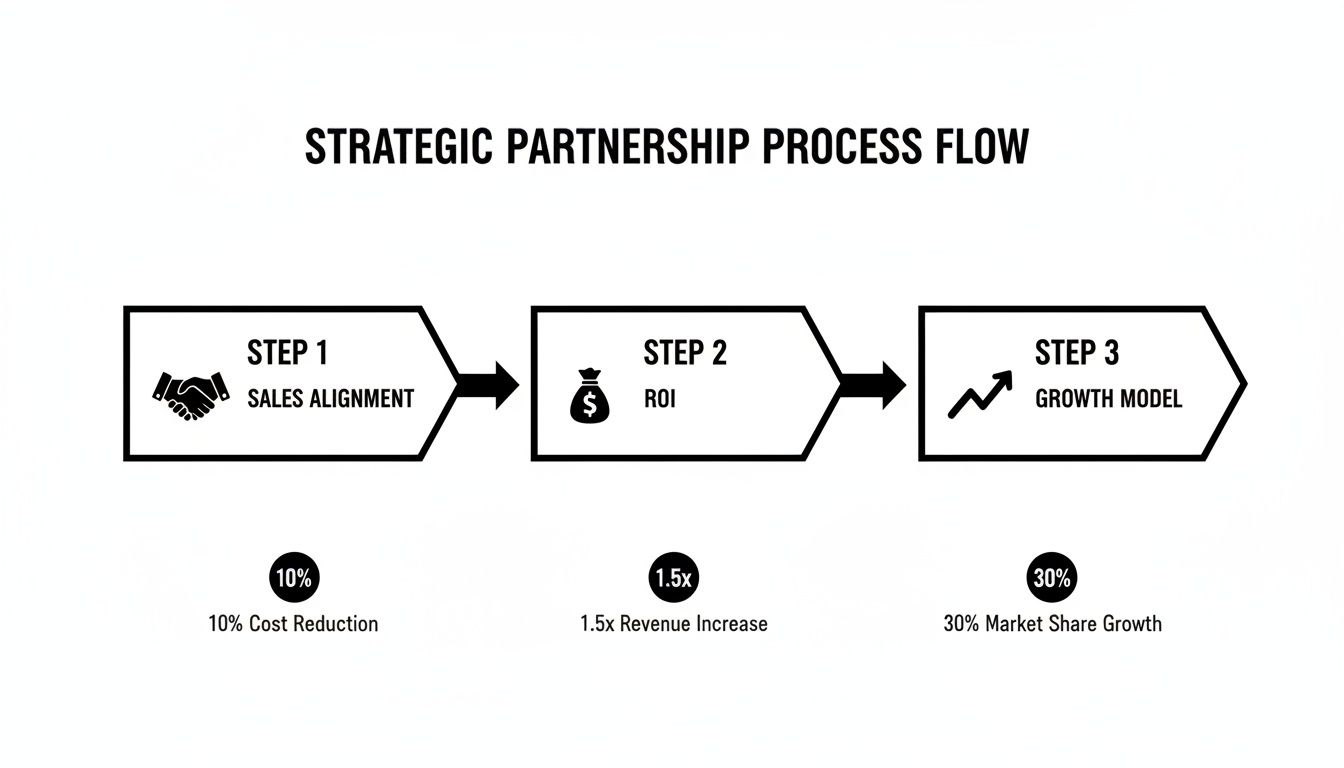
The key takeaway is that each step is connected. This creates a flywheel effect where better alignment leads to better financial results and a much stronger growth trajectory.
The final output is the Strategic Marketing Roadmap. This is your prioritized plan, detailing specific initiatives, timelines, required resources, and the exact KPIs you'll use to measure success. To see what kinds of tactics might make up a roadmap like this, take a look at our full range of B2B marketing services.
This table provides a high-level overview of how these phases typically unfold, clarifying the activities and outcomes at each step.
Phases of a Strategic Marketing Engagement
| Phase | Key Activities | Primary Deliverable |
|---|---|---|
| 1. Discovery & Audit | Stakeholder/customer interviews, data analysis, competitive review, and internal process mapping. | A Comprehensive Findings Report detailing strengths, weaknesses, and key growth opportunities. |
| 2. Strategy & Roadmap | Goal setting, defining strategic pillars, initiative prioritization, and resource planning. | A Strategic Marketing Roadmap with clear initiatives, timelines, KPIs, and budget allocation. |
| 3. Implementation | Sourcing talent, project management, creative feedback, and technology stack recommendations. | A Project & Accountability Plan to keep execution on track and ensure quality. |
| 4. Optimization | KPI tracking, performance reporting, A/B testing analysis, and iterative strategy adjustments. | Ongoing Performance Reports & Strategy Refinements to maximize ROI. |
Each stage is designed to flow logically into the next, ensuring that strategy is never disconnected from execution.
Phase 3: Implementation Oversight
A plan is only as good as its execution. In this phase, the consultant shifts from pure strategist to a guide and an accountability partner. They don't usually do all the day-to-day work—that’s your team’s job—but they provide the senior-level oversight to make sure the plan is implemented correctly and stays on track.
This is a highly collaborative stage. Your consultant might help you find and vet freelancers or agencies, give feedback on ad creative, or help your team get the hang of new marketing software. They essentially act as a fractional CMO, giving you executive-level guidance without the full-time cost.
Regular check-ins, performance reviews, and hands-on project management support are the cornerstones here. It’s all about clearing roadblocks and empowering your team to execute with confidence.
Phase 4: Performance Optimization
Finally, a marketing strategy is never "set it and forget it." The market changes, customers evolve, and your plan has to adapt. The optimization phase is a continuous loop of measuring, analyzing, and refining.
Using the KPIs set in the roadmap, the consultant helps you track progress and see what's working and what isn't. This data-driven feedback loop allows for smart, agile adjustments. Maybe one content pillar is outperforming all others, or a paid channel isn't delivering the right quality of leads. Based on that data, you can double down on what’s working and pull back from what isn't, making sure your marketing investment is always pulling its weight.
How to Choose the Right Consulting Partner
Picking a strategic marketing partner is, without a doubt, the most important decision you'll make in this entire journey. The right firm is a force multiplier for your team, bringing a level of clarity and focus that can truly accelerate growth.
But the wrong one? They can burn through your budget in a heartbeat and leave you more confused than when you started.
This isn't about hiring another vendor to just check tasks off a list. You're looking for a genuine partner—someone who will embed themselves in your business, understand your vision, and get in the trenches with you. That means you have to look past the slick sales pitch and really dig into their experience, process, and, just as importantly, their cultural fit.
Look for Proven SaaS Expertise
The B2B SaaS world plays by its own rules. We’re talking longer sales cycles, complex buyer committees, and a very specific set of metrics that matter—CAC, LTV, churn, you know the drill. A consultant who spends their days working with e-commerce or local service businesses just won't get the nuances.
You need a partner who lives and breathes SaaS. It should be obvious from the moment you start talking to them.
Here’s how to spot the real deal:
- Case Studies That Mirror Your Problems: Don't get distracted by big-name logos. Ask for examples of companies that were staring down the same challenges you are. Were they struggling with lead quality? A sales cycle that dragged on forever? Low trial-to-paid conversion rates?
- Industry Fluency: They need to speak your language without a second thought. Do they naturally talk about Product-Led Growth (PLG), the difference between MQLs and SQLs, and Annual Recurring Revenue (ARR)? If they stumble here, that's a red flag.
- A Relevant Network: A well-connected consultant in the SaaS space is invaluable. They often have a trusted network of other experts—from sales trainers to UX designers—that can become an extension of your team.
Assess Their Strategic Process and Communication Style
A brilliant strategy is completely useless if the process for creating and implementing it is a chaotic mess. Your first few conversations should give you a clear window into how they operate. A top-tier consultant is organized, transparent, and works from a well-defined methodology.
The right consulting partner won't just give you answers; they will ask you the right questions. Their goal should be to deeply understand your business, challenge your assumptions, and co-create a strategy with your team, not just hand over a document.
Ask them to walk you through a typical engagement. How do they kick off the discovery and audit phase? What does their communication cadence look like—weekly check-ins, monthly reports? You're looking for someone who values collaboration and provides clear, consistent updates.
Key Questions to Ask a Potential Consulting Partner
When you're vetting potential partners, the quality of your questions will dictate the quality of your decision. Get past the surface-level stuff and dig into the "how" and "why" of their approach.
Here’s a checklist of questions to guide those crucial conversations:
Process and Integration:
- "Walk me through the first 30 days of an engagement with a company like ours. What actually happens?"
- "How do you make sure the strategy you build actually gets adopted by our team and doesn't just collect dust?"
- "What level of involvement will you need from our leadership and other key departments?"
Measuring Success:
- "How do you define and measure success? Can you give me a specific client example?"
- "What are the leading indicators you track to know we're on the right path, before we see lagging results like revenue?"
- "What happens if we're not hitting our goals? How do you approach course corrections?"
Experience and Fit:
- "Tell me about a time you had to deliver difficult feedback to a client. What was the situation, and how did it turn out?"
- "Which of your past projects are you most proud of, and why?"
- "What type of client is not a good fit for you?" (This one is very telling!)
The answers you get will reveal everything you need to know about their strategic depth, their commitment to a true partnership, and whether their working style fits your company's culture. Finding that alignment is the key to a successful and impactful strategic marketing consulting relationship.
Measuring the ROI of Your Consulting Investment

At the end of the day, every business decision boils down to one simple question: what’s the return? Bringing on a strategic marketing consultant is no different. It’s not just another expense; it’s a capital investment in building a predictable, scalable growth engine. But to justify it, you need to know how to measure the impact.
Calculating the ROI of a consultant isn’t a single, clean number. It’s about tracking a story told through interconnected metrics that paint a full picture of your company’s health, from early signs of momentum to long-term profitability. To get that full picture, you need to look at two kinds of indicators: leading and lagging.
Leading Indicators: Your Early Warning System
Think of leading indicators as your early warning system. They give you immediate feedback that the new strategy is working, often long before the big revenue numbers start rolling in. These are the first signs that your investment is already paying off.
Consider them the vital signs of your marketing engine:
- Improved MQL Quality: You stop chasing volume and start attracting the right leads. This means your sales team spends less time sifting through noise and more time in meaningful conversations.
- Higher Conversion Rates: A clearer message and a targeted strategy naturally lead to more visitors taking the action you want, whether that's booking a demo, signing up for a trial, or downloading a resource.
- Shorter Sales Cycles: When marketing hands off genuinely qualified, educated prospects, deals close faster. That six-month sales cycle might just shrink to four.
These early wins are vital. They build confidence across the team and prove that the strategic shifts are making a real-world difference right away.
Building the business case for a consultant is about changing the conversation from cost to value. It reframes the engagement as a high-yield investment in profitable growth, not just another line item on the marketing budget.
Lagging Indicators: The Financial Proof
While leading indicators show you're on the right track, lagging indicators are where you see the financial payoff. These are the bottom-line results that the C-suite and investors live and breathe. They reflect the true financial health and long-term viability of your business.
These are the core metrics that prove your investment was a success:
- Increased Customer Lifetime Value (CLV): A better strategy doesn't just attract new customers; it attracts the right customers—the ones who stick around longer and become more valuable over time.
- Lower Customer Acquisition Cost (CAC): By cutting out the channels that don’t work and doubling down on what does, you acquire new customers far more efficiently.
- Higher Marketing-Sourced Revenue: This is the big one. You can confidently point to a growing percentage of new revenue and say, "Marketing did that."
A great consulting partnership is laser-focused on moving these numbers. It isn't about delivering a binder of recommendations; it's about driving execution that produces tangible results. According to Hinge Marketing's 2024 High Growth Study, the fastest-growing professional services firms are growing 4.4 times faster than their peers, showcasing the power of strategic focus.
By tracking both leading and lagging indicators, you can build a powerful business case that shows both immediate progress and lasting financial gain. To see how to structure your internal operations for this kind of success, take a look at our guide on The Content Marketing Operations Maturity Model.
Common Questions About Strategic Marketing Consulting
If you're thinking about bringing in a strategic marketing consultant, you probably have a few questions. That's smart. Let's walk through some of the most common ones we hear from SaaS leaders.
What's the Real Difference Between a Consultant and an Agency?
It’s a great question, and the answer is a lot like the difference between an architect and a general contractor.
A strategic marketing consultant is your architect. They’re the ones who dive deep into your business goals, your market, and your customers to draw up the master blueprint for growth. They figure out the why and the what—the core strategy that will get you where you need to go.
A marketing agency, on the other hand, is the contractor. They are the specialists who come in to build what the architect designed. They’re fantastic at the how—executing specific tasks like running Google Ads, producing content, or managing social media channels based on that strategic blueprint. Often, the best results come from having both: the consultant guiding the big picture and the agency executing the day-to-day work flawlessly.
How Long Does a Typical Engagement Last?
There's no one-size-fits-all answer, but a full strategic deep-dive usually takes somewhere between three to six months. This gives you enough time to do the upfront discovery work properly, build a robust strategy and roadmap, and then help guide the initial rollout to make sure it gets off to a strong start.
This isn't about a quick, temporary fix. The whole point is to build a growth engine that lasts. That means taking the time to create a solid foundation and making sure your team is set up for success long after the initial project is done.
After that foundational work is complete, many clients shift to a more flexible advisory retainer. This keeps a C-level strategist in their corner to help navigate challenges and optimize performance, but with a much lighter monthly commitment.
How Much Does Strategic Marketing Consulting Cost?
The investment can vary quite a bit depending on the scope of the project. For a comprehensive strategy and roadmap, most B2B SaaS companies can expect project fees to fall somewhere in the $15,000 to $50,000+ range. For ongoing advisory work, retainers typically run between $5,000 and $15,000 per month.
The key is to stop thinking of it as a "cost" and start seeing it as an investment in predictable revenue. A good consultant doesn't just spend your money; they show you how to invest it more intelligently to shorten your sales cycle, attract better customers, and ultimately drive a serious return.
Ready to stop guessing and start building a predictable revenue engine? The team at Mick-Mar Inc. specializes in creating data-driven marketing strategies that deliver real results for B2B SaaS companies. Schedule a free consultation today and let's build your blueprint for growth.