
Let's be honest, creating content without a plan is like trying to build a house without a blueprint. You might end up with a few walls and a roof, but it’s probably not going to be a place anyone wants to live in. A digital marketing content strategy is that essential blueprint for everything you publish.
It’s the master plan that connects every blog post, webinar, and social media update back to your core business goals. The whole point is to make sure you’re not just making noise, but creating the right content, for the right people, at the right time.
What Is a Digital Marketing Content Strategy Anyway?

Think of it this way: your marketing efforts are the construction crew. Without the architect's blueprint—your content strategy—the crew is just guessing. They might pour a foundation here or put up a frame there, but nothing connects. The end result is chaotic, inefficient, and definitely not built to last.
Without a strategy, you’re stuck in a cycle of what I call "random acts of content." A blog post this week, a LinkedIn update next week, maybe a video when someone has time. These sporadic efforts might create a little buzz, but they rarely lead to predictable, sustainable growth.
Why This Blueprint Is Non-Negotiable
A documented strategy is what turns your marketing from a guessing game into a reliable growth engine. It brings clarity and purpose to your team, guiding every decision on what to create, where to publish, and how to tell if it's actually working. For SaaS and B2B companies, where the sales cycle is long and trust is everything, this isn't just a nice-to-have; it's the foundation of your business.
A solid plan helps you:
- Zero in on the right audience by creating content that speaks directly to their biggest challenges.
- Establish real authority and trust by consistently providing genuinely helpful information.
- Boost your SEO performance by systematically targeting the keywords and topics your audience is searching for.
- Generate high-quality leads by thoughtfully guiding people from casual interest to a purchasing decision.
A content strategy isn't just a list of blog post ideas. It's a documented plan that clearly states your business goals, defines your target audience, and explains exactly how your content will bridge that gap. It's the 'why' behind the 'what.'
To see the difference clearly, let's break it down.
Strategy vs Tactics Quick Comparison
| Aspect | With a Content Strategy (The Blueprint) | Without a Content Strategy (Random Acts of Content) |
|---|---|---|
| Foundation | Based on audience research, business goals, and data. | Driven by gut feelings, trends, or what competitors are doing. |
| Direction | Clear, long-term vision. Every piece has a purpose. | Inconsistent and short-sighted. Chasing shiny objects. |
| Content Creation | Proactive and planned. Content serves a specific journey stage. | Reactive and sporadic. "We need a blog post for this week!" |
| Measurement | Focused on meaningful business KPIs like leads and revenue. | Measured by vanity metrics like likes, shares, and traffic spikes. |
| Outcome | Creates a sustainable, predictable growth engine and a brand asset. | Leads to burnout, wasted resources, and inconsistent results. |
| Team Alignment | Everyone is rowing in the same direction toward shared goals. | Teams work in silos, often duplicating effort or sending mixed messages. |
Ultimately, a strategy gives you a framework for making smart, consistent decisions, while a tactics-only approach leaves you guessing.
The proof is in the numbers. Recent data shows that the global content marketing market is projected to grow substantially, underscoring its shift from a trend to a fundamental business practice. It's no surprise that 84% of organizations now have a formal content strategy in place, according to the latest content marketing trends from Blogging Wizard. If you're not one of them, you're not just falling behind—you're building without a plan.
Building Your Strategy's Foundation
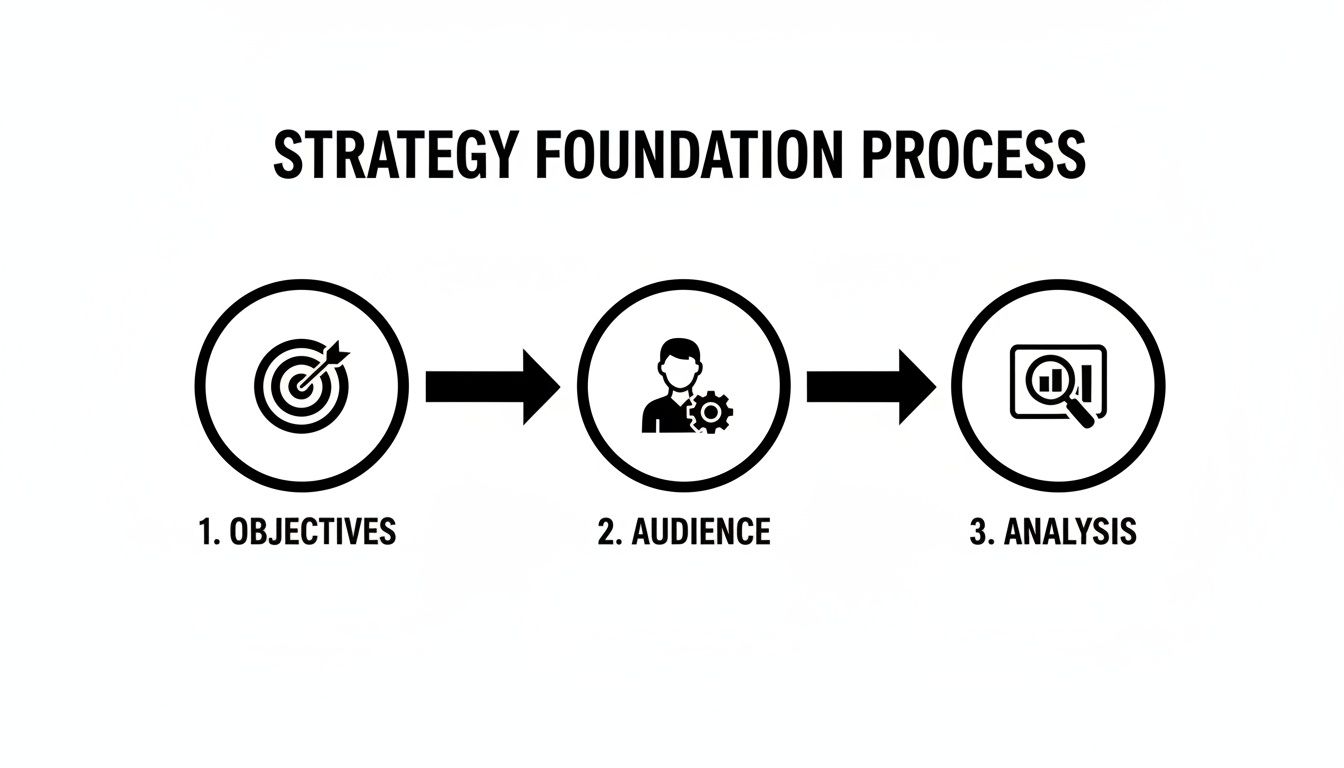
Every great building starts with a solid foundation, and your digital marketing content strategy is no different. This is where we move from big ideas to a concrete plan of attack, laying the groundwork that will support every single piece of content you create. If you skip this part, you're building on sand—your efforts might look good for a minute, but they won't last.
This foundational stage is all about making deliberate choices. It means getting crystal clear on what you want to achieve, understanding who you're talking to on a deep, human level, and knowing the competitive landscape you're walking into.
Let's break these essentials down into actionable steps.
Define Your Business Objectives
Before you write a single blog post or record a single video, you have to know why you're doing it. Your content needs a job to do, and that job must be tied directly to a real business goal. Otherwise, you're just making noise, and that’s a quick way to burn through your budget with nothing to show for it.
Start with a simple question: What does a "win" look like for our business in the next quarter or year? Your content is a tool to get you there.
For most B2B and SaaS companies, the usual suspects are:
- Generating more qualified leads by getting the contact info of people actively looking for what you sell.
- Increasing brand authority and becoming the name everyone trusts for insights in your niche.
- Improving customer retention by creating helpful content that turns users into power users.
- Driving organic traffic to your site by showing up when your ideal customers search for answers on Google.
Our friendly advice? Pick one or two primary goals to really focus on. Trying to do everything at once just dilutes your efforts and makes it impossible to figure out what's actually moving the needle. A clear objective is your North Star—it guides every decision from here on out.
Deep Dive Into Your Audience
Once you've got your "why," it’s time to nail down your "who." You simply can't create content that hits home if you don't truly get the people you're trying to reach. This goes way beyond surface-level demographics. To build a winning strategy, you need detailed buyer personas.
A buyer persona is essentially a character sketch of your ideal customer, pieced together from real data and market research. Think of it as creating a profile for the exact person you want to attract.
To build a persona that’s actually useful, you need to dig into:
- Their professional world: What’s their job title? What does a typical day look like for them?
- Their biggest headaches: What problems keep them up at night? What challenges are they trying to solve that your product can fix?
- Their goals and motivations: What does success look like in their role? What are they trying to accomplish?
- Where they hang out online: What blogs do they read? Which social media channels are they on? What industry communities are they part of?
You can gather all this by interviewing your best customers, sending out surveys, and—our personal favorite—just talking to your sales and support teams. They're on the front lines every day. This research turns a vague "target audience" into a real person you can write for.
Conduct Keyword and Competitive Analysis
With your goals set and your audience in focus, the last foundational piece is to map out the terrain. You need to know what topics your audience is searching for and what your competitors are already saying about them. This is how you find your unique angle and spot opportunities everyone else has missed.
Start with keyword research. Use tools to find the exact phrases your buyer personas are typing into search engines. The goal isn't just traffic; it's about attracting the right traffic—people who are actively looking for a solution like yours.
Next, do a little competitive analysis. Pick 3-5 of your main competitors and see what they're up to. Look for:
- What topics are they owning?
- Which of their articles get the most traffic and shares?
- What content formats are they using (e.g., blogs, videos, webinars)?
- And most importantly, where are the gaps? What aren't they talking about that your audience needs to know?
This analysis is your secret weapon. Instead of just copying what others are doing, you can create content that goes deeper, offers a fresh take, or answers questions your competitors have completely ignored.
Nailing these three things—your goals, your audience, and the competitive landscape—gives you the unshakable foundation your entire strategy needs. To help put it all together, this comprehensive content marketing strategy template is a great resource for organizing these foundational elements into a clear plan.
Mapping Content to the Buyer's Journey
Creating great content is only half the battle. The real magic happens when you get that content in front of the right person at the exact moment they need it. That's what separates a decent content strategy from a truly effective one.
Think of it like a conversation. You wouldn't ask someone to marry you on the first date, right? In the same way, you can't push for a product demo when someone is just starting to figure out they even have a problem.
The buyer’s journey is simply the path people take from first realizing they have a problem to making a final purchase. When you map your content to each stage of this journey, you create a natural, helpful dialogue that guides potential customers from being total strangers to becoming your biggest fans. This turns your content from a random collection of articles into a powerful system for nurturing leads.
The Awareness Stage: "What's My Problem?"
In the Awareness stage, your potential customer is just waking up to a problem. They might not even have the words for it yet. They're asking "why" questions, like, "Why is our sales pipeline so sluggish?" or "Why does our team's workflow feel so chaotic?" They aren't looking for your product; they're looking for answers.
Your role here is to be the helpful expert, not a salesperson. The content you create for this stage needs to be purely educational and focused on their pain points. The goal is to build trust and get your brand on their radar as a credible resource.
Good formats for this stage include:
- Educational blog posts that answer their most pressing questions.
- Informative infographics that make complex topics or data easy to digest.
- Explainer videos that offer a high-level look at a specific challenge or concept.
This is your first impression. Make it a good one by simply being helpful.
The Consideration Stage: "What Are My Options?"
Once someone has put a name to their problem, they enter the Consideration stage. Now, they're on a mission, actively researching and comparing potential solutions. Their questions shift from "why" to "how," such as "How can we automate our workflow?" or "How do the top project management tools stack up?"
At this point, your content can become more solution-oriented, but you're still not going for the hard sell. You're moving the conversation from defining the problem to exploring the solutions. This is your chance to show off your expertise and prove you genuinely understand their world.
The goal of Consideration stage content is to position your brand as the best possible solution by providing in-depth, valuable guidance that helps the buyer make an informed decision.
This is where the foundational work of setting objectives, knowing your audience, and analyzing the competitive landscape really pays off. It ensures what you create for each stage is perfectly aligned with both your business goals and your audience's needs.
Content that shines in the Consideration stage:
- In-depth guides or eBooks that provide a comprehensive roadmap for solving their problem.
- Case studies that tell a compelling story of how a similar company found success with your help.
- Webinars featuring industry experts who can discuss best practices and different solutions.
- Comparison articles that honestly weigh the pros and cons of various approaches (including yours).
The Decision Stage: "Are You the Right Choice?"
Finally, the prospect arrives at the Decision stage. They’ve done their homework, they have a short list, and they're ready to pull the trigger. Now they're asking "which" questions: "Which subscription plan is right for us?" or "Which company offers the best customer support?"
This is your moment. It’s time to be direct and make your offer. Content in this stage should be all about your product, designed to knock down any final barriers to purchase and make it incredibly easy for them to choose you. This is where you convert all that built-up interest into action.
Effective Decision stage content includes:
- Product demos and free trials so they can see and feel the solution for themselves.
- Clear, transparent pricing pages that eliminate any confusion or last-minute surprises.
- Customer testimonials and reviews to provide that crucial social proof and build their confidence in you.
By thoughtfully guiding people through these three stages, you create a seamless journey that feels helpful and authentic, not aggressive. And that’s how you turn a curious reader into a loyal customer.
Choosing Your Channels and Content Formats
Even the best content on earth is useless if no one ever sees it. A winning content strategy isn't just about what you say, but where and how you say it. This is all about picking the right channels and content formats that your audience actually enjoys.
Think of your content like a carefully crafted package. Your channels—your blog, social media, email—are the delivery trucks. If you send that package with the wrong service, it gets lost, delayed, or dropped at the wrong house. Picking the right channels ensures your valuable content gets delivered straight into the hands of the people who need it most.
Mastering Your Core Channels
The goal isn't to be everywhere. Trying to post on every single platform is a fast track to burnout and watered-down results. The smart play is to master a few key channels where your ideal customers are already hanging out. For most B2B and SaaS companies, this usually means a powerful trio.
-
Your Company Blog: This is your home base. It’s the engine that powers your SEO and the library where you store your most valuable assets. A great blog attracts organic traffic day in and day out, answers customer questions at scale, and cements your brand as a go-to authority.
-
Social Media: This is where you build your community. Platforms like LinkedIn are perfect for B2B, letting you connect with peers, share quick insights, and put a human face on your brand. It’s less about the hard sell and more about starting real conversations.
-
Email Marketing: Still one of the most direct and powerful ways to build relationships. Once someone trusts you with their email address, you have a direct line to them. Email is unparalleled for guiding prospects through their journey with personalized, relevant content.
Selecting Formats That Resonate
Just as important as the channel is the format you use. A 3,000-word guide might be a killer blog post, but it would be a complete flop as a TikTok video. You have to match the format to the channel and, more importantly, to how your audience likes to consume information.
Social media, in particular, has totally changed the game. A recent analysis found that social media users spend nearly 2.5 hours per day on these platforms, making it a critical space for engagement. And what are they watching? Video. It's the undisputed champ, with a staggering 91% of businesses using it as a key marketing tool in 2023. For content strategists, this means short-form videos and influencer stories aren't just nice-to-haves anymore. You can dig into more of these trends in these digital marketing statistics from Marketing Dive.
Your content format should never be an afterthought. It’s a strategic choice that dictates how your message is received. Choose formats that make it easy for your audience to say "yes" to engaging with you.
The Power of Content Repurposing
Let's be real: creating genuinely great content takes a ton of time and resources. But here's the good news—you don't have to reinvent the wheel for every single post. This is where the magic of content repurposing comes in.
Content repurposing is simply the art of taking one big piece of content and spinning it into multiple different formats for different channels. This isn't just copying and pasting. It’s about intelligently adapting your core message to fit a new context, and it's one of the most efficient things you can do.
Here’s what that looks like in action:
- Start with a Pillar Asset: Let's say you host a one-hour webinar on a hot industry topic.
- Blog Post Series: You can break down the webinar’s main sections into four in-depth blog posts.
- Social Media Clips: Snip the most compelling 60-second moments from the recording into short video clips for LinkedIn or X.
- Infographic: Pull out all the key stats and data points and have a designer create a shareable infographic.
- Email Nurture Sequence: Use the core ideas to write a five-part email series for new subscribers.
Just like that, one hour of work turned into more than a dozen unique pieces of content. If you want to dive deeper, we've got a ton of actionable ideas in our guide on effective content repurposing strategies. This approach gets your message in front of more people on more platforms, all without burning out your team.
Measuring Success and Proving ROI
Look, creating great content is a fantastic start. But if you can't show it's actually working, your strategy is just flying blind. The old saying, "If you can't measure it, you can't improve it," has never been more relevant. It's so easy to get lost in a sea of "vanity metrics"—likes, shares, and page views that make you feel good but don't actually move the needle on business results.
A powerful content strategy cuts right through that noise. It zeroes in on Key Performance Indicators (KPIs) that directly connect your content efforts to tangible business goals. This is how you prove your value, justify your budget, and make smart decisions to steer the ship. The whole point is to shift the conversation from "how many people saw our content?" to "what business impact did our content create?"
Aligning KPIs With Your Business Goals
The real secret to meaningful measurement is to stop tracking everything and start tracking the right things. The metrics that truly matter depend entirely on the business objectives you set from the beginning. Let's connect the dots.
-
If your goal is Brand Awareness: You're trying to become a recognized name in your space. Your KPIs need to reflect your growing reach and authority. Think organic traffic (are more people finding you via search?), keyword rankings (are you climbing the SERPs for terms that matter?), and social mentions (is your brand's share of the online conversation growing?).
-
If your goal is Lead Generation: Now, the focus shifts from eyeballs to actions. You need to fill the sales pipeline. Key metrics here are conversion rate (what percentage of visitors download your guide or book a demo?), Cost Per Lead (CPL) (how much are you spending to get one new lead?), and lead quality (are these MQLs that sales will actually be happy to talk to?).
-
If your goal is Customer Loyalty & Retention: For SaaS and B2B, this is huge. You want to keep the customers you have and turn them into fans. You'll want to track engagement rate (are people actually reading and interacting with your content?), repeat visitor rate (are they coming back for more?), and even look for correlations between content consumption and a higher Customer Lifetime Value (CLV).
Ultimately, a core part of any content strategy is knowing how to measure content performance to make sure your hard work is paying off.
To help you visualize this, here’s a breakdown of which KPIs to focus on for common business goals.
Key Content Marketing KPIs by Business Goal
| Business Goal | Primary KPIs to Track | Example Metric |
|---|---|---|
| Brand Awareness | Organic Traffic, Keyword Rankings, Social Mentions, Share of Voice | 25% increase in non-branded organic traffic quarter-over-quarter. |
| Lead Generation | Conversion Rate, MQLs Generated, Cost Per Lead (CPL) | 50 new MQLs generated from blog content in Q2 at a CPL of $75. |
| Sales Enablement | Content Usage by Sales, Lead-to-Customer Conversion Rate | Sales team used the new case study in 30% of late-stage deals. |
| Customer Loyalty | Repeat Visitor Rate, Engagement Rate (Time on Page, Comments) | 40% repeat visitor rate for the customer-focused knowledge base. |
This table isn't exhaustive, but it gives you a solid starting point for connecting your content activities directly to business outcomes.
Creating a Simple Measurement Dashboard
You don't need some ridiculously complex system to track your progress. Honestly, a simple dashboard in a spreadsheet can give you all the clarity you need to prove your content’s return on investment (ROI). It's all about presenting the right data in a way that tells a clear story to your boss and other stakeholders.
For a more detailed look, our guide on how to measure marketing ROI gets into the nitty-gritty of the financial side of things.
Your dashboard needs to translate content metrics into business language. Instead of just reporting "organic traffic went up 20%," you connect it to an outcome: "Our focus on top-of-funnel blog content drove a 20% increase in organic traffic, which generated 50 new marketing-qualified leads for the sales team last quarter." See the difference? That framing immediately shows the business impact.
A great measurement framework doesn't just report on the past; it informs the future. It helps you see which content pillars are resonating, which channels are delivering, and where you should double down on your efforts.
By consistently tracking these goal-aligned KPIs, you transform your content from a line item expense into a proven revenue driver. This data-driven approach is what separates the good content marketers from the great ones.
Your 90-Day Content Strategy Action Plan

A great strategy is just a document until you put it into action. To get this off the ground and start seeing real results, let’s break the whole process down into a practical 90-day roadmap.
This plan is all about building momentum. We'll start with the foundational work, move into creating and publishing content, and wrap up by learning from the data so we can get smarter.
Think of it like building a house. The first month is pouring the concrete foundation—it has to be solid, and you can't rush it. The second month is framing the walls and getting the structure up. The final month is inspecting the work and deciding which rooms to finish next.
Month 1: Foundation And Planning
Your first 30 days are all about discovery and setup. The goal is to get razor-sharp clarity on your goals, your audience, and what your competitors are doing before you write a single word. This upfront work saves you from wasting time and money later.
Here’s your checklist for getting started:
- Finalize Business Objectives: Nail down your primary goal (e.g., generate 50 marketing-qualified leads) and a secondary one (e.g., boost organic traffic by 15%).
- Conduct Audience Interviews: Talk to at least five current customers and a couple of people from your sales team. This is the fastest way to refine your buyer personas with real-world insights.
- Perform a Content Gap Analysis: Find three to five core topics that your audience is looking for but your competitors are completely ignoring.
- Set Up Analytics: Double-check that Google Analytics, your CRM, and other tools are configured correctly to track your KPIs from the very beginning.
Month 2: Creation And Launch
With a solid foundation in place, month two is where the fun begins. Now it’s time to start producing your first key pieces of content and getting them out into the world. The focus here is on quality, not quantity, as you begin to test the waters with your new strategy.
This is also the perfect time to build your content workflow. You need a central place to manage everything, and our guide on how to create a content calendar walks you through setting up a production schedule that actually works.
Your main tasks for this month:
- Develop Your First Pillar Post: Create one big, authoritative piece of content—like a 3,000-word guide—based on the research you did last month.
- Create Supporting Content: Break down that pillar post into smaller, bite-sized assets. Think three related blog posts, five social media clips, and one infographic.
- Launch Your First Campaign: Start promoting your new content on your primary channels, like your email newsletter and LinkedIn page.
Key Insight: Your first content launch isn't a final exam; it's a live experiment. Pay close attention to the early engagement signals—they’ll tell you exactly what’s hitting the mark with your audience.
Month 3: Measurement And Optimization
In the final month of the plan, your focus shifts from creating to listening. You now have enough performance data to see what’s working, what’s flopping, and where you should be putting more energy. What you learn here will shape your entire strategy for the next quarter.
The goal is to stop guessing and start making decisions based on hard data. Dive into your dashboards and look for the story the numbers are telling you.
Your priorities for this month:
- Analyze Early Performance Data: Which formats and channels brought in the most traffic, engagement, and leads?
- Gather Audience Feedback: Don’t be afraid to ask. Send a quick survey to your email list or run a poll on social media to get direct input.
- Plan Your Next Content Sprint: Use your findings to map out your content for the next 90 days, doubling down on the tactics that proved successful.
Frequently Asked Questions
Even with the best-laid plans, questions will always come up. A digital marketing content strategy has a lot of moving parts, and let's be honest, it can get a little tricky. Here are some quick, no-nonsense answers to the questions we hear most often from marketers.
Think of this as your go-to cheat sheet for those moments when you just need a straight answer to keep things moving.
How Often Should I Publish New Content?
Ah, the classic "quality vs. quantity" debate. The real answer? Consistency always trumps frequency. It’s much, much better to publish one incredible, deeply researched article every single week than it is to churn out five mediocre posts whenever you have a spare moment.
The right publishing cadence is all about your audience and what your team can realistically handle. A B2B SaaS company might see fantastic results from one powerful pillar post and a handful of social media updates each week. On the other hand, a consumer-facing brand might need to be on social media daily just to stay top-of-mind.
Our advice? Start with a schedule you know you can stick to. From there, watch your analytics like a hawk to see what frequency actually drives the best results.
What Is the Difference Between a Content Strategy and an SEO Strategy?
Here’s a simple way to think about it: your content strategy is the 'what' and the 'why.' It’s the blueprint that decides what topics you'll cover to hit specific business goals. Your SEO strategy is the 'how'—it’s the set of tactics you use to make sure search engines, and more importantly, actual people, can find your great content.
An SEO strategy is a crucial pillar that holds up your content strategy. But a complete content plan goes way beyond search rankings, mapping out how you’ll use channels like social media and email to connect with customers at every single stage of their journey.
How Do I Generate Content Ideas That Resonate?
The best content ideas almost never come from sitting in a conference room trying to brainstorm. They come from one place: your audience. Your goal is to become an obsessive expert on their problems.
- Talk to your internal teams. Go through customer support tickets. Take your sales reps out for coffee and ask them about the most common questions they get from prospects. This is gold.
- Be a fly on the wall. Hang out in industry forums, LinkedIn Groups, or subreddits where your ideal customers are. What are they complaining about? What questions are they asking over and over?
- Use the tools of the trade. Dig into keyword data to see what people are actively searching for. Use a tool like Ahrefs or Semrush to analyze your competitors' top-performing content and find the gaps you can fill.
When you blend these approaches, you'll never run out of audience-focused ideas that actually make an impact.
Ready to stop throwing content at the wall and start building a predictable growth engine? Mick-Mar Inc. specializes in creating powerful digital marketing content strategies for B2B and SaaS companies. Let's build a roadmap that drives real business results. Learn how we can help you grow.