An integrated marketing communications strategy—often called IMC—is a plan to get all your marketing channels singing from the same hymn sheet. It’s the difference between a brand that feels solid and trustworthy and one that just feels… a bit all over the place.
This approach ensures every single customer interaction, from a LinkedIn ad to a sales demo, tells the same cohesive story.
What an Integrated Marketing Communications Strategy Really Means

Let's cut through the jargon. An integrated marketing communications strategy isn’t about just being active on a bunch of different platforms. It’s about orchestrating them so they work together to create a single, powerful voice for your SaaS brand.
Think of it like this: you can have a group of talented musicians all playing their own tune on a street corner, or you can have a symphony orchestra. In the orchestra, every musician has a different part, but they're all following the same conductor and the same piece of music. The result is something powerful and moving that a jumble of individual efforts could never match. That's IMC in a nutshell.
This strategy directly tackles a problem most SaaS companies know all too well: siloed marketing teams. The content team is over here, the PR team is over there, and the digital ads team is off in its own world. Everyone's working hard, but their disconnected efforts often lead to mixed messages that confuse customers and dilute the brand's impact.
The Growing Need for a Unified Voice
In today's hyper-competitive SaaS world, a unified message isn't a "nice-to-have" anymore. It's essential. Your potential customers bounce between dozens of touchpoints before they ever think about buying. They might see a post on LinkedIn, read a G2 review, visit your pricing page, and then finally talk to your sales team.
If your messaging, tone, and value proposition feel different at each of these steps, it creates friction and erodes trust. A truly integrated strategy smooths out that journey, ensuring that no matter how someone interacts with your brand, the experience is consistent and reinforces your core promise. This is how you build real brand loyalty and drive revenue.
The market data backs this up. The global IMC market was valued at around USD 2,965.2 million in 2024 and is expected to hit nearly USD 6,352.99 million by 2031, growing at a compound annual rate of about 11.5%. This explosive growth is driven by the clear need for consistent brand stories across a dizzying number of channels. You can dive deeper into the market trends in the full IMC market research.
An integrated strategy isn't about shouting the same message everywhere. It's about telling a consistent story that adapts intelligently to the context of each channel, creating a richer, more engaging brand narrative for your audience.
To help you get started, here’s a quick overview of the key pillars we'll be building on throughout this guide.
Key Pillars of an Integrated SaaS Marketing Strategy
| Pillar | Core Function | Example SaaS Application |
|---|---|---|
| Clear Objectives | Defining what success looks like in measurable terms. | Increase trial sign-ups from enterprise accounts by 25% in Q3. |
| Audience & Journey | Deeply understanding who you're talking to and how they buy. | Mapping the path from a blog post view to a demo request for a fintech CFO persona. |
| Unified Messaging | Crafting a core value proposition that is consistent everywhere. | A productivity tool's message of "regain your focus" is used in ads, website copy, and sales scripts. |
| Channel Integration | Making different marketing channels work together. | A webinar (Events) is promoted via email and LinkedIn ads (Digital) and repurposed into a blog post (Content). |
| Measurement & KPIs | Tracking performance and proving ROI across the entire funnel. | Using attribution modeling to see how PR mentions influence branded search and lead generation. |
These pillars form the foundation of a robust IMC strategy.
This guide is designed to move you from theory to practice. We're about to lay out a practical framework, complete with actionable advice, to help you build and launch your own successful integrated marketing communications strategy.
Building the Foundation for Your IMC Plan

Before a single ad gets launched or an email gets sent, the real work begins. A brilliant integrated marketing communications strategy isn’t just about clever campaigns; it's built on a bedrock of crystal-clear goals and a genuine, almost obsessive, understanding of your audience.
Getting this initial planning phase right is what separates the campaigns that make a real business impact from those that just make noise. Think of it like a blueprint for a house—you wouldn't start hammering without one. For a deeper dive into this initial setup, exploring an effective strategic planning process is a great way to ensure every piece of your IMC plan aligns with your big-picture business goals.
Define Your Objectives with Precision
Let’s be real. Goals like "get more leads" or "increase brand awareness" aren't goals; they're wishes. They lack the teeth needed to drive a focused strategy. To get this right, your objectives have to be specific, measurable, and directly tied to a business outcome. This is how you prove marketing’s worth and keep everyone pulling in the same direction.
Here's how to turn a vague wish into a real objective:
- Vague Goal: "We need more leads."
- Actionable IMC Objective: "Increase Marketing Qualified Leads (MQLs) from enterprise accounts by 25% next quarter by integrating targeted LinkedIn ads with our upcoming webinar series."
See the difference? This reframed goal immediately gives your team clarity. It defines who you're after (enterprise accounts), what success looks like (a 25% MQL bump), and how you'll start (LinkedIn ads + webinars). These objectives become the North Star for every decision that follows.
Go Beyond Demographics to Truly Know Your Audience
Knowing your buyer's job title is just scratching the surface. A truly integrated strategy demands that you get inside their world. What are their biggest headaches? What does a "win" look like for them? Where do they go for advice? This is about moving past basic personas and into the realm of psychographics and behavior.
It means mapping out the entire customer journey, identifying every single touchpoint along the way. From the moment they stumble upon a review of your product on a tech blog to the demo request they finally submit, you need to understand their experience.
The real goal here is to build a complete picture of who your customers are. More importantly, you need to know where and how they interact with brands, so you can meet them in the right place with the right message.
Map the SaaS Customer Journey
Mapping the buyer's journey isn't just a box to check; it's a strategic tool. It reveals the moments that matter most, shines a light on friction points, and uncovers opportunities to create a seamless, cohesive experience from start to finish.
A good starting point is to outline the key stages every SaaS buyer goes through:
- Awareness: The prospect has a problem but might not have a name for it yet. They're Googling things like "how to improve team collaboration." Your job is to show up with helpful, educational content that doesn't feel like a sales pitch.
- Consideration: They're now actively researching solutions. This is when they hit G2, compare feature lists, and scrutinize pricing pages. Your messaging here needs to be razor-sharp, highlighting exactly what makes you different.
- Decision: It's down to the final contenders. They're ready to see the product in action, so they might request a demo or start a free trial. Every interaction at this stage must be flawless and build on the trust you've already established.
- Retention & Advocacy: The journey doesn't stop once the contract is signed. Onboarding, support, and ongoing communication are what turn a customer into a loyal fan who brings you more business.
When you understand this path inside and out, you can design an integrated marketing communications strategy that feels less like marketing and more like a trusted guide leading prospects to the solution they've been searching for. For more insights on nailing these core elements, check out our complete guide to building a winning marketing strategy.
Crafting a Unified Brand Message That Connects
Once you've nailed down your objectives and have a crystal-clear picture of your audience, it's time to build the creative heart of your integrated marketing communications strategy. This is where we move from the 'why' to the 'what'—developing a powerful, unified message that feels consistent whether someone sees it in a tweet, reads it on your blog, or hears it in a sales demo.
Consistency is what builds brand trust. It's that simple. When your message feels familiar and reliable everywhere, it cuts through the noise and gives customers the clarity they're looking for. This isn’t about mindlessly repeating the same tagline. It's about ensuring every single piece of communication flows from the same core idea and personality.
The Messaging Hierarchy: Your Foundation for Consistency
To pull this off, you need a messaging hierarchy. I like to think of it as a pyramid. At the very top, you have your single, overarching brand promise. Holding that up are a few key messaging pillars, and at the base, you have all the specific proof points, features, and stories that make your claims real.
This structure is a lifesaver. It gives your team the guardrails they need to be creative without straying from the core message. It lets them adapt what they're saying for any channel or format without losing the soul of the brand.
Here’s how this might look for a B2B SaaS company:
- Brand Promise: This is the one big idea you want lodged in your audience's mind. It’s the ultimate value you deliver, boiled down to a single, powerful concept. For a project management tool, it might be: "Effortless collaboration that brings your team's best ideas to life."
- Messaging Pillars: These are the 3-4 core themes that prove your brand promise. They’re your main differentiators or benefits. For our project management tool, the pillars could be: Seamless Integration, Real-Time Visibility, and Simplified Workflows.
- Proof Points & Stories: This is where the rubber meets the road—the hard evidence. For each pillar, you need tangible proof: customer testimonials, case studies, specific data points, and feature callouts. For Real-Time Visibility, a proof point could be: "Our dashboard updates every five seconds, so you always know exactly where projects stand."
When you build out this hierarchy, you're arming everyone in the company—from sales reps to customer support agents—with a clear playbook. A social media manager can grab a pillar to craft a LinkedIn post. A content writer can dive deep into a proof point to build a compelling case study. It all feels connected because it all ladders back up to the same promise.
Finding Your Brand Voice and Tone
Of course, what you say is only half the battle. How you say it is just as crucial. Your brand voice is your company’s personality, while your tone is how you adjust that personality for different situations. Are you witty and informal, or are you more authoritative and buttoned-up?
A consistent voice builds a strong brand character that people can actually connect with. Think of Slack’s helpful and slightly quirky voice versus Oracle’s more formal, enterprise-focused tone. Both work because they are authentic to the brand and meet audience expectations.
To define your voice, start by brainstorming adjectives that describe your brand. Are you empowering, straightforward, playful, or sophisticated? Pick a few and create some simple guidelines to help your team stay on track. This is a non-negotiable part of strong content marketing and strategic communications. If you're looking to go deeper on this, we've put together a comprehensive guide on aligning content with strategic communications.
The Tangible Impact of Brand Consistency
Getting this right isn't just a "nice-to-have" branding exercise; it directly impacts your bottom line. Research from 2023 shows that a seamless customer experience leads to loyalty and higher spending.
The numbers back this up. According to one report, brands that maintain a high level of consistency across their platforms see revenue increases of up to 23%. You can learn more about these figures and other trends in integrated marketing for global companies.
Every single touchpoint—from an in-app notification to your website's hero banner—needs to feel like it’s coming from one brand with one clear purpose. This unified message is the engine of a successful integrated marketing communications strategy, turning what could be fragmented interactions into a cohesive and compelling brand story.
4. Orchestrating Your SaaS Marketing Channels
This is where the rubber meets the road. After all the foundational work—setting objectives, mapping the customer journey, and nailing down your message—it's time to bring it all to life across your marketing channels. The real goal isn't just to show up everywhere; it’s to make every channel work in concert, creating a seamless experience that guides people from "who are you?" to "take my money!"
I like to think of an effective integrated marketing communications strategy as conducting an orchestra. Each channel is a different instrument. SEO might be the steady rhythm of the percussion section, while a big PR hit is a soaring trumpet solo. They all have unique roles, but they’re playing from the same sheet music. The result is so much more powerful than any single instrument playing alone.
Before you deploy anything, you have to be certain the core message is locked in. This simple flow is a great way to think about it.
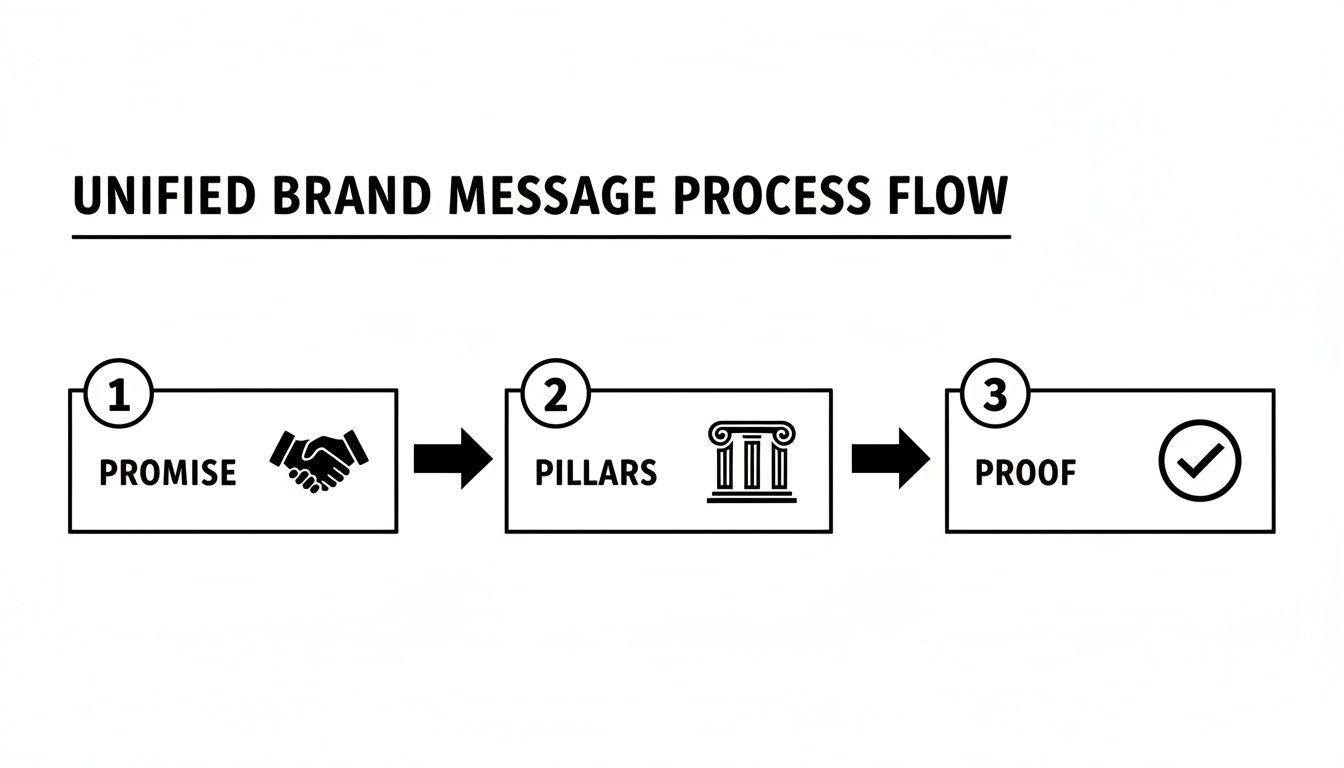
Starting with your core brand promise, then backing it up with supporting message pillars and tangible proof points, gives you the foundation for consistent messaging everywhere.
The Core SaaS Channel Mix
For any SaaS business, your channel mix needs to be a smart blend of digital muscle, real-world connection, and product-led communication. The exact recipe will change based on your audience and specific goals, but I've found that most winning strategies rely on these four key areas.
The magic happens when you create a system where one channel feeds the next. Think about it: a single PR mention in a trade publication can be amplified with paid social ads. Those ads drive traffic to a high-value webinar. That webinar, promoted through your email list, captures leads who are then dropped into an automated nurture sequence. Every single piece works together.
Digital Channels: The Engine of Growth
For nearly every SaaS company, digital is the non-negotiable growth engine. It’s where your audience spends their time, researches problems, and compares you to the competition. A coordinated attack here is absolutely essential.
- SEO & Content Marketing: This is your long game for attracting high-intent prospects. Your content needs to be the definitive resource for your audience’s biggest pain points, and solid SEO ensures they actually find it when they’re searching for solutions.
- PPC & Paid Social: These channels give you that instant visibility and the power to target specific personas with laser precision. Use them to get eyes on your best content, drive demo requests, or just grab attention at the very top of the funnel.
- Email Marketing: This is your direct line. It's the perfect channel for nurturing leads who aren't ready to buy, announcing new features to excited users, and driving retention by sending genuinely valuable stuff right to their inbox.
Your digital channels should never operate in silos. The keywords you’re targeting in SEO should inform your PPC campaigns. The audience insights from your paid social ads should give you ideas for your next blog post. It's a continuous feedback loop that makes everything smarter.
Events: Connecting in a Hybrid World
Whether they're virtual or in-person, events provide a rare chance to build real relationships and generate some of your highest-quality leads. They put a human face on what can otherwise be a faceless software brand.
- Webinars & Virtual Summits: These are incredibly scalable ways to showcase your team's expertise, demo your product without being overly "salesy," and engage with an audience from all over the world.
- Trade Shows & Conferences: Don't discount the power of shaking hands. In-person events are still invaluable for networking, meeting those hard-to-reach enterprise buyers, and just getting a real-time pulse on what's happening in your industry.
The key, as always, is integration. Promote your upcoming webinar with paid ads. Follow up with everyone who stopped by your booth with a targeted email sequence. Chop up your 45-minute keynote presentation into a dozen blog posts and social media clips. Understanding the finer points of digital marketing and advertising is what helps you squeeze every drop of value from your event content.
Public Relations & Product Marketing: The Connective Tissue
These two functions are the glue holding your external story and internal product truth together. They ensure what you say you do and what your product actually does are perfectly aligned.
Public Relations (PR) is all about building credibility through third-party validation. Let's be honest, a glowing review in a major tech publication or a feature story on an industry podcast is worth more than ten of your own ads. Your PR efforts must be tightly coordinated with your content and social teams to amplify every single mention for maximum impact.
Product Marketing sits at the intersection of product, marketing, and sales. It’s their job to make sure the value of your product is the hero of every communication. This team is on the hook for:
- Crafting compelling feature announcements that resonate with users.
- Developing sales enablement materials like battle cards and case studies.
- Managing the entire go-to-market strategy for new releases.
When product marketing is properly integrated, your sales reps are using the exact same messaging as your social media manager. This creates a cohesive, trustworthy experience for the buyer. From a press release to an in-app notification, every touchpoint reinforces the same core value you promise to deliver.
How to Measure and Optimize Your IMC Strategy
So, you've designed a brilliant, multi-channel campaign. That’s a huge step, but it’s only half the battle. A strategy without clear measurement is just a well-intentioned guess. This is where you connect your integrated marketing efforts directly to business results, using hard data to prove ROI and make every future campaign even smarter.
It’s easy to get sidetracked by vanity metrics. Think social media likes, page views, or impressions. While these can signal some top-of-funnel activity, they don’t tell the whole story and they certainly won't impress the C-suite. To show real value, your focus needs to shift to the kind of business outcomes that executives actually care about.
Moving Beyond Vanity Metrics
The real magic of an integrated strategy is its ability to influence the entire customer lifecycle, not just one piece of it. That means your measurement framework has to be just as holistic, tying marketing activities to tangible revenue outcomes. The metrics that truly matter are the ones that tell a financial story.
Here’s where you should be looking:
- Customer Acquisition Cost (CAC): What does it actually cost you to land a new customer? A successful IMC strategy should systematically lower this number by improving efficiency across all your channels.
- Customer Lifetime Value (CLV): This is the total revenue you can expect from a single customer over their entire relationship with you. Great IMC builds loyalty and makes this number climb.
- Marketing-Influenced Pipeline: How much of the sales pipeline has been touched by marketing? This is a powerful way to show marketing's direct contribution to sales opportunities.
Focusing on these numbers paints a much clearer picture of how your strategy impacts the bottom line. Once your IMC plan is live, you have to continually assess how to measure marketing effectiveness to make sure you're actually moving the needle.
Setting Channel-Specific KPIs
While those big-picture business metrics are your North Star, you still need to know what’s happening on the ground. This means tracking performance at the channel level to spot what's working and where you need to make adjustments. The trick is to choose KPIs that have a clear, logical connection back to your larger goals.
In SaaS, this often means tracking concrete KPIs for each channel and then pulling them all into a unified dashboard. This setup helps you see the whole picture, shifting the focus from siloed outputs (like blog traffic) to combined outcomes (like MQL growth and CLV).
Here’s what that looks like in practice:
- Paid Media (PPC/Social Ads): Don't just count clicks. Zero in on Cost Per Acquisition (CPA) and Return on Ad Spend (ROAS) to understand true efficiency and profitability.
- SEO & Content: Sure, track organic traffic growth, but the real win is the organic conversion rate for high-value actions like demo requests or trial sign-ups.
- Email Marketing: Open and click-through rates are table stakes. The metric that matters is the conversion rate from your email campaigns.
- Social Media: Move past engagement metrics and start tracking assisted conversions. This shows you how social interactions are influencing the final sale, even if they aren't the last click.
To see the forest for the trees, you need a way to bring all this channel-specific data together. Tools like Google Analytics 4 or HubSpot are great for creating a single dashboard where you can see how everything connects.
Don't just report on what happened. Your real goal is to understand why it happened. A unified dashboard lets you see how a spike in PR mentions led to more branded searches, which in turn drove more high-quality demo requests. That's the story you want to tell.
IMC Channel Integration and Measurement
The table below breaks down how you can think about integrating various channels and what to measure to gauge their collective impact. It connects the dots between specific channel tactics, their primary KPIs, and the ultimate business outcome you're aiming for.
| Channel | Integration Tactic Example | Primary KPIs | Business Outcome Metric |
|---|---|---|---|
| Content & SEO | Blog post promoted via email and social ads. | Organic Ranking, Demo Sign-ups | CAC Reduction |
| Paid Media | Retargeting webinar attendees with a special offer ad. | Cost per MQL, ROAS | MQL-to-SQL Conversion Rate |
| PR & Events | Driving event sign-ups with a press release feature. | Media Mentions, Attendee Count | Marketing-Influenced Pipeline |
| Product Marketing | Announcing a new feature via in-app, email, and blog. | Feature Adoption Rate, Upsells | Customer Lifetime Value (CLV) |
This approach helps ensure that every team understands how their piece of the puzzle contributes to the bigger picture, moving everyone toward the same overarching business goals.
Embracing Multi-Touch Attribution
One of the thorniest challenges in a complex SaaS sales cycle is attribution. A customer might see a LinkedIn ad, read three blog posts, attend a webinar, and then finally convert after getting a targeted email. Which channel gets the credit? A last-click model would give it all to the email, which is just plain wrong.
This is exactly why multi-touch attribution is a non-negotiable for any serious IMC strategy. It helps you understand how different touchpoints work together to secure a conversion, giving you a far more accurate view of what’s truly driving growth.
Different models distribute credit in different ways:
- Linear: Gives equal credit to every single touchpoint along the customer's journey.
- Time-Decay: Gives more credit to the touchpoints that happened closer to the conversion.
- U-Shaped: Gives the most credit to the very first touch and the very last touch, splitting the rest among the interactions in the middle.
There isn't a single "perfect" model that works for everyone; the best choice really depends on your typical sales cycle and business goals. But by simply moving to a multi-touch approach, you can stop the internal arguments over which channel is the "winner" and start making smarter budget decisions based on how all your channels collaborate to generate revenue.
Got Questions About Integrated Marketing? We've Got Answers.
Even the best-laid plans run into tricky situations. When you're rolling out a new integrated marketing communications strategy, questions are not just likely—they're guaranteed. Having straight-up, practical answers can be the difference between a smooth execution and a series of frustrating roadblocks.
Let's dive into some of the most common questions I hear from SaaS marketing leaders. Think of this as your personal FAQ for those moments when you're stuck and need a clear path forward.
How Do We Actually Get Different Teams to Work Together?
This is the big one, isn't it? Marketing, sales, product, and PR often operate in their own worlds, with their own goals and metrics. You can't just force collaboration; you have to create an environment where it becomes the natural, obvious way to work.
The first step is to get everyone aiming at the same target. Establish shared, high-level business goals that every team can see their role in, like increasing Marketing-Influenced Pipeline by 30%. This immediately shifts the conversation away from siloed vanity metrics and toward a collective mission.
Regular cross-functional meetings are a must, but they need a purpose. Instead of just going around the room for departmental updates, structure these check-ins around progress toward those shared goals.
The real magic happens when you shift the mindset from "my team's KPIs" to "our company's growth." When the sales team sees how a PR mention is warming up their leads, or the product team understands how their feature launch is being amplified across all marketing channels, that’s when genuine teamwork starts to click.
We Have a Limited Budget. Which Channels Should We Focus On?
It's so tempting to try and be everywhere at once, but that's a recipe for burning through cash with little to show for it. When your budget is tight, smart prioritization is your best friend. Don't spread yourself thin.
- Go back to your customer journey map. Where do your ideal buyers actually hang out when they're researching solutions like yours? Is it a specific subreddit, a certain industry publication, or are they heavy LinkedIn users? Double down there first.
- Prioritize high-intent channels. For almost every SaaS company, this means getting your SEO and content marketing house in order. Capturing people who are actively searching for what you do is one of the most efficient, long-term ways to generate quality leads.
- Use paid ads like a scalpel, not a sledgehammer. Forget massive, broad awareness campaigns. Use your ad spend for laser-focused actions, like retargeting visitors who checked out your pricing page or promoting a demo to a hand-picked list of target accounts.
How Long Until We See Real Results from All This?
Let's be clear: an integrated marketing communications strategy is a long game, not a quick hack. While you might see an immediate lift from a specific tactic like a new ad campaign, the real, compounding power of an integrated approach takes time to build momentum.
I tell my clients to think about results in stages:
- The First 90 Days (1-3 months): You should start seeing better engagement across the board. Your messaging will feel more consistent, and you'll notice metrics like click-through rates and social shares improve.
- The Next Quarter (3-6 months): This is when the lead generation engine really starts to turn. You’ll begin to see a measurable increase in MQLs and, because your channels are working together, a lower Customer Acquisition Cost (CAC).
- The Long Haul (6-12+ months): Now, the full impact becomes undeniable. You’ll see a much stronger brand presence in the market, better organic search rankings, and a clear, measurable lift in customer lifetime value and top-line revenue.
The most critical part is managing expectations internally from day one. Walk your leadership team through the plan, be upfront about the timeline, and share leading indicators along the way to show progress long before the big revenue numbers hit the dashboard.
At Mick-Mar Inc., we live and breathe this stuff. We specialize in building and executing the kind of integrated marketing that fuels real growth for SaaS companies. If you're ready to stop the siloed efforts and build a powerful, cohesive growth engine, let's talk. See how we can create a custom roadmap for your success by visiting us at https://mick-mar.com/.