Think of a telematics marketing agency as more than just another B2B firm. They’re a specialized growth partner for companies deep in the world of fleet management, connected vehicles, and automotive tech. Their real job is to take your complex technical features and translate them into bottom-line business results, making sure your message hits home with a very technical audience.
What a Telematics Marketing Agency Actually Does

Imagine trying to sell a sophisticated surgical laser using a brochure designed for a local car wash. The messaging, the tone, the entire value proposition – it would all fall flat. That’s the exact challenge telematics companies face when they hire a generalist marketing firm.
A telematics marketing agency is the specialist who closes that gap. They act as the bridge between your intricate technology and the real-world headaches of fleet managers, logistics directors, and safety officers.
The core of their work is to build a growth engine specifically for the telematics industry, not just apply generic tactics. They already speak the language of ELD mandates, CAN bus data, and predictive maintenance. More importantly, they know how to turn those features into compelling benefits that resonate with decision-makers who need to justify every dollar spent.
Moving Beyond General Telematics Marketing
A typical marketing agency might celebrate metrics like a spike in website traffic or a few more social media followers. A telematics agency, on the other hand, is laser-focused on what actually moves the needle for your business. Their whole approach is different because they live at the intersection of deep technical understanding and sharp marketing execution.
This specialization has a massive impact on your results. They aren’t just “creating content”; they’re producing assets that solve specific, costly problems for your ideal customers.
Here’s how their focus changes the game:
- From Brand Awareness to Industry Authority: It’s not about just getting your name out there. It’s about positioning your company as the expert on critical topics like fleet safety and operational efficiency.
- From Lead Generation to Pipeline Creation: The goal isn’t to collect a list of emails. It’s to attract, nurture, and hand over qualified sales opportunities who already get why your solution is valuable.
- From Product Features to Business Outcomes: They skillfully reframe technical specs into tangible results, showing how your dash cams can slash insurance claims and save a company thousands.
A key advantage is their ability to put value into context. For example, they can show how real-time telematics data helps a city public works department perform predictive maintenance on a vehicle, potentially saving $1,700 on a single tow and avoiding crippling downtime.
Why Specialization Is a Competitive Advantage
The telematics industry is no place for marketing generalists. Your buyers are smart, analytical, and risk-averse. They need to see a clear, undeniable path to ROI and operational improvement before they’ll even agree to a demo. A specialized agency already knows how to build that business case from day one.
They understand that a fleet manager in Memphis is worried about vehicle utilization, while a county in Florida is focused on generator uptime during hurricane season. This level of insight allows them to craft messages that speak directly to those distinct pain points.
When you partner with a team that already has this industry fluency, you get to skip the frustratingly long learning curve and start seeing meaningful results much faster. To see how a specialized approach can fuel growth, you can explore a range of focused marketing services. Ultimately, this expertise is what transforms marketing from a simple expense into a powerful revenue engine.
What a Telematics Marketing Agency Actually Does to Drive Growth
A top-tier telematics marketing agency doesn’t run generic campaigns. They operate with a very specific set of tools, each one fine-tuned to tackle the unique challenges of selling complex tech to a savvy audience. This isn’t about casting a wide net for brand awareness; it’s about making a direct, measurable impact on your sales pipeline.
Think of it like a specialized mechanic’s toolbox. Sure, a generalist has a basic wrench set that can handle most jobs. But a true specialist has the precise diagnostic equipment and custom tools needed to service a high-performance engine. That level of precision is what separates marketing that works from campaigns that fall flat with technical buyers.
This approach is all about connecting the “what” (the marketing tactic) with the “why” (its specific value in the telematics world). The goal is to build campaigns that speak the language of logistics directors, fleet operations managers, and CTOs.
When we talk about marketing services for telematics, it’s not just about applying old strategies to a new industry. It’s about fundamentally adapting those strategies to address the specific pain points, regulations, and sales cycles of the telematics world. Below is a breakdown of how standard marketing services get a specialized makeover.
Specialized Marketing Services for Telematics Companies
| Marketing Service | General Application | Telematics-Specific Application |
|---|---|---|
| Technical Content & SEO | Writing blog posts and web copy to attract a broad audience. | Creating in-depth whitepapers on regulatory changes like FMCSA ELD exemptions or ROI calculators for specific hardware. |
| Account-Based Marketing | Targeting companies that fit a general ideal customer profile. | Identifying a handful of high-value enterprise fleets and creating hyper-personalized campaigns for their key decision-makers (e.g., CFO, Safety Director). |
| Digital Advertising | Running broad social media ads based on demographics and interests. | Launching LinkedIn campaigns targeting professionals by job title (e.g., “Fleet Manager”), industry (e.g., “Long-Haul Trucking”), and company size. |
| Product Marketing | Highlighting product features and benefits for a general market. | Developing messaging that ties specific features (like AI dash cams) to tangible business outcomes (like reducing insurance premiums or litigation costs). |
As you can see, the difference lies in the details. It’s this deep industry knowledge that allows an agency to move beyond generic tactics and deliver real results.
Technical Content and SEO
In the telematics world, content is more than just blog posts. It’s about building a library of authoritative resources that solve real, complex problems for your audience. A great agency knows how to turn dense technical concepts into genuinely valuable assets.
This means going way beyond surface-level articles. For example, an agency can help you not just market your solutions but also navigate the complex regulatory environment, educating the market on nuanced topics like FMCSA ELD exemptions.
Here’s what that looks like in the real world:
- In-Depth Whitepapers: Detailed guides on new regulations or proving the ROI of specific telematics hardware.
- ROI-Focused Case Studies: Showing exactly how a public sector client used AI dash cams to sidestep an estimated $1 million in legal and insurance costs.
- Technical Blog Posts: Content that gets into the weeds, comparing different GPS hardware or explaining the intricacies of CAN bus data integration.
These resources are then supercharged with technical SEO. The whole point is to make sure that when a fleet manager searches for a solution to their biggest problem, your company is the first one they find.
Account-Based Marketing for Enterprise Fleets
Selling to large, enterprise-level fleets is a game of strategy, not volume. Account-Based Marketing (ABM) is a focused approach where marketing and sales work in lockstep to go after a specific list of high-value accounts.
Instead of spraying messages everywhere, an agency using ABM will help you pinpoint the key decision-makers within a target fleet. From the safety director to the CFO, each one gets a personalized campaign tailored to what they care about most.
The big idea behind ABM is simple but incredibly effective: treat each high-value account as a market of one. This builds real relationships and dramatically shortens the long sales cycles that are so common in B2B telematics.
This strategy is a game-changer for telematics companies aiming to land those major contracts. It ensures every marketing dollar is spent on accounts with the highest revenue potential, putting marketing and sales on the exact same page.
Precision-Targeted Digital Advertising
When it comes to digital ads in telematics, you need a scalpel, not a sledgehammer. A specialized agency knows how to use platforms like LinkedIn to zero in on professionals by their exact job title, company size, and even the industry-specific groups they belong to. It’s not about getting clicks; it’s about getting the right clicks.
The best campaigns are built on a rock-solid understanding of the buyer. An ad for a logistics director might hammer on fuel efficiency and route optimization. For a safety manager, that same ad would be a waste of money—they need to see messaging about driver scoring and collision avoidance.
This level of precision ensures your ad spend is hyper-efficient, placing your solution right in front of the people with the power to say “yes.” For anyone serious about nailing this kind of targeted outreach, diving deeper into specialized product marketing is a smart move that can give you a real edge.
Riding the Telematics Wave
The telematics industry is absolutely exploding. It’s not just steady growth; we’re seeing a massive acceleration thanks to a perfect storm of new government rules, the electric vehicle (EV) boom, and an insatiable hunger from businesses for data that can fine-tune their operations. This is a gold rush for any telematics provider paying attention.
But with all that opportunity comes a lot of noise. It feels like new competitors pop up every week, and everyone is shouting to get noticed. In a market this crowded and moving this fast, a great product just isn’t enough to win. You have to be seen, heard, and trusted.
This is exactly why a specialized telematics marketing agency isn’t a luxury anymore—it’s a necessity. Think of it this way: a general marketing firm can hand you a generic road map. A specialist, on the other hand, is like an experienced local guide who knows the shortcuts, the roadblocks to avoid, and the exact route to get you where you need to go, faster.
The Numbers Don’t Lie
To really get a feel for how competitive this space is, you have to look at the money pouring in. Telematics has gone from a niche tech to a foundational piece of the automotive and fleet management world. The latest reports paint a pretty wild picture.
The market hit a valuation of $111.75 billion in 2024 and is expected to jump to $129.89 billion by the end of 2025. That’s a compound annual growth rate (CAGR) of 16.2%—a staggering pace. And it’s not hitting the brakes anytime soon. Forecasts show the market rocketing to $234.96 billion by 2029. If you want to dive deeper into these figures, check out the full telematics market report on The Business Research Company.
That multi-billion dollar prize is on the table. The trick is cutting through the overwhelming noise to reach buyers who are drowning in options.
Why Smart Marketing Isn’t Optional Anymore
In a market this huge and cutthroat, growth isn’t a given. Pouring money into specialized marketing has shifted from a “nice-to-have” to a core part of staying in business. The best marketing wins because it does more than just run ads; it educates a technical audience, builds real trust, and proves its value beyond a shadow of a doubt.
A dedicated agency gets you there by:
- Carving Out Your Niche: They dig in to find what makes your solution truly unique and then craft a story that connects with the specific problems your ideal buyers face.
- Building Your Reputation: Through expert-level content, they help you become the go-to resource in the industry, not just another company trying to sell something.
- Finding the Right Customers: They use data to zero in on the most profitable market segments, so you’re not just throwing your marketing budget at the wall and hoping something sticks.
The problem isn’t a lack of customers; it’s that those customers have way too many choices. A specialist agency’s real job is to make your company the only logical choice for the right buyer.
At the end of the day, successfully navigating this market takes more than a solid product. It demands a marketing engine just as powerful. A telematics-focused agency brings the expertise to cut through the static, connect with the people who need your solution, and turn all this market potential into actual revenue. It’s the one investment that truly moves the needle.
Mapping Marketing to the Telematics Buyer Journey
Let’s be honest, selling a telematics solution isn’t like selling a pair of shoes. It’s a high-stakes, consultative sale that involves weaving through a complex maze of decision-makers—from the fleet manager on the ground to the CFO in the C-suite. Each person has different priorities, different problems, and different questions.
This is where a savvy telematics marketing agency proves its worth. They don’t just blast out generic ads; they meticulously map their strategy to every single stage of this winding buyer journey. They understand that the path often starts with a Fleet Manager frantically Googling ways to slash soaring fuel costs and ends months later with a CFO poring over an ROI analysis before giving the final nod. A winning marketing plan has to build trust and deliver real value at every turn.
This strategic approach isn’t just a “nice-to-have”—it’s essential in a market that’s absolutely exploding. This infographic paints a clear picture of the industry’s projected growth, showing just how critical sophisticated marketing is to grab a piece of the pie.
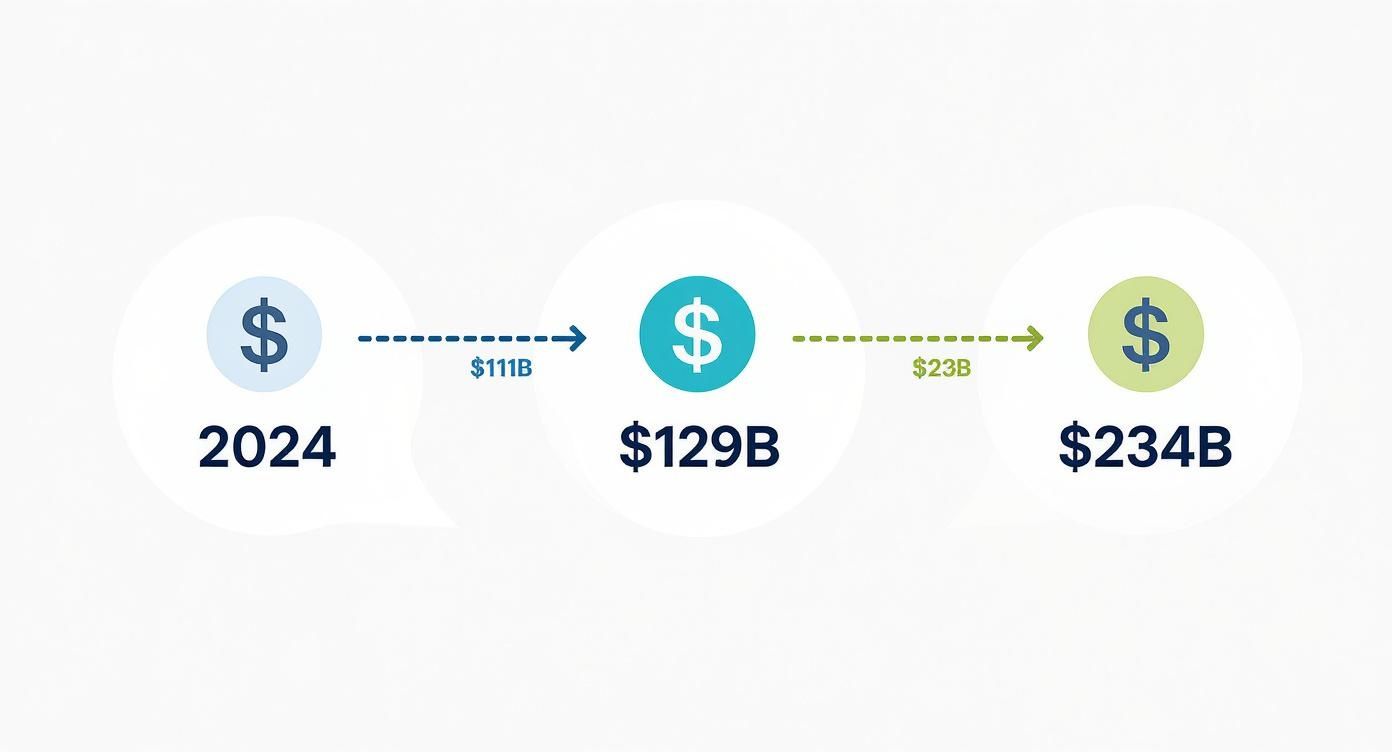
That jump from $111 billion in 2024 to a staggering $234 billion by 2029 highlights both the immense opportunity and the fierce competition you’re up against.
The Awareness Stage
Right at the start, your potential customers aren’t even thinking about your product. They’re thinking about their problems. A Fleet Manager might be searching for “how to lower fleet fuel consumption,” while a Safety Director is looking up “ways to reduce accident rates.” They have a pain point, and they’re looking for an answer.
At this stage, an agency’s job is to be the helpful expert in the room, not the pushy salesperson. They focus on creating educational, top-of-funnel content that directly addresses these early-stage questions.
Here’s what that looks like in practice:
- Blog Posts: Think articles like, “The Top 5 Hidden Costs Draining Your Fleet’s Budget.”
- Informative Guides: Downloadable resources, such as “A Fleet Manager’s Plain-English Guide to ELD Compliance.”
- Webinars: Live sessions centered on industry trends and common challenges, not a sales pitch.
This kind of content slowly but surely positions your brand as a credible authority, building a foundation of trust long before you ever ask for the sale.
The Consideration Stage
Okay, so now your potential buyer has a name for their problem. The next logical step? They start seriously evaluating solutions. This is the “comparison shopping” phase, where they’re digging into the details, weighing their options, and comparing different telematics platforms, hardware, and software features.
This is when a marketing agency shifts gears. The content becomes more focused and solution-oriented, designed to clearly show why your platform is the perfect fit for their unique challenges.
At this point, the conversation changes. It’s no longer “What is my problem?” but “What is the best way to solve it?” The marketing materials must provide clear, compelling answers that point them straight to you.
Here, you’ll see more detailed content like platform comparison charts, deep-dive feature guides, and customer success stories. It’s also the ideal time to explore different approaches to content marketing and strategic communications to make sure your message is not only authoritative but also genuinely persuasive.
The Decision Stage
We’re in the home stretch. The buyer is on the verge of making a choice, but they need to justify it. They have to build a solid business case to get the final sign-off from other key players, like the CFO or CEO. What they need now is cold, hard proof that your solution will deliver a tangible return on their investment.
An agency’s role here is to arm them with powerful, data-driven proof that erases any lingering doubt. This is where you bring out the big guns: compelling case studies filled with hard numbers and interactive ROI calculators. For example, a case study showing how a city saved an estimated $1 million in taxpayer dollars by implementing AI dash cams can be the final nudge needed to close the deal.
By guiding leads through this entire journey, a telematics marketing agency becomes much more than just a vendor. They become a genuine growth partner. They don’t just generate a list of names; they build a pipeline of educated, confident buyers who are fully prepared to invest.
What’s Fueling the Telematics Boom?
The telematics industry isn’t one giant, monolithic market. It’s more like a collection of fast-growing ecosystems, each powered by different forces. This rapid expansion creates a ton of opportunity, but it also means a one-size-fits-all marketing strategy is doomed to fail. Trying to sell to a government fleet manager the same way you’d approach an automotive OEM just won’t cut it.
A deep understanding of these distinct sectors is what separates a great telematics marketing agency from the rest. It’s not just about segmenting an audience; it’s about recognizing that the core motivations, sales cycles, and decision-making drivers are fundamentally different. Nailing these nuances is the secret to building campaigns that don’t just get seen, but actually connect with the specific problems your buyers need to solve.
One of the biggest forces at play? Government regulation. These mandates essentially create demand out of thin air, turning what was once a “nice-to-have” technology into a must-have piece of equipment for entire industries.
The Unstoppable Force of Regulatory Mandates
Think of regulations as a powerful tailwind pushing the telematics industry forward. When a government makes a technology mandatory, it instantly creates a massive, motivated market. Suddenly, companies aren’t just thinking about telematics for efficiency—they are legally required to adopt it to stay in business.
This creates a perfect opening for smart marketing. An agency that knows the space can build campaigns that educate the market not just on the technology, but on the ins and outs of the regulations themselves. It’s about positioning your solution as the key to compliance.
A couple of game-changing examples come to mind:
- Europe’s eCall System: This mandate forces car manufacturers to install tech that automatically calls for help after a serious crash. It single-handedly pushed OEMs to integrate telematics systems right on the factory floor.
- India’s AIS-140 Standard: This rule requires all commercial vehicles to have tracking devices for safety and monitoring. The result? A massive, overnight demand for aftermarket telematics solutions across the entire country.
These aren’t just local rules; they’re market-defining events. The automotive telematics market is expected to jump from $10.02 billion in 2025 to $16.72 billion by 2032, and a huge part of that growth comes from regulatory pressure. In the EU and nearby regions, the adoption rate for OEM-embedded telematics already hit 97% in 2024 and is on track for 100% by 2025. You can dig deeper into these numbers in this detailed automotive telematics report.
The Two Worlds of Telematics: Consumer Cars vs. Commercial Fleets
Beyond regulations, the industry is split into two major arenas, and a savvy marketing agency knows they are worlds apart. You can’t use the same playbook for both.
First, you have consumer automotive telematics. Here, the real customers are the Original Equipment Manufacturers (OEMs)—the big-name car brands. Selling to them is a long, complex B2B dance. It’s all about convincing them to embed your hardware and software directly into their next line of vehicles. The marketing conversations revolve around technical specs, long-term reliability, and the ability to scale up for massive production runs.
In the consumer space, the goal is to become a trusted, long-term partner to an automaker. A single deal can mean your technology gets installed in millions of cars over several years.
Then there’s the commercial fleet segment. This is a totally different ballgame. Your audience here is any business that operates vehicles—from a local plumbing company with five vans to a national trucking firm with thousands of rigs. The solutions are typically aftermarket devices, and the sales cycle is much shorter because it’s all about immediate ROI.
Marketing to fleet managers means you have to speak their language: business results. They want to know precisely how your solution will:
- Slash fuel costs
- Boost driver safety and lower their insurance premiums
- Simplify maintenance and keep vehicles on the road
- Ensure they’re compliant with rules like the ELD mandate
The pitch is less about the fancy tech and more about solving real, everyday business headaches that hit the bottom line. To win in both of these worlds, you need a level of specialized expertise that a general-purpose agency just can’t offer.
How to Choose the Right Telematics Marketing Partner
Picking a marketing agency is a big deal. When you’re selling something as complex as a telematics solution, it’s a make-or-break decision. A general B2B agency just won’t cut it—they don’t have the industry chops to get the job done right. You need a specialist who already gets your world and speaks the language of your buyers.
It’s easy to get wowed by a slick sales pitch. The real work is asking the tough, specific questions that reveal if they actually know what they’re talking about. The right telematics marketing agency can supercharge your growth, but the wrong one can burn through your budget and waste months of precious time.
Here’s a practical framework to help you vet potential partners and confidently pick a team that will actually drive results.
Go Beyond the Portfolio – Look for Industry Proof
Any agency can pull together a portfolio of pretty designs and flashy campaigns. That’s table stakes. What you need is hard evidence that they understand the unique grind of the telematics space.
Forget about vague success stories from some random B2B SaaS company. You need to see exactly what they’ve accomplished for businesses that look a lot like yours.
Here’s what you should be asking for:
- Telematics Case Studies: Get your hands on detailed case studies from their telematics clients. These should spell out the specific problem, the strategy they used to fix it, and—most importantly—the cold, hard numbers that prove it worked.
- Competitor Knowledge: Grill them on the competitive landscape. A true specialist should be able to talk intelligently about the market positioning of major players like Geotab, Powerfleet, and Samsara.
- Content and Campaign Samples: Ask to see the actual content they’ve created for other telematics companies. Does it sound like it was written by someone who knows the industry, or is it full of generic buzzwords? Does it speak directly to the headaches of a fleet manager or a logistics director?
Evaluate Their Technical and Market Fluency
A real partner gets it: the commercial telematics market isn’t just growing, it’s getting more complicated. The market is expected to jump from $32.08 billion in 2025 to a massive $48.72 billion by 2029. This boom is fueled by increasingly complex hardware and software, which means you need specialized marketing to educate buyers and close deals. You can dig into the commercial telematics market trends on Technavio for more detail.
Your agency has to be able to keep up. When you’re talking with them, see how comfortable they are with the technical side of things. Can they hang in a conversation about ELD compliance, CAN bus data, or the difference between OEM-embedded and aftermarket hardware?
A lack of technical fluency is a massive red flag. If an agency can’t grasp the fundamentals of your product, they will never create marketing that connects with your sharp, knowledgeable buyers.
Watch Out for These Critical Red Flags
Knowing what to look for is only half the battle; you also need to know what to run from. Certain warning signs should give you serious pause before you sign anything.
1. Unrealistic Promises: If an agency guarantees you the #1 spot on Google in 30 days or promises to triple your leads overnight, you should head for the door. Real marketing in a complex B2B industry is a marathon, not a sprint. It demands strategy and patience, not get-rich-quick gimmicks.
2. A “One-Size-Fits-All” Approach: Does their proposal feel like a template they just swapped your logo into? A specialist should present a custom strategy built around your specific goals, your ideal customer, and where you sit in the market.
3. Generic B2C Language: Pay close attention to the words they use. If you hear a lot about “consumers” and “brand loyalty” but not much about “qualified sales opportunities” or “buyer enablement,” their experience is likely in the consumer world. That’s a terrible fit for the long, considered sales cycles of B2B telematics.
Choosing the right telematics marketing agency is about finding a true partner—one who is as obsessed with your business outcomes as you are. By using this checklist, you can cut through the noise and find a team with the proven expertise to help you win your share of this booming market.
Frequently Asked Questions
What’s the Real Difference Between a Telematics Agency and a General B2B Agency?
It all comes down to deep, practical industry knowledge. A general B2B agency is great at the mechanics of marketing, but a telematics marketing agency lives and breathes your world. They already know the difference between an ELD and a basic GPS tracker and can tell you the specific headaches that keep a fleet manager up at night versus a safety director.
This built-in expertise is a massive shortcut. It means they can craft marketing campaigns that speak with genuine authority from day one, building trust with your target audience and pulling in high-quality leads much more quickly. There’s no learning curve—they hit the ground running because they already speak your language.
How Much Should I Budget for a Specialist Agency?
There’s no single price tag, as it really depends on what you need to accomplish. Most specialized agencies work on a monthly retainer, which can range from a few thousand dollars to upwards of $20,000.
Think of it less as a cost and more as an investment scaled to your growth ambitions. The retainer covers a mix of services like content creation, paid ad campaigns, or technical SEO. You’re not just buying marketing tasks; you’re bringing on a strategic growth partner.
The most important thing to remember is that marketing in a technical field like telematics is a long game. While you can get some quick wins, the real, sustainable growth comes from building a solid foundation that creates a powerful sales pipeline over time.
What Results Can I Expect, and How Fast?
You’ll see different results on different timelines. Paid advertising can spark interest and generate leads almost immediately. But the foundational work, like content marketing and SEO, is an investment that pays dividends over the long haul.
A good rule of thumb is to look for early signs of progress, like a noticeable jump in website traffic and a steadier flow of leads, within the first 3-6 months. The more significant, revenue-driving impact on your sales pipeline usually becomes clear after 6-12 months of consistent, focused effort with the right agency.
Ready to partner with a marketing agency that already gets it? At Mick-Mar Inc., we build strategic roadmaps that turn complex telematics solutions into powerful growth engines. Let’s build your growth plan together.