Ever tried to market something as complex as an entire city? That’s the exciting challenge of smart city marketing. You’re not just selling a destination; you’re promoting a vision for the future. Think of it as a strategic game plan cities use to broadcast their tech-forward identity and attract serious investment, skilled talent, and new residents.
What Is Smart City Marketing?
Forget the old-school tourism slogans and simple civic pride campaigns. Smart city marketing is a whole different ballgame. Instead of just highlighting historical landmarks, it spins a compelling narrative about a city’s future – one built on data, seamless connectivity, and constant innovation. It’s about branding an entire urban ecosystem.
This isn’t just bragging about having the latest gadgets. It’s about clearly communicating how technology is woven into the fabric of daily life to make things genuinely better for everyone. With the global smart cities market valued at around $1.14 trillion in 2023 and projected to hit $6.96 trillion by 2030, the economic stakes are massive. It’s a friendly but fierce competition for growth.
More Than Just Tech Buzzwords
At its heart, smart city marketing is about showing, not just telling. It’s designed to prove tangible benefits and connect with specific groups by highlighting advancements and their real-world impact.
- For Investors: The message is all about stability and opportunity. It showcases reliable infrastructure, a welcoming environment for public-private partnerships, and a forward-thinking government, signaling a safe and profitable place to invest capital.
- For Residents: Here, the focus is on practical, everyday improvements. We’re talking less time stuck in traffic, better public safety, and more responsive city services—all of which help get the community excited and on board.
- For Talent: For innovators and skilled professionals, the city is presented as a dynamic hub. It’s a place with exciting career paths and a fantastic quality of life, making it an easy choice for their next move.
A truly smart city makes sure progress benefits everyone, not just the wealthy. The real goal is to build a city where innovation is measured by its impact, not just its novelty.
Communicating a Connected Smart City Vision
A great smart city marketing strategy is a masterclass in storytelling. It takes separate initiatives—like smart traffic lights, efficient waste management, or public Wi-Fi—and weaves them into a single, cohesive story. It’s not enough to have these individual pieces; you have to explain how they all connect to create a smarter, more sustainable city.
Understanding the foundational elements is key. For example, work on Building Smarter Cities with ZPN Modular Energy Solutions shows how a modular energy grid is a critical part of the bigger picture.
Ultimately, this kind of marketing proves that a city isn’t just waiting for the future to happen. It’s actively building it, step by step, and inviting the right people and capital to join in.
Building Your Smart City Brand Identity
A powerful smart city brand is much more than just fiber optic cables and flashy sensors; it’s a clear, compelling story about where a city is headed. This narrative captures the imagination of investors, draws in top talent, and rallies the community.
Building this identity isn’t magic. It rests on three essential pillars that work together to signal forward-thinking leadership and build trust. Without a strong brand, even the most brilliant projects can stall, failing to gain momentum. A well-defined identity, on the other hand, turns abstract tech plans into a tangible vision people can get behind.
Crafting a Unified Vision
First up is a unified vision. Think of this as the city’s North Star—a simple, powerful statement that explains where you’re going and why it matters. This isn’t a dusty, jargon-filled mission statement. It’s a story that answers the big questions for potential investors and skilled professionals: What problems are you solving? What will life look like here in the future?
A sharp vision acts as a filter for every decision. It ensures all your marketing messages, from a high-stakes investment pitch to a simple community newsletter, tell the same cohesive story. That consistency is the secret sauce to building brand awareness that actually sticks. It broadcasts to the world that you have a plan, creating a sense of confidence and unstoppable momentum.
Fostering Deep Citizen Engagement
Next, you have to cultivate deep citizen engagement. Your residents aren’t just a passive audience; they’re your most powerful and authentic advocates. A smart city isn’t something built for people—it’s built with them. When your citizens truly understand and embrace new technologies, like a smart transit app that shaves time off their commute, they become living proof of your city’s success.
This pillar is all about turning residents into active participants. How do you do that?
- Pilot Programs: Roll out small-scale initiatives and get direct, honest feedback.
- Public Demos: Let people get their hands on new tech and see how it works for themselves.
- Feedback Channels: Create easy-to-use platforms where residents can share their ideas and concerns.
When people feel heard and see the real-world benefits in their daily lives, they become the best marketing asset you could ever ask for. Their genuine stories build trust far more effectively than any glossy ad campaign ever could.
Forging Strategic Public-Private Partnerships
The final pillar is creating strategic public-private partnerships (PPPs). Bringing the right partners on board sends a powerful signal to the global market. Having established tech companies, nimble startups, and major financial institutions put their resources and reputation on the line shows that your city is stable, credible, and open for business.
A strong brand isn’t just about perception; it’s an economic engine. The story a city tells directly influences its ability to secure the capital needed for transformative growth.
These collaborations don’t just amplify your marketing—they drive real, measurable economic outcomes. A 2023 report highlighted that smart city technologies can boost GDP per capita by 21% and population growth by 13%. This isn’t a niche market; it now includes thousands of companies and startups, with investors pouring billions into cities that have a clear, well-marketed vision. You can dive deeper into this economic impact with research on smarter cities of the future.
To put it all together, here’s a look at how these three pillars form the foundation of a resilient smart city brand.
The Three Pillars of Smart City Branding
| Pillar | Marketing Focus | Key Activities | Primary Goal |
|---|---|---|---|
| Unified Vision | Storytelling & Consistency | Crafting a clear narrative, aligning all communications, creating investor pitches | To establish a clear, confident, and memorable identity for the city’s future. |
| Citizen Engagement | Advocacy & Authenticity | Running pilot programs, hosting public demos, creating feedback channels, sharing success stories | To turn residents into brand ambassadors who provide social proof and build community trust. |
| Public-Private Partnerships | Credibility & Validation | Securing investments, launching joint ventures with tech firms, co-developing solutions | To signal market confidence, validate the city’s strategy, and accelerate development. |
Ultimately, a brand built on a clear vision, deep citizen engagement, and strong partnerships isn’t just attractive—it’s authentic and built to last, setting the stage for real, sustainable growth.
Effective Marketing Strategies for Urban Innovation
Once you’ve nailed down a strong brand identity, it’s time to shift from theory to action. Marketing a smart city isn’t like selling a product with traditional ads. It’s about rolling out targeted strategies that show citizens, businesses, and investors the real, tangible value of your vision. This means getting past broad announcements and creating experiences that make the city’s future feel real.
The real goal here is to spark genuine engagement. You need tactics that connect with a modern, tech-savvy audience. Whether it’s a compelling video that breaks down a complex new initiative or an immersive public demo, every touchpoint should echo the city’s commitment to progress and a better quality of life. This is how you build momentum and turn bystanders into advocates.
Deploying Targeted Digital Strategies
When it comes to digital marketing for a smart city, a generic, one-size-fits-all approach just won’t cut it. Success comes from creating specific content that speaks directly to what your different audiences—from local residents to global investors—actually care about. It’s a multi-channel game where every platform has a distinct job.
- Content Marketing as an Explainer: Use detailed blog posts, white papers, and easy-to-digest videos to unpack complicated projects. Think of an article that clearly explains how a new smart grid will lower energy bills for families and businesses. That’s a direct benefit people can get behind.
- Data-Driven Social Media Campaigns: Don’t just post announcements. Use social media to share real-time data that shows genuine quality-of-life improvements. Post about reduced traffic congestion times or faster emergency responses. This turns abstract data into concrete wins for the whole community.
- Strategic Email Marketing: Build segmented email lists for your key audiences. Investors should get updates on project milestones and potential ROI, while residents could receive newsletters about new city services and chances to give feedback.
The infographic below shows how a solid brand identity—built on vision, engagement, and partnerships—is the launchpad for all your marketing strategies.
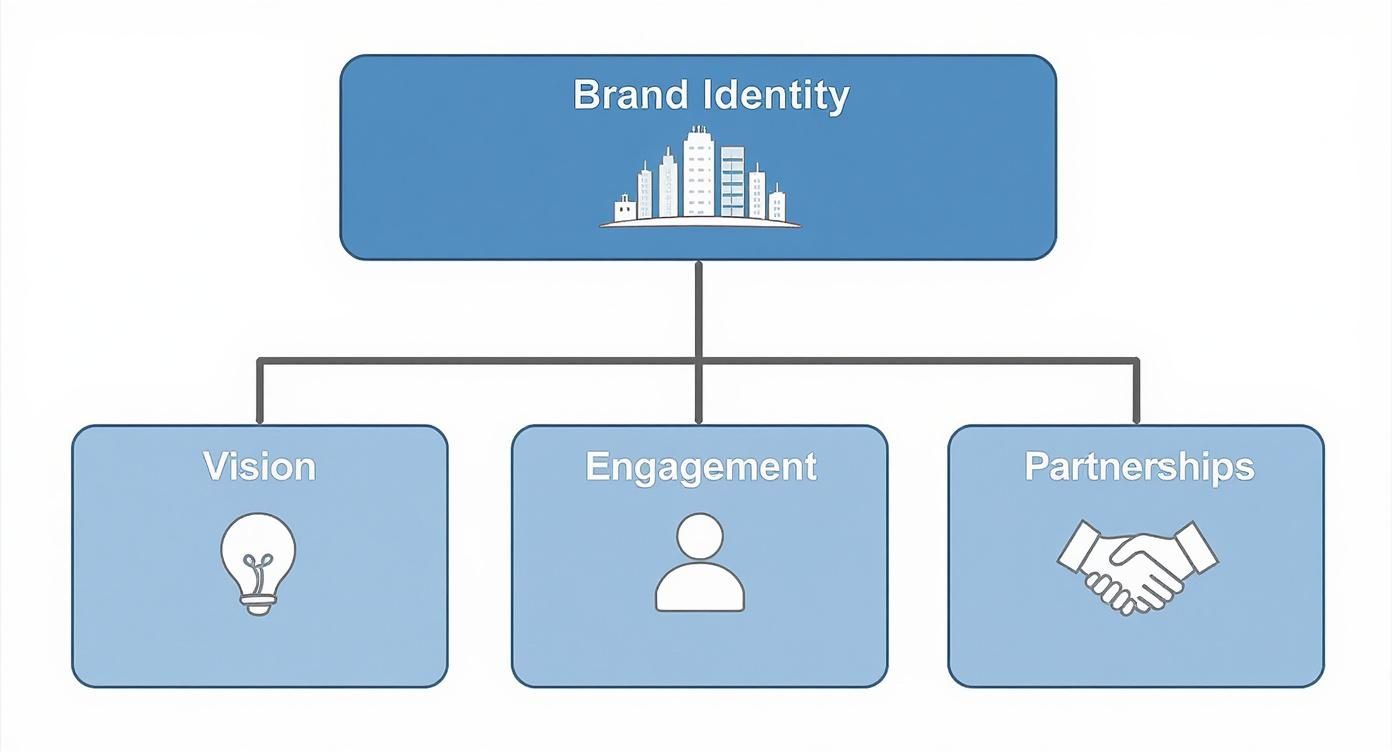
This visual makes it clear: a strong brand identity isn’t just a logo. It’s the foundation from which all successful community engagement and partnership efforts grow.
The Power of Experiential Marketing
While a smart digital presence is essential, nothing makes people believe like a hands-on experience. Experiential marketing lets people actually see, touch, and interact with the city’s future. It creates powerful, persuasive moments that a screen simply can’t replicate.
Experiential events transform smart city concepts from abstract ideas into tangible realities, building trust and excitement in a way that no advertisement can.
These events are all about making the city’s innovations impossible to ignore.
- Host Tech Summits and Investor Days: Get global leaders, tech innovators, and financial partners in the same room to showcase your city’s progress. These events signal that you’re a serious player on the world stage and open doors for crucial networking.
- Create Interactive Public Demos: Set up live demonstrations of new tech in busy public spaces. Imagine a pop-up in a town square where people can interact with a new smart transit kiosk and ask questions on the spot.
- Build ‘Living Labs’: Designate entire districts or neighborhoods as “living labs” to pilot and fine-tune new technologies. This demonstrates a deep commitment to innovation and creates a real-world testing ground that attracts startups and researchers. For cities looking to fund this kind of forward-thinking infrastructure, exploring options like grants for sustainable community microgrids is a critical step.
When you bring it all together, these strategies create a dynamic marketing ecosystem. By mixing insightful digital content with unforgettable real-world experiences, a city can communicate its vision effectively and prove it’s building a better future for everyone.
How to Target Your Key Audiences
Effective smart city marketing isn’t about shouting into the void. It’s about starting the right conversations with the right people. Think about it: a message that gets a tech investor excited will likely fall flat with a lifelong resident. True success hinges on segmenting your audience and telling a story that speaks directly to what each group actually cares about.
This means moving past generic, city-wide announcements and creating focused campaigns that connect with the specific needs and desires of each demographic. It’s a fundamental shift in how cities communicate. If you want to dig deeper into this strategy, our guide on what is demand generation marketing is a great place to start.

Engaging with Residents and the Community
Your residents are your most important audience. They’re also your most powerful ambassadors if you get the messaging right. For this group, you need to focus on tangible, everyday benefits. Abstract concepts like “IoT integration” don’t mean much, but a real-time transit app that shaves 15 minutes off their commute? That means everything.
The goal here is simple: communicate direct value and build trust through total transparency.
- Messaging Focus: Zero in on quality-of-life improvements. We’re talking about less traffic, cleaner air, faster emergency response times, and public services that are actually convenient.
- Best Channels: Go where the community already is. Use local news outlets, neighborhood social media groups, public forums, and the city’s own mobile apps.
Attracting Investors and Businesses
When you’re talking to investors and businesses, the conversation completely changes. It’s no longer about convenience; it’s all about opportunity. This audience is looking for stability, growth potential, and a clear return on their investment. Your marketing needs to paint a picture of a well-run, forward-thinking, and economically thriving city.
A city that can clearly articulate its long-term technological roadmap and its commitment to public-private partnerships becomes an irresistible destination for capital.
Your messaging should be professional and packed with data, proving the city is a secure bet for long-term growth. The global smart city market is already broken into key areas like Smart Transportation, Smart Buildings, and Smart Citizen Services, which allows you to tailor your pitch to specific initiatives. This is a massive advantage, especially since North America currently holds the largest slice of the market, thanks to solid infrastructure and major tech investment.
Drawing in Tech Talent and Innovators
Finally, you need to attract the brilliant minds who will actually build and maintain your smart city. Tech talent, from software engineers to urban planners, wants more than just a paycheck. They’re looking for a dynamic community where their work has an impact and they can enjoy a fantastic quality of life. You’re not just selling a job; you’re selling an entire ecosystem.
- Messaging Focus: Position your city as a hub of creation and innovation. Highlight career growth, networking opportunities, access to game-changing projects, and a vibrant local culture.
- Best Channels: Reach them on professional networks like LinkedIn, niche tech job boards, and through university partnerships. Sponsoring industry conferences and hackathons is also a powerful way to get on their radar.
Smart City Marketing Win Examples
Theory is great, but seeing these strategies in action is even better. Let’s look at a few cities that have truly nailed their smart city marketing, moving beyond buzzwords to achieve remarkable results. These urban centers didn’t just install new tech; they told a powerful story about their vision for the future.
Their success gives us a clear roadmap for what works. They show how a great story can pull in global investment, attract the best and brightest minds, and get the local community excited about what’s next.
Singapore: Building the “Smart Nation” Brand
Singapore’s “Smart Nation” initiative is a masterclass in how to build a world-class brand. Instead of promoting a mishmash of tech projects, the city-state crafted a single, unified story about progress, efficiency, and an exceptional quality of life. This narrative wasn’t just for attracting outside investment—it became part of the national identity.
Their marketing was sharp and strategic:
- Who they targeted: They went after global businesses and top-tier tech talent, pitching Singapore as a real-world “living lab” for innovation.
- How they did it: High-profile international summits, partnerships with major tech players, and a steady rollout of citizen-focused apps for transport and healthcare made their vision feel real and immediate.
- What happened: The “Smart Nation” brand is now globally recognized as a symbol of technological progress. This has attracted a flood of foreign investment and cemented Singapore’s reputation as the place to be for tech in Asia.
This kind of focused strategy is exactly why cities like Singapore are set to dominate. A 2023 market analysis confirmed the smart city market is on a massive growth trajectory, with some reports projecting it to leap from USD 850.38 billion in 2025 to over USD 2,317.68 billion by 2032. You can dig into the numbers and find more insights into the expanding smart city market.
Barcelona: A City Built on Sustainability and IoT
Barcelona carved out a different, yet equally powerful, niche. The city built its entire brand around sustainability and the Internet of Things (IoT), positioning itself as a pioneer in green technology and open data. This was more than just an environmental statement; it was a smart economic move.
Barcelona proved that a smart city brand can be built on a foundation of values. By championing sustainability, they attracted a specific type of investor and innovator who wanted to be part of a purpose-driven urban ecosystem.
The city’s marketing team was brilliant at turning complex technology into tangible, real-world benefits for everyone to see.
- Who they targeted: Barcelona focused on green-tech companies, sustainable investment funds, and the data science community.
- How they did it: They launched open data platforms, giving innovators free rein to use city information. They also became famous for their IoT-driven solutions for smart lighting, waste management, and parking—all of which showed clear environmental wins and serious cost savings.
- What happened: The city became a magnet for green-tech startups and a premier European destination for tech conferences and talent. It was a powerful lesson that a specialized focus can deliver huge rewards.
Common Questions About Smart City Marketing
As the idea of a smart city becomes less of a sci-fi concept and more of a practical reality, it’s natural for questions to pop up. City leaders, urban planners, and investors are all trying to understand what this new approach to city branding really means.
Let’s dive into some of the most common questions to clear up the confusion and offer some direct insights. This is about more than just bolting on new tech; it’s a completely different way for cities to communicate their value to the world.
How Is Smart City Marketing Different From Tourism Marketing?
This is a big one, and it’s easy to get them mixed up. While both are about promoting a city, their audiences and ultimate goals couldn’t be more different.
Tourism marketing is all about attracting visitors for short-term stays. It highlights the fun stuff—attractions, restaurants, and entertainment. The goal is to sell an experience, a memorable vacation.
On the other hand, smart city marketing is playing a much longer game. It targets long-term stakeholders like investors, innovative companies, and the highly skilled talent needed to fuel them. It’s about selling a strategic vision for the future. The message here focuses on economic opportunity, robust tech infrastructure, and a higher quality of life, all designed to secure permanent investment and build a stronger community. Think of it as a strategic play for sustainable growth, not just a weekend getaway.
What Is the Role of Citizens in This Process?
Citizens aren’t just an audience; they are the heart and soul of any smart city initiative. They are the most important participants and, ultimately, the best advocates a city can have. The most successful smart city marketing campaigns involve residents right from the start through pilot programs, public forums, and easy-to-use feedback channels.
When residents see and feel the direct benefits of new initiatives, like a smart parking app that saves them time or a community energy program that lowers their bills, their positive experiences become the most powerful and authentic marketing asset a city can have.
Their adoption and word-of-mouth praise create the kind of social proof that no ad campaign can buy. It proves the city’s vision isn’t just talk; it’s delivering real, tangible value to the people who live there.
How Can a Smaller City Compete With a Limited Budget?
A smaller city doesn’t need a massive budget to make a huge impact. What it needs is a razor-sharp focus. Instead of trying to be everything to everyone, the trick is to pick a specific niche and absolutely own it. This could be anything from pioneering smart waste management to launching a city-wide digital literacy program.
Once you’ve chosen that niche, execute it perfectly and then build your marketing around that specific success story.
- Create detailed case studies that clearly show the project’s impressive results.
- Pitch your story to local and industry-specific media to build genuine credibility.
- Position the project as a “living lab” to attract targeted investment from companies in that space.
Showing focused, measurable progress is often way more compelling to investors than a big, flashy campaign that’s spread too thin. Speaking of measurement, you can explore more on how to measure marketing ROI to prove the value of these focused efforts.
At Mick-Mar Inc., we specialize in crafting powerful marketing strategies that tell your unique story. Whether you’re a SaaS company or an innovator in the energy sector, we build customized roadmaps to drive growth and connect you with the right audience. Discover how we can help you build your brand’s future at https://mick-mar.com/.