Demand generation marketing is all about creating genuine excitement and awareness for your company before a prospect even thinks about making a purchase. Think of it as a friendly, long-term strategy focused on building a loyal audience and educating the market, making you the first name that pops into their head when a need finally arises.
What Exactly Is Demand Generation Marketing?
Let’s start with a fun analogy. Imagine you’re throwing a dinner party. You could just send out a bunch of invitations and hope people show up -that’s a bit like old-school lead generation.
Or, you could start creating a buzz before the invitations even go out. You might share a few incredible recipes on social media, get a local food blogger to rave about your planned menu, and create an atmosphere so irresistible that people are practically begging for an invite. That’s the core idea behind demand generation. It’s about making people want to come to your party before they’re even invited.
It’s a strategic, full-funnel approach designed to build lasting trust and authority with your target audience. Instead of just trying to capture contact information, demand gen focuses on becoming a go-to resource. You solve problems and offer real value without immediately asking for anything in return. This approach nurtures potential customers by making them aware of a challenge they might not have even noticed and then positioning your brand as the expert who can help.
The Modern Approach To Building Interest
Marketing has come a long way from just chasing leads. Today, a modern demand generation program is a sophisticated, data-driven strategy that covers the entire buyer’s journey. It’s all about precision targeting and personalized engagement, using real-time data to find prospects showing high intent and nurturing them across multiple touchpoints.
This means demand generation isn’t a single activity but a symphony of ongoing marketing efforts working in harmony. Some of the most common activities include:
- Valuable Content Creation: Publishing genuinely helpful blog posts, in-depth eBooks, and educational webinars.
- Brand Visibility: Using SEO and social media to ensure your solutions are discoverable. A huge piece of this is learning how to build brand awareness the right way.
- Community Engagement: Actively building relationships through podcasts, industry events, and online forums where your audience hangs out.
To wrap your head around the concept quickly, here’s a simple table that breaks down the core principles.
Demand Generation At A Glance
| Core Principle | What It Means In Practice |
|---|---|
| Educate, Don’t Sell | Focus on providing value and solving audience problems through content. |
| Play The Long Game | Build trust and relationships over time, not just chase quick conversions. |
| Be Everywhere | Engage your audience on the channels they already use and prefer. |
| Create Demand | Make your audience aware of problems they didn’t know they had and position your solution. |
This table shows how demand generation shifts the focus from immediate sales to creating a sustainable pipeline of interested, educated buyers.
By focusing on educating your market and building authentic relationships, you create a pipeline of prospects who are not just aware of your brand but actively interested in what you have to offer.
When you get this right, the result is powerful. When your prospects are finally ready to buy, they don’t just know your name—they already trust it.
The Core Components Of A Winning Demand Generation Strategy
An effective demand generation engine isn’t about finding one magic tactic. It’s a carefully orchestrated mix of different moving parts, all working together in harmony. Think of it like a high-performance car—you need the engine, the fuel, the wheels, and a solid navigation system, all synced up to get you where you need to go. Each piece is essential for guiding potential customers from “who are you?” to “I can’t live without you.”
This integrated approach makes sure you’re not just showing up, but you’re actually being helpful at every single stage of their journey. Let’s break down the pillars that hold up a successful demand generation strategy.
Content Marketing: The Fuel For Your Engine
Content is the absolute lifeblood of demand generation. This isn’t about writing thinly veiled sales pitches. It’s about creating genuinely useful resources that solve real problems for your audience, drawing them in and educating them along the way. We’re talking in-depth blog posts, insightful whitepapers, engaging webinars, and practical checklists.
The whole point is to position your brand as a trusted authority—the go-to source in your niche. When you consistently provide value without asking for anything in return, you build a massive amount of credibility. For any SaaS company, this requires a solid plan. You can find everything you need to know in this complete guide to building a SaaS content marketing strategy. Of course, a great plan needs great execution, and tools like a headline generator can be a huge help in grabbing that initial attention.
This infographic breaks down how different channels contribute to the sales pipeline, and it’s no surprise what’s at the top.
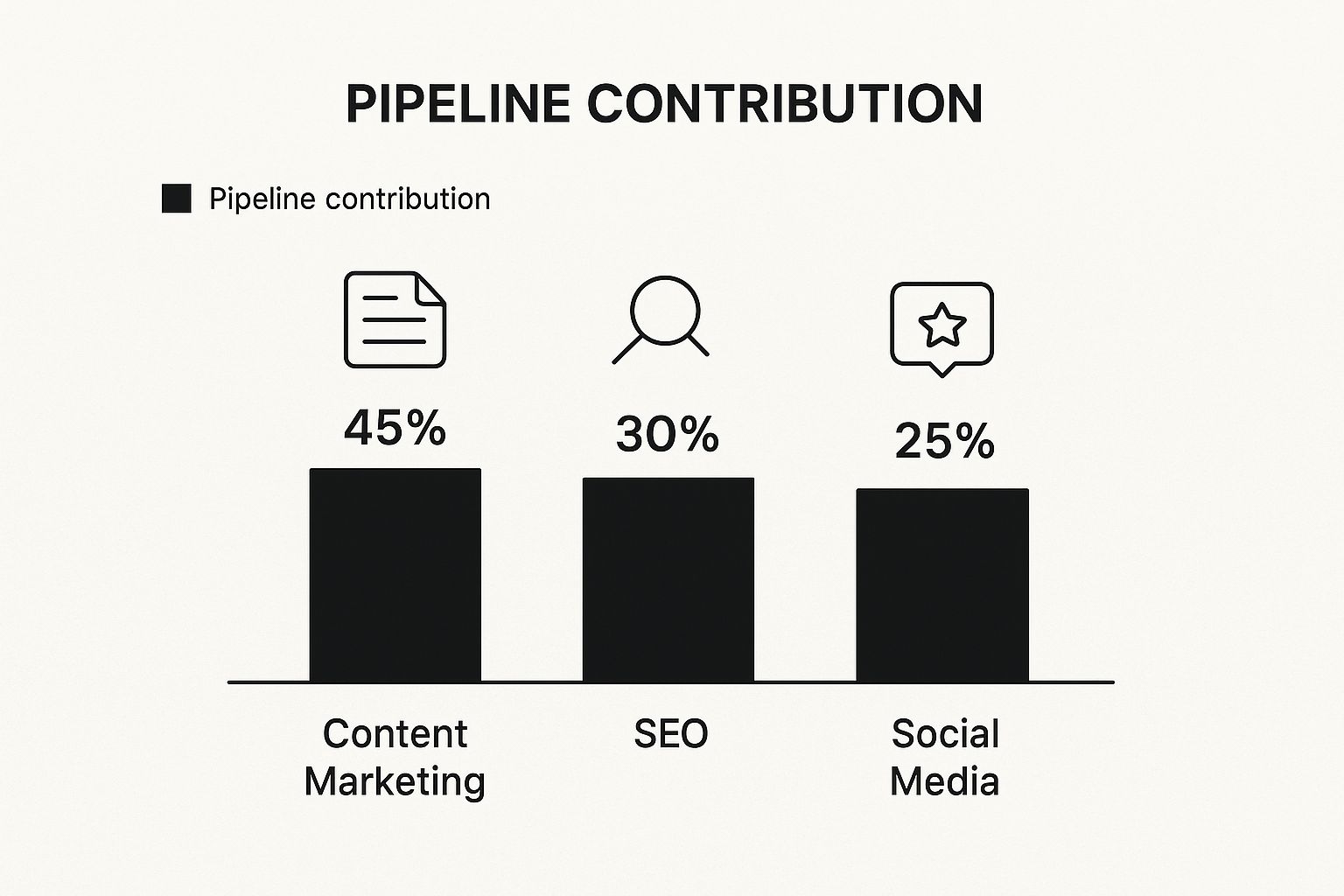
As you can see, high-quality content is the single biggest driver of qualified opportunities. It really is central to any strategy that hopes to succeed.
Strategic SEO: Making Your Brand Discoverable
Look, you can create the most brilliant content in the world, but if no one can find it, it might as well not exist. That’s where Search Engine Optimization (SEO) comes in. It’s the navigation system that guides prospects straight from a Google search to your digital doorstep.
Smart SEO is all about making sure that when your ideal customer types a problem into their search bar, your solution is what pops up. This involves a few key things:
- Keyword Research: Getting inside your customer’s head to understand the exact words and questions they use.
- On-Page Optimization: Making sure your content is structured in a way that search engines can easily understand and rank.
- Technical SEO: Ensuring your website is fast, secure, and works perfectly on mobile phones to give everyone a great experience.
By lining up your content with what people are actively looking for, you capture traffic from people with high intent—the ones who are already raising their hands for help.
A successful demand generation strategy is customer-centric at its core. It meets audiences where they are, answers the questions they have, and builds trust long before a sales conversation ever begins.
Social Media and Paid Advertising
While content and SEO build that strong foundation, social media and paid ads are the megaphones that get your message out to a much wider audience. Social media is where you build a community. It lets you have real conversations and share your valuable content where your audience already hangs out. It’s all about building relationships, just on a massive scale.
Paid advertising, on the other hand, gives you speed and laser-focused precision. Platforms like LinkedIn or Google Ads let you target people by specific job titles, industries, or even online behaviors, making sure your message lands in front of the right eyeballs at the right time. This is perfect for pushing high-value assets like a webinar or a new eBook to a very specific audience, helping you fill your pipeline much faster.
Demand Generation vs. Lead Generation: Uncovering The Key Difference
This is easily one of the most common mix-ups in marketing, but truly understanding the difference is a game-changer for your entire strategy. While they sound alike, demand generation and lead generation are two distinct plays that work together to drive growth.
Think of it this way: Demand generation is like hosting a huge, must-attend industry party. You’re not collecting business cards at the door. Instead, you’re creating an incredible experience with great music (valuable content), amazing conversations (community building), and becoming known as the best host in town. People hear about it, they want to be there, and they start talking about you.
Lead generation, on the other hand, is when you pull someone aside at that party who’s clearly interested and ask, “Hey, we’re hosting a private workshop next week on this exact topic. Can I get your email to send you an invite?” It’s a direct, targeted action to capture the details of someone who is already engaged.

Different Goals For Different Stages
Here’s the most important thing to remember: these aren’t opposing forces. They’re partners in crime. Demand generation works at the top of the funnel, making your brand the one people think of first. Lead generation kicks in further down, turning that hard-earned awareness into actual contacts for your sales team.
When you do demand gen right, you create a pipeline full of people who already know, like, and trust you. This makes your lead generation efforts exponentially more effective because the audience is pre-sold on your value. Looking at proven B2B lead generation strategies makes the distinction even clearer; they are designed for capture, not broad education.
A classic mistake is jumping straight to lead generation without building any demand first. It’s the marketing equivalent of asking for a marriage proposal on the first date—it’s just too aggressive, too soon.
To lay it all out, let’s look at a side-by-side comparison. This table breaks down exactly where each discipline shines.
Demand Generation vs. Lead Generation Key Differences
| Aspect | Demand Generation | Lead Generation |
|---|---|---|
| Primary Goal | Build awareness, educate the market, and create desire for your solution. | Convert existing interest into contact information (a lead). |
| Core Focus | Long-term brand building and establishing thought leadership with a wide audience. | Short-term conversion and capturing details from a targeted segment. |
| Key Tactics | Blog posts, podcasts, social media, ungated reports, free tools, community events. | Gated content (eBooks, whitepapers), webinar sign-ups, demo requests, contact forms. |
| Success Metrics | Website traffic, brand name searches, social media engagement, share of voice. | Marketing Qualified Leads (MQLs), Cost Per Lead (CPL), form conversion rates. |
Ultimately, the smartest marketing strategies don’t make you choose. They use powerful demand generation to warm up the entire market, then deploy precise lead generation tactics to identify who is ready to talk business.
Is Investing in Demand Generation Actually Worth It?
Let’s get straight to the point. Shifting your marketing efforts toward demand generation isn’t just about trying a new set of tactics. It’s a fundamental investment in how your business grows – one that turns marketing from a cost center into a serious revenue engine.
Think about it this way: you’re creating a steady stream of high-quality leads who already know who you are and what you do. They don’t just stumble into a sales call; they show up genuinely interested and educated. This simple shift can drastically shorten your sales cycle because the initial “getting to know you” phase is already done. Your sales team gets to skip the cold introductions and jump straight into meaningful conversations with people who already see you as a credible expert.
It Aligns Your Teams and Makes You an Authority
One of the best side effects of a solid demand generation strategy is how it naturally pulls your sales and marketing teams together. When everyone is focused on educating the same ideal customer, they start speaking the same language and chasing the same goals. That old-school friction between the two departments? It starts to disappear, replaced by a shared drive for sustainable growth.
At the same time, consistently putting out valuable content does more than just attract eyeballs. It cements your reputation. You become the go-to resource, the first name that pops into someone’s head when they have a problem you can solve.
That kind of trust is priceless. When a prospect already believes you can help them, the sales process feels less like a pitch and more like a partnership to find the right solution.
The Proof Is in the Revenue
Ultimately, this is all about growing the business, and this is where demand generation really proves its worth. The numbers don’t lie. Recent industry data shows a clear connection between a commitment to demand gen and real top-line growth.
A 2024 survey revealed that 35% of marketing teams are actively increasing their demand generation budgets. And it’s paying off. 28% of companies are forecasting revenue jumps of between 11% and 20%, all thanks to these focused efforts. You can dig deeper into the data by checking out the latest demand generation benchmarks for 2025.
This data just confirms what experienced marketers have known for a while: building genuine demand isn’t just a smart move, it’s essential for any company that’s serious about long-term success.
How To Measure Demand Generation Success
You can’t improve what you don’t measure. But with demand generation, you have to be measuring the right things. It’s easy to get sidetracked by vanity metrics like social media likes or website visits, but those numbers don’t pay the bills.
To really prove that your demand generation strategy is working, you need to focus on key performance indicators (KPIs) that connect directly to business health and, most importantly, revenue. This is how you shift from simply counting leads to understanding the actual impact your work has on the bottom line.
Key Metrics That Tell The Whole Story
Getting a clear picture of your success means tracking metrics that tie your marketing activities to real business outcomes. These are the numbers that show both the efficiency of your marketing spend and the long-term value you’re creating.
For any SaaS company, these are the metrics that truly matter:
- Customer Acquisition Cost (CAC): This is the total cost of your sales and marketing efforts to bring in a single new customer. A falling CAC over time is a great sign that your demand generation is getting more efficient and effective.
- Customer Lifetime Value (CLV): This metric forecasts the total revenue you can expect from a single customer over the entire course of their relationship with you. A high CLV tells you that you’re not just getting customers—you’re getting the right kind of high-value customers.
- Marketing-Sourced Revenue: This is the gold standard. It tracks the revenue that came directly from your marketing activities, giving you undeniable proof of your team’s contribution to the company’s growth.
When marketing and sales are both tracking these numbers, it creates incredible alignment. For a deeper look at this, check out our guide on improving B2B sales and marketing alignment.
By focusing on outcome-based metrics like CLV and Marketing-Sourced Revenue, you shift the conversation from “how many leads did we get?” to “how much business did we drive?” This is how marketing earns a seat at the revenue table.
Connecting Tactics To Tangible Returns
The link between your tactics and your results becomes crystal clear when you measure properly. For example, recent 2023 data shows that 76% of marketers using account-based marketing (ABM), a core demand generation tactic, see higher returns compared to other strategies. Speed also matters immensely. Following up with an interested web lead within five minutes can boost your odds of converting them by a staggering nine times.
Ultimately, measuring demand generation is about connecting the dots. It’s about drawing a straight line from your content, campaigns, and community building all the way to closed deals. When you have the data to back up your strategy, you can make smarter decisions, optimize your budget, and drive predictable, sustainable growth.
Building Your First Demand Generation Campaign
Alright, let’s move from theory to action. Getting your first demand generation campaign off the ground can feel a bit daunting, but it’s really just a matter of following a solid plan. Think of it like a recipe—if you have the right ingredients and follow the steps in order, you’re going to end up with something great.
The whole process boils down to four key stages. Each one builds on the last, ensuring you’re actually creating genuine demand, not just making a bunch of noise.
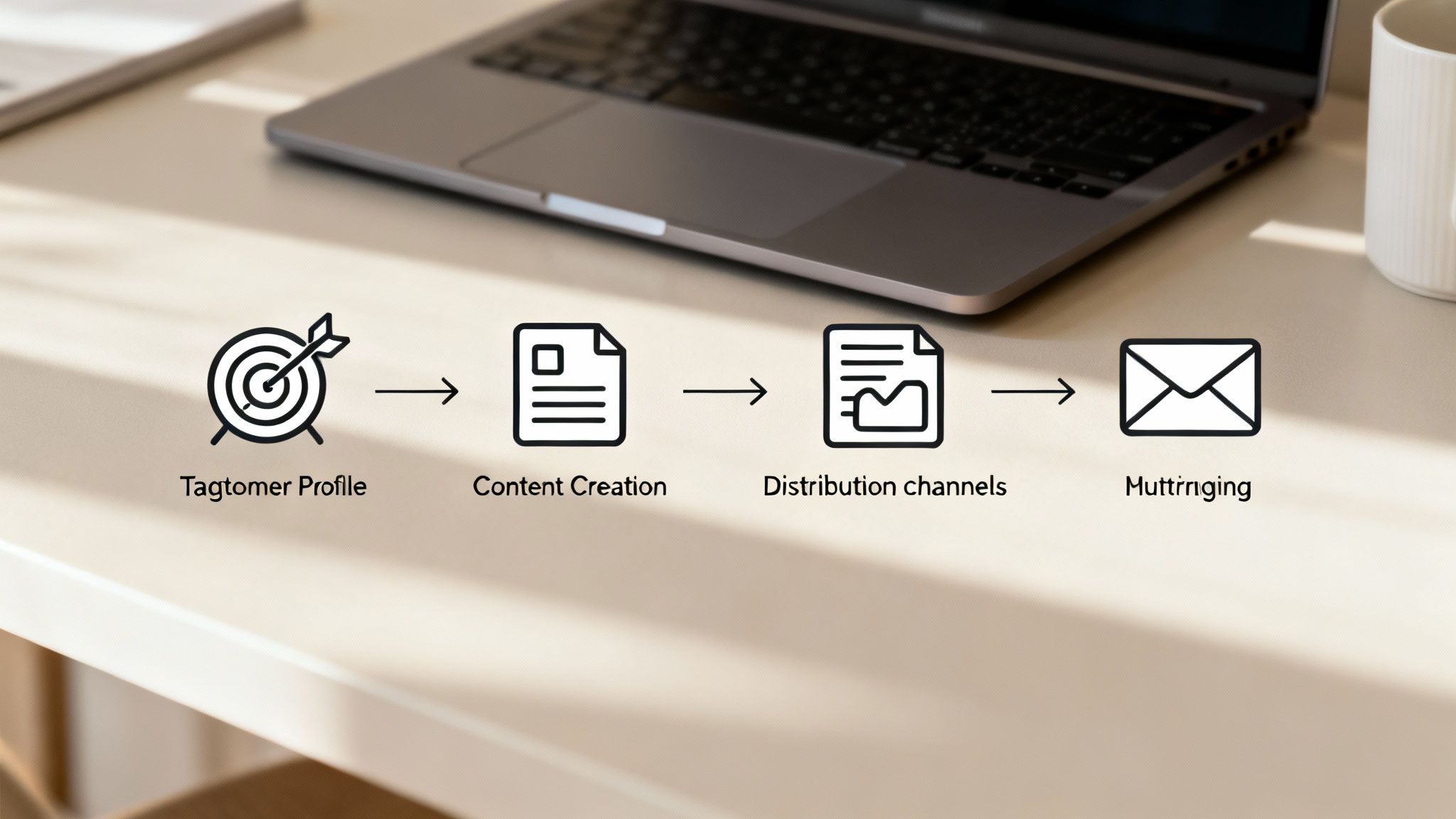
A Four-Step Campaign Framework
Ready to dive in? Here’s a practical, step-by-step process that will take you from a rough idea to a fully launched campaign.
- Pinpoint Your Ideal Customer Profile (ICP)
First things first: you have to know exactly who you’re talking to. Your Ideal Customer Profile (ICP) is more than just a job title and company size; it’s a deep dive into the person whose problems you solve. What keeps them up at night? What are their biggest frustrations and career goals? Get this right, and everything else falls into place. - Create High-Value, Problem-Solving Content
Now that you know your ICP, it’s time to create content that speaks directly to their pain points. This isn’t the time to brag about your product’s features. Instead, offer real solutions. Think blog posts, insightful webinars, handy free tools, or a podcast that tackles their biggest challenges head-on. The goal here is simple: be genuinely helpful.
By consistently delivering no-strings-attached value, you build a foundation of trust. Your audience starts to see you not as a vendor, but as an indispensable resource.
- Choose the Right Distribution Channels
Even the world’s best content is useless if no one sees it. You need to figure out where your ICP hangs out online. Are they scrolling through LinkedIn, asking questions in niche Slack communities, or listening to specific industry podcasts? Go there. Meet them on their turf to make sure your message actually lands. - Implement a Nurturing Sequence
Once you’ve grabbed their attention, the real work of building a relationship begins. This is where you continue providing value over time, maybe through a great email newsletter or by engaging with them on social media. This nurturing process keeps your brand top-of-mind, so when they’re finally ready to buy, you’re the first one they think of.
Frequently Asked Questions About Demand Generation
As you start exploring demand generation, a few common questions are bound to pop up. Let’s walk through some of the practical stuff to help you get your bearings and start planning a solid strategy.
How Much Should I Budget for Demand Generation?
This is the big one, isn’t it? While there’s no universal magic number, a solid benchmark for many SaaS companies is to set aside 10% to 20% of your projected annual revenue.
But that’s just a starting point. Your company’s stage really dictates the final number. A scrappy startup trying to carve out its space might need to invest more heavily at first just to get on the map. On the other hand, an established market leader might allocate a smaller percentage, focusing more on maintaining their position.
The best way to think about it is as a long-term investment, not a short-term spend. Your budget needs to cover everything from creating great content to the tech that powers it all, plus any ad spend you plan. The goal is to start with a number that lets you execute consistently and well, then adjust as you see what’s working.
Setting a budget for demand generation isn’t just about allocating funds; it’s about committing to a strategic philosophy of building brand equity and a sustainable pipeline over time.
What Are The Best Tools for a Demand Generation Tech Stack?
It’s easy to get lost in the sea of marketing tools out there. Instead of obsessing over specific brand names, it’s much more helpful to think about the types of tools you’ll need to support your strategy.
- Marketing Automation Platform: You’ll absolutely need something to nurture potential customers and track how they’re engaging with you. Tools like HubSpot or Marketo are the workhorses here, handling things like email sequences and lead scoring.
- Analytics and SEO Tools: You can’t improve what you don’t measure. Platforms like Google Analytics, Ahrefs, or Semrush are non-negotiable for understanding where your traffic is coming from, how your content is performing in search, and where new opportunities lie.
- Customer Relationship Management (CRM): This is the glue that holds your sales and marketing efforts together. A good CRM like Salesforce acts as the single source of truth, giving everyone a clear picture of every interaction with a prospect or customer.
How Long Does It Take To See Results?
This is where you need to play the long game. Demand generation is a marathon, not a sprint, and it’s fundamentally different from a lead gen campaign that might bring in new contacts overnight.
You’ll probably start seeing some early signs of life – what we call leading indicators – within the first 3 to 6 months. This looks like more website traffic, better engagement on social media, or even more people searching for your brand name directly.
But the real payoff, the meaningful impact on revenue and a lower customer acquisition cost, takes time. You should plan for at least 9 to 12 months of consistent, focused effort before you see those bigger results. That’s the time it takes for your content to gain traction, for your brand to build real authority, and for your audience to truly grow and trust you.
Ready to transform your marketing from a cost center into a powerful revenue engine? The experts at Mick-Mar Inc. specialize in building custom demand generation strategies that drive real business growth for SaaS companies. Start building your growth roadmap with us today!