A solid product marketing launch plan is your playbook for bringing a new product to market. It's not just a checklist; it's the strategic document that covers everything from your initial research and messaging to the go-to-market plan, launch day chaos, and what happens afterward.
When you get it right, this plan is what turns a hopeful product release into a calculated business win, getting every team rowing in the same direction.
Building Your Pre-Launch Foundation
Let's be honest: a product launch is won or lost months before anyone in the public ever sees it. This is the foundational work—the deep, strategic thinking that separates a launch that makes a real impact from one that just makes a little noise. It’s all about building a solid base of research, positioning, and clear, no-nonsense goals.
Think about this: a 2023 survey by Product School revealed that 47% of product managers consider a lack of a clear product strategy and roadmap as their biggest challenge. That statistic should be a wake-up call. The launches that succeed are the ones that are data-driven from the start, with planning that often begins 6 to 12 months ahead of time.
This pre-launch process is a logical flow, starting with research, defining your place in the market, and then setting goals based on that reality.
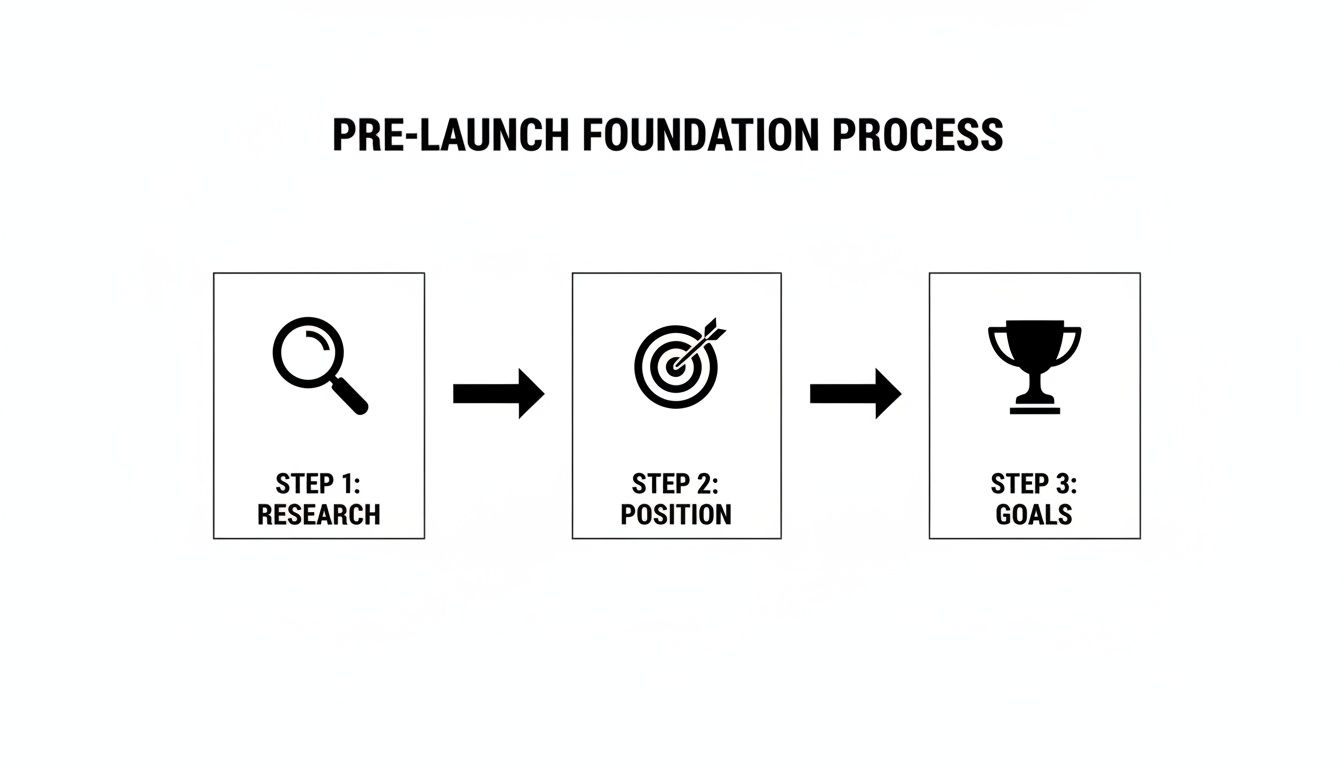
As you can see, each step builds on the last. Your goals aren't just pulled out of thin air; they're directly tied to the real market needs you've already uncovered.
Before diving into the timeline and tactics, it's crucial to get these core strategic elements locked in. The table below summarizes what you need to define and why it matters so much.
Core Components of Your Pre-Launch Foundation
| Component | Description | Why It's Critical |
|---|---|---|
| Market Research | Deeply understanding your Ideal Customer Profile (ICP), their pain points, existing solutions, and market gaps. | You can't solve a problem you don't fully understand. This insight is the raw material for all your messaging and strategy. |
| Positioning & Messaging | Crafting a clear, unique position in the market and developing 2-3 core messaging pillars to communicate that value. | This is how you differentiate. It's your story, telling the right people why they should choose you over anyone else. |
| Launch Goals & KPIs | Setting specific, measurable targets (MQLs, conversion rates, pipeline) that align with business objectives. | This turns a vague "successful launch" into a concrete, measurable outcome that proves the ROI of your efforts. |
With these foundational pieces in place, every subsequent decision—from the channels you choose to the content you create—becomes clearer and more effective.
Uncovering Market and Customer Truths
Before you can position anything, you need to become an expert on your customer's world. This isn’t about a quick glance at competitor websites; it's about embedding yourself in their reality to understand their problems better than they do.
Your research needs to answer some tough questions:
- What are the biggest daily frustrations for our Ideal Customer Profile (ICP)? Pay attention to the emotional words they use in interviews or on review sites.
- How are they actually solving this problem now? This isn't just about direct competitors. It could be a clunky spreadsheet, a manual process, or even just ignoring the problem.
- Where are the real gaps in the market? Look for the underserved niches or the common complaints about existing tools that your product is uniquely built to fix.
Friendly tip: The best insights don't come from a competitor's feature list; they come from listening to a customer describe their workflow and hearing them sigh. That sigh is where your opportunity lies.
Defining Your Product Position and Messaging
With those rich customer insights, you can now carve out a position that makes your product the only logical choice for your target audience. Your positioning statement is your internal North Star—a single, powerful sentence clarifying who you serve, what you do, and why you’re different.
From that core position, you build out your messaging pillars. These are the 2-3 core themes that will show up in every piece of communication, from your website copy to your sales decks.
For instance, if you're launching a project management tool for creative agencies, your pillars might be:
- Frictionless Client Collaboration: Focusing on features that kill the back-and-forth of feedback and approvals.
- Uninterrupted Creative Flow: Highlighting integrations with tools like Figma or Adobe and smart task automation.
- Real-Time Project Profitability: Emphasizing easy time tracking and budget reporting that creatives will actually use.
As you start shaping your product's story, crafting an effective SaaS marketing plan is essential for connecting these messages to a wider go-to-market motion.
Setting Clear and Measurable Launch Goals
Finally, you need to define what success actually looks like. Vague goals like "generate buzz" are meaningless. You need specific, measurable KPIs that tie directly back to the business's bottom line.
Your primary goals should be concrete and ambitious. For example:
- Generate 500 new Marketing Qualified Leads (MQLs) in the first 30 days.
- Achieve a 15% trial-to-paid conversion rate from launch-specific sign-ups.
- Secure 10 media placements or interviews in top-tier industry publications.
- Drive $100,000 in new sales pipeline within the first quarter post-launch.
Setting these KPIs upfront gives every team a finish line to run toward. More importantly, it gives you a clear, objective way to measure the true impact of your launch long after the initial excitement fades.
Crafting Your Go-To-Market Channel Strategy
Okay, you've nailed down your core messaging. Now comes the fun part: figuring out how to get that message out into the world. Your Go-To-Market (GTM) strategy isn't about shouting from every rooftop. It’s about making smart, deliberate choices to show up in the right places, at the right time, to connect with the right people.
Think of your GTM plan as a balanced investment portfolio. You need long-term assets that build value over time, like SEO and a solid content library. But you also need short-term drivers—like paid social ads or a sharp email campaign—to generate that initial buzz and get the ball rolling quickly.

The real magic happens when you create an integrated system. Each channel should support the others, creating a seamless and compelling experience for anyone who stumbles across your new product.
Selecting the Right Channel Mix
Choosing your channels shouldn't be a shot in the dark. Go back to that deep customer research you did in the pre-launch phase. Where does your Ideal Customer Profile (ICP) actually hang out online?
Are they scrolling through specific LinkedIn groups? Do they follow certain industry influencers on X? Or maybe they live and die by peer-review sites like G2 and Capterra? Your channel selection should be a direct answer to these questions.
For example, if you're launching a SaaS tool for developers, you’ll likely lean into technical blog content, get active in developer forums, and maybe sponsor a few niche newsletters they trust. But for a new HR platform? The playbook shifts to LinkedIn thought leadership, webinars on compliance, and hyper-targeted ads based on job titles.
Here are a few core channels to consider for a SaaS launch:
- Content Marketing & SEO: This is your long game. Creating genuinely helpful blog posts, guides, and resources builds organic traffic and, more importantly, establishes your brand as an authority people can trust.
- Paid Social & Search: Need to make a splash now? Platforms like LinkedIn Ads or Google Ads can put your message directly in front of a hand-picked audience, driving those crucial early sign-ups and demo requests.
- Email Marketing: Never, ever underestimate your email list. This is your warmest audience. Use a well-timed email sequence to build anticipation, offer early access, and light a fire under them on launch day.
- Partner & Influencer Marketing: Teaming up with complementary brands or respected voices in your industry can give you instant credibility and open the door to a whole new, highly relevant audience.
Allocating Your Budget and Resources
Once you’ve picked your channels, it’s time to put your money where your mouth is. Instead of spreading your budget thinly across ten different platforms, it's wiser to double down on the 2-3 channels that your research suggests will have the biggest impact. A product launch isn't the time for broad experimentation; it's about focused, disciplined execution.
Success demands fresh thinking—think teaser campaigns, influencer collaborations, and exclusive "behind-the-scenes" previews to build real excitement. If you're looking for inspiration, you can discover some modern product launch ideas on teamout.com.
Friendly tip: A great GTM strategy isn't about having the biggest budget. It's about having the smartest budget, where every dollar is spent intentionally to reach the people most likely to become your next loyal customers.
Balancing these efforts is a core skill in modern digital marketing and advertising, ensuring your paid and organic channels are working in concert, not against each other.
Building Your Launch Calendar
With your channels selected and budget locked in, the final piece is mapping everything onto a detailed launch calendar. This becomes your command center, sequencing every single activity from the first pre-launch whisper to the post-launch follow-up. A well-built calendar is the difference between a chaotic launch and a symphony of perfectly timed execution.
We recommend breaking the calendar down into three distinct phases:
- Pre-Launch (4-6 weeks out): This is all about building a sense of anticipation. Start dropping hints with teaser social media posts, put up a "coming soon" landing page to capture emails, and give early briefings to key partners or friendly industry analysts.
- Launch Week (The main event): Showtime. This is the coordinated blitz where everything goes live. The official announcement blog post is published, the email sequence deploys, paid ads are switched on, and your team is on standby to engage with every comment and question.
- Post-Launch (2-4 weeks after): The work isn't over when the launch button is pushed. Now you need to sustain the momentum. Share early customer wins, publish the first case study, host a "deep dive" webinar on the new features, and keep promoting all that great launch content you created.
This timeline provides a clear, actionable roadmap for every person involved, turning a mountain of tasks into a manageable, synchronized campaign. It’s the operational backbone of your entire product marketing launch plan.
Driving Cross-Functional Launch Alignment
Let’s be honest: a SaaS launch is the ultimate team sport. You can craft the most brilliant messaging and have a killer channel strategy, but if your teams are working in silos, the whole thing can quickly unravel. Nothing sinks a launch faster than organizational friction—it’s the quickest path to inconsistent customer experiences and blown opportunities.
Getting everyone on the same page isn't just a "nice-to-have." It's the operational glue that holds your entire product marketing launch plan together.
This is where the Product Marketing Manager (PMM) steps into the spotlight, acting as the central nervous system for the launch. In fact, research from the Product Marketing Alliance in 2023 shows just how central PMMs are: 88.8% work hand-in-glove with the product team and 81% collaborate directly with marketing. They are the essential bridge between departments.

The real objective here is to build a system where everyone knows their part, feels a sense of ownership, and is pulling in the exact same direction.
Establishing Clear Roles With a RACI Chart
Ambiguity is the enemy of a smooth launch. The single best tool for cutting through the confusion is a RACI chart. The acronym, which stands for Responsible, Accountable, Consulted, and Informed, provides a simple but powerful framework to clarify who does what.
It’s all about making sure no critical task falls through the cracks.
- Responsible: The person (or people) who actually does the work.
- Accountable: The one individual who owns the outcome. Critically, there can only be one "A" per task.
- Consulted: The subject matter experts you tap for feedback before work gets done.
- Informed: Anyone who needs to be kept in the loop on progress after a decision is made.
Going through the exercise of creating a RACI chart forces you to have those crucial ownership conversations upfront. To see how this plays out in practice, looking at examples of integrated marketing communications can be incredibly helpful for ensuring every department's output tells the same cohesive story.
Here’s a simplified RACI chart to show you what this might look like for a SaaS launch.
Sample Launch Team RACI Chart
This table breaks down who is responsible for what across key launch activities, preventing the dreaded "I thought you were handling that" moment.
| Key Activity | Product | Marketing | Sales | Support |
|---|---|---|---|---|
| Finalize Messaging | C | A | C | I |
| Create Demo Script | C | R | A | C |
| Develop Sales Battlecards | I | A/R | C | C |
| Write Knowledge Base Articles | C | C | I | A/R |
| Launch Day Comms | I | A/R | I | I |
By defining these roles clearly, you create a shared understanding and eliminate guesswork, which is exactly what you need under the pressure of a launch.
Arming Your Sales Team for Success
Your sales team is on the front lines. They need to be your most confident and well-prepared advocates from the moment the launch goes live. Strong sales enablement isn't just about emailing them a slide deck—it’s about arming them with the knowledge, tools, and confidence to win deals.
This process has to start weeks before launch day, not days. You want them to feel like an essential part of the launch, not just downstream recipients of information.
Every solid sales enablement kit should include these essentials:
- Sales Battlecards: A one-page cheat sheet that nails the key messaging, top value props, ideal customer profile, and how you stack up against the competition.
- Demo Scripts: A clear, repeatable script that walks prospects through the most compelling features and ties them directly back to their biggest pain points.
- Objection Handling Guide: A practical FAQ that anticipates the tough questions and gives your reps concise, confident answers.
Friendly tip: A well-enabled sales rep doesn't just sell a product; they sell a solution with conviction. The materials you provide are their armor and their sword in competitive conversations.
Building these repeatable systems is a core part of operational excellence. If you're looking to dive deeper, you might find our resources on marketing operations helpful.
Maintaining Momentum With a Communication Cadence
Finally, alignment isn't a one-and-done kickoff meeting. It’s an ongoing process. To keep everyone in sync and maintain momentum, you need to establish a regular communication rhythm.
A weekly 30-minute sync-up is usually all it takes. Keep the agenda ruthlessly efficient: review progress, flag blockers, and confirm next steps. A shared dashboard in a tool like Asana or Monday.com, or even a detailed Google Sheet, can serve as the single source of truth between meetings.
This steady cadence ensures that when launch day finally arrives, there are no surprises. Every single team knows exactly what to do, what to expect, and how their piece of the puzzle contributes to the big picture. That’s how you get a truly unified and powerful launch.
Executing Your Launch Day Playbook
The big day is here. After months of planning, plotting, and prepping, it's finally time to launch. But launch day isn't just about flipping a switch; it's about flawlessly orchestrating a live performance. Success now comes down to how well you manage the moving parts, monitor what’s happening in real-time, and react—quickly and together. Your launch plan transforms from a strategic document into an operational playbook.
Think of it as your mission control. You absolutely need a centralized hub—a dedicated Slack channel or Microsoft Teams group is perfect for this. This "war room" is where key people from marketing, sales, product, and support will live for the day. It's your command center for tracking every metric, sharing customer feedback instantly, and making smart decisions on the fly without waiting for a scheduled meeting.
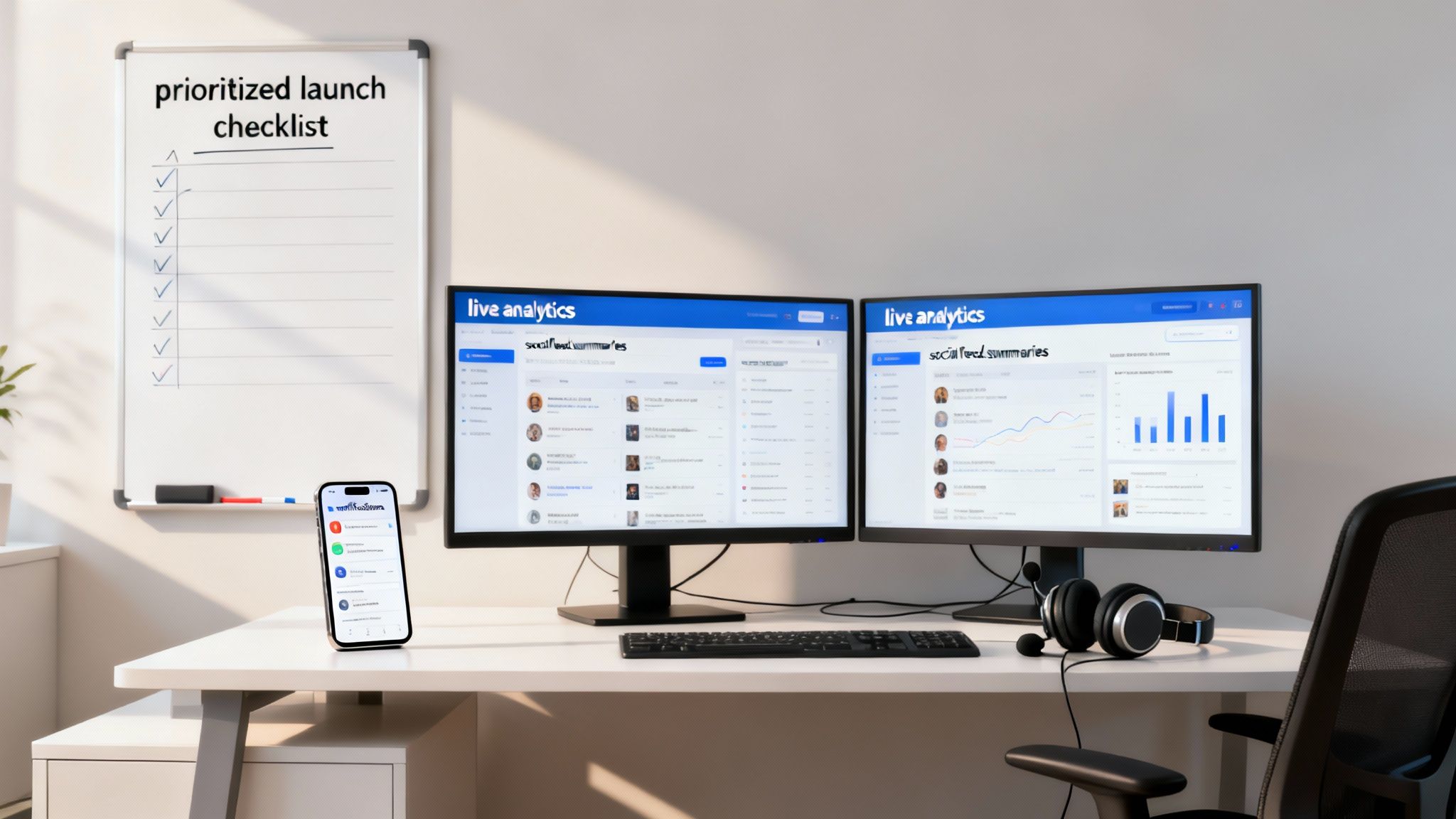
This central hub is what turns potential chaos into a celebrated success. It ensures everyone is on the same page, all the time, making problem-solving incredibly fast.
The Final Pre-Flight Checklist
Before you push the big red button, you need to run through one last, meticulous check. This is not the time to assume anything works. Your goal here is to catch any tiny detail that could trip you up and create a poor first impression for customers who have been waiting for this.
Your pre-flight checklist should be brutally detailed, with a specific owner for every single item. Here are a few things that must be on it:
- Website & Landing Pages: Are all the new pages actually live? Do all the links go to the right place? Crucially, are the forms capturing leads and sending them to your CRM correctly?
- Marketing & Comms: Confirm every announcement email, social media post, and the press release is scheduled and ready to go. One wrong click can send things out prematurely.
- Sales Enablement: Has the sales team reviewed the final battlecards and demo scripts? More importantly, do they actually feel confident using them? A quick gut check can go a long way.
- Support Readiness: Does the support team have access to all the new knowledge base articles? Do they know the exact protocol for escalating any launch-related tickets?
Friendly tip: This isn't just a to-do list; it's the final walkthrough a pilot does before takeoff. It’s a systematic check designed to give everyone confidence that every component is ready for action.
Managing Comms and Monitoring Performance
With everything double-checked, it's go-time. Kick things off internally. An all-hands announcement gets the entire company fired up and reminds everyone why you built this in the first place—to solve a real customer problem. This internal rally is huge for morale and makes everyone feel like a part of the win.
At the same time, your external communications blitz begins. The press release goes out, the announcement email lands in inboxes, and the social media campaign lights up. Now, your focus shifts entirely to monitoring.
This is where your war room earns its keep. You need to be tracking both quantitative and qualitative feedback as it happens.
Key Metrics to Watch Immediately:
- Website Traffic: Are we seeing a spike in visitors to the new landing pages? Where are they coming from?
- Trial Sign-ups: Is the main CTA working? Are people converting from visitors into leads or new users?
- Social Engagement: What’s the initial reaction? Are people excited? Confused? Are they sharing the news?
You need a clear plan for handling the unexpected. If a user finds a bug, who on the product team is the point person? If a key influencer on Twitter asks a tough question, who owns crafting the response? Defining these roles before you need them is the secret to a calm, professional, and effective launch day.
Sustaining Momentum After The Launch
The confetti has settled, the launch-day Slack channel is finally quiet, and that first big spike in traffic is starting to level off. It's so tempting to call it a win and immediately pivot to the next big project. But that's a huge mistake.
A great launch isn't the finish line; it's the starting gun for your next phase of growth. The real work begins right now—turning that initial buzz into durable, long-term momentum. This is where you find out if you really have something special.
This post-launch period is all about obsessively listening to your new users, figuring out what's resonating, and building a powerful feedback loop to fuel both your product roadmap and future marketing. Skipping this part is like running a fantastic sprint only to stop ten feet before the end of the marathon.
Activating the Customer Feedback Loop
Your first customers are an absolute goldmine of information. They're the ones stress-testing your product in the real world, and their early experiences—the good, the bad, and the ugly—are invaluable. The key is to systematically gather and, more importantly, act on what they're telling you. Don't just wait for it to trickle in; go get it.
Here are a few channels we've found essential for capturing early feedback:
- Targeted In-App Surveys: Use a tool like Hotjar or Pendo to ask simple, contextual questions right inside your product. For example, right after someone uses a new feature for the first time, pop up a quick question: "On a scale of 1-5, how easy was that to use?"
- Support Ticket Analysis: Your support team is on the front lines, hearing everything. Work with them to tag and categorize tickets related to the new launch. If you see a dozen tickets about users getting stuck in the same spot, that's not just a support problem—it's a critical product insight.
- One-on-One Customer Interviews: This is our personal favorite. Reach out to your most engaged early adopters and ask for 20 minutes of their time. These conversations uncover the "why" behind the data, revealing pain points and brilliant use cases you never would have imagined.
Friendly tip: The goal isn’t just to collect feedback; it’s to find the pattern. When you hear the same frustration described in three different ways across surveys, support tickets, and interviews, you've struck gold. That’s a genuine signal that needs your attention.
Zeroing In On Post-Launch KPIs
The metrics you were glued to on launch day, like website traffic and social media mentions, are not the same ones that matter a month later. It's time to shift your focus from awareness to adoption and retention. These are the KPIs that tell you if your product is actually delivering on its promise.
Your post-launch dashboard should be laser-focused on:
- User Adoption & Activation Rate: Of all the people who signed up, what percentage are completing the key actions that lead to that "aha moment"? A high sign-up number with a low activation rate is a classic sign that your product's value isn't connecting.
- Feature Usage Data: Dig into the analytics. Which parts of the new product are people actually using? Are there powerful features that are being completely ignored? This data is crucial for refining your onboarding flows and guiding your next development sprint.
- Early Churn Signals: Are new users bailing after the first week? Are they downgrading from paid plans as soon as the trial ends? Identifying these patterns early gives you a chance to intervene before it's too late.
This data-driven approach removes the guesswork from your post-launch plan. It shows you exactly where to apply your energy to improve the customer experience and drive real, sustainable growth.
Fueling a Continuous Marketing Engine
That big marketing blitz for launch day? That was just the first chapter. To keep the momentum going, you need to transition into an "always-on" marketing engine that uses your early successes to attract the next wave of customers. It's all about turning that initial interest into compelling social proof.
Your ongoing marketing plan should be built around a few key activities:
- Develop Customer Case Studies: Find your happiest early customers and partner with them to tell their story. A well-crafted case study is one of the most powerful sales assets you can create, showing prospects exactly what your product can help them achieve.
- Host "Deep Dive" Webinars: Go beyond the high-level launch announcement. Host a webinar that showcases advanced use cases or answers the most common questions you've been getting. This not only provides immense value to your new users but also becomes a fantastic piece of evergreen content for your website.
- Create "Early Wins" Content: Don't be shy about sharing milestones and positive feedback. A blog post titled "What We Learned in Our First 30 Days" or social media posts highlighting glowing customer quotes can be incredibly effective at building credibility and trust with new prospects.
By focusing on these strategies, you create a self-sustaining cycle. You gather feedback to make the product better, analyze data to understand what users really want, and leverage early wins to attract more customers. This is how a single launch event becomes the foundation for lasting success.
Frequently Asked Questions
Even with a rock-solid plan, questions are going to pop up. It’s just the nature of the beast when you're dealing with a process this complex, with so many moving parts and so much on the line. Let's tackle some of the most common questions we hear from SaaS founders and product marketers to help clear things up.
How Far In Advance Should You Plan A Product Launch?
This is the big one, and the honest answer is: it depends. But for a major SaaS launch—we’re talking a brand-new product or a massive V2 release—you absolutely need to start planning 4-6 months out. That timeframe isn't just a number we pulled out of thin air; it’s the realistic runway you need to get the foundational work done right.
Giving yourself that much lead time allows you to properly handle the essentials:
- Real Market Research: Digging deep to actually understand customer pain points and where your competitors are dropping the ball.
- Positioning & Messaging: Testing and refining your story until it’s so sharp and compelling it cuts through the noise.
- Getting Everyone on the Same Page: Making sure sales, support, and product are all aligned and telling the same story.
- Creating Your Assets: Building out high-quality content, landing pages, and sales decks without that last-minute, panicked rush.
For smaller feature drops or updates, you can usually get away with a much shorter timeline, maybe 4-8 weeks. The trick is to match your planning window to the splash you want to make in the market.
What Are The Most Important KPIs To Track For A Launch?
Your launch KPIs have to tie directly back to what you're trying to achieve as a business. While every launch has its own flavor, there's a core set of metrics that will always give you a clear picture of success. We like to break them down into leading and lagging indicators.
Leading indicators are your early warning system; they tell you if you're on the right track right away:
- Website Traffic: Are people actually visiting your new product pages?
- Social Media Engagement: What’s the buzz? Look at shares, comments, and the overall vibe.
- Press & Media Mentions: Is anyone in your industry talking about you?
Lagging indicators show you the real business impact after the launch-day dust settles:
- Marketing Qualified Leads (MQLs): How many genuinely interested people are entering your funnel?
- Trial Sign-ups or Demo Requests: This is the key conversion for most SaaS products.
- Trial-to-Paid Conversion Rate: Are those curious free users turning into paying customers?
- New Monthly Recurring Revenue (MRR): The ultimate measure of whether the launch made money.
- User Adoption/Activation Rates: Are new users actually using the key features that provide value?
Friendly tip: Don't get distracted by vanity metrics. A million impressions look great in a report, but 100 activated trial users who become paying customers are what will actually grow your business. Focus on the numbers that signal real customer commitment.
What Is The Biggest Mistake Companies Make In A Product Launch?
We've seen it time and time again. The single most damaging mistake is terrible internal communication and alignment. You could have the most amazing product ever built, but if your own teams aren't on the same page, your customer experience will be a complete mess.
This breakdown shows up in a few painful ways:
- Sales reps get blindsided by prospect questions they have no idea how to answer.
- Marketing is out there promising a feature that the product team knows won't be ready for another month.
- Customer support is left scrambling to troubleshoot new problems, leaving your first users frustrated and angry.
A great launch needs a single source of truth. When everyone—from the CEO down to the newest support hire—understands who you're selling to, what the core value is, and what the timeline looks like, the entire launch feels cohesive and professional to the outside world.
What’s The Difference Between A Product Launch And A GTM Strategy?
This is a really important one, and people mix these up all the time. Here’s a simple way to think about it: your Go-To-Market (GTM) strategy is the entire war plan, while the product launch is the first, decisive battle.
A Go-To-Market (GTM) strategy is the big-picture, long-term blueprint for how you'll win in a market. It covers everything from pricing and sales channels to your overall market positioning and the complete customer journey.
The product launch, on the other hand, is a specific, time-bound event within that GTM strategy. It’s the coordinated push to create a massive wave of awareness and adoption right at the beginning. The launch provides the initial thrust, but the GTM strategy is what keeps the rocket going long after launch day.
At Mick-Mar Inc., we live and breathe this stuff. We build and execute strategic product marketing launch plans that deliver real results for SaaS companies. We work with you side-by-side through every stage, making sure your next launch gets the attention and impact it deserves.
Discover how our product marketing services can elevate your next launch