
In today's competitive B2B landscape, casting a wide net and hoping for the best is a fast track to wasted budgets. The game has shifted from volume to value, from shouting at crowds to having meaningful conversations with the right people. This is where Account-Based Marketing (ABM) steps in, transforming from a buzzword into a strategic game-changer. ABM isn't just another campaign; it's a fundamental shift in how sales and marketing teams work together to win, keep, and grow their most valuable accounts.
This focused approach really pays off. A 2023 study by ITSMA and the ABM Leadership Alliance found that 87% of marketers measuring ROI say that ABM outperforms every other marketing investment. The real challenge, though, is moving from knowing what ABM is to actually doing it well. Generic advice doesn't help when you need a clear, actionable plan that drives revenue and builds lasting customer relationships.
This guide cuts through the theory and dives straight into 10 practical, actionable account based marketing tactics designed for B2B organizations. We’re skipping the fluff and focusing on what works right now. For each tactic, you’ll get a simple roadmap covering the essentials for success:
- What it is: A straightforward explanation of the tactic.
- Why it matters: The strategic value for your business.
- How to implement it: Actionable steps for your people, processes, and tech.
- Sample KPIs: Key metrics to measure your success.
- Channel Examples: Where you can apply the tactic.
- Real-world tips: A handy tip or mini-case study to bring it to life.
Our goal is to give you a comprehensive playbook that empowers your team to launch a precision-driven ABM strategy and achieve results you can actually measure.
1. Personalized Account Research and Profiling
Think of this as the detective work that sets up your entire ABM strategy for success. Personalized account research involves a deep-dive into your target accounts to understand their specific business challenges, strategic goals, who's on the buying committee, and what tech they're already using. This intelligence transforms generic outreach into a hyper-relevant conversation, showing you've done your homework and genuinely understand their world.

This process goes way beyond surface-level data, helping you create detailed profiles that arm both your marketing and sales teams with the context they need for meaningful chats. Effective ABM relies on this deep research to pinpoint the key stakeholders and decision-makers, often with the help of advanced hero discovery tools. Instead of casting a wide, impersonal net, this approach allows you to tailor every touchpoint—from ad copy to sales calls—directly to the account’s pain points and priorities.
How to Implement This Tactic
- People: Assign a dedicated resource or a small "account intelligence" team to handle the research. Get your Account Executives (AEs) and Sales Development Reps (SDRs) involved to ensure the info you gather is actually useful for sales.
- Process: Create a standardized "Account Profile Template" to keep data collection consistent. This should include fields for company info, key people, recent news, current tech, and known company goals. Plan to refresh this info every quarter.
- Technology: Use a mix of tools to get the full picture. Platforms like ZoomInfo or Apollo.io are great for contact and company data, LinkedIn Sales Navigator helps with mapping out the organization, and intent data providers like 6sense can show you which accounts are actively researching solutions like yours.
Deployment Tip: Don’t just collect data—synthesize it! Create a one-page "Account Brief" for each high-value target that sums up the most critical insights. This brief should be the go-to resource for anyone on the revenue team before they engage with the account.
2. Customized Content Marketing and Thought Leadership
This is where you stop creating one-size-fits-all content and start tailoring it to the specific pain points, industry challenges, and goals of your target accounts. It's about developing highly relevant materials like industry-specific whitepapers, bespoke case studies, or personalized executive briefings that speak directly to a prospect's unique situation.
This approach dramatically increases engagement because it proves you understand an account's world before the first sales call even happens. For instance, instead of a generic ebook on "Improving Efficiency," you could create a report titled "How Financial Services Firms Can Streamline Compliance Reporting" specifically for your banking targets. This level of personalization positions your brand as a strategic partner, not just another vendor, and is a cornerstone of modern content marketing and strategic communications. By arming your sales team with these hyper-relevant assets, you enable more meaningful and credible conversations.
How to Implement This Tactic
- People: Get your content strategist, subject matter experts (SMEs), and product marketers involved. Work closely with the sales team to gather insights from their account interactions, ensuring your content addresses real-world questions and priorities.
- Process: Start by grouping your target accounts into clusters based on industry or challenges. Create a content matrix that maps existing assets to these clusters and identifies any gaps. Develop a repeatable process for "versioning" core content like case studies or whitepapers for specific verticals by tweaking stats, language, and examples for maximum relevance.
- Technology: Use a Digital Asset Management (DAM) or content management system (CMS) to organize and tag content by target account, industry, and use case. Leverage marketing automation platforms like HubSpot or Marketo to distribute this personalized content and track engagement at the account level.
Deployment Tip: You don't have to start from scratch every time. Repurpose a high-performing webinar into an industry-specific blog series, an infographic, and a short video clip. A single core asset can be "atomized" into multiple personalized pieces of content, maximizing your team's efficiency and impact.
3. Multi-Channel Orchestrated Outreach Campaigns
Multi-channel orchestrated outreach is all about engaging target accounts across multiple platforms at the same time, in a coordinated and strategic way. Instead of just relying on email, this tactic surrounds the buying committee with consistent, personalized messaging through a mix of email, social media (like LinkedIn), display ads, direct mail, and even phone calls. This creates a cohesive brand experience that reinforces your value at every turn.
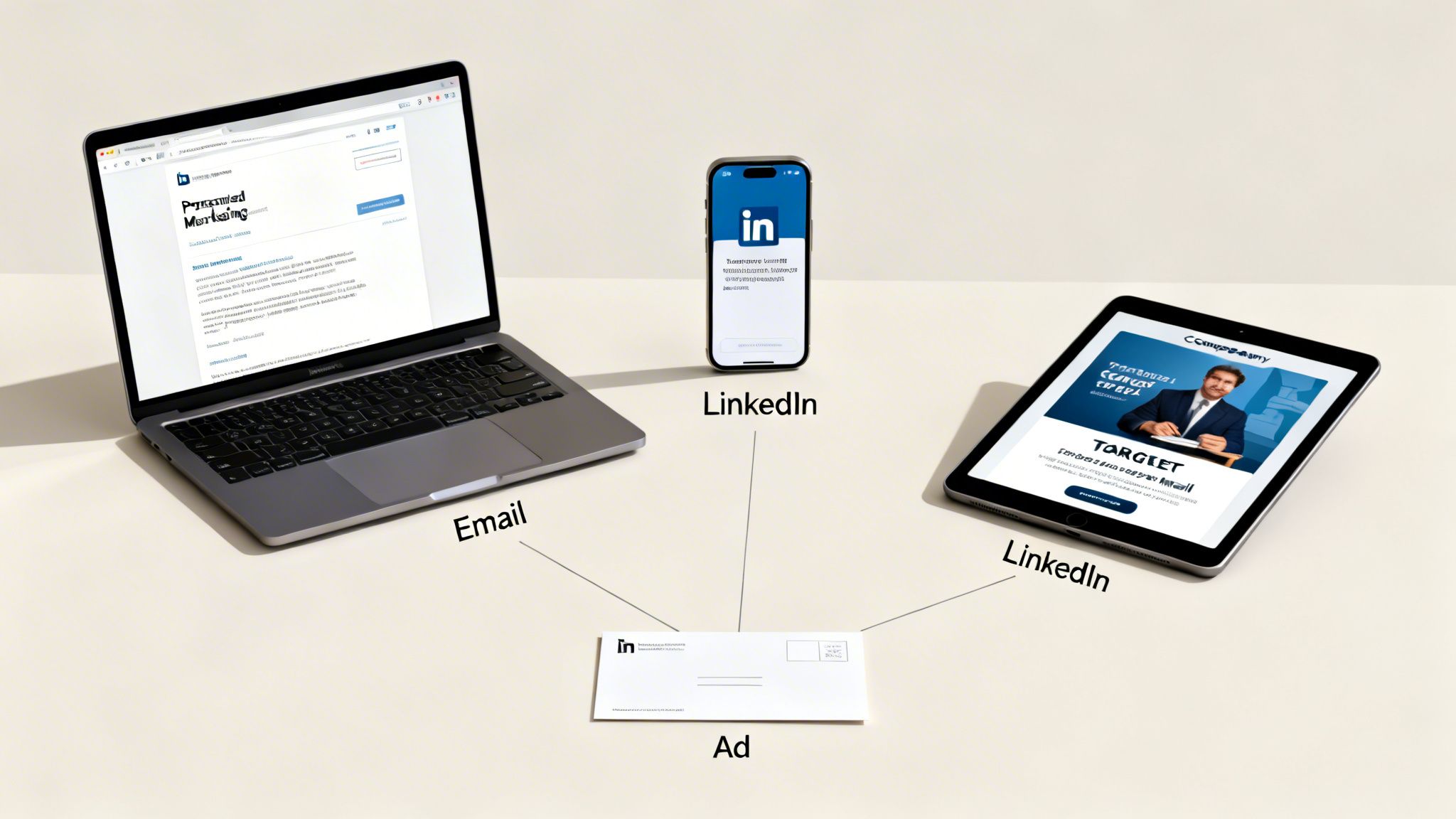
This is one of the most effective account based marketing tactics because it respects that modern buyers don't follow a straight line. By showing up in the various channels where your prospects are already active, you increase the chances of grabbing their attention. The key here is orchestration—making sure each touchpoint builds on the last, guiding the account smoothly from awareness to consideration.
How to Implement This Tactic
- People: This requires tight teamwork between marketing (managing ads, email, social) and sales (SDRs/AEs handling calls and personalized messages). Appoint a campaign manager to oversee the entire sequence and ensure a smooth flow.
- Process: Map out the ideal touchpoint sequence for a specific persona within a target account. For example, a C-level exec might first see a display ad, then get a high-value direct mail piece, followed by a personalized LinkedIn connection request from an AE. Set clear rules and frequency caps (e.g., 5-7 touches over three weeks) to avoid being overwhelming.
- Technology: An ABM platform like Terminus or 6sense is crucial for orchestrating display ads and identifying account-level engagement. Marketing automation platforms (e.g., HubSpot) manage email sequences, while sales engagement tools (e.g., Outreach, Salesloft) coordinate personalized sales outreach across phone, email, and social.
Deployment Tip: Start small with a two or three-channel play, like coordinated LinkedIn ads, an SDR email sequence, and direct messages. Test different combinations to see what resonates with your target accounts before scaling up to more complex campaigns.
4. Account-Based Advertising and Retargeting
Think of account-based advertising as a precision strike. It uses paid media to deliver tailored ads exclusively to individuals within your target accounts. Instead of the traditional "spray and pray" approach, this method uses account lists, IP addresses, and cookie data to make sure your budget is spent only on reaching the decision-makers and influencers who matter most. This keeps your brand top-of-mind and warms up key stakeholders before sales outreach even begins.
This tactic is essential for scaling ABM beyond one-to-one outreach, letting you surround the entire buying committee with consistent, relevant messaging. Platforms like LinkedIn, Demandbase, and 6sense have made this popular by allowing marketers to upload target account lists and serve personalized ads directly to employees at those companies. It’s a powerful way to support sales efforts, provide "air cover" for ongoing conversations, and ensure your message hits home across the entire organization.
How to Implement This Tactic
- People: Your paid media specialist or digital marketing manager will handle the campaign setup and optimization. They'll need to work closely with the content team to develop ad creative and with the sales team to coordinate messaging and timing.
- Process: Segment your account list into tiers (e.g., Tier 1, Tier 2) and create different ad campaigns for each. Develop messaging that maps your ad copy and creative to the specific pain points you identified during your research. Set up a regular (bi-weekly) meeting to review performance metrics like account engagement and pipeline influence.
- Technology: Use an ABM platform like Terminus, 6sense, or Demandbase to target accounts showing buying intent. Leverage LinkedIn's Matched Audiences feature by uploading your account lists to run highly targeted social campaigns. For more insights on campaign strategy, you can explore various aspects of digital marketing and advertising.
Deployment Tip: Don’t just run brand awareness ads. Create a sequential advertising journey. Start with high-level, problem-focused ads, then retarget engaged accounts with content like case studies or webinar invites, and finally, serve demo-request ads to accounts showing the highest intent.
5. Sales and Marketing Alignment with Shared Account Lists
You can't have true account-based marketing without sales and marketing being on the same team. This tactic makes that partnership official by creating a single, agreed-upon target account list that both teams commit to pursuing. It breaks down the classic silos, ensuring that marketing’s efforts to warm up an account are perfectly in sync with sales’ efforts to close it. This alignment is the engine that drives all other account based marketing tactics.
When sales and marketing operate from a shared playbook, the entire customer journey feels seamless. Marketing creates air cover with content tailored to the account's needs, while sales steps in with perfectly timed, context-aware outreach. According to a 2023 report from Folloze, 91% of companies using ABM say they have better alignment between sales and marketing. This coordinated approach prevents disjointed experiences and ensures every interaction moves the account forward.
How to Implement This Tactic
- People: Foster a "revenue team" mindset by creating an ABM council with leaders from both sales and marketing. Assign a clear "account owner" (usually an AE) who orchestrates the strategy for their accounts, with marketing counterparts acting as strategic partners.
- Process: Formalize the partnership with a Service Level Agreement (SLA) that defines roles, responsibilities, and shared KPIs like account engagement and pipeline velocity. Hold a weekly or bi-weekly "ABM Sync" meeting for both teams to review progress, share intel, and plan upcoming plays.
- Technology: Use a shared CRM like Salesforce as the single source of truth for all account data and interaction history. Integrate your marketing automation (e.g., HubSpot) and sales engagement tools (e.g., Salesloft) to get a unified view of all touchpoints.
Deployment Tip: Create joint "Account Plan" templates. Before engaging a high-value account, the assigned sales and marketing leads should fill out a one-page plan outlining key stakeholders, business pains, proposed messaging, and a multi-channel engagement strategy for the next 90 days.
6. Personalized Executive Engagement and Relationship Building
This is a high-touch ABM tactic focused on building genuine relationships with the most influential decision-makers at your target accounts. Instead of a direct sales pitch, this approach prioritizes establishing trust through peer-to-peer connections, exclusive experiences, and value-driven conversations. The goal is to position your company as a strategic partner by engaging executives on their terms with relevant industry insights.
This tactic recognizes that major enterprise deals are often sealed at the C-suite level. By creating direct lines of communication between your leadership and theirs, you can bypass traditional gatekeepers and embed your organization within the account's strategic inner circle. These high-impact account-based marketing tactics are crucial for winning and keeping high-value enterprise clients.
How to Implement This Tactic
- People: Involve your own C-suite and VPs as executive sponsors to lead outreach and host events. Assign senior AEs or Strategic Account Managers as the primary "relationship owners" responsible for coordinating everything and documenting it in the CRM.
- Process: Develop an "Executive Engagement Playbook" that maps out the key executive personas for each target account. Create a tiered engagement model: high-value accounts might get a 1:1 dinner with your CEO, while others are invited to an exclusive roundtable. Research each executive's background to personalize every interaction.
- Technology: Use LinkedIn Sales Navigator to identify and research target executives. Leverage your CRM (like Salesforce or HubSpot) to track all relationship activities. Event management platforms like Bizzabo or Cvent can help organize your exclusive events.
Deployment Tip: Frame your initial outreach as a peer-to-peer invitation for a strategic chat, not a sales meeting. A message from your CEO to a target CEO asking to share insights on a mutual industry challenge is far more likely to get a response than a standard demo request.
7. Account Scoring and Intent Data Integration
This powerful ABM tactic involves creating a dynamic scoring model that prioritizes your target accounts based on how likely they are to buy. It goes beyond simple lead scoring by combining static data (like industry and company size) with dynamic behavioral signals, engagement metrics, and crucial third-party intent data. This helps you see not only which accounts are a good fit but also when they are actively in a buying cycle.
By integrating intent data from providers like Bombora or using platforms like 6sense and Demandbase, you can see which accounts are researching your solution or competitors across the web. This intelligence allows your team to focus its limited resources on accounts showing clear purchase intent, dramatically improving efficiency. Instead of guessing which accounts are ready for outreach, you can engage them with precision right when their interest is highest.
How to Implement This Tactic
- People: Form a cross-functional "scoring council" with folks from marketing ops, sales ops, and sales leadership. This group will define the scoring criteria and be responsible for improving the model over time.
- Process: Start by defining your Ideal Customer Profile (ICP) to build a foundational "fit" score. Layer on engagement scoring based on interactions with your website and content. Finally, integrate third-party intent data. Set clear thresholds that trigger specific actions, like flagging an account as a "Marketing Qualified Account" (MQA) or alerting an SDR for outreach.
- Technology: Use a dedicated ABM platform like 6sense, Demandbase, or Terminus that has native account scoring and intent data. Alternatively, integrate a third-party intent data provider like Bombora with your marketing automation platform (e.g., HubSpot) and CRM to build a custom model.
Deployment Tip: Don't "set and forget" your scoring model. Schedule a quarterly review with your scoring council to analyze which scored accounts turned into pipeline and deals. Use this data to refine your model and improve its predictive accuracy.
8. Account-Specific Landing Pages and Website Experiences
Creating customized digital destinations is a fantastic ABM tactic that shows you've done your homework. This involves building dedicated landing pages, microsites, or personalized website experiences specifically for your target accounts. Instead of sending high-value prospects to a generic homepage, you guide them to a space that speaks their language—featuring their company logo, industry-specific imagery, and messaging that addresses their known challenges.

This level of personalization immediately signals relevance and respect for the account's time, which significantly increases engagement and conversions. When a decision-maker from a target account sees a page built just for them, it transforms the interaction from a cold outreach into a warm, consultative conversation. To efficiently scale the creation of personalized content and account-specific landing pages, understanding the principles of programmatic SEO can be a huge help.
How to Implement This Tactic
- People: This is a team effort. Your web developer or a marketing ops specialist will handle the technical setup. Content marketers will craft the personalized copy, and designers will ensure the page looks great.
- Process: Start by tiering your accounts and focus your personalization efforts on Tier 1. Develop a master landing page template that can be quickly cloned and customized with dynamic fields for the company name, logo, and specific pain points. Use these pages as the central hub for all campaigns targeting that account.
- Technology: Leverage website personalization tools within your marketing automation platform like HubSpot or Marketo. For more advanced capabilities, dedicated ABM platforms like Demandbase or Terminus allow for dynamic content that changes based on the visitor's IP address or other data, scaling personalization across your entire site.
Deployment Tip: Don't stop at just the hero section. Personalize the social proof by featuring case studies or testimonials from similar companies in the same industry. If a prospect from a financial services company visits, make sure they see success stories from other banks, not manufacturing firms.
9. ABM Events and Hosted Experiences
ABM events are exclusive, high-touch experiences designed for key individuals within your target accounts. These aren't massive trade shows; think more intimate gatherings like executive roundtables, VIP dinners, or hands-on workshops that provide immense value and foster deep relationships. This tactic shifts the focus from lead generation to relationship building, creating a memorable brand interaction that digital channels just can't replicate.
In a crowded market, a well-run event cuts through the noise and positions your company as a strategic partner. By creating a non-sales environment focused on peer-to-peer learning, you provide a platform for decision-makers to solve their challenges. This approach shows you're committed to their success, building the trust needed to accelerate complex sales cycles.
How to Implement This Tactic
- People: Involve your senior leadership and subject matter experts as hosts or speakers to add credibility and attract high-level attendees. Your event marketing team will handle logistics, while sales will own the invitation and follow-up process.
- Process: Start with the "who" before the "what." Identify the key people from your top-tier accounts you want to engage. Design the event content and format around their specific pain points, not your product features. Develop a multi-touch invitation sequence and a structured post-event follow-up plan.
- Technology: Use an event management platform like Luma or Bizzabo for registrations and communication. Leverage your CRM and marketing automation platform (e.g., HubSpot) to track invitations, attendance, and post-event engagement. Use LinkedIn Sales Navigator to identify and invite the right people. To see how these elements come together, check out how Mick-Mar builds impactful corporate event experiences.
Deployment Tip: Keep the guest list small and highly curated, ideally between 12-30 people. The goal is to facilitate meaningful conversation, not to fill a room. Ensure there's a good mix of customers and prospects to spark authentic peer discussions. Focus on value first, sales second.
10. Account-Based Customer Success, Expansion, and ABM Analytics
Your ABM efforts shouldn't stop once a deal is closed; they are just as powerful for post-sale success and expansion. This approach applies ABM principles to your existing customer base, treating key accounts with the same personalized engagement used to acquire them. It combines this customer-centric focus with robust analytics to measure the impact of ABM across the entire lifecycle, from first contact to renewal and upsell.
This dual strategy transforms customer success from a reactive support function into a proactive revenue engine. By continuously delivering value and aligning with a customer's evolving business goals, you create fertile ground for expansion. At the same time, dedicated ABM analytics give you a clear, data-driven view of what's working, allowing you to prove ROI and optimize your strategy for both winning new business and keeping it.
How to Implement This Tactic
- People: Create cross-functional "account pods" consisting of an Account Manager, a Customer Success Manager (CSM), and relevant product specialists for top-tier customers. Appoint a marketing or revenue ops analyst to own ABM analytics and track performance.
- Process: Develop formalized "Account Expansion Plans" for strategic customers, outlining goals and potential upsell paths. Implement regular Quarterly Business Reviews (QBRs) to showcase value and uncover new opportunities. Establish a clear process for tracking account-level engagement and its influence on revenue.
- Technology: Use your CRM (like Salesforce) as the central hub for tracking all customer interactions. Leverage customer success platforms like Gainsight or ChurnZero to monitor account health. Employ ABM analytics tools such as 6sense, Terminus, or Marketo to measure account progression and attribute revenue to specific activities.
Deployment Tip: Don't measure ABM with traditional lead-gen metrics. Instead, create a dedicated dashboard that tracks account-level KPIs like pipeline velocity, deal size increase, customer lifetime value (LTV), and net revenue retention (NRR). This shifts the focus from vanity metrics to real business impact.
ABM Tactics: 10-Point Comparison
| Tactic | Complexity 🔄 | Resources & Scalability ⚡ | Expected Effectiveness ⭐ | Ideal Use Cases 📊 | Key Advantage / Tip 💡 |
|---|---|---|---|---|---|
| Personalized Account Research and Profiling | High — time‑intensive research and data integration | High — requires intelligence tools and dedicated analysts; hard to scale | ⭐⭐⭐⭐ — enables highly targeted, relevant outreach | Enterprise/mid‑market SaaS, regulated sectors (cybersecurity, energy) | Standardize templates; update profiles regularly |
| Customized Content Marketing and Thought Leadership | Medium‑High — content strategy + personalization workflow | High — creative resources, SMEs; scaling is resource‑heavy | ⭐⭐⭐⭐ — drives engagement and positions as expert | Vertical campaigns, long sales cycles, executive education | Build content clusters and repurpose assets |
| Multi‑Channel Orchestrated Outreach Campaigns | High — coordination across channels and timing | High — marketing automation, media spend, orchestration tools | ⭐⭐⭐ — increases penetration and multi‑stakeholder responses | Pre‑event warmup, complex buying committees, conference follow‑up | Map journeys, set frequency caps (5–7 touches) |
| Account‑Based Advertising and Retargeting | Medium — platform setup and audience mapping | Medium‑High — ad budgets, account ID platforms; scalable with spend | ⭐⭐⭐ — efficient spend and brand warming at scale | Warming accounts at scale, supplementing outbound efforts | Layer intent data, refresh creative every 2–4 weeks |
| Sales & Marketing Alignment with Shared Account Lists | Medium — governance and cultural change | Medium — CRM/process changes; scalable with clear SLAs | ⭐⭐⭐⭐ — reduces duplication, accelerates cycles | Organizations needing coordinated GTM and shared KPIs | Assign account owners; use joint scorecards |
| Personalized Executive Engagement & Relationship Building | Very High — bespoke planning and VIP coordination | Very High — executive time, events, travel; limited scale | ⭐⭐⭐⭐ — builds trust and can accelerate strategic deals | Top strategic accounts, relationship‑driven procurement | Limit to top accounts; document interactions in CRM |
| Account Scoring & Intent Data Integration | Medium — model building and integrations | Medium — intent platforms and analytics; scales with tooling | ⭐⭐⭐⭐ — prioritizes high‑intent accounts and timing | Prioritization, competitive markets, timing outreach | Start with fit scoring, validate with sales, refine quarterly |
| Account‑Specific Landing Pages & Website Experiences | Medium — personalization tooling and content variants | Medium‑High — personalization platform + design; complex at scale | ⭐⭐⭐ — increases relevance and conversion for targeted visits | Top 20–30 accounts, campaign hubs, role‑based messaging | Use templates for rapid customization and A/B testing |
| ABM Events and Hosted Experiences | High — event logistics and curation | High — budget, planning, speakers; resource‑intensive | ⭐⭐⭐⭐ — memorable, high‑value relationship building | Executive roundtables, peer forums, VIP customer events | Keep events intimate (12–30); follow up with personalized next steps |
| Account‑Based Customer Success, Expansion & ABM Analytics | Very High — cross‑functional processes and attribution models | Very High — CSMs, analytics stack, integrations; costly to scale | ⭐⭐⭐⭐ — increases LTV, reduces churn, demonstrates ABM ROI | Post‑sale expansion programs, strategic accounts, retention focus | Define expansion KPIs, implement account‑level revenue tracking |
Putting It All Together: Your Path to ABM Mastery
You've just explored a full suite of ten powerful account based marketing tactics, each a vital part of a modern B2B growth engine. From the foundational work of deep account research and sales-marketing alignment to the sophisticated execution of multi-channel campaigns and personalized websites, the path forward is clear. The true power of ABM isn't in picking one tactic, but in strategically weaving them together into a cohesive, customer-centric program.
The journey we've mapped out is a progressive one. It starts with knowing your customer on a deep level, a principle that supports every other successful action. It then expands into creating valuable content and engaging key decision-makers through targeted advertising and executive outreach. Finally, it matures with the integration of intent data, analytics, and a focus on growing relationships with your best existing customers.
Key Takeaways for Immediate Action
To turn this knowledge into tangible results, focus on these core principles:
- Start with Alignment, Not Technology: The most common reason ABM fails is a disconnect between sales and marketing. Before you buy any new software, make sure both teams are united around a shared target account list, common goals, and agreed-upon KPIs. This is your non-negotiable first step.
- Prioritization is Paramount: Not all accounts are created equal. Use a mix of company data, intent signals, and strategic value to create a tiered account list. Your most resource-intensive account based marketing tactics, like hosted events, should be reserved for your Tier 1 targets.
- Personalization is Deeper than a Name: True personalization goes way beyond mail-merging a first name. It means understanding an account's specific pain points, industry trends, and strategic goals. This insight, gathered from your research, should influence your messaging and content across all channels.
- Measure What Matters: Move beyond traditional marketing metrics like lead volume. Successful ABM programs track account-level engagement, pipeline velocity, deal size, and, ultimately, revenue. Use ABM analytics to prove ROI and fine-tune your strategy over time.
Building Your ABM Flywheel
Think of these tactics not as a checklist, but as interlocking gears in a machine. Strong alignment powers effective content creation. That content fuels multi-channel outreach. The data from that outreach informs your account scoring. This creates a self-reinforcing cycle—an ABM flywheel—that gains momentum with each successful engagement.
This strategic, focused approach is why ABM continues to deliver exceptional results. That 2023 ITSMA report also highlighted that 71% of companies saw their relationships with target accounts significantly improve with ABM. By treating each target account as a market of one, you cut through the noise, build deeper relationships, and drive more predictable, sustainable revenue growth. The key is to start small, prove value with a pilot program, and incrementally layer on more sophisticated account based marketing tactics as you learn and scale. Your path to mastery is a marathon, not a sprint, built on data, collaboration, and a relentless focus on delivering value.
Ready to move from theory to execution? Building a high-performance ABM program requires expertise and strategic focus. As a specialized partner, Mick-Mar Inc. helps B2B companies design and implement integrated ABM roadmaps, ensuring every tactic is aligned with your revenue goals. Let us help you build the ABM powerhouse your business deserves by visiting Mick-Mar Inc. to start the conversation.